


Unlock Peak Shopify SEO: Master Keyword Research for Explosive Growth
Did you know organic search is the engine behind over 45% of e-commerce revenue? Yet, countless Shopify entrepreneurs miss out on high-intent shoppers due to scattered search terms. Strategic Shopify keyword research is your secret weapon, aligning your products and collections with what your customers are actively searching for. This sharpens your store’s visibility, amplifies relevance, and drives serious conversions. Dive into this ultimate guide to uncover the secrets of Shopify keyword research: how to decode search intent, leverage top-tier tools for deep insights, master a proven workflow, implement killer on-page tactics, explore advanced voice and international strategies, track crucial performance metrics, and discover how BlackBelt Commerce – Your Shopify Growth Architects – can propel your store to sustainable SEO dominance.
Shopify SEO Snapshot: Critical Stats & Trends
SEO is the bedrock of high-ranking Shopify stores, fueling organic traffic and boosting sales. In fact, Shopify stores snag a massive 70% of their traffic from organic search. Pages that hit those top spots? They pull in a staggering 35% more clicks than their lower-ranking counterparts.
This resource lays out the undeniable impact of SEO on Shopify stores, highlighting organic traffic surges and conversion rate boosts.
What Exactly Is Shopify Keyword Research and Why Is It Your SEO Superpower?
Shopify keyword research is the strategic hunt for the precise phrases your ideal customers type into search engines. It’s about pinpointing these high-value terms to supercharge your product and collection pages. This process unlocks lucrative opportunities, shapes your content strategy, and floods your storefront with qualified organic traffic.
The Art of Keyword Research: Fueling Your SEO Engine
Keyword research is the deep dive into the words and phrases (keywords) people use when searching on platforms like Google and Bing for information, products, or services. Through this exploration, you’ll grasp the exact language your audience uses when seeking out what you offer, and you’ll discover the monthly search volume – the sheer number of people looking for those terms.
This source defines keyword research and underscores its critical role in understanding your audience’s unique search language.
How Does Smart Keyword Research Elevate Your Shopify Store’s Visibility?
Keyword research is the bridge connecting your store’s content to the actual language your shoppers use. When your product titles, descriptions, and meta tags mirror targeted search queries, search engines reward you with higher rankings and prime real estate in search results. Precisely selecting terms also slashes bounce rates by perfectly matching user intent, sending powerful quality signals to Google and dramatically expanding your store’s reach.
What Are the Game-Changing Benefits of Nail-It Shopify Keyword Research?
Mastering Shopify keyword research delivers three core advantages:
- Explosive Organic Traffic – Target high-volume, low-competition keywords to attract a flood of qualified visitors.
- Skyrocketing Conversion Rates – Align your copy with buyer intent to boost engagement and drive purchases.
- Strategic Growth Intelligence – Monitor keyword performance to uncover seasonal trends and fresh product angles for expansion.
Decoding Search Intent: Your Blueprint for Shopify Keyword Strategy Success
Understanding search intent means deciphering *why* shoppers type specific terms—whether they’re seeking information, comparing options, ready to buy, or looking for a specific brand. This insight ensures your Shopify pages perfectly match their purpose. By mapping intent, you can strategically categorize keywords, guiding visitors seamlessly through a logical funnel, from initial research to the final purchase.
What Are the Core Search Intents Every Shopify Store Needs to Know?
Shoppers navigate their buying journey with four primary intents when searching on Shopify:
- Informational Intent: Users hunting for answers (e.g., “how to care for a cashmere sweater”).
- Commercial Intent: Buyers comparing and evaluating options (e.g., “best sustainable activewear brands 2024”).
- Transactional Intent: Ready-to-buy queries (e.g., “buy organic cotton t-shirt online”).
- Navigational Intent: Searches for specific brands or pages (e.g., “Patagonia official store Shopify”).
Each intent demands a tailored content approach: engaging blog posts for informational needs, in-depth comparison guides for commercial research, highly optimized product pages for transactions, and crystal-clear site navigation for brand searches.
How Do You Align Shopify Keywords with Buyer Intent for Maximum Conversions?
Mastering keyword-to-intent alignment involves:
- Grouping long-tail and question-based phrases under informative blog content.
- Developing compelling “compare” and “vs.” pages around commercial queries.
- Embedding transactional keywords strategically within titles, URLs, and clear calls-to-action.
- Ensuring branded queries swiftly direct users to the correct collection or homepage.
This precise alignment guides visitors effortlessly from discovery to purchase, eliminating friction and significantly boosting your average order value.
Why Is Intent Analysis Non-Negotiable for Ecommerce Keyword Research on Shopify?
Intent analysis cuts through the noise, revealing the true context behind every search phrase and eliminating guesswork in keyword prioritization. By focusing on what shoppers *truly* seek—be it knowledge, comparison, or the checkout button—you allocate your optimization resources where they deliver the highest ROI, propelling more visitors down your sales funnel.
The Elite Arsenal: Top Keyword Research Tools for Shopify SEO Domination
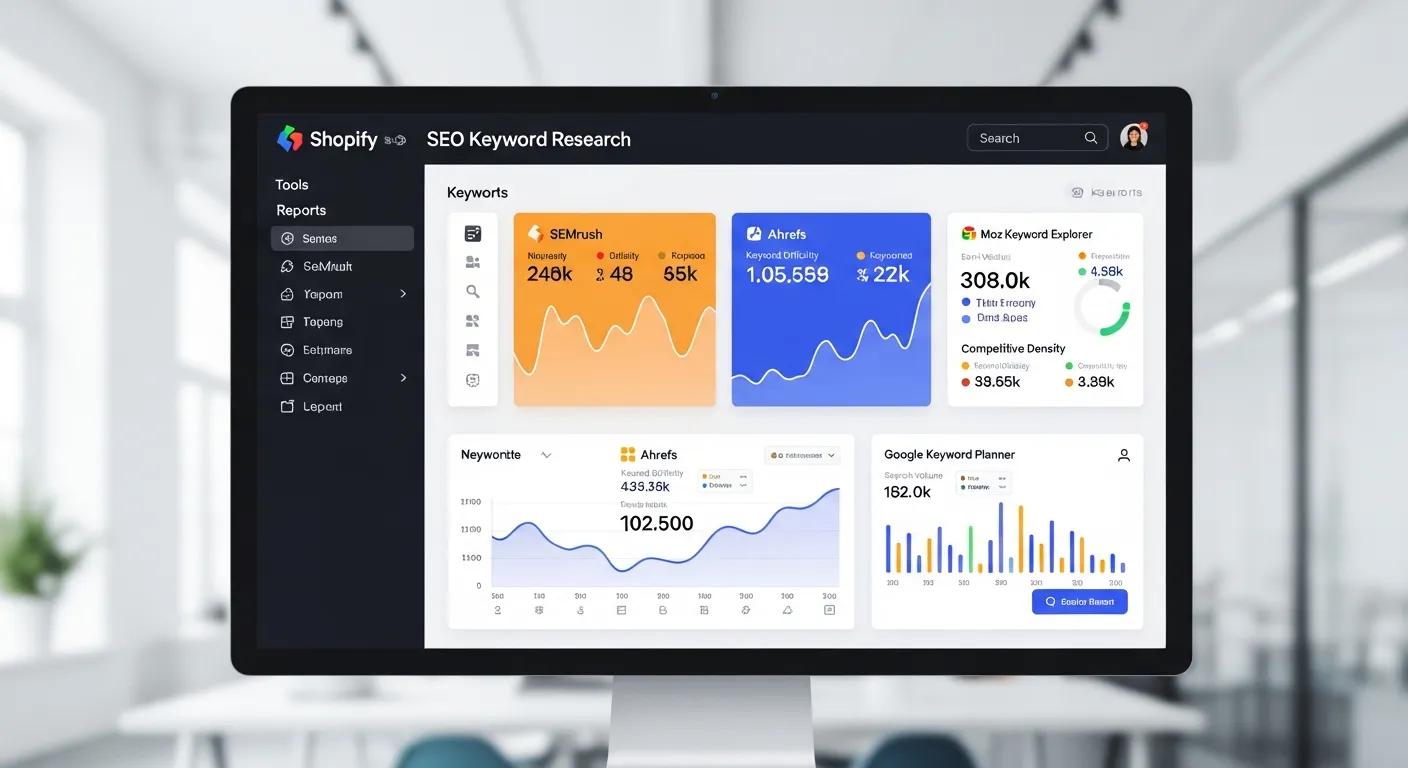
Savvy Shopify merchants deploy a potent blend of industry-standard SEO platforms and specialized Shopify apps to unearth, evaluate, and track keywords. Selecting the optimal combination guarantees comprehensive search volume data, sharp competitor intelligence, and vigilant daily performance monitoring.
Your Top 7 Keyword Research Tools for Shopify SEO Supremacy
Keyword research is the lifeblood for Shopify stores aiming to attract laser-targeted traffic, elevate product visibility, and craft content that resonates with customer searches. Google Keyword Planner is your go-to free resource for search volume and competition insights. For advanced keyword analysis and deep competitor intelligence, Ahrefs and Semrush are indispensable.
This resource spotlights the critical importance of keyword research for Shopify stores and introduces a suite of powerful tools for discovering relevant keywords.
How to Wield Google Keyword Planner for Your Shopify Product Keywords?
Google Keyword Planner is your gateway to monthly search volume and projected bid estimates, essential for identifying high-impact terms for your Shopify catalog. Here’s how to harness its power:
- Log in to Google Ads and navigate to Keyword Planner.
- Choose “Discover new keywords” and input your core product terms.
- Refine results by location and language to precisely match your target market.
- Export your keyword ideas and meticulously sort them by average monthly searches and competition levels.
These insights will guide your selection of product names and descriptor combinations that most effectively capture your target audience’s attention, informing your title tag and meta description optimizations.
What Edge Do Ahrefs and Semrush Give You in Shopify Keyword Research?
Ahrefs and Semrush go far beyond basic volume metrics, delivering critical intelligence such as:
- Keyword Difficulty Scores – Gauge the true effort required to achieve top rankings.
- Competitor Keyword Dominance – Uncover the exact keywords your top rivals are ranking for.
- SERP Feature Opportunities – Identify chances for featured snippets and “People Also Ask” inclusions.
- Historical Trend Analysis – Track seasonality and spot emerging search patterns.
This advanced analytics suite empowers you to craft deeper strategic plans and conduct precise competitive gap analyses for your Shopify store.
Which Shopify-Specific Tools Supercharge Keyword Discovery and Tracking?
While general SEO platforms offer broad research capabilities, these Shopify apps streamline your keyword workflows directly within your store:
- Plug in SEO – Provides daily monitoring of on-page keyword usage and metadata issues.
- Smart SEO – Automates alt-tag and JSON-LD generation to fortify your keyword coverage.
- SEO Manager – Delivers real-time keyword growth tracking within your Shopify dashboard.
- Shopify Searchanise – Analyzes onsite search queries to reveal hidden customer language.
Each app integrates seamlessly with your store, slashing manual data exports and consolidating insights under one roof for lightning-fast keyword iteration.
How to Benchmark Keyword Metrics Across Your Toolset?
To ensure unwavering keyword decision-making, compare these vital metrics side-by-side:
Your Master Plan: The Step-by-Step Shopify Keyword Research Process
An effective Shopify keyword workflow progresses from broad ideation to razor-sharp selection, ensuring every page targets terms that perfectly balance search volume, user intent, and competitive landscape.
How to Generate Powerful Seed Keywords for Your Shopify Empire?
Seed keywords are the foundational search terms that encapsulate your core products and brand themes. Generate them by:
- Scouring Google Autocomplete suggestions for your primary product categories.
- Deep-diving into your top-selling items within the Shopify dashboard.
- Mining customer reviews and support inquiries for authentic language.
- Exploring niche forums and relevant social media conversations.
These seed terms are the launchpad for deeper, tool-driven research and will help you uncover adjacent product opportunities.
How to Mine Competitor Keywords for Untapped Shopify SEO Gold?
Competitor analysis is your roadmap to identifying keyword gaps and discovering new traffic streams. Follow this strategic approach:
- Pinpoint 3–5 direct Shopify competitors with commanding organic rankings.
- Utilize Ahrefs or Semrush to extract their highest-ranking keywords and successful featured snippet strategies.
- Filter for terms with substantial search volume but a manageable ranking difficulty.
- Adapt and integrate these prime opportunities into your product page and content strategy.
This meticulous process uncovers undervalued search queries that your store can rapidly dominate.
How to Unearth and Deploy Long-Tail Keywords for Maximum Shopify Impact?
Long-tail phrases are conversion powerhouses, precisely matching specific buyer needs. To capture them:
- Combine product attributes (color, material, style) into multi-word, highly specific queries.
- Leverage “how to” and “where to buy” question formats that signal purchase intent.
- Incorporate local modifiers like city or region for hyper-targeted offers.
- Mine customer feedback and onsite search logs for unique, high-value phrases.
Integrating these long-tail keywords into your descriptions and blog content attracts niche audiences with undeniable purchase intent.
How to Strategically Evaluate Keyword Difficulty and Search Volume for Shopify SEO?
Effective prioritization hinges on balancing effort with potential reward. Use this framework to compare volume and difficulty:
This strategic triage ensures your resources are laser-focused on achievable terms before tackling the most competitive keywords.
Mastering Shopify Page Optimization: Integrating Keywords for Peak Performance
Seamlessly weaving your chosen keywords into your Shopify store’s architecture and content ensures every page resonates powerfully with both search engines and your target shoppers.
What Are the Golden Rules for Integrating Keywords into Shopify Product Descriptions?
Strategic keyword placement follows these essential guidelines:
- Embed primary keywords within your product titles and URL handles.
- Kick off descriptions with a clear, concise definition that naturally incorporates the target phrase.
- Distribute related keywords within bullet-pointed feature lists for maximum scannability.
- Enhance image alt text with descriptive, keyword-rich phrases that paint a clear picture.
- Craft compelling meta descriptions that strategically include transactional or commercial intent terms.
The Ultimate Shopify SEO Best Practices Playbook
Implementing Shopify SEO best practices is crucial for elevating your online store’s visibility in search results, driving more organic traffic, and ultimately, boosting sales. This involves meticulous optimization of on-page elements like meta tags and URLs, developing exceptional content, ensuring robust technical performance, and building authority through strategic off-page efforts.
This resource offers a comprehensive overview of Shopify SEO best practices, covering on-page optimization, content creation, and technical SEO essentials.
How to Architect Collection Pages for Unbeatable Keyword Relevance?
High-performing collection pages act as powerful category hubs:
- Utilize collection names that precisely match high-volume, mid-difficulty keywords.
- Craft a compelling 100–150 word introduction that defines the category using semantically rich terms.
- Link to your top products using anchor text that mirrors subcategory keywords.
- Implement smart facet filters labeled with long-tail modifier keywords (e.g., size, material, brand).
This structured hierarchy clarifies your site’s architecture for both search engine crawlers and your valuable shoppers.
How Does Keyword Optimization Directly Boost Shopify Store Conversion Rates?
Keyword optimization supercharges conversions by perfectly aligning page content with user expectations. When shoppers find precisely what they searched for in titles, descriptions, and calls-to-action, trust signals intensify, and bounce rates plummet. Enhanced onsite relevance also naturally encourages exploration of related products, significantly increasing average order value and overall cart size.
Advanced Shopify Keyword Research Tactics for Maximum SEO Impact
Beyond foundational research, advanced techniques tap into emerging trends, hyper-local demand, and global markets to exponentially expand your Shopify store’s reach.
How to Integrate Voice Search Keywords into Your Shopify SEO Master Plan?

Voice queries are inherently longer and more conversational. To capture this burgeoning traffic:
- Target natural language phrases starting with “who,” “what,” “where,” and “how.”
- Optimize FAQ-style headings within your blog posts to directly mirror spoken questions.
- Implement schema markup for Q&A sections (via apps like Smart SEO) to boost voice assistant discoverability.
- Monitor Google Search Console’s “queries” report for emerging conversational terms to integrate dynamically.
This forward-thinking approach positions your store to capture the rapidly growing trend of voice-activated shopping behaviors across mobile and smart devices.
Voice Search Optimization: Your Shopify Store’s Next Frontier
Voice searches are typically more expansive and conversational. Instead of just typing “shoes,” users ask, “Where can I buy comfortable running shoes near me?” This fundamental shift means your Shopify store must be optimized with natural language keywords, making it effortless for voice assistants to pinpoint your store as the definitive answer.
This source breaks down the key differences between voice and traditional search and provides actionable strategies for optimizing a Shopify store for voice queries.
How Can Hyper-Local SEO Keyword Research Drive Shopify Store Growth?
Local keyword research is your key to unlocking foot traffic and regional sales by:
- Appending geographic modifiers (city, neighborhood) to product and collection pages.
- Developing dedicated location-based landing pages to attract nearby shoppers.
- Encouraging user-generated content through local reviews and testimonials.
- Integrating Google My Business and local directory mentions to solidify regional authority.
Local optimization ensures your Shopify store becomes the top result when buyers search for products “near me” or within their specific city.
Shopify Local SEO Strategies: Command Your Geographic Market
Local SEO is a highly targeted online marketing strategy designed to put your Shopify store directly in front of potential customers within your specific geographic area. This means when someone nearby searches for products or services like yours, your store is significantly more likely to appear as a top contender.
This source demystifies the fundamentals of local SEO and illustrates its powerful benefits for Shopify stores.
What Are the Best Practices for International Shopify Keyword Research?
Expanding globally requires cultural finesse and linguistic precision:
- Employ native-level translators or specialized tools to generate accurate foreign-language seed terms.
- Implement hreflang tags and subdomain structures tailored for each target market.
- Investigate non-Google search engines (e.g., Baidu, Yandex) to understand local user behavior.
- Adapt meta tags, headings, and images to align with local preferences and search conventions.
Strategic international research prevents costly mistranslations and maximizes relevancy across diverse global markets.
Expand Your Reach Globally: Conquer Shopify International SEO
Keyword research is the cornerstone of multilingual SEO success. Carefully consider the nuances of language and cultural context when selecting keywords, as what resonates in one market may fall flat in another. Leveraging local tools and consulting with native speakers can dramatically elevate your keyword strategy.
This source offers invaluable insights for conducting keyword research for international SEO, emphasizing the critical importance of language and cultural context.
Measuring Success: Tracking Your Shopify Keyword Performance for Sustained Growth
Continuous measurement validates your keyword strategy and uncovers new optimization opportunities, paving the way for enduring growth.
Which Shopify Reports and Google Analytics Metrics Prove Keyword Success?
A powerful combination of Shopify’s native reports and Google Analytics provides a crystal-clear view of keyword performance through:
- Organic Search Sessions – The volume of visitors arriving via search engines like Google and Bing.
- Landing Page Report – Identifies your top-performing pages by traffic source.
- Search Terms – Onsite query logs revealing the exact language your customers use.
- Bounce Rate & Dwell Time – Crucial engagement indicators of keyword relevance.
- Conversion Rate by Landing Page – Measures the ROI generated by your targeted keywords.
Vigilantly monitoring these metrics pinpoints where strategic adjustments can accelerate traffic and conversions.
How to Refine Your Shopify SEO Using Keyword Ranking and Traffic Data?
Refinement is an iterative cycle of analysis and decisive action:
- Track ranking positions for your priority keywords using tools like Ahrefs or Semrush.
- Correlate ranking shifts with organic traffic trends in Google Search Console.
- Update meta titles, headings, and body content on underperforming pages to boost relevance.
- Expand internal linking to pages gaining traction, effectively distributing authority.
- Conduct quarterly reassessments to capture emerging query trends and seasonal shifts.
This dynamic, iterative approach keeps your Shopify store perfectly aligned with the ever-evolving search landscape.
What KPIs Signal Maximum SEO Impact from Your Shopify Keyword Research?
Key performance indicators that truly reflect SEO success include:
- Organic Traffic Growth – A consistent, upward trajectory in sessions.
- Average SERP Position – Demonstrable movement towards top-3 rankings.
- Click-Through Rate (CTR) – The percentage of impressions that convert into clicks.
- Conversion Rate – The ratio of purchases to organic sessions.
- Revenue per Visitor – The monetary value directly attributable to SEO referrals.
Exceptional performance across these KPIs is definitive proof that your keyword strategy is driving tangible business results.
Partner with BlackBelt Commerce: Your Shopify Keyword Research Growth Accelerator
BlackBelt Commerce offers specialized Shopify SEO services that fuse cutting-edge keyword research with expert on-page, technical, and content strategy execution.
Shopify SEO Experts: Blackbelt Commerce – Driving Your Success
SEO, or Search Engine Optimization, is the practice of refining your website to enhance its visibility within search engine results. For Shopify stores, this is paramount because higher search rankings translate directly into increased organic traffic, amplified brand visibility, and ultimately, a significant boost in sales.
This source defines SEO and articulates its indispensable importance for Shopify stores aiming for growth.
What Unique Shopify SEO Keyword Strategies Does BlackBelt Commerce Deploy?
Our proprietary methodology combines advanced machine-learning insights with meticulous manual competitor gap analysis to uncover hidden keyword opportunities. We integrate cross-channel data, implement dynamic keyword segmentation, and leverage exclusive in-house Shopify apps to automate on-page optimizations, ensuring sustained ranking gains.
How Have BlackBelt Commerce’s Keyword Research Techniques Delivered Proven Results?
By collaborating with BlackBelt Commerce, a leading fashion retailer experienced a remarkable 120% surge in organic traffic and a 35% uplift in conversion rates within just three months. Similarly, a health supplements store witnessed a 50% increase in average order value after we refined their long-tail keyword targeting and overhauled their collection page hierarchies.
Ready to Elevate Your Shopify Store? Start Your Expert Consultation Today!
Begin by requesting your complimentary SEO audit and keyword gap analysis from our elite Shopify experts. We’ll deliver a bespoke action plan detailing high-impact terms, strategic content recommendations, and precise on-page adjustments—setting your store on a clear trajectory towards accelerated SEO-driven growth and maximized sales.
Supercharge your Shopify store with data-driven keyword strategies, measurable performance tracking, and the unparalleled guidance of BlackBelt Commerce. Transform search queries into loyal customers and unlock your e-commerce potential today.
Research Support
Shopify SEO: Your Essential 12-Step Beginner’s Blueprint
Acquiring backlinks—links from other reputable websites pointing to yours—is one of the most powerful strategies for enhancing your SEO performance. Backlinks serve as strong signals to search engines, validating your site’s authority and trustworthiness, making it more deserving of top rankings.
This source emphasizes the critical role of backlinks in elevating SEO performance.

