


Nearly 60 percent of American online retailers report challenges when entering international markets. Expanding beyond U.S. borders is no longer just about offering global shipping, especially as customer expectations rise and competitors adapt to rapidly changing technologies. For American Shopify store owners and digital marketing managers, understanding today’s cross-border ecommerce landscape means learning how new systems, digital tools, and localized experiences are setting brands up for real international growth and stronger market presence.
Table of Contents
- What Cross-Border Ecommerce Means Today
- Types of Cross-Border Ecommerce Transactions
- Key Challenges Facing U.S. Shopify Stores
- Legal and Tax Considerations for U.S. Merchants
- Effective Strategies for Global Shopify Success
Key Takeaways
| Point | Details |
|---|---|
| Cross-Border E-Commerce Expansion | Businesses can leverage advanced technologies and localization strategies to engage international consumers directly, drastically reshaping their sales models. |
| Diverse Transaction Models | Understanding the distinct cross-border transaction types (B2C, B2B, C2C) is essential for optimizing global market strategies and overcoming unique challenges. |
| Regulatory and Tax Compliance | U.S. merchants must navigate complex international legal frameworks and tax obligations to successfully expand their cross-border operations. |
| Tech Investments for Global Success | Prioritizing technological investments such as multi-currency support and AI personalization can significantly enhance global consumer engagement and conversion rates. |
What Cross-Border Ecommerce Means Today
Cross-border e-commerce represents a transformative global business model enabling international online transactions that transcend traditional geographic boundaries. At its core, this approach allows businesses to sell products directly to consumers across different countries, leveraging digital platforms and advanced technological infrastructure. Cross-border e-commerce involves transactions between entities in different customs territories, fundamentally reshaping how brands engage with international markets.
Modern cross-border e-commerce goes far beyond simple international shipping. It encompasses complex systems integrating digital payment technologies, multilingual customer support, localized marketing strategies, and sophisticated logistics networks. Emerging technologies like artificial intelligence, cloud computing, and big data analytics are driving unprecedented capabilities for businesses seeking global market expansion. Brands can now instantaneously connect with consumers worldwide, offering personalized shopping experiences that were impossible just a decade ago.
The economic potential of cross-border e-commerce is staggering. Global forecasts estimate trillions in international online sales by 2025, signaling a massive opportunity for Shopify store owners willing to strategically internationalize their operations. Successful cross-border strategies require understanding complex variables like local consumer preferences, regulatory compliance, payment method variations, and cultural nuances that influence purchasing behavior.
Pro tip: Research and implement at least three localization strategies for your target international markets, such as offering currency conversion, providing region-specific product descriptions, and understanding local shipping expectations.
Types of Cross-Border Ecommerce Transactions
Cross-border e-commerce encompasses several distinct transaction models that fundamentally transform how businesses and consumers interact across international markets. Cross-border e-commerce transactions include multiple transaction types such as business-to-consumer (B2C), business-to-business (B2B), and consumer-to-consumer (C2C), each presenting unique challenges and opportunities for Shopify store owners seeking global expansion.
Business-to-Consumer (B2C) transactions represent the most common cross-border e-commerce model, where online retailers sell products directly to international consumers. These transactions require sophisticated logistics, localized payment processing, and compliance with diverse international regulations. Cross-border supply chains increasingly involve dual-channel strategies, including direct sales by manufacturers and retail through intermediaries, which allows businesses to optimize their global market penetration strategies.
Business-to-Business (B2B) and Consumer-to-Consumer (C2C) transactions offer additional complexity. B2B cross-border transactions often involve larger order volumes, more intricate pricing negotiations, and specialized shipping requirements. C2C transactions, typically facilitated through global marketplaces, enable individual sellers to reach international buyers, creating a decentralized and dynamic global trading ecosystem. These transaction types demand advanced technological infrastructure, robust payment systems, and nuanced understanding of international trade protocols.
Here’s a quick overview of key differences among cross-border e-commerce transaction types:
| Transaction Type | Participants | Typical Order Size | Unique Challenges |
|---|---|---|---|
| B2C | Business & Consumer | Small to medium | Logistics, localization |
| B2B | Two Businesses | Large and bulk | Pricing, complex regulations |
| C2C | Individual Sellers & Buyers | Small | Decentralized trade, fraud risk |
Pro tip: Develop a comprehensive cross-border strategy by mapping out specific transaction type requirements, understanding local market regulations, and investing in flexible technological solutions that can adapt to different international commerce models.
Key Challenges Facing U.S. Shopify Stores
Complex legal and regulatory challenges represent significant obstacles for U.S. Shopify stores expanding into cross-border e-commerce, requiring sophisticated strategies to navigate international market complexities. U.S. online retailers must carefully address a multifaceted landscape of international trade requirements, including nuanced compliance issues that extend far beyond traditional domestic selling models.
The primary challenges encompass multiple interconnected domains. Regulatory compliance emerges as a critical concern, with U.S. Shopify stores needing to understand diverse international legal frameworks governing digital transactions. This includes intricate details surrounding data privacy regulations, intellectual property protections, and jurisdiction-specific consumer protection laws. Tax structures, customs regulations, and import/export restrictions create additional layers of complexity that can quickly overwhelm unprepared businesses.
Technological and operational challenges further compound the difficulties for U.S. Shopify stores. Implementing robust security protocols becomes paramount when expanding internationally, as cross-border transactions introduce heightened risks of fraud and cybersecurity threats. Payment processing variations, language localization, currency conversion, and adapting to diverse consumer behaviors demand significant technological investment and strategic planning. Successful international expansion requires a holistic approach that balances technological capability with cultural intelligence and regulatory awareness.

Pro tip: Develop a comprehensive international market entry strategy by conducting thorough research on target countries, consulting with legal experts specializing in international e-commerce, and investing in adaptable technological infrastructure that can scale across different regulatory environments.
Legal and Tax Considerations for U.S. Merchants
U.S. merchants navigating international e-commerce must manage complex tax obligations across multiple jurisdictions, presenting a sophisticated challenge for Shopify store owners seeking global market expansion. The intricate landscape of international taxation demands a strategic and nuanced approach that goes beyond traditional domestic selling frameworks.
The primary tax complexity stems from Value Added Tax (VAT) and Goods and Services Tax (GST) requirements. Since over 160 countries impose indirect taxes on goods and services, U.S. merchants must develop comprehensive strategies for accurate tax collection and remittance. These obligations significantly impact product pricing, landed costs, and overall profitability. Shopify tax management solutions can help merchants navigate these intricate regulatory environments, ensuring compliance and minimizing potential financial risks.
Legal considerations extend far beyond tax calculations. Merchants must understand jurisdiction-specific regulations governing digital transactions, data privacy, consumer protection, and intellectual property rights. Each international market presents unique legal requirements that can dramatically affect business operations. Successful cross-border e-commerce demands a proactive approach that includes continuous legal education, strategic compliance planning, and potentially engaging local legal experts to provide market-specific guidance.
Pro tip: Develop a comprehensive international tax and legal compliance strategy by consulting with cross-border e-commerce specialists, leveraging technology-driven compliance tools, and maintaining meticulous documentation of international transactions.
Effective Strategies for Global Shopify Success
Global Shopify success requires a comprehensive, data-driven approach to international market expansion, transforming traditional e-commerce practices into sophisticated, localized customer experiences. Modern Shopify merchants must develop nuanced strategies that transcend basic translation and shipping logistics, focusing instead on creating deeply personalized, culturally resonant shopping journeys.
Key strategic elements include technological localization and advanced market targeting. AI-powered personalization technologies enable merchants to dynamically adapt their online stores, delivering customized experiences that resonate with specific international audiences. This involves implementing multi-currency support, integrating preferred local payment methods, and developing regionally tailored marketing campaigns that speak directly to cultural preferences and consumer behaviors.
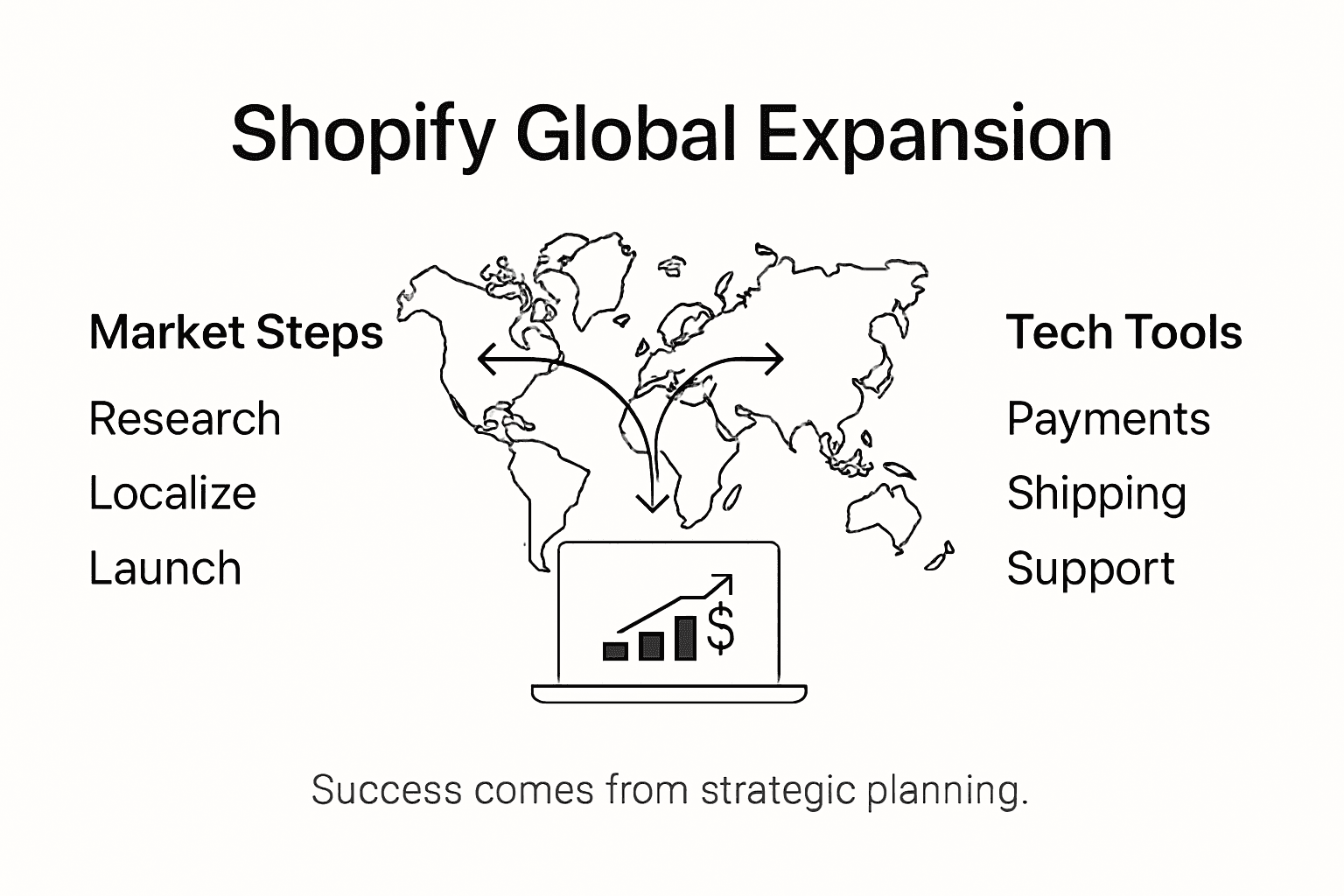
Technological infrastructure plays a critical role in global expansion success. Merchants must prioritize mobile-first design, optimize for voice search and conversational commerce, and leverage sophisticated data analytics tools. Going global with Shopify internationalization requires robust technological capabilities that can seamlessly manage complex logistics, automate marketing workflows, and provide real-time insights into international market performance. Understanding and anticipating regional consumer expectations becomes the cornerstone of sustainable global growth.
Below is a summary of strategic technology investments that drive global Shopify success:
| Technology Investment | Purpose | Business Impact |
|---|---|---|
| Multi-currency support | Enable local purchasing | Higher global conversion |
| AI-powered personalization | Adapt experience to region | Boosts customer engagement |
| Mobile-first design | Meet mobile shopping trends | Expands global reach |
| Payment integration | Support local payment types | Reduces checkout abandonment |
Pro tip: Create a comprehensive international market entry playbook that includes detailed research on target markets, technology integration plans, and adaptive marketing strategies, treating each new region as a unique ecosystem with distinct consumer dynamics.
Unlock Global Growth With Expert Shopify Solutions
Expanding your Shopify store into international markets presents unique challenges like complex regulatory compliance, multi-currency integration, and localized customer experiences. These pain points revealed in the article show how crucial it is to have a tailored cross-border e-commerce strategy that adapts to diverse consumer behaviors and intricate global logistics. At Blackbelt Commerce, we specialize in creating custom Shopify solutions that address these exact challenges—leveraging multi-language integrations, AI-driven personalization, and robust payment system setups to help your store thrive worldwide.

Ready to overcome barriers like tax complexities and localization hurdles while maximizing your international revenue potential? Discover how our expert team can transform your Shopify store with scalable, high-performance development and marketing strategies that boost conversion rates and global reach. Take the first step toward your global success story by visiting Blackbelt Commerce or exploring our demonstrative case studies and service offerings at Blackbelt Commerce. Don’t wait to position your business for international triumph.
Frequently Asked Questions
What is cross-border e-commerce?
Cross-border e-commerce refers to the buying and selling of goods and services between businesses and consumers in different countries, utilizing digital platforms to facilitate international transactions.
What are the main types of cross-border e-commerce transactions?
The main types of cross-border e-commerce transactions are Business-to-Consumer (B2C), Business-to-Business (B2B), and Consumer-to-Consumer (C2C). Each type has distinct characteristics and challenges related to logistics, pricing, and regulations.
What challenges do U.S. Shopify stores face when expanding internationally?
U.S. Shopify stores face complex legal and regulatory challenges, such as compliance with international trade laws, tax obligations like VAT and GST, and requirements for data privacy and consumer protection.
How can Shopify merchants optimize their cross-border e-commerce strategies?
Shopify merchants can optimize their strategies by implementing localization techniques (like multi-currency support and region-specific marketing), investing in advanced technological solutions, and understanding the unique preferences of international consumers.
Recommended
- Why Multichannel Thinking is Key for Shopify Store Success
- Going Global with Shopify Internationalisation — Blackbelt Commerce
- Unconventional Strategies to Grow Your E-Commerce Store
- Social Media | Key Reasons To Incorporate Into Your Shopify Store – Shopify Experts: Grow Your eCommerce Revenue
Quick Answer: What is cross-border ecommerce
What is cross-border ecommerce should be treated as a strategy decision that affects localization, payments, fulfillment, tax, UX, content, and customer trust. Shopify merchants need a practical plan that turns global demand into a store experience that feels local, reliable, and easy to buy from.
Want a sharper Shopify growth plan?
Want to turn What is cross-border ecommerce into a practical Shopify growth plan? Book a strategy call and we will help you clarify the next move.
Key Takeaways
- Use What is cross-border ecommerce to clarify the business problem and the highest-impact next step for a Shopify store.
- Connect recommendations to customer trust, UX, conversion, SEO, analytics, operations, and revenue.
- Link naturally to Blackbelt Commerce money pages and the home page without weakening editorial trust.
- Avoid generic ecommerce advice; make the guidance specific to Shopify constraints and opportunities.
- Use the same-page Calendly CTA only after the post has delivered useful guidance.
How this connects to your Shopify growth strategy
For the Shopify Growth, CRO, and Store Optimization cluster, this article should make What is cross-border ecommerce practical, specific, and commercially useful while protecting editorial trust. The bridge to Blackbelt Commerce should show when expert planning, implementation, SEO/CRO discipline, or Shopify Plus support can reduce risk and turn the reader’s next decision into measurable progress.
Want a sharper Shopify growth plan?
Use this guide as a decision tool. Then book a strategy call when you want a practical roadmap for your store.
Related Shopify resources
These internal resources support the Shopify Growth, CRO, and Store Optimization topic cluster and help connect this guide to stronger commercial next steps:
- Shopify CRO services
- Shopify experts
- Shopify Plus agencies
- Shopify CRO services — Primary money/service page for this search intent
- Blackbelt Commerce — Home-page authority link for brand and core Shopify expertise
- Shopify experts — Money-page link requested for expert-hiring intent
- Shopify custom development — Development service page for implementation and technical help
- Shopify checkout optimization — Related conversion article
- Shopify conversion optimization — Related CRO article
Questions store owners ask before taking action
Why does What is cross-border ecommerce matter for Shopify merchants?
It matters when the topic affects customer trust, conversion, operations, SEO, analytics, or the team’s ability to scale the store cleanly.
How should the article guide the reader?
It should answer the search intent first, then connect the topic to practical next steps, related resources, and expert support when that next step is useful.
What is the lead-generation goal?
The goal is a qualified strategy-call booking after the article has delivered enough value for the reader to trust Blackbelt Commerce with the next decision.
Future articles needed for topical dominance
To build deeper topical authority around this cluster, these supporting topics should be created later and linked back into this article:
- What is cross-border ecommerce Checklist for Shopify Stores: Creates an actionable support article that can earn long-tail searches and link back to relevant money pages.
- Common What is cross-border ecommerce Mistakes That Hurt Shopify Revenue: Targets problem-aware readers and explains UX, SEO, conversion, and implementation risk.
- How Shopify Experts Prioritize What is cross-border ecommerce: Links informational intent to expert support without turning the main article into a sales pitch.
Want a sharper Shopify growth plan?
Ready to turn the advice in this article into an action plan? Open the calendar here and choose a time that works for you.

