


Nearly half of American Shopify merchants admit they lack confidence in their analytics setup, even though data-driven decisions are crucial for growth. For digital marketing managers steering mid-sized stores, understanding the right metrics and tools can mean the difference between flat sales and compounding success. This guide reveals how strategic analytics go beyond reports, offering practical insights to help you master traffic and conversion optimization for true business growth.
Table of Contents
- What Analytics Means For Shopify Stores
- Essential Analytics Tools And Reports
- Key Metrics Driving Store Performance
- Advanced Applications For Conversion Optimization
- Pitfalls And Common Mistakes To Avoid
Key Takeaways
| Point | Details |
|---|---|
| Importance of Analytics | Analytics provide strategic insights that help Shopify store owners optimize performance and enhance customer experiences. |
| Essential Metrics | Key performance indicators such as conversion rates and customer acquisition costs are critical for understanding store health and performance. |
| Tools for Insights | Utilizing both Shopify’s built-in analytics and third-party tools allows for deeper insights and improved data-driven decision-making. |
| Common Pitfalls | Avoiding data misinterpretation and establishing clear objectives can prevent wasted resources and help refine analytics strategies. |
What Analytics Means for Shopify Stores
For Shopify store owners, analytics represent far more than simple data points—they are strategic roadmaps revealing the intricate dynamics of online business performance. Web analytics offer valuable insights into user interactions, enabling digital entrepreneurs to transform raw numbers into actionable growth strategies that directly impact revenue and customer experience.
At its core, analytics in the Shopify ecosystem encompasses comprehensive tracking of critical metrics like website traffic, conversion rates, customer behavior patterns, and sales performance. These insights go beyond surface-level observations, providing nuanced understanding of how customers navigate your digital storefront. By interpreting financial and operational data systematically, store owners can identify precise opportunities for optimization, from product positioning to marketing channel effectiveness.
The power of Shopify analytics lies in its ability to translate complex data into clear strategic directions. Store owners can track essential metrics such as:
- Visitor traffic sources
- Conversion rates by product category
- Average order value
- Customer acquisition costs
- Repeat purchase percentages
- Abandoned cart rates
These granular insights allow merchants to make data-driven decisions that incrementally improve store performance, customer experience, and overall profitability.
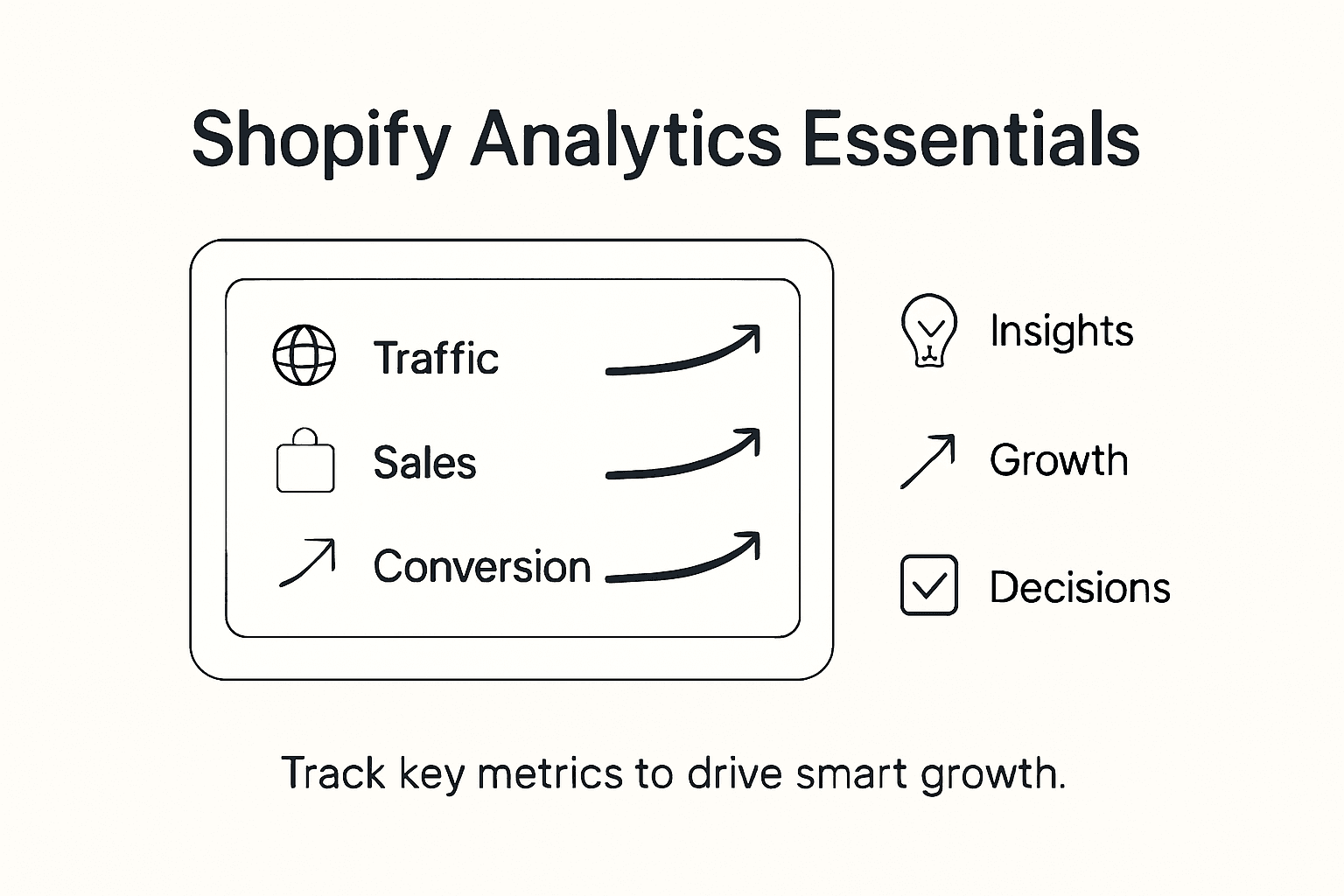
Pro Tip: Set up custom dashboards in your Shopify analytics that highlight your most critical Key Performance Indicators (KPIs) and review them consistently to maintain a pulse on your store’s health and growth potential.
Essential Analytics Tools and Reports
Shopify store owners have access to a robust ecosystem of analytics tools designed to transform raw data into strategic business intelligence. Comprehensive data and reporting tools are essential for tracking market trends and consumer behavior, enabling merchants to make informed decisions that drive growth and profitability.
The core analytics landscape for Shopify stores includes several critical reporting categories. Performance metrics and analytical interfaces provided by Shopify help merchants monitor key business indicators such as:
- Sales Performance Reports
- Customer Acquisition Metrics
- Conversion Rate Tracking
- Traffic Source Analysis
- Product Performance Dashboards
- Inventory Turnover Insights
These tools offer more than simple number-crunching. They provide contextualized insights that help store owners understand complex customer journeys, identify potential bottlenecks in their sales funnel, and develop targeted strategies for growth. Advanced analytics platforms can integrate data from multiple sources, creating a comprehensive view of store performance that goes beyond traditional reporting.
Most successful Shopify merchants leverage both built-in Shopify analytics and third-party tools to gain comprehensive insights. This multi-layered approach allows for deeper analysis, custom reporting, and more nuanced understanding of store performance across different dimensions.
Here’s a summary of how Shopify analytics tools can be enhanced for deeper business insights:
| Analytics Tool Type | Main Function | Added Business Value |
|---|---|---|
| Shopify Built-in Reports | Standard sales and traffic | Quick overview of store health |
| Third-Party Integrations | Customized data analysis | Advanced segmentation options |
| Custom Dashboards | Tailored KPI tracking | Focus on strategic objectives |
| Multi-Source Platforms | Combined data sources | Holistic performance insights |
Pro Tip: Create a weekly analytics review routine where you examine your most critical metrics, comparing current performance against historical data and identifying emerging trends or potential optimization opportunities.
Key Metrics Driving Store Performance
Successful Shopify merchants understand that performance metrics are the vital signs of their online business. Key performance indicators reveal critical insights into sales volume, merchant engagement, and growth trends, providing a comprehensive view of store health and potential for expansion.
The most crucial metrics can be categorized into several strategic groups that provide holistic insights into store performance:
-
Financial Metrics
- Average Order Value (AOV)
- Total Revenue
- Gross Profit Margin
- Net Profit
-
Customer Engagement Metrics
- Conversion Rate
- Customer Acquisition Cost
- Customer Lifetime Value
- Repeat Purchase Rate
-
Operational Performance
- Inventory Turnover
- Shipping Time
- Product Return Rate
- Cart Abandonment Rate
Website performance metrics also play a critical role in understanding user interactions and platform effectiveness, including factors like page load speed, mobile responsiveness, and user interface accessibility. These technical indicators directly impact customer experience and can significantly influence conversion rates.

By systematically tracking and analyzing these metrics, Shopify store owners can develop targeted strategies for improvement, identify potential bottlenecks, and make data-driven decisions that drive sustainable growth. The key is not just collecting data, but transforming those numbers into actionable insights that can be implemented to enhance overall store performance.
Pro Tip: Create a custom dashboard that consolidates your most critical metrics, allowing you to quickly assess your store’s performance and identify areas requiring immediate attention or strategic optimization.
Advanced Applications for Conversion Optimization
Shopify store owners are increasingly leveraging advanced analytics to transform their conversion strategies. Machine learning models now enable sophisticated demand forecasting and dynamic pricing optimization, allowing merchants to create highly targeted approaches that dramatically improve sales performance.
The most powerful conversion optimization techniques integrate multiple advanced analytical approaches:
-
Predictive Customer Behavior
- Machine learning pattern recognition
- Personalized recommendation engines
- Behavioral segmentation
- Predictive purchase probability modeling
-
Dynamic Pricing Strategies
- Real-time market price adjustments
- Competitive landscape analysis
- Customer willingness-to-pay modeling
- Automated pricing optimization
-
Conversion Funnel Intelligence
- Detailed user journey mapping
- Friction point identification
- Conversion rate optimization techniques
- Automated A/B testing frameworks
Advanced optimization algorithms enable merchants to explore complex design strategies and quantify performance uncertainty, providing unprecedented insights into potential business improvements. These sophisticated techniques go beyond traditional analytics, offering a nuanced understanding of customer interactions and potential conversion opportunities.
Successful implementation requires a holistic approach that combines technological sophistication with deep understanding of customer psychology. By integrating machine learning, predictive modeling, and dynamic optimization strategies, Shopify store owners can create intelligent systems that continuously adapt and improve conversion performance.
Pro Tip: Implement a quarterly review process that uses advanced analytics to systematically audit and refine your conversion optimization strategies, ensuring your approach remains agile and responsive to changing market dynamics.
Pitfalls and Common Mistakes to Avoid
Shopify store owners often encounter significant challenges when implementing analytics strategies that can undermine their growth potential. Common pitfalls include fundamental misunderstandings about effectively using analytics and implementing measurement systems without strategic alignment, which can lead to wasted resources and missed opportunities.
The most critical mistakes in Shopify analytics implementation typically fall into several key categories:
-
Data Misinterpretation
- Treating metrics in isolation
- Failing to understand contextual nuances
- Overemphasizing vanity metrics
- Ignoring statistical significance
-
Strategic Execution Errors
- Collecting data without clear objectives
- Lacking a structured analysis framework
- Inconsistent tracking methodologies
- Insufficient cross-functional communication
-
Technical Implementation Problems
- Improper tracking configuration
- Overlooking data privacy regulations
- Inadequate data security protocols
- Relying on default analytics settings
Successful organizations recognize that data collection means nothing without translating insights into meaningful, actionable strategies, creating a continuous improvement cycle that drives real business growth. The most effective Shopify stores view analytics not as a static reporting tool, but as a dynamic system for ongoing performance optimization.
Navigating these challenges requires a disciplined, strategic approach that combines technical expertise with business acumen. Store owners must develop a holistic perspective that sees analytics as an integrated, evolving practice rather than a one-time implementation.
Below is a comparison of typical analytics pitfalls and how to avoid them effectively:
| Common Mistake | Impact on Store | Preventive Best Practice |
|---|---|---|
| Focusing on vanity metrics | Misleading performance | Prioritize actionable KPIs |
| Unclear objectives | Inefficient data usage | Set clear measurement goals |
| Poor data configuration | Inaccurate reporting | Regularly audit tracking setup |
| Ignoring contextual factors | Flawed optimization | Analyze metrics with business context |
Pro Tip: Conduct a quarterly analytics audit to systematically review your tracking setup, validate data accuracy, and realign your metrics with current business objectives.
Unlock the Full Potential of Your Shopify Store with Expert Analytics Solutions
The article highlights the critical role of analytics in driving measurable growth for Shopify stores by turning raw data into actionable insights. Many Shopify merchants struggle with challenges like interpreting financial and operational metrics, optimizing conversion rates, and avoiding common data pitfalls. If you want to transform your store’s analytics from overwhelming numbers into clear, strategic decisions that fuel revenue growth and improve customer experience, tailored expertise is key.
At Blackbelt Commerce, we empower Shopify entrepreneurs with custom analytics integrations, advanced data-driven optimization strategies, and AI-enhanced storefront solutions designed to boost conversion rates and maximize profitability. Our comprehensive approach covers everything from consultation and custom theme development to ongoing support, ensuring your analytics work in harmony with your business goals.
Discover how our proven process and specialized Shopify solutions can help you overcome common analytics challenges, avoid costly mistakes, and unlock sustainable growth. Take control of your store’s performance with Blackbelt Commerce today.
Elevate your Shopify store’s analytics and growth strategy now. Visit Blackbelt Commerce to explore our portfolio of successful projects and schedule a consultation to start turning data insights into higher revenue and customer engagement. Don’t let analytics complexity hold you back—partner with expert Shopify developers who understand the power of precision data for your business success.
Frequently Asked Questions
What is the importance of analytics for Shopify store owners?
Analytics provide crucial insights into user interactions, allowing store owners to understand customer behavior, track performance metrics, and implement strategies that improve revenue and customer experience.
What key metrics should Shopify store owners monitor?
Shopify store owners should track metrics such as visitor traffic sources, conversion rates, average order value, customer acquisition costs, repeat purchase percentages, and abandoned cart rates to gauge store performance effectively.
How can I enhance my Shopify store’s analytics capabilities?
To enhance analytics, consider using third-party tools for customized data analysis, create custom dashboards focused on key performance indicators, and regularly review your metrics to identify growth opportunities.
What common pitfalls should I avoid when using analytics for my Shopify store?
Common pitfalls include misinterpreting data, lacking clear objectives for data collection, poor configuration of tracking systems, and ignoring the context of metrics. It’s essential to align analytics practices with strategic business goals.
Recommended
- Top Analytics Tools for Shopify: Elevate Your Sales Strategy – Shopify Experts: Grow Your eCommerce Revenue
- Elevate Your Strategy with Shopify Data Analysis Techniques – Shopify Experts: Grow Your eCommerce Revenue
- Best Shopify Analytics Tools: In-Depth Reviews and Insights – Shopify Experts: Grow Your eCommerce Revenue
- Master Shopify Performance Tracking Solutions to Boost Sales – Shopify Experts: Grow Your eCommerce Revenue
Quick Answer: role of analytics in shopify stores
Shopify analytics tools help merchants understand what is driving traffic, conversion, average order value, repeat purchases, and customer drop-off. The right analytics stack should connect data to action, so store owners can prioritize improvements instead of collecting reports that never change the business.
Want a sharper Shopify growth plan?
If this article connects to a current store decision, use the calendar to book a strategy call and turn the idea into a practical plan.
Key Takeaways
- Start with the search intent behind role of analytics in shopify stores: the reader needs a clear explanation before they are ready for a service conversation.
- Keep the advice practical and specific so the post feels editorial, useful, and worth sharing.
- Use the topic cluster links to connect the article to related BBC expertise instead of leaving it as a standalone blog post.
- Add a natural commercial bridge only after the article has answered the reader’s main question.
- Use the same-page Calendly CTA so qualified readers can book a strategy call without being sent to a long form.
How this connects to your Shopify growth strategy
This article should remain useful for readers researching role of analytics in shopify stores, but it also needs to show when the topic becomes a business decision. For the Shopify Growth Strategy cluster, the commercial bridge is practical: once the reader understands the concept, the next step is deciding whether their current Shopify setup can support the desired experience, conversion path, and operational workflow. That is where expert planning, design, development, CRO, and SEO support can turn the idea into measurable store improvements.
Want a sharper Shopify growth plan?
Use this guide as a decision tool. Then book a strategy call when you want a practical roadmap for your store.
Related Shopify resources
These internal resources support the Shopify Growth Strategy topic cluster and help connect this guide to stronger commercial next steps:
- Shopify Custom Development
- Shopify experts
- Shopify Plus agencies
- Shopify Custom Development — Parent service page for the reader’s next commercial step
- Shopify experts — Money-page link requested for expert-hiring intent
- Shopify Plus agencies — Money-page link requested for high-growth and Plus-agency intent
- Shopify CRO — Conversion service page for readers focused on revenue and lead generation
- Shopify landing page design — Related design and conversion article for custom storefront decisions
- custom e-commerce solution — Related custom ecommerce article that supports build-vs-template decisions
- ecommerce web solution — Related ecommerce solution article for broader platform planning
Questions store owners ask before taking action
What does role of analytics in shopify stores mean for a Shopify merchant?
For a Shopify merchant, role of analytics in shopify stores is about choosing or improving the store experience in a way that supports traffic, trust, conversion, and long-term operations.
When should a store owner get expert help?
Expert help becomes useful when the decision affects SEO, conversion, theme architecture, integrations, migration risk, or revenue-critical customer journeys.
How should this topic connect to a broader content cluster?
The post should link to a parent service page, related support articles, and money pages so Google and AI systems understand how the article supports a broader area of expertise.
What is the lead-generation goal of this article?
The article should educate first, then guide qualified readers toward booking a strategy call when they need help applying the advice to their own store.
What should be avoided during optimization?
Avoid filler, unrelated phrases, invented statistics, broken formatting, duplicated CTAs, and any edit that makes the article feel less helpful or less polished.
Future articles needed for topical dominance
To build deeper topical authority around this cluster, these supporting topics should be created later and linked back into this article:
- Role Of Analytics In Shopify Stores Checklist for Shopify Store Owners: Creates a practical support article that turns the Shopify Growth Strategy topic into an actionable review tool.
- Common Role Of Analytics In Shopify Stores Mistakes and How to Avoid Them: Captures problem-aware searches and gives BBC a natural place to explain implementation risks without hard selling.
- When to Hire Shopify Experts for Role Of Analytics In Shopify Stores: Connects informational demand to the expert-hiring money page while preserving educational intent.
Want a sharper Shopify growth plan?
Ready to turn the advice in this article into an action plan? Open the calendar here and choose a time that works for you.

