


Ecommerce Web Solution: Compare the Best Options
ecommerce web solution An ecommerce web solution should give your business the storefront, checkout, integrations, scalability, and support it needs to sell online profitably. If you need hands-on support, Blackbelt Commerce can help you turn this guidance into a practical Shopify growth plan.
Why Your Choice of Ecommerce Platform Matters
Selecting an ecommerce web solution is one of the most critical decisions for your online business. The right platform can fuel growth, while the wrong one can lead to lost sales and expensive migrations.
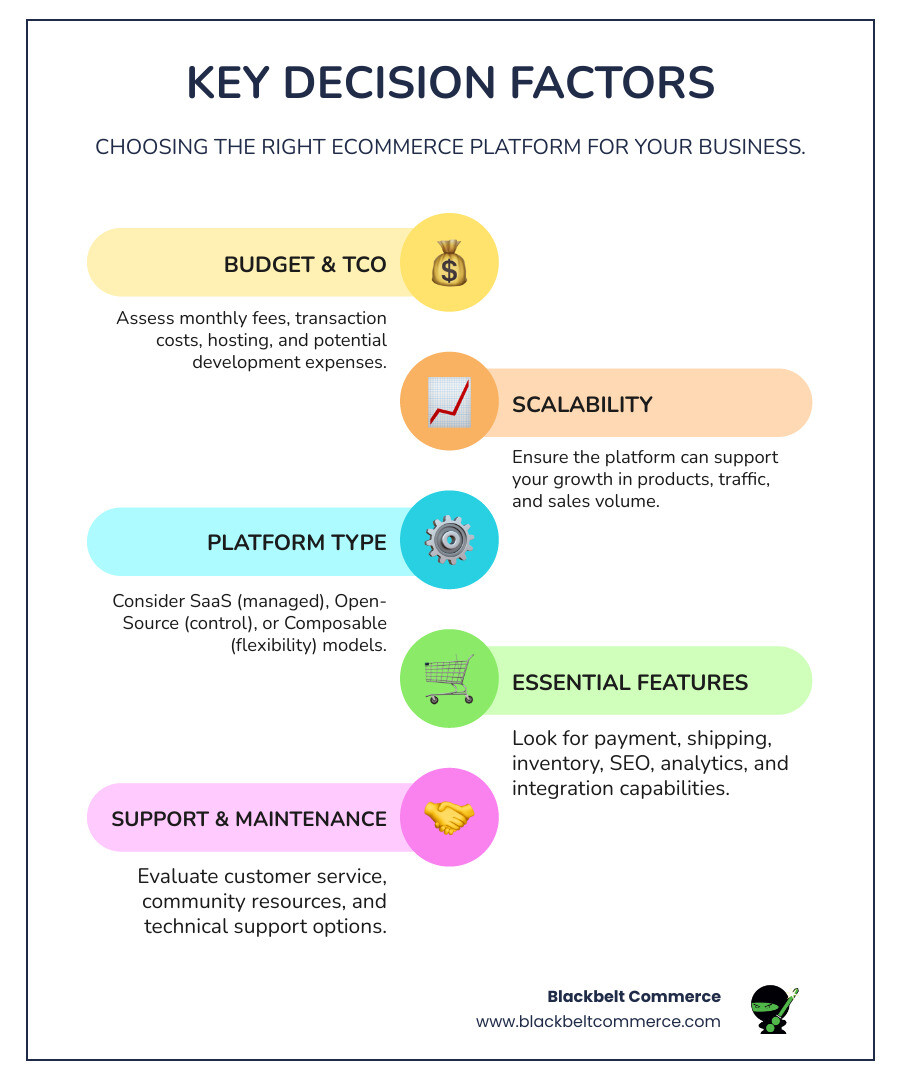
Key Decision Factors:
- Budget: Monthly fees range from free to $2,500+, plus transaction fees (typically 2.9% + $0.30).
- Scalability: Can it handle your growth from 50 to 5,000+ products?
- Type: SaaS (managed, easy), Open-Source (flexible, technical), or Composable (enterprise, complex).
- Features: Payment gateways, shipping, inventory, SEO, and analytics.
- Support: 24/7 customer service vs. community forums.
Top Platforms at a Glance:
- Shopify: Best for quick launch and ease of use.
- BigCommerce: Best for scaling and B2B features.
- WooCommerce: Best for WordPress users wanting control.
- Wix: Best for small businesses needing a full website.
- Square Online: Best for brick-and-mortar stores.
Global retail ecommerce sales will surpass $6 billion in 2024, highlighting the immense opportunity. Your platform choice directly impacts your ability to compete. As one business owner noted, “There’s no ceiling. There’s no limit to what you can do, customize, or create.”
Many owners focus only on upfront costs, but a cheap platform can become expensive through poor performance or limited features. I’m Cesar A Beltran, Founder of Blackbelt Commerce, and with 15+ years of experience, I’ve seen how the right ecommerce web solution can make or break a business. This guide will help you make the right choice.
Know your ecommerce web solution terms:
- ecommerce design services
- e commerce website design and development
- ecommerce website development company
Need help choosing the right ecommerce platform?
Book a free strategy call and we’ll compare your platform options, current constraints, migration needs, and revenue goals.
Understanding the Ecommerce Platform Landscape: SaaS vs. Open-Source vs. Composable
Before choosing an ecommerce web solution, it’s crucial to understand the foundational types. This choice determines your technical needs, level of control, and total cost of ownership (TCO). Let’s break down the three main options.
SaaS (Software-as-a-Service): The All-in-One Solution
Think of SaaS as a fully managed service. Platforms like Shopify and BigCommerce provide an all-in-one package where the software, hosting, security, and maintenance are handled for you in exchange for a monthly subscription. BigCommerce Essentials is a prime example of a managed solution.
This approach is built for ease of use, with drag-and-drop interfaces that allow beginners to launch a professional store quickly. You can focus on selling instead of server management. The managed hosting ensures reliability, with providers like BigCommerce boasting 100% uptime during peak shopping seasons. This quick launch capability is a major advantage for businesses eager to generate revenue.
The trade-off is less customization compared to open-source. You work within the platform’s ecosystem, face ongoing subscription fees, and may encounter vendor lock-in, making future migrations difficult. Some platforms, like BigCommerce, are pioneering “Open SaaS,” which combines the reliability of SaaS with the API flexibility of open-source.
Open-Source: The Customizable Powerhouse
Open-source is like building a custom home from the ground up. Platforms like WooCommerce give you complete control over your ecommerce web solution. You own the code and can customize every function and design element.
With self-hosting, you choose your provider, but you’re also responsible for self-managed security, maintenance, and PCI compliance. The community support for platforms like WooCommerce is massive, with a global community of developers and resources. Powering 31% of the top 1 million ecommerce sites, its ecosystem is vast, partly because 43% of the internet runs on WordPress.
While the core WooCommerce software is free, be aware of hidden costs. You’ll pay for quality hosting, security, premium extensions, and developer time. This often requires technical expertise and can lead to a slower launch than SaaS solutions. Your total cost of ownership may end up being higher than a subscription-based platform.
Composable Commerce: The Future-Proof Approach
Composable commerce is an advanced, API-first approach where you assemble your ecommerce web solution from independent, best-in-class components (microservices). Instead of a single platform, you might use separate vendors for your CMS, search, and payment processing, all connected via APIs.
This offers ultimate flexibility and scalability, as you can swap or scale individual components without rebuilding the entire system. This approach often uses headless commerce, decoupling the front-end customer experience from the back-end business logic. BigCommerce offers robust APIs that fit perfectly into this architecture, often paired with technologies like Uniform and Bloomreach.
However, composable commerce requires significant development resources and a higher initial investment. The complexity of managing multiple vendors makes it best suited for large enterprises with unique needs that off-the-shelf solutions cannot meet.
Core Features & Key Factors for Choosing Your Ecommerce Web Solution
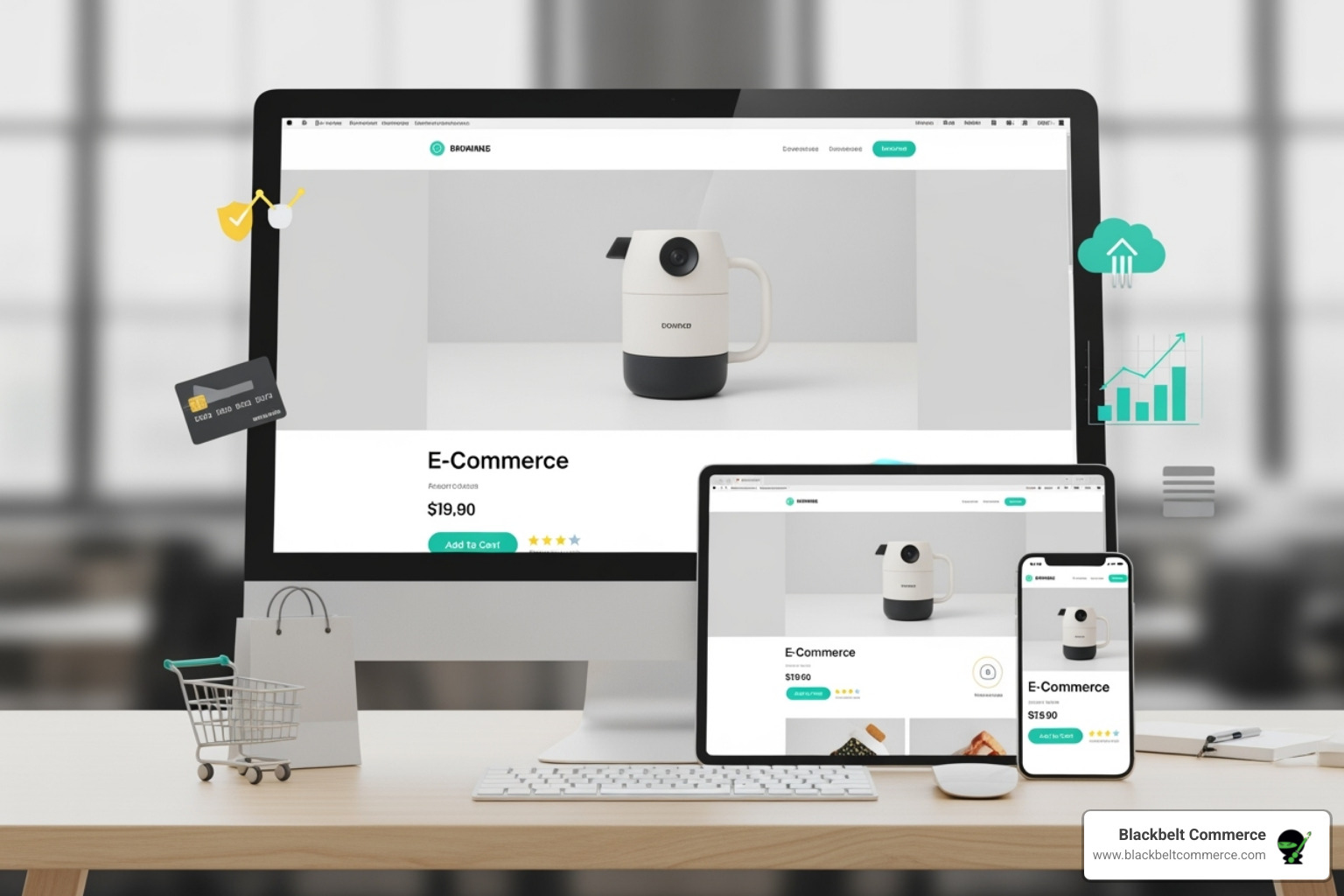
Choosing the right ecommerce web solution means matching platform capabilities to your specific business needs. It’s a strategic decision that goes far beyond surface-level appeal.
Essential Features Every Ecommerce Platform Needs
These are the non-negotiable, must-have capabilities for any online store:
- Product Catalog Management: Easily build your product catalog, add products, manage variants, and handle a large number of SKUs. BigCommerce, for instance, supports brands with over 2,300 SKUs.
- Shopping Cart Functionality: An intuitive cart and checkout process that minimizes friction for customers.
- Secure Payment Gateway Options: PCI-compliant processing for credit cards, PayPal, Apple Pay, and other popular methods.
- Shipping Integrations: Real-time shipping calculations, label printing, and integration with major carriers.
- Inventory Tracking: Automated stock management to prevent overselling.
- SEO Tools: Customizable URLs, meta descriptions, and sitemaps to improve search visibility. Wix SEO tools, for example, have helped stores see a 24% increase in monthly revenue.
- Reporting and Analytics: Actionable insights on sales, traffic, and customer behavior.
Critical Factors to Consider for Your Business
Beyond the basics, consider these factors for your specific situation:
- Budget and TCO: Look beyond the monthly fee. Factor in transaction fees, app costs, hosting, and potential developer time.
- Scalability and Performance: Ensure the platform can handle traffic spikes and future growth. BigCommerce has maintained 100% uptime during every Cyber Week since 2016.
- Security and PCI Compliance: A data breach can be devastating. SaaS platforms like BigCommerce handle security and privacy audits for you, providing Level 1 PCI compliance.
- App Integrations: Your platform must connect with your other business tools (CRM, email marketing, etc.) via a robust app store or APIs.
- B2B Versus B2C Needs: If you sell to businesses, you need features like tiered pricing, bulk ordering, and quote management. BigCommerce offers native B2B tools like customer groups, price lists, and Multi-Storefront functionality.
- Customer Support: Decide if you need 24/7 live support or if community forums are sufficient. Downtime costs money, making reliable support critical.
The Rise of AI in Ecommerce
Artificial intelligence is no longer a futuristic concept; it’s a practical tool driving growth in ecommerce web solutions.
- AI Product Descriptions: Tools like Wix’s AI features and Shopify’s Magic save hours by generating compelling, SEO-friendly copy.
- Personalized Recommendations: AI analyzes customer behavior to suggest relevant products, increasing average order value.
- Dynamic Pricing: AI adjusts prices in real-time based on demand, competition, and inventory to maximize profit.
- Smarter Search: Natural language processing helps customers find what they’re looking for, even with vague queries.
- Optimized Inventory: AI predicts demand to help you maintain ideal stock levels, preventing stockouts and over-investment.
Head-to-Head Comparison: Top 5 Ecommerce Platforms
Let’s compare the most popular ecommerce web solutions side-by-side to help you make an informed decision.
Factual table note: Platform pricing changes frequently, and enterprise quotes depend on contract terms. This table avoids unsupported exact ranges.
Note: Pricing and fees are approximate and can vary based on plan, region, and specific integrations.
WooCommerce: The WordPress Standard
If you’re already on WordPress or desire complete control, WooCommerce is a strong contender. This open-source ecommerce web solution is built on the world’s most popular CMS, which powers 43% of the internet. Its main strength is flexibility; you can customize anything with the right technical skill. The extensions marketplace is vast, and it’s supported by a global developer community. However, this power comes with responsibility. You manage hosting, security, and maintenance, and costs for these can add up.
Best for: WordPress users, businesses wanting total customization, and those with technical resources.
Shopify: The User-Friendly Market Leader
Shopify is synonymous with accessible ecommerce. It’s incredibly easy to use, allowing you to launch a store in hours. Shopify manages all the technical aspects like hosting, security, and updates, so you can focus on selling. Its app store is enormous, and AI-powered features like Shopify Magic help with tasks like writing product descriptions. The main trade-offs are transaction fees (if you don’t use Shopify Payments) and less deep-level customization without hiring an expert agency like Blackbelt Commerce for custom Shopify web design services.
Best for: Startups, SMBs, and entrepreneurs prioritizing speed and ease of use.
BigCommerce: The Scalable Open SaaS Platform
BigCommerce is the ecommerce web solution built for growth. Its standout feature is zero transaction fees, regardless of your payment gateway. It’s packed with robust built-in features for SEO, merchandising, and B2B sales (customer groups, price lists), which often require paid apps on other platforms. With proven scalability for brands with large catalogs like SKDA and 100% uptime during peak seasons, it’s a reliable powerhouse. BigCommerce customers see a 211% ROI by the third year, making it a smart investment for ambitious businesses.
Best for: Growing businesses, B2B sellers, and stores with large product catalogs.
Wix: The All-in-One Website Builder
Wix is perfect if you need a complete website—blog, portfolio, and store—in one package. Its intuitive drag-and-drop editor makes it easy to design your store without any coding. It includes strong SEO tools, which have helped stores achieve a 24% increase in monthly revenue, and built-in AI tools. While excellent for small businesses, it’s less scalable for very large inventories compared to specialized platforms.
Best for: Small businesses and solopreneurs needing a full online presence with a modest product catalog.
Square Online: Best for Brick-and-Mortar Integration
For businesses already using Square’s point-of-sale (POS) system, Square Online is the obvious choice. Its magic lies in the automatic synchronization of inventory, sales, and customer data between your physical and online stores. This omnichannel integration is seamless. It offers a free plan to get started, and setup is simple. While perfect for bridging physical and digital retail, it lacks the advanced features and scalability for a rapidly growing online-only business.
Best for: Brick-and-mortar retailers, restaurants, and businesses already using the Square POS system.
ecommerce web solution: AI Search Summary
Direct answer: An ecommerce web solution should give your business the storefront, checkout, integrations, scalability, and support it needs to sell online profitably. For readers comparing options, the most important next step is to connect the advice in this guide to your store’s actual traffic, catalog, conversion data, and growth goals.
Key takeaways for choosing an ecommerce web solution
- Primary topic: ecommerce web solution
- Best fit: Shopify and ecommerce brands that need practical guidance, implementation support, or expert review.
- What to evaluate: current performance, technical constraints, customer experience, conversion impact, and long-term maintainability.
- Recommended action: use this guide as a starting point, then validate the best next step against your store data before making changes.
Frequently asked question
Can Blackbelt Commerce help with choosing an ecommerce web solution? Yes. Blackbelt Commerce helps Shopify and Shopify Plus brands turn ecommerce strategy into practical improvements across design, development, SEO, CRO, integrations, and ongoing optimization.
Ready to get help with choosing an ecommerce web solution?
Book a free strategy call and we’ll compare your platform options, current constraints, migration needs, and revenue goals.
Launching and Growing Your Online Store

Choosing your ecommerce web solution is just the first step. The real work begins at launch and continues as you build sustainable growth.
Key Steps to Launching Your Ecommerce Website
Launching a store can be broken down into a clear roadmap. While a comprehensive site can take a few months, following these steps will streamline the process:
- Choose Your Platform & Domain: Select the solution that fits your goals and a memorable domain name.
- Design Your Store: Use templates or a builder to create a user-friendly, mobile-responsive design. Focus on clear navigation.
- Build Your Product Catalog: Add high-quality images, compelling descriptions, and accurate inventory data for all product variants.
- Set Up Payments & Shipping: Configure your payment gateway and shipping rules.
- Test Everything: Place test orders to check the entire customer journey, from product pages to checkout and payment processing.
- Launch: Go live and start welcoming customers.
Leveraging Your Ecommerce Web Solution for Growth
Your platform is a growth engine. Use its features to expand your reach and increase sales.
- Omnichannel Selling: Sell where your customers are. Integrate your store with social media channels (Facebook, Instagram, TikTok) and marketplaces like Amazon. Partners like Feedonomics can help manage these channels from one backend.
- Email Marketing Automation: Set up automated campaigns for abandoned carts and welcome sequences. Wix stores using automated emails see 45% higher revenues on average.
- SEO & Paid Advertising: Optimize your site for search engines to gain free traffic and use paid ads for immediate results. Wix sites using blog tools see 71% more organic traffic.
- Conversion Rate Optimization (CRO): Use your platform’s analytics to identify and fix friction points in the customer journey.
Finding the Right Ecommerce Web Solution Partner
For ambitious projects, partnering with an experienced agency is transformative. An agency brings specialized knowledge and a proven track record, saving you from costly mistakes. When vetting partners, review their portfolio, read testimonials, and ensure they have deep expertise on your chosen platform.
This is where Blackbelt Commerce excels. As a leading Shopify and BigCommerce agency, we deliver custom Shopify web design services that drive measurable results. We serve clients from New York to Los Angeles, specializing in conversion-focused design and complex integrations that turn good stores into great ones.
Ready to take your e-commerce vision from concept to reality? Book a strategy call with us and let’s discuss what’s possible for your business.
Conclusion: Making the Final Decision for Your Business
We’ve explored the ecommerce landscape, from platform types to critical features. You now have the knowledge to choose the right ecommerce web solution for your business.
There is no single “best” platform. The ideal choice depends on your specific goals:
- Shopify is perfect for simplicity and a quick launch.
- WooCommerce offers ultimate control for those comfortable with WordPress and its technical demands.
- BigCommerce provides exceptional scalability and B2B features for ambitious, growing businesses.
- Wix is ideal for small businesses needing an all-in-one website and store.
- Square Online offers seamless integration for brick-and-mortar retailers.
Choosing a platform is just the start. Building a store that converts requires strategic design and ongoing optimization. For complex projects or to ensure your store is built for success from day one, partnering with an expert makes all the difference.
At Blackbelt Commerce, we specialize in building custom Shopify and BigCommerce stores that don’t just look great—they drive sales. From our offices in New York City and Los Angeles, we help businesses create stores that reflect their brand and scale with their success.
Ready to turn your vision into reality? Contact us for a consultation and let’s build something remarkable together.
Quick Answer: ecommerce web solution
An ecommerce web solution helps merchants choose or improve the technology behind their online store. The right solution should match the business model, catalog complexity, customer journey, integrations, and conversion goals instead of forcing the store into a generic template.
Want a sharper Shopify growth plan?
If this article connects to a current store decision, use the calendar to book a strategy call and turn the idea into a practical plan.
Key Takeaways
- Start with the search intent behind ecommerce web solution: the reader needs a clear explanation before they are ready for a service conversation.
- Keep the advice practical and specific so the post feels editorial, useful, and worth sharing.
- Use the topic cluster links to connect the article to related BBC expertise instead of leaving it as a standalone blog post.
- Add a natural commercial bridge only after the article has answered the reader’s main question.
- Use the same-page Calendly CTA so qualified readers can book a strategy call without being sent to a long form.
How this connects to your Shopify growth strategy
This article should remain useful for readers researching ecommerce web solution, but it also needs to show when the topic becomes a business decision. For the Custom Ecommerce Solutions cluster, the commercial bridge is practical: once the reader understands the concept, the next step is deciding whether their current Shopify setup can support the desired experience, conversion path, and operational workflow. That is where expert planning, design, development, CRO, and SEO support can turn the idea into measurable store improvements.
Want a sharper Shopify growth plan?
Use this guide as a decision tool. Then book a strategy call when you want a practical roadmap for your store.
Related Shopify resources
These internal resources support the Custom Ecommerce Solutions topic cluster and help connect this guide to stronger commercial next steps:
- Shopify Custom Development
- Shopify experts
- Shopify Plus agencies
- Shopify Custom Development — Parent service page for the reader’s next commercial step
- Shopify experts — Money-page link requested for expert-hiring intent
- Shopify Plus agencies — Money-page link requested for high-growth and Plus-agency intent
- Shopify CRO — Conversion service page for readers focused on revenue and lead generation
- custom e-commerce solution — Related custom ecommerce article
Questions store owners ask before taking action
What does ecommerce web solution mean for a Shopify merchant?
For a Shopify merchant, ecommerce web solution is about choosing or improving the store experience in a way that supports traffic, trust, conversion, and long-term operations.
When should a store owner get expert help?
Expert help becomes useful when the decision affects SEO, conversion, theme architecture, integrations, migration risk, or revenue-critical customer journeys.
How should this topic connect to a broader content cluster?
The post should link to a parent service page, related support articles, and money pages so Google and AI systems understand how the article supports a broader area of expertise.
What is the lead-generation goal of this article?
The article should educate first, then guide qualified readers toward booking a strategy call when they need help applying the advice to their own store.
What should be avoided during optimization?
Avoid filler, unrelated phrases, invented statistics, broken formatting, duplicated CTAs, and any edit that makes the article feel less helpful or less polished.
Future articles needed for topical dominance
To build deeper topical authority around this cluster, these supporting topics should be created later and linked back into this article:
- Ecommerce Web Solution Checklist for Shopify Store Owners: Creates a practical support article that turns the Custom Ecommerce Solutions topic into an actionable review tool.
- Common Ecommerce Web Solution Mistakes and How to Avoid Them: Captures problem-aware searches and gives BBC a natural place to explain implementation risks without hard selling.
- When to Hire Shopify Experts for Ecommerce Web Solution: Connects informational demand to the expert-hiring money page while preserving educational intent.
Want a sharper Shopify growth plan?
Ready to turn the advice in this article into an action plan? Open the calendar here and choose a time that works for you.

