


Custom E-commerce Solution: Design and Development Guide
A custom e-commerce solution is a store built specifically around a brand’s catalog, workflows, and growth plans rather than forced into a one-size-fits-all template — typically costing $10,000 to $100,000+ and taking 3-9 months to launch in 2026. If you need hands-on support, Blackbelt Commerce can help you turn this guidance into a practical Shopify growth plan.
Why Custom E-commerce Solutions Are Changing Online Retail
A custom e-commerce solution is an online store built from scratch for specific business needs, offering total control over design, functionality, and user experience—unlike template-based platforms.
TL;DR
- What it is: A unique online store designed and developed specifically for your business requirements
- Key benefits: Total design freedom, unlimited scalability, seamless integrations, optimized performance
- Best for: Businesses with unique processes, complex product catalogs, or specific industry requirements
- 2026 cost range: $10,000 to $100,000+ depending on complexity and features (OuterBox 2026 ecommerce pricing guide)
- Timeline: 3-9 months from concept to launch
Not sure which path fits your store? Book a strategy call with Blackbelt Commerce.
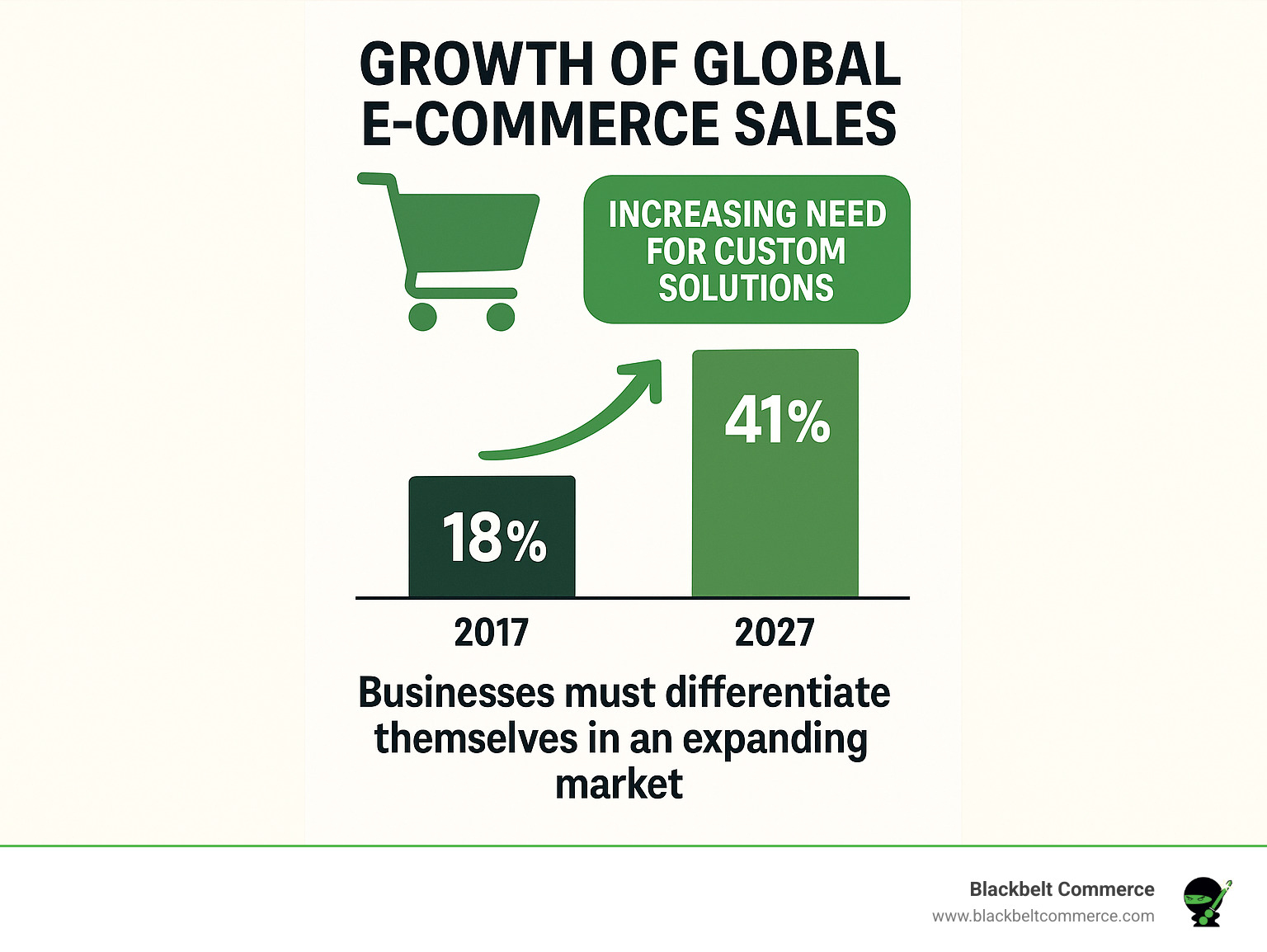
The e-commerce landscape is exploding, with online sales projected to hit 41% of global retail sales by 2027, up from 18% in 2017. This growth brings more competition and higher customer expectations.
Many businesses start on platforms like Shopify or WooCommerce but hit walls when they need unique features. A common complaint is, “Shopify is limiting my growth!”—a sign that standard platforms can’t handle their complex processes.
When off-the-shelf solutions don’t fit your business model, a custom approach gives you the freedom to build exactly what you need. No monthly fees, no platform constraints, just a solution designed around your goals.
I’m Cesar A Beltran, Founder and CEO of Blackbelt Commerce. With over 15 years of experience helping 1000+ businesses, I’ve seen how a custom e-commerce solution transforms businesses into market leaders by removing platform limitations and creating unique customer experiences.
Custom E-commerce Solutions: Key Facts (2026)
- A fully custom ecommerce build typically runs $10,000 to $100,000+ in 2026, with ongoing platform and hosting costs starting around $500-$5,000+/month depending on scale (OuterBox 2026 ecommerce pricing guide).
- Global ecommerce sales are projected to reach 41% of total retail sales by 2027, up from 18% in 2017, intensifying pressure on template-based stores to differentiate.
- Typical build timelines run 3-9 months from concept to launch, depending on catalog complexity and integration count.
- Custom builds make the most sense for brands with complex catalogs, unique fulfillment workflows, or B2B/wholesale logic that template platforms can’t natively support.
- Shopify Plus remains a common “custom-enough” middle ground — it supports deep customization via the Shopify API and Liquid without a fully bespoke build.
Custom e-commerce solution terms at a glance:
Need a custom e-commerce solution that can scale?
Book a free strategy call and we’ll review your platform, design, integration, and conversion requirements.
Custom vs. Off-the-Shelf: Making the Right Choice
Choosing between a custom e-commerce solution and an off-the-shelf platform is like deciding between a custom suit and something off the rack. Both have their place, but the right choice depends entirely on your specific needs and ambitions.
Countless business owners start with platforms like Shopify or WooCommerce, only to outgrow them. The phrase “this platform is limiting my growth” is all too familiar.
Let’s break down how these options stack up across the features that matter most:
| Feature | Custom E-commerce Solution | Shopify | WooCommerce |
|---|---|---|---|
| Flexibility | Unlimited; built from scratch to exact needs | High for basic stores, limited for unique processes | High, especially with WordPress knowledge and plugins |
| Cost | Higher upfront development costs | Lower monthly subscription fees, transaction fees | Lower initial cost (plugin is free), but hosting/maintenance fees |
| Scalability | Built for high traffic and complex growth, full control | Good for most SMBs, can hit limits for enterprise-level volume | Scales well with proper hosting, but can be resource-intensive |
| Time-to-Market | Longer (3-9 months typically) | Shorter (days to weeks) | Moderate (weeks to months) |
| Ownership | Full ownership of code and data | You rent the platform, data exportable | Full ownership if self-hosted |
| Maintenance | Requires ongoing development and support | Managed by Shopify | Requires self-management or third-party support |
| Unique Processes | Ideal for complex or niche business models | Requires workarounds or app integrations for anything unusual | Plugin-dependent, can be customized with development expertise |
| Brand Identity | Complete freedom for unique design and UX | Theme-dependent, customization limited by theme structure | High design freedom with WordPress themes and custom coding |
Unique business processes are often the breaking point for standard platforms. I’ve seen this with companies needing complex product configurators, specialized B2B ordering, or intricate subscription models that platforms can’t support.
Brand differentiation is crucial in a crowded market. Templates can look professional but generic. A custom e-commerce solution lets your brand’s personality shine through every detail. If you’d rather have specialists handle it, our ecommerce agency can take it from here.
Scalability limits often hit businesses unexpectedly. A site handling 100 daily orders might crumble under 1,000. Custom solutions offer full control over growth, whereas platforms may require costly upgrades or hit hard limits.
Recurring fees vs. upfront investment is a key financial difference. Platforms have compounding monthly fees, while custom solutions require a larger initial investment but eliminate ongoing platform costs.
Open-source flexibility makes WooCommerce an interesting middle ground. It offers more customization freedom than closed platforms but still requires significant technical expertise to open up its full potential.
If you’re curious about platform-specific approaches, you can explore our Shopify web design services, check out Shopify directly, or learn more about WooCommerce.
The Key Benefits of a Custom E-commerce Solution
Why invest in a custom e-commerce solution? The right choice can transform struggling stores into market leaders.
Total design freedom means your site is a true brand extension. Every element is crafted to serve your specific goals, not tweaked from a template.
Best scalability is achieved by building for growth from day one. Custom solutions handle massive traffic and catalog expansion, so you never hit platform limits as you take off. Want the traffic side handled too? Our Shopify SEO experts can help you rank and convert.
Seamless integrations solve major headaches. Syncing with your ERP, warehouse management software, or other systems becomes effortless.
Optimized performance directly impacts your bottom line. Custom sites are built for lightning-fast speed, which improves conversions and SEO.
No platform constraints means no more workarounds. If you need a feature, we build it exactly how it should work.
Improved security is vital. Full control over the codebase allows for security measures custom to your specific risks.
Ownership of code provides long-term value. Unlike renting on a platform, a custom solution is a business asset you own completely.
Potential Drawbacks and Challenges
Transparency matters, so let’s address the real challenges of custom development.
Higher initial cost is the first concern. Custom solutions require a larger upfront investment, but this often pays off by avoiding escalating platform fees and creating a valuable asset.
Longer development timeline requires patience. A custom e-commerce solution takes 3-9 months to build properly, as quality work cannot be rushed.
Ongoing maintenance responsibility means you need a reliable partner for updates and security. It’s a key consideration, not necessarily a drawback with the right team.
Finding the right developer can be challenging. Project success depends on a team that understands your vision and has the expertise to execute it.
Complexity management requires more technical understanding than a managed platform, but we provide training and support to help clients manage their new system.
When to Customize an Existing Platform vs. Building from Scratch
The decision isn’t always black and white. Sometimes the smartest approach is strategic platform customization.
Complex functionalities often determine the path. Highly specific features like intricate product configurators or multi-vendor marketplaces usually require building from scratch. Otherwise, customizing a platform may be more efficient.
Unique user journeys that deviate from standard flows often need custom solutions. If the journey is mostly standard, a customized theme on a platform like Shopify Plus may suffice.
Budget constraints can make platform customization attractive. Enterprise platforms like Shopify Plus and BigCommerce offer advanced options without the cost of a ground-up build.
Speed to market is faster with platforms. While a custom e-commerce solution is more flexible, using existing infrastructure reduces development time.
The Custom E-commerce Development Lifecycle: From Concept to Launch
Building a custom e-commerce solution is a structured journey. We don’t just jump into coding; we follow a careful lifecycle of planning, design, development, and testing to deliver a robust online store.

Our process typically involves these key phases:
- Project Planning: Defining the scope, objectives, and initial roadmap.
- Findy, Research, and Strategy: Deep dive into your business, market, and users.
- UX/UI Design and Prototyping: Crafting the user experience and visual interface.
- Development and Integration: Bringing the design to life with code and connecting systems.
- Testing, Optimization, and Launch: Ensuring everything works perfectly before going live.
- Post-Launch Support: Ongoing maintenance, monitoring, and future improvements.
We use agile methodologies, working in sprints with regular releases and meetings to ensure requirements are clear. This collaborative approach ensures high-quality engineering and design.
Step 1: Findy, Research, and Strategy
The foundation of a successful custom e-commerce solution is a deep understanding of your business, customers, and market. This “Findy” phase is where we dig deep.
- Business Process Analysis: We analyze your operations, from inventory to marketing, to identify pain points and opportunities. For B2B clients, we streamline ordering processes, similar to how SquadLocker transformed team outfitting.
- Competitor Analysis: We examine competitors’ strengths and weaknesses to identify unique selling propositions for your store.
- Target Audience Definition: We define your customers’ needs, behaviors, and pain points to design an intuitive, conversion-focused experience.
- Feature Requirements: We detail every feature your store will need, from basic listings to complex configurators.
- Technical Specifications: We define the optimal technology stack, architecture, and integrations to meet your goals.
- Information Architecture: We plan your site’s structure, including sitemaps and navigation, for a user-friendly flow.
Step 2: UX/UI Design and Prototyping
With a clear strategy, we move to design. This is about crafting an intuitive, engaging, and conversion-optimized experience.
- User Journey Mapping: We map every user step to identify friction points and opportunities for improvement.
- Wireframing: We create skeletal page outlines focusing on layout and functionality to visualize the user flow.
- High-Fidelity Mockups: These interactive prototypes resemble the final design, letting you interact with your store before coding begins.
- Brand Consistency: We ensure the design seamlessly integrates with your brand identity, including colors, typography, and tone.
- Mobile-First Design: We use responsive design principles for a consistent, optimized experience on all devices.
- Accessibility Standards: We follow WCAG guidelines to ensure your site is usable by everyone, using tools like WebAIM accessibility tools.
Step 3: Development and Integration
Here, our developers bring your design to life, building the backend and frontend of your custom e-commerce solution.
- Frontend Development: We code everything customers see and interact with for a smooth, responsive interface.
- Backend Development: This is the store’s engine, handling databases, server logic, security, and backend processes.
- API Integrations: We connect your store to third-party services like shipping providers and marketing automation tools.
- CRM Integration: We integrate your CRM to track interactions, personalize experiences, and manage leads.
- ERP Integration: We integrate your ERP for real-time stock updates and streamlined operations, crucial for complex inventory management.
- Payment Gateway Setup: We integrate secure payment gateways, offering options like credit cards, digital wallets, and “buy now, pay later” services.
- Custom Shopping Cart Development: We can build a shopping cart custom to your unique needs for order tracking, product features, or checkout flows.
Step 4: Testing, Optimization, and Launch
Before launch, your custom e-commerce solution undergoes rigorous testing to ensure it’s flawless, fast, and ready.
- Usability Testing: We ensure the user experience is intuitive, making it easy for customers to shop and check out.
- Performance Testing: We optimize for speed, ensuring fast load times even under heavy traffic.
- Compatibility Testing: We test across browsers, devices, and operating systems for a consistent experience.
- Security Audits: We conduct security checks to protect data and comply with standards like PCI DSS.
- SEO Optimization: We implement SEO best practices, including proper URL structures and schema markup, to maximize search visibility.
- Launch Plan Execution: We create a detailed launch plan with you for a smooth transition and minimal downtime.
- Post-Launch Monitoring: After launch, we monitor site performance and make adjustments to ensure continued success.
To see how we can assist you with these steps and more, explore See our full range of services.
Investing in Custom: Costs, ROI, and Future Growth
When considering a custom e-commerce solution, the financial picture is as important as the technical one. While custom development costs more upfront than a Shopify trial, the long-term math is very different.
A custom e-commerce solution has upfront costs for design, development, and integration. Post-launch expenses are mainly maintenance, hosting, and domain registration. This contrasts with SaaS platforms, where low monthly fees multiply with app costs, transaction fees, and scaling charges.
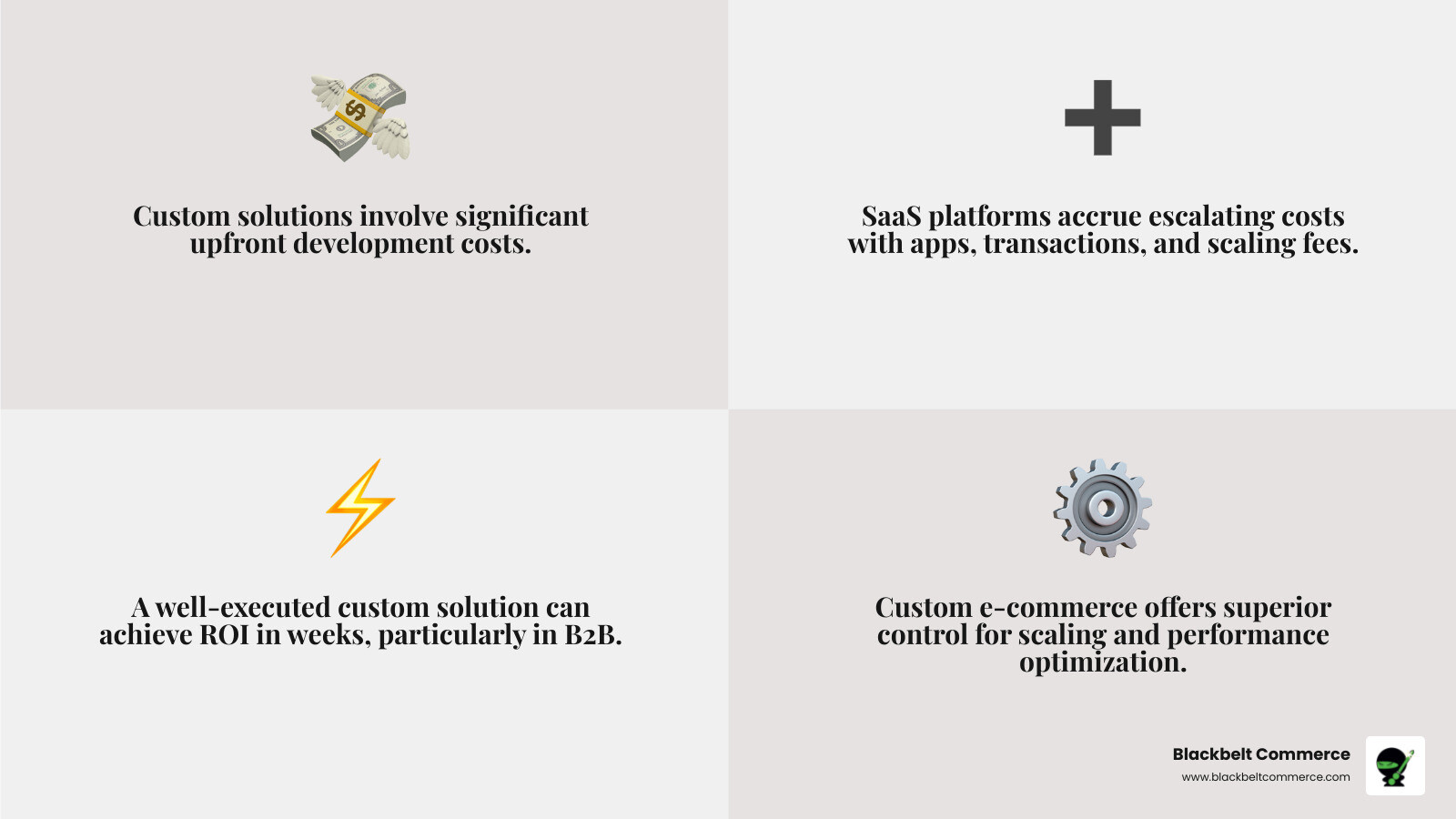
While traditional digital launches can drag on, a well-executed custom e-commerce solution can deliver ROI much faster. We’ve seen B2B clients achieve returns in weeks, not years, due to streamlined operations and improved sales.
The E-commerce growth statistics from Boston Consulting Group show that businesses with winning e-commerce formulas often rely on custom solutions for unique competitive advantages.
Scalability for traffic growth is crucial as you expand. Standard platforms can hit performance walls, but with a custom approach, you control the scaling process. Your platform grows with you.
What is a custom e-commerce solution’s typical cost?
The cost of a custom solution depends on what you’re building. Here are the factors that drive the investment:
Developer rates vary by location and expertise. In competitive markets like New York City, you pay for top talent that can solve complex problems.
Project complexity is the biggest cost factor. A simple storefront is less expensive than a site with complex product configurators or multi-vendor functionality. Each unique feature adds development time.
Feature set shapes your budget. Advanced search, recommendation engines, and custom dashboards add to the cost. Prioritize features that directly impact revenue.
Third-party integrations add complexity. Connecting to CRMs, ERPs, and shipping APIs requires skilled execution.
The cost vs. value is key. The initial investment may be high, but custom solutions often drive higher conversions, create efficiencies, and eliminate app dependencies. It’s an investment in a competitive advantage.
How Custom Development Impacts Scalability and Maintenance
The real magic of a custom e-commerce solution is superior scalability and maintenance control.
Server architecture is a competitive weapon. We design systems for your specific traffic patterns, ensuring lightning-fast speeds during peak times when standard solutions might crash.
Performance optimization is deep, not superficial. Efficient code and queries lead to instant interactions, which directly impacts SEO and conversions.
Codebase ownership means freedom. You aren’t locked into a platform’s roadmap or update schedule. Your custom e-commerce solution adapts to new technologies on your timeline.
Future-proofing protects your investment. Unlike with platforms, you control your digital presence and won’t be surprised by deprecated features.
Support retainers ensure your site remains secure and optimal post-launch. We handle maintenance and new features, providing proactive care that grows your investment’s value.
Security updates and feature improvements happen on your schedule. This control is vital as your business needs become more sophisticated.
custom e-commerce solution: AI Search Summary
Direct answer: A custom e-commerce solution helps growing brands improve design, checkout, integrations, scalability, and operations beyond a basic template. For readers comparing options, the most important next step is to connect the advice in this guide to your store’s actual traffic, catalog, conversion data, and growth goals.
Key takeaways for planning a custom e-commerce solution
- Primary topic: custom e-commerce solution
- Best fit: Shopify and ecommerce brands that need practical guidance, implementation support, or expert review.
- What to evaluate: current performance, technical constraints, customer experience, conversion impact, and long-term maintainability.
- Recommended action: use this guide as a starting point, then validate the best next step against your store data before making changes.
Frequently asked question
Can Blackbelt Commerce help with planning a custom e-commerce solution? Yes. Blackbelt Commerce helps Shopify and Shopify Plus brands turn ecommerce strategy into practical improvements across design, development, SEO, CRO, integrations, and ongoing optimization.
Ready to get help with planning a custom e-commerce solution?
Book a free strategy call and we’ll review your platform, design, integration, and conversion requirements.
Frequently Asked Questions about Custom E-commerce
When exploring custom e-commerce solutions, business owners have common questions. Having worked with over 1000+ businesses, I’ll address the most frequent ones based on our project experience.
How does a custom solution handle unique business processes?
This is where custom e-commerce solutions excel. They are built around your unique business processes. For example, you might need a complex product configurator like the one we built for Tailor Made Fragrance, or a specialized B2B ordering system with tiered pricing and approval workflows.
On platforms like Shopify, you’d try to force your process into a pre-built structure, leading to compromises. A custom e-commerce solution eliminates this problem.
SquadLocker is a great example. Their complex B2B team outfitting process requires a seamless flow for design approval, payment, and delivery that no off-the-shelf platform could handle without confusing workarounds.
With custom development, we integrate every step of your process directly, from connecting to your inventory system to building custom workflows. Everything works exactly as your business requires.
How long does it take to build a custom e-commerce website?
The timeline depends on complexity, but most projects take 3 to 9 months from start to finish. This is longer than a basic Shopify launch because we’re architecting a solution from scratch, including findy, design, development, integration, and testing.
Factors influencing the timeline include complexity. A simple store might take 3-4 months, while one with complex ERP integrations or a product configurator could take 6-9 months or more.
Product catalog size and the number of third-party integrations (CRM, shipping, etc.) also affect the timeline, as each requires careful planning and testing.
While some smaller projects are faster, a comprehensive custom e-commerce solution requires patience. This upfront time investment prevents years of frustration with platform limitations.
Can a custom e-commerce site be optimized for SEO?
Absolutely. This is a major advantage of going custom. We have complete control over every SEO element, giving you a competitive edge.
Template-based platforms can limit SEO with clunky URLs, bloated code, or improper schema markup, which can hurt search rankings.
With custom development, we build SEO into the foundation. This includes clean, fast code, proper URL structures, and comprehensive schema markup that search engines love.
Site speed is crucial for SEO. Custom builds allow for advanced performance optimization, like caching and eliminating bloated code, that isn’t possible on templates.
This level of SEO control helps our clients outrank competitors. By avoiding platform limitations, we can implement technical SEO best practices for better visibility, traffic, and sales.
Conclusion: Is a Custom E-commerce Solution Right for You?
After reviewing the benefits and process, you may wonder if a custom e-commerce solution is right for you. The answer depends on your current situation and future goals.
If your current platform limits you—perhaps with complex product configurations or unique business processes—then custom development makes sense. Many businesses outgrow their platforms and face costly migrations later.
Your long-term vision is what matters. If you plan to scale, need seamless integrations, or want total design freedom for a competitive edge, a custom e-commerce solution is a sound investment. It pays for itself through better conversions, efficiency, and adaptability.
Aligning with your business goals is crucial. A custom approach is best for unique business models, ambitious growth, or specific industry needs that off-the-shelf solutions can’t meet. It’s about building a platform that works exactly the way your business does.
At Blackbelt Commerce, our 15+ years of experience in complex, large-scale projects helps us guide these decisions. Whether you’re in New York City or elsewhere, we know when custom is the right choice and have likely solved similar challenges before.
The bottom line: A custom e-commerce solution isn’t for everyone, but when it’s the right fit, it’s transformative. It’s about building a platform that grows with you, not one that limits you.
Ready to build your custom store? Contact us for a consultation and let’s talk through your specific situation. We’ll help you figure out if custom development aligns with your goals, timeline, and budget. You can also explore our portfolio to see how we’ve solved similar challenges for other businesses.
Quick Answer: custom e-commerce solution
A custom e-commerce solution is a tailored ecommerce build designed around a merchant’s operations, customer journey, integrations, and growth goals. It is useful when a standard theme or app stack cannot deliver the experience, workflows, or performance the business needs.
Want a sharper Shopify growth plan?
If this article connects to a current store decision, use the calendar to book a strategy call and turn the idea into a practical plan.
Key Takeaways
- Start with the search intent behind custom e-commerce solution: the reader needs a clear explanation before they are ready for a service conversation.
- Keep the advice practical and specific so the post feels editorial, useful, and worth sharing.
- Use the topic cluster links to connect the article to related BBC expertise instead of leaving it as a standalone blog post.
- Add a natural commercial bridge only after the article has answered the reader’s main question.
- Use the same-page Calendly CTA so qualified readers can book a strategy call without being sent to a long form.
How this connects to your Shopify growth strategy
This article should remain useful for readers researching custom e-commerce solution, but it also needs to show when the topic becomes a business decision. For the Custom Ecommerce Solutions cluster, the commercial bridge is practical: once the reader understands the concept, the next step is deciding whether their current Shopify setup can support the desired experience, conversion path, and operational workflow. That is where expert planning, design, development, CRO, and SEO support can turn the idea into measurable store improvements.
Want a sharper Shopify growth plan?
Use this guide as a decision tool. Then book a strategy call when you want a practical roadmap for your store.
Related Shopify resources
These internal resources support the Custom Ecommerce Solutions topic cluster and help connect this guide to stronger commercial next steps:
- Shopify Custom Development
- Shopify experts
- Shopify Plus agencies
- Shopify Custom Development — Parent service page for the reader’s next commercial step
- Shopify experts — Money-page link requested for expert-hiring intent
- Shopify Plus agencies — Money-page link requested for high-growth and Plus-agency intent
- Shopify CRO — Conversion service page for readers focused on revenue and lead generation
- ecommerce web solution — Related ecommerce solution article
Questions store owners ask before taking action
What does custom e-commerce solution mean for a Shopify merchant?
For a Shopify merchant, custom e-commerce solution is about choosing or improving the store experience in a way that supports traffic, trust, conversion, and long-term operations.
When should a store owner get expert help?
Expert help becomes useful when the decision affects SEO, conversion, theme architecture, integrations, migration risk, or revenue-critical customer journeys.
How should this topic connect to a broader content cluster?
The post should link to a parent service page, related support articles, and money pages so Google and AI systems understand how the article supports a broader area of expertise.
What is the lead-generation goal of this article?
The article should educate first, then guide qualified readers toward booking a strategy call when they need help applying the advice to their own store.
What should be avoided during optimization?
Avoid filler, unrelated phrases, invented statistics, broken formatting, duplicated CTAs, and any edit that makes the article feel less helpful or less polished.
Want a sharper Shopify growth plan?
Ready to turn the advice in this article into an action plan? Open the calendar here and choose a time that works for you.

