


American Shopify merchants face a unique challenge: more than 97% of online visitors leave without making a purchase. Understanding what truly drives ecommerce conversion rates matters for every store owner striving to transform site traffic into actual revenue. This article dives into the data behind conversion rates, breaks down common myths, and reveals actionable strategies designed for high-growth American businesses eager to maximize every customer interaction.
Table of Contents
- Ecommerce Conversion Rate Defined and Debunked
- Types of Ecommerce Conversions Explained
- How Conversion Rate Works on Shopify
- Key Benchmarks and Performance Metrics
- Common Mistakes Hurting Conversion Rate
- Proven Strategies to Optimize Conversions
Key Takeaways
| Point | Details |
|---|---|
| Understanding Conversion Rates | Ecommerce conversion rates measure the percentage of visitors who complete a purchase, highlighting the relationship between user experience and sales effectiveness. |
| Types of Conversions | Different types of ecommerce conversions, including transactional, lead generation, and informational, provide valuable insights into customer engagement and sales potential. |
| Conversion Rate Optimization | Successful conversion optimization requires a multifaceted approach, focusing on personalization, technical performance, and seamless user experience to enhance sales outcomes. |
| Common Mistakes | Many store owners make critical errors related to user experience and trust, which can undermine conversion rates; identifying and addressing these pitfalls is essential for improvement. |
Ecommerce Conversion Rate Defined and Debunked
Ecommerce conversion rate represents the percentage of website visitors who complete a desired action, typically making a purchase. Understanding conversion rates accurately requires moving beyond simplistic metrics to analyze the nuanced interactions between site traffic, user experience, and purchase behavior.
At its core, conversion rate measures the effectiveness of an online store in transforming casual browsers into paying customers. For Shopify store owners, this metric goes far beyond a simple mathematical calculation. It represents a comprehensive assessment of site design, product presentation, user interface, and psychological triggers that motivate purchasing decisions. Successful stores recognize that conversion rates reflect multiple interconnected factors, including site speed, product clarity, checkout process simplicity, and overall user trust.
Contrary to popular misconceptions, high traffic does not automatically guarantee high conversions. Many store owners mistakenly believe that increasing website visitors will proportionally increase sales. However, research demonstrates that conversion quality matters significantly more than raw traffic volume. Sophisticated ecommerce strategies focus on attracting targeted, high-intent visitors who are more likely to complete purchases, rather than pursuing broad, unfocused audience expansion.
Pro tip: Regularly audit your Shopify store’s conversion funnel by tracking user behavior, identifying drop-off points, and implementing incremental improvements to enhance overall purchasing experience.
Types of Ecommerce Conversions Explained
Ecommerce conversions are not a one-size-fits-all metric. Different types of conversions span across multiple interaction categories that go well beyond simple product purchases. These conversions represent critical touchpoints in a customer’s journey, each carrying unique strategic significance for Shopify store owners looking to optimize their online performance.
The primary conversion types include transactional conversions, which represent the most direct measure of success – completed sales where customers exchange money for products or services. However, equally important are lead generation conversions, where potential customers provide contact information, signaling interest in future purchases. Some Shopify stores also track informational conversions, measuring engagement through actions like downloading resources, watching product videos, or signing up for newsletters. These nuanced conversion metrics help businesses understand customer behavior across different interaction channels, providing insights beyond traditional sales tracking.
Understanding the spectrum of conversion types allows store owners to develop more sophisticated marketing strategies. For instance, B2B ecommerce platforms might prioritize lead generation conversions, while direct-to-consumer stores focus more on immediate transactional conversions. Each conversion type carries different value – a newsletter signup might seem less valuable than a sale, but it represents a potential future customer relationship with significant long-term revenue potential.
Here’s a concise comparison of primary ecommerce conversion types and their strategic importance:
| Conversion Type | Main Objective | Business Impact |
|---|---|---|
| Transactional | Drive completed sales | Generates immediate revenue |
| Lead Generation | Collect customer information | Cultivates future sales |
| Informational | Increase engagement | Builds long-term relationships |
Pro tip: Create custom conversion tracking for each interaction type in your Shopify analytics to gain granular insights into how different customer actions contribute to your overall business growth.
How Conversion Rate Works on Shopify
Shopify provides a comprehensive ecosystem designed to track and optimize conversion rates for online merchants. Conversion tracking begins with sophisticated analytics that monitor multiple sales channels, including web, mobile, social media, and in-person transactions. This multi-channel approach allows store owners to understand how different platforms contribute to their overall conversion performance.
The conversion mechanism on Shopify operates through integrated tools that measure key performance indicators. These include critical metrics like visitor-to-customer ratios, checkout completion rates, and average order values. Each interaction is meticulously tracked, from initial website visit to final purchase, providing merchants with granular insights into customer behavior. Detailed performance tracking helps merchants understand the nuanced journey from initial interest to completed transaction, enabling more targeted optimization strategies.
Shopify’s conversion rate infrastructure goes beyond simple transaction tracking. The platform offers advanced features like abandoned cart recovery, personalized marketing tools, and integrated payment processing that streamline the customer purchase journey. These tools work synergistically to reduce friction in the buying process, ultimately improving conversion rates by making it easier for customers to complete their purchases. Merchants can leverage these built-in capabilities to create a more seamless shopping experience that naturally encourages higher conversion rates.
Pro tip: Configure your Shopify analytics dashboard to track micro-conversions alongside primary sales metrics, giving you a more comprehensive view of customer engagement and purchase potential.
Key Benchmarks and Performance Metrics
Quarterly ecommerce sales metrics provide critical insights into the performance landscape for online retailers. These benchmarks help Shopify store owners understand how their conversion rates compare to broader industry standards, offering a comprehensive view of their business performance within the national retail ecosystem. Understanding these metrics goes beyond simple number-tracking, providing strategic context for growth and optimization.
The key performance indicators for ecommerce conversion rates typically include several critical measurements. These encompass visitor-to-customer conversion rates, average order value, cart abandonment rates, and revenue per visitor. Economic research from specialized consumer economics departments reveals nuanced insights into purchasing behaviors that can help merchants understand the underlying drivers of conversion performance. Industry benchmarks suggest that top-performing Shopify stores typically achieve conversion rates between 1.5% and 3%, though this can vary significantly across different product categories and market segments.
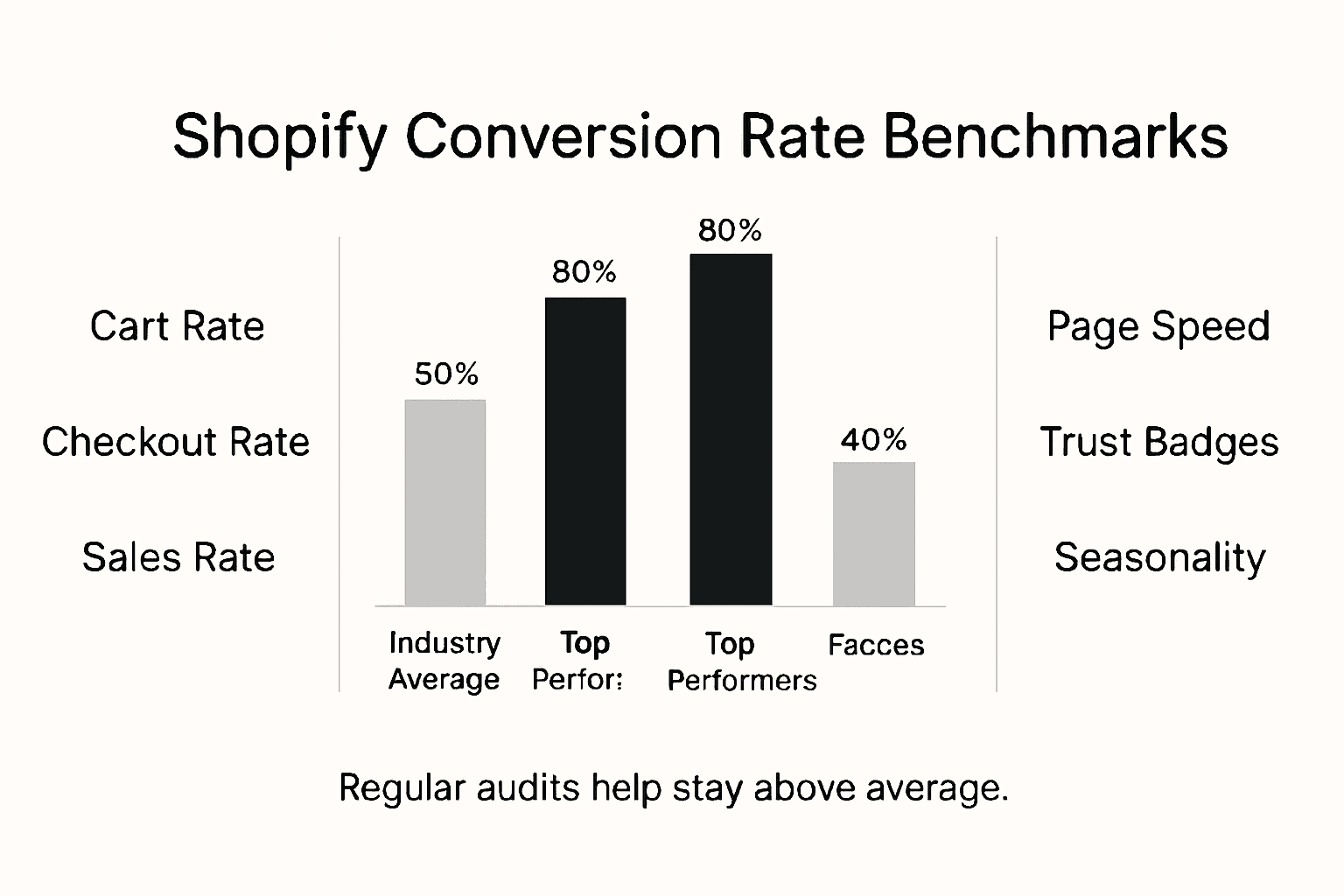
Seasonal variations play a crucial role in conversion rate benchmarking. Retail periods like holiday shopping seasons dramatically impact conversion metrics, with some industries experiencing conversion rate spikes of up to 4-5% during peak shopping times. Sophisticated store owners track these fluctuations meticulously, understanding that conversion rates are not static but dynamic indicators of market demand, consumer confidence, and overall economic conditions. Comparative analysis across different time periods and market segments provides the most meaningful insights for strategic decision-making.
Pro tip: Develop a quarterly benchmarking dashboard that compares your store’s conversion rates against industry standards, tracking both overall performance and seasonal variations to identify improvement opportunities.
Common Mistakes Hurting Conversion Rate
Pandemic-era ecommerce trends revealed significant operational challenges that continue to undermine conversion rates for online retailers. Many Shopify store owners unknowingly sabotage their potential sales by overlooking critical user experience elements that directly impact customer decision-making. Understanding these common pitfalls is the first step toward developing a more effective and conversion-focused online store strategy.
The most prevalent conversion killers typically emerge from technical and user experience shortcomings. Detailed U.S. Census Bureau research highlights operational inefficiencies that dramatically reduce purchase completion rates, including slow checkout processes, inadequate mobile responsiveness, and confusing navigation structures. Many stores suffer from poor inventory management, unclear product descriptions, and complex purchasing workflows that frustrate potential customers and drive them away before completing a transaction. These technical barriers create unnecessary friction in the customer journey, transforming what could be a seamless purchasing experience into a complicated and discouraging process.

Beyond technical issues, marketing and trust-related mistakes significantly impact conversion rates. Common errors include generic product imagery, lack of social proof, insufficient customer reviews, and unclear return policies. Stores that fail to build immediate trust through transparent communication, professional design, and authentic customer testimonials struggle to convert visitors into buyers. The most successful Shopify merchants recognize that conversion optimization is a holistic process involving technical performance, visual design, messaging clarity, and psychological reassurance for potential customers.
Pro tip: Conduct a monthly conversion audit by walking through your entire purchase process as a new customer, identifying and systematically eliminating any points of friction or confusion in your online store.
Proven Strategies to Optimize Conversions
Strategic ecommerce optimization requires a multifaceted approach that goes far beyond simple website tweaks. Successful Shopify stores understand that conversion optimization is a comprehensive process involving technical performance, user experience design, and sophisticated marketing strategies. The most effective tactics target specific customer pain points while creating a seamless, intuitive purchasing journey.
The core conversion optimization strategies encompass several critical dimensions. Personalization stands out as a powerful technique, where stores leverage customer data to create tailored shopping experiences. This includes dynamic product recommendations, customized landing pages, and targeted messaging that speaks directly to individual customer preferences. Advanced multi-channel selling strategies help merchants expand their reach and create multiple touchpoints for potential customers, increasing the likelihood of conversion. Effective stores integrate their online presence across platforms like social media, marketplaces, and their primary Shopify storefront, creating a cohesive and accessible shopping experience.
Technical optimization plays an equally crucial role in conversion enhancement. This involves rigorous performance testing, mobile responsiveness, streamlined checkout processes, and transparent pricing and shipping information. Top-performing stores invest in high-quality product imagery, comprehensive and clear product descriptions, and trust-building elements like customer reviews, security badges, and flexible return policies. The goal is to remove any potential barriers that might prevent a customer from completing their purchase, transforming uncertainty into confidence.
The following summary outlines core Shopify conversion optimization strategies and their effects:
| Strategy | Description | Effect on Conversions |
|---|---|---|
| Personalization | Customized shopping experiences | Higher engagement, sales |
| Multi-channel Selling | Selling on web, social, marketplaces | Expands customer reach |
| Technical Optimization | Fast site, mobile-friendly checkout | Reduces barriers to purchase |
Pro tip: Implement A/B testing on key conversion elements like product descriptions, call-to-action buttons, and checkout flows, systematically measuring and iterating to incrementally improve your store’s performance.
Unlock Higher Shopify Conversion Rates with Expert Support
Many Shopify store owners face the challenge of turning visitors into paying customers despite strong traffic numbers. The article highlights key pain points such as slow checkout processes, poor mobile responsiveness, and lack of personalized experiences that can kill your conversion rate. If you want to move beyond surface-level fixes and embrace a strategy built on tailored design, advanced optimization, and ongoing support, expert help can make all the difference.
At Blackbelt Commerce, we specialize in custom Shopify solutions that address these exact challenges. Our proven approaches include custom theme development, streamlined checkout flows, and AI-driven personalization to boost engagement and sales. By leveraging our expertise in Shopify Plus and multi-channel integration, you get a seamless store that reduces friction and inspires customer trust.
Take control of your ecommerce growth today and start transforming casual browsers into loyal buyers.

Ready to elevate your Shopify store’s conversion performance now Explore our portfolio and discover how Blackbelt Commerce can create a high-performance storefront built to grow revenue. Don’t wait to unlock the full potential of your Shopify store Visit Blackbelt Commerce and let’s build your success together.
Learn more about our custom Shopify development and optimization services tailored for ambitious Shopify merchants.
Frequently Asked Questions
What is the ecommerce conversion rate?
Ecommerce conversion rate is the percentage of website visitors who complete a desired action, usually by making a purchase. It reflects the effectiveness of an online store in turning casual browsers into paying customers.
How can I improve the conversion rate of my Shopify store?
To improve your Shopify store’s conversion rate, focus on optimizing user experience, ensuring quick site speed, simplifying the checkout process, and creating clear product presentations. Regular audits of the conversion funnel can also help identify drop-off points for improvements.
What types of ecommerce conversions should I track?
You should track various types of conversions, including transactional conversions (completed sales), lead generation conversions (contact information submissions), and informational conversions (engagement through actions like video views or newsletter sign-ups). Each type reveals valuable insights into customer behavior.
Why does high traffic not guarantee high conversions?
High traffic does not guarantee high conversions because the quality of traffic matters more than the quantity. It’s important to attract targeted, high-intent visitors who are more likely to make a purchase, rather than simply increasing traffic through unfocused marketing efforts.
Recommended
- Maximize Conversions: E-Commerce Optimization Tips
- Shopify Conversion Rate Explained: Complete Guide
- Shopify CRO services: 3 Proven Steps to Boost Sales
- Why Optimize Ecommerce Stores: Complete Guide – Shopify Experts: Grow Your eCommerce Revenue
Quick Answer: What is ecommerce conversion rate
What is ecommerce conversion rate should improve how a Shopify store converts traffic into trust, customers, and revenue. The article should connect UX, store features, merchandising, analytics, performance, and conversion paths so readers understand what to fix and when expert help can accelerate results.
Want a sharper Shopify growth plan?
Want to turn What is ecommerce conversion rate into a practical Shopify growth plan? Book a strategy call and we will help you clarify the next move.
Key Takeaways
- Use What is ecommerce conversion rate to clarify the business problem and the highest-impact next step for a Shopify store.
- Connect recommendations to customer trust, UX, conversion, SEO, analytics, operations, and revenue.
- Link naturally to Blackbelt Commerce money pages and the home page without weakening editorial trust.
- Avoid generic ecommerce advice; make the guidance specific to Shopify constraints and opportunities.
- Use the same-page Calendly CTA only after the post has delivered useful guidance.
How this connects to your Shopify growth strategy
For the Shopify Growth, CRO, and Store Optimization cluster, this article should make What is ecommerce conversion rate practical, specific, and commercially useful while protecting editorial trust. The bridge to Blackbelt Commerce should show when expert planning, implementation, SEO/CRO discipline, or Shopify Plus support can reduce risk and turn the reader’s next decision into measurable progress.
Want a sharper Shopify growth plan?
Use this guide as a decision tool. Then book a strategy call when you want a practical roadmap for your store.
Related Shopify resources
These internal resources support the Shopify Growth, CRO, and Store Optimization topic cluster and help connect this guide to stronger commercial next steps:
- Shopify CRO services
- Shopify experts
- Shopify Plus agencies
- Shopify CRO services — Primary money/service page for this search intent
- Blackbelt Commerce — Home-page authority link for brand and core Shopify expertise
- Shopify experts — Money-page link requested for expert-hiring intent
- Shopify custom development — Development service page for implementation and technical help
- Shopify checkout optimization — Related conversion article
- Shopify conversion optimization — Related CRO article
Questions store owners ask before taking action
Why does What is ecommerce conversion rate matter for Shopify merchants?
It matters when the topic affects customer trust, conversion, operations, SEO, analytics, or the team’s ability to scale the store cleanly.
How should the article guide the reader?
It should answer the search intent first, then connect the topic to practical next steps, related resources, and expert support when that next step is useful.
What is the lead-generation goal?
The goal is a qualified strategy-call booking after the article has delivered enough value for the reader to trust Blackbelt Commerce with the next decision.
Future articles needed for topical dominance
To build deeper topical authority around this cluster, these supporting topics should be created later and linked back into this article:
- What is ecommerce conversion rate Checklist for Shopify Stores: Creates an actionable support article that can earn long-tail searches and link back to relevant money pages.
- Common What is ecommerce conversion rate Mistakes That Hurt Shopify Revenue: Targets problem-aware readers and explains UX, SEO, conversion, and implementation risk.
- How Shopify Experts Prioritize What is ecommerce conversion rate: Links informational intent to expert support without turning the main article into a sales pitch.
Want a sharper Shopify growth plan?
Ready to turn the advice in this article into an action plan? Open the calendar here and choose a time that works for you.

