


Most American ecommerce businesses face a pivotal challenge where raw numbers alone are no longer enough to compete. With over 80 percent of digital leaders crediting data-driven strategies for outperforming their peers, the ability to translate analytics into real results is reshaping the online retail landscape. Understanding how to turn complex data into smarter decisions can be the key difference between rapid growth and getting left behind in an increasingly crowded market.
Table of Contents
- Defining Data-Driven Ecommerce Strategy Essentials
- Types of Data in Modern Ecommerce Operations
- Analyzing Customer Behavior With Key Metrics
- Integrating Data Tools Across Shopify Stores
- Common Data Challenges and Mistakes to Avoid
Key Takeaways
| Point | Details |
|---|---|
| Data-Driven Ecommerce Strategy | Effective ecommerce strategies should rely on quantitative data to make informed business decisions, enhancing customer understanding and personalizing experiences. |
| Types of Data Utilization | Utilizing diverse data types such as transactional, behavioral, and social media engagement helps businesses anticipate customer needs and refine marketing strategies. |
| Key Performance Metrics | Monitoring crucial metrics like conversion rate and customer lifetime value is essential for optimizing customer experience and driving growth. |
| Overcoming Data Challenges | Businesses must address challenges like poor data quality and siloed systems to transform data into actionable insights that drive operational improvements. |
Defining Data-Driven Ecommerce Strategy Essentials
Modern ecommerce success hinges on transforming raw data into actionable strategic insights. At its core, a data-driven ecommerce strategy represents a systematic approach where every business decision is powered by quantitative evidence rather than intuition. Advanced customer analytics capabilities enable businesses to understand complex consumer behaviors with unprecedented precision.
The fundamental components of a robust data-driven strategy encompass several critical dimensions. Merchants must collect comprehensive data across multiple touchpoints including website interactions, purchase history, customer demographic information, and engagement metrics. These datapoints become the foundation for understanding customer journeys, predicting purchasing patterns, and personalizing shopping experiences. Marketing practices increasingly rely on digital technologies to expand traditional analysis beyond simple transactional tracking.
Successful implementation requires sophisticated technological infrastructure and analytical capabilities. Key strategy elements include:
- Real-time performance tracking
- Predictive customer behavior modeling
- Segmentation and personalization algorithms
- Comprehensive conversion funnel analysis
- Continuous experimentation and optimization
By embracing a data-driven approach, ecommerce businesses can make informed decisions, reduce operational inefficiencies, and create more targeted, effective marketing strategies that directly respond to customer needs and preferences.
Types of Data in Modern Ecommerce Operations
Modern ecommerce operations rely on a sophisticated ecosystem of data sources that provide critical insights into customer behavior and business performance. Session-level interaction records capture intricate details of customer navigation and purchasing decisions, enabling businesses to develop nuanced understanding of consumer patterns and preferences.
The primary categories of data in ecommerce encompass multiple strategic dimensions:
- Transactional Data: Purchase history, order values, frequency of purchases
- Customer Profile Data: Demographics, location, browsing history, account information
- Behavioral Data: Website interactions, click patterns, time spent on pages
- Social Media Engagement: Likes, shares, comments, brand interactions
- Product Performance Data: Inventory levels, sales volumes, customer reviews
Big data sources in ecommerce provide comprehensive insights into consumer trends and predictive analytics, transforming raw information into actionable strategic intelligence. Advanced machine learning algorithms can process these diverse data streams, generating sophisticated predictive models that help businesses anticipate customer needs, optimize marketing strategies, and enhance overall operational efficiency.

Successful data utilization requires robust technological infrastructure, sophisticated analytical tools, and a strategic approach to collecting, processing, and interpreting complex information. By leveraging these diverse data types, ecommerce businesses can create personalized experiences, improve customer retention, and drive sustainable growth in an increasingly competitive digital marketplace.
Analyzing Customer Behavior With Key Metrics
Customer behavior analysis transforms raw data into strategic insights that power intelligent business decisions. Machine learning frameworks enable sophisticated processing of session-level interaction records, revealing intricate patterns of customer navigation, engagement, and purchasing behavior that traditional analytics cannot capture.
Key performance metrics critical for understanding customer behavior include:
- Conversion Rate: Percentage of visitors completing a purchase
- Average Order Value (AOV): Total revenue divided by number of orders
- Customer Lifetime Value (CLV): Predicted total revenue from a customer relationship
- Cart Abandonment Rate: Percentage of users who add items to cart but do not complete purchase
- Repeat Purchase Rate: Frequency of customers making multiple purchases
- Time on Site: Average duration of user engagement
- Bounce Rate: Percentage of visitors leaving site after viewing single page
Understanding these metrics requires advanced analytical approaches that go beyond surface-level statistics. Sophisticated algorithms can segment customers, predict behavior patterns, and identify potential friction points in the purchasing journey. By interpreting these metrics holistically, businesses can develop targeted strategies that address specific customer needs, optimize user experience, and drive sustainable growth.
Successful customer behavior analysis demands continuous monitoring, iterative testing, and a willingness to adapt strategies based on emerging data insights. The most effective ecommerce operations treat data not as a static resource, but as a dynamic tool for understanding and anticipating customer preferences, ultimately creating more personalized and engaging shopping experiences.
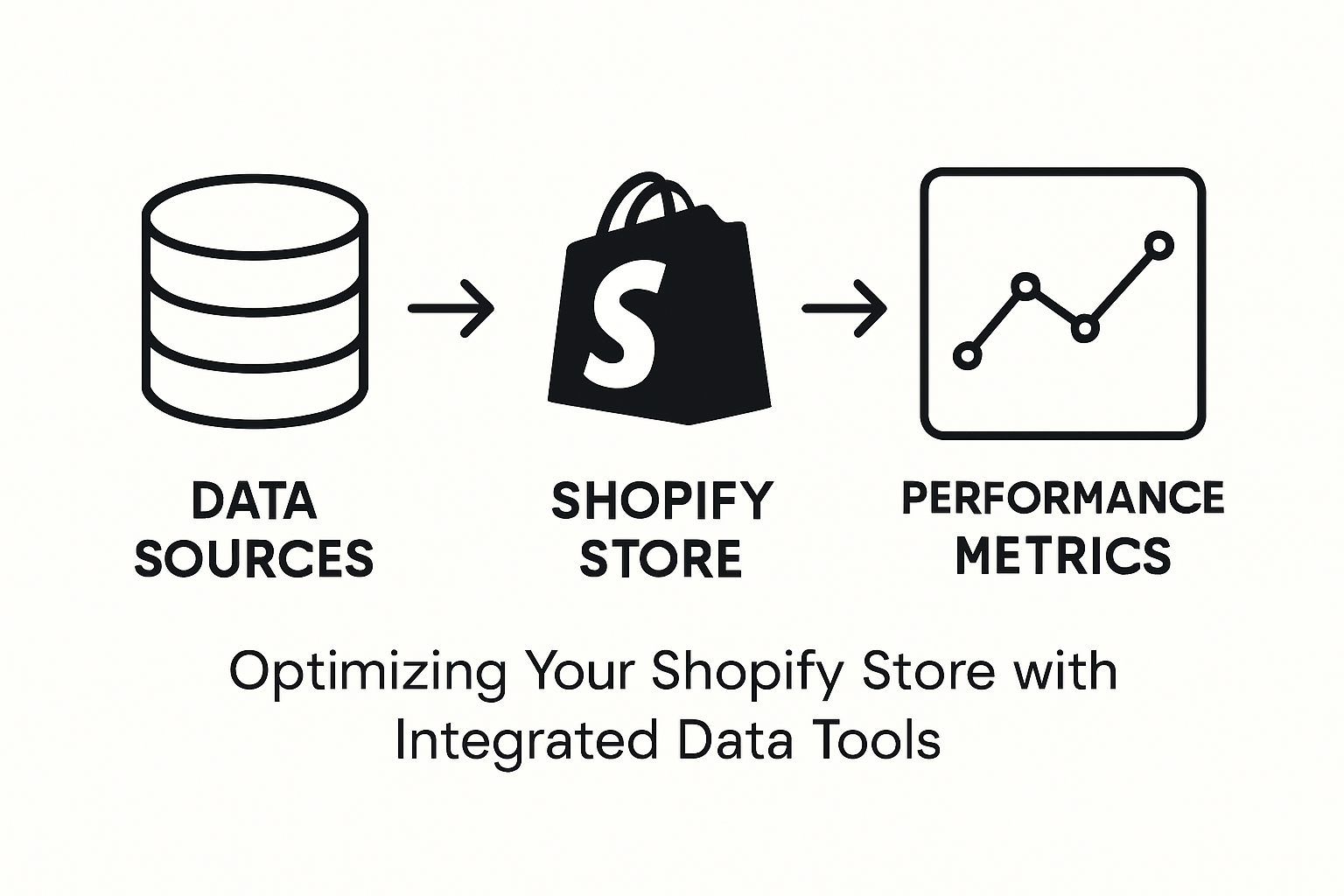
Integrating Data Tools Across Shopify Stores
Data integration represents a critical strategy for transforming raw information into actionable business intelligence. Sophisticated data collection architectures enable comprehensive logging and discovery processes, providing Shopify store owners with unprecedented insights into their operational performance.
Key considerations for effective data tool integration include:
- Compatibility with existing Shopify infrastructure
- Real-time data synchronization capabilities
- Scalability across different store sizes and complexity
- Robust security and privacy protection mechanisms
- Seamless API connections
- Advanced visualization and reporting features
Headless commerce architectures offer innovative approaches to decoupling front-end experiences from back-end functionality, enabling merchants to implement advanced data tools without disrupting core operational systems. This approach allows for more flexible, customizable data integration strategies that can adapt quickly to changing business requirements.
Successful data tool integration demands a strategic approach that balances technological complexity with practical business needs. Store owners must carefully evaluate tools based on their specific requirements, ensuring seamless data flow, comprehensive analytics, and the ability to derive meaningful insights that drive operational improvements and revenue growth. The most effective integrations transform complex data streams into clear, actionable intelligence that empowers merchants to make informed decisions and stay competitive in the rapidly evolving digital marketplace.
Common Data Challenges and Mistakes to Avoid
Data strategy requires careful navigation through complex technological and strategic landscapes. E-commerce businesses frequently encounter significant challenges in understanding and transforming collected data into meaningful business value, creating potential roadblocks to effective decision-making.
Common data challenges that merchants must proactively address include:
- Incomplete Data Collection: Failing to capture comprehensive customer interaction points
- Poor Data Quality: Relying on inconsistent, outdated, or inaccurate information
- Siloed Data Repositories: Maintaining disconnected data systems that prevent holistic analysis
- Overcomplicated Analytics: Creating complex models that obscure actionable insights
- Privacy and Security Vulnerabilities: Inadequate protection of sensitive customer information
- Lack of Contextualization: Analyzing raw numbers without understanding underlying behavioral patterns
Effective data integration requires sophisticated pre-processing techniques that reduce computational complexity and support meaningful analysis, transforming raw information into strategic intelligence. Successful merchants approach data not as a technical challenge, but as a strategic asset that demands continuous refinement, careful interpretation, and a nuanced understanding of underlying business objectives.
Mitigating these challenges demands a comprehensive approach that balances technological capability with strategic insight. Store owners must develop robust data governance frameworks, invest in continuous learning and adaptation, and maintain a critical perspective that goes beyond simple numerical reporting. The most successful data strategies treat information as a dynamic, evolving resource that requires ongoing cultivation, rigorous validation, and a commitment to extracting meaningful, actionable intelligence.
Unlock Your Ecommerce Growth With a Data-Driven Shopify Strategy
Navigating challenges like incomplete data collection and siloed data systems can stall your ecommerce growth. This article highlights the importance of real-time performance tracking, predictive customer modeling, and seamless data integration to create personalized shopping experiences that increase conversion rates and customer retention. If you want to transform complex analytics into actionable business intelligence, understanding these data-driven strategy essentials is key.
At Blackbelt Commerce, we specialize in developing custom Shopify solutions that integrate advanced data tools perfectly aligned with your store’s needs. Our expertise in Shopify Plus solutions, headless commerce architectures, and AI-powered personalization helps tackle common pitfalls like poor data quality and overcomplicated analytics. Whether it’s optimizing your store’s conversion funnel or implementing scalable data infrastructures, our proven process—from consultation through ongoing support—is designed to accelerate your business growth.

Ready to unlock your full ecommerce potential using a strategic, data-driven approach? Explore our client success stories and discover how our tailored Shopify services can elevate your online store’s performance today. Visit Blackbelt Commerce now and start building the future of your ecommerce business.
Frequently Asked Questions
What is a data-driven ecommerce strategy?
A data-driven ecommerce strategy is a systematic approach where business decisions are informed by quantitative data rather than intuition, using analytics to understand consumer behavior and enhance operational efficiency.
What types of data are important for ecommerce operations?
Key types of data include transactional data (purchase history), customer profile data (demographics), behavioral data (website interactions), social media engagement, and product performance data, all of which provide insights into customer trends and preferences.
How can I analyze customer behavior in ecommerce?
Customer behavior can be analyzed using key metrics such as conversion rate, average order value, customer lifetime value, cart abandonment rate, repeat purchase rate, time on site, and bounce rate, allowing businesses to optimize the purchasing journey and improve user experience.
What challenges should I avoid in implementing a data-driven strategy?
Common challenges include incomplete data collection, poor data quality, siloed data systems, overly complex analytics, privacy and security vulnerabilities, and a lack of contextual understanding in data interpretation.
Recommended
- E-commerce growth strategy: Top 3 Pillars
- E-commerce content strategy: 15 Winning Strategies
- Leverage Data to Scale Your Shopify Plus Store
- E-commerce strategy consulting: Your 2025 Edge
- Understanding Managing Customer Expectations in Diesel Services – My WordPress
Quick Answer: Data-driven ecommerce strategy
Data-driven ecommerce strategy should improve how a Shopify store converts traffic into trust, customers, and revenue. The article should connect UX, store features, security, automation, performance, analytics, and conversion paths so readers understand what to fix and when expert help can accelerate results.
Want a sharper Shopify growth plan?
Want to turn Data-driven ecommerce strategy into a practical Shopify growth plan? Book a strategy call and we will help you clarify the next move.
Key Takeaways
- Use Data-driven ecommerce strategy to clarify the business problem and the highest-impact next step for a Shopify store.
- Connect recommendations to customer trust, UX, conversion, SEO, analytics, operations, and revenue.
- Link naturally to Blackbelt Commerce money pages and the home page without weakening editorial trust.
- Avoid generic ecommerce advice; make the guidance specific to Shopify constraints and opportunities.
- Use the same-page Calendly CTA only after the post has delivered useful guidance.
How this connects to your Shopify growth strategy
For the Shopify Growth, CRO, and Store Optimization cluster, this article should make Data-driven ecommerce strategy practical, specific, and commercially useful while protecting editorial trust. The bridge to Blackbelt Commerce should show when expert planning, implementation, SEO/CRO discipline, or Shopify Plus support can reduce risk and turn the reader’s next decision into measurable progress.
Want a sharper Shopify growth plan?
Use this guide as a decision tool. Then book a strategy call when you want a practical roadmap for your store.
Related Shopify resources
These internal resources support the Shopify Growth, CRO, and Store Optimization topic cluster and help connect this guide to stronger commercial next steps:
- Shopify CRO services
- Shopify experts
- Shopify Plus agencies
- Shopify CRO services — Primary money/service page for this search intent
- Blackbelt Commerce — Home-page authority link for brand and core Shopify expertise
- Shopify experts — Money-page link requested for expert-hiring intent
- Shopify custom development — Development service page for implementation and technical help
- Shopify checkout optimization — Related conversion article
- Shopify conversion optimization — Related CRO article
Questions store owners ask before taking action
Why does Data-driven ecommerce strategy matter for Shopify merchants?
It matters when the topic affects customer trust, conversion, operations, SEO, analytics, or the team’s ability to scale the store cleanly.
How should the article guide the reader?
It should answer the search intent first, then connect the topic to practical next steps, related resources, and expert support when that next step is useful.
What is the lead-generation goal?
The goal is a qualified strategy-call booking after the article has delivered enough value for the reader to trust Blackbelt Commerce with the next decision.
Future articles needed for topical dominance
To build deeper topical authority around this cluster, these supporting topics should be created later and linked back into this article:
- Data-driven ecommerce strategy Checklist for Shopify Stores: Creates an actionable support article that can earn long-tail searches and link back to relevant money pages.
- Common Data-driven ecommerce strategy Mistakes That Hurt Shopify Revenue: Targets problem-aware readers and explains UX, SEO, conversion, and implementation risk.
- How Shopify Experts Prioritize Data-driven ecommerce strategy: Links informational intent to expert support without turning the main article into a sales pitch.
Want a sharper Shopify growth plan?
Ready to turn the advice in this article into an action plan? Open the calendar here and choose a time that works for you.

