

A $3.2M apparel brand we worked with earlier this year was doing everything right by traditional SEO standards. Google Search Console was healthy. Collection pages ranked on page one. Blog content was clean and keyword-aligned. And then their organic traffic started flattening — not dropping, just ceasing to grow — while their paid CAC crept up 22% in six months. When we pulled AI referral data, the picture was immediate: their store generated almost zero traffic from ChatGPT, Perplexity, or Google AI Overviews. Not because they had a penalty. Because AI search engines had never learned to recommend them.
We’ve watched this happen across enough Plus stores now that it’s no longer a surprise. What surprises founders is usually the same thing: they assumed being good at SEO meant being visible in AI search. It doesn’t. The two systems have different requirements, and most Shopify stores — even well-optimized ones — are failing the new test in the same five ways.
TL;DR: AI-referred shoppers convert nearly 50% higher and spend 14% more per order than organic search visitors, according to Shopify’s Q1 2026 commerce data. Most Shopify Plus stores are invisible to AI search not because of a technical failure, but because of a data quality gap — thin product descriptions, incomplete structured markup, and no off-site brand signal. The fix isn’t a new app. It’s treating your product data and brand presence with the same seriousness you gave keyword rankings in 2022.
Why AI Search Changes the Stakes for $1M–$10M Brands
This isn’t a developer story. It’s a revenue story, and the numbers are worth sitting with before we get into the mechanics.
According to Shopify’s Q1 2026 commerce data, AI-referred sessions convert at nearly 50% higher rates than organic search on product detail pages. Average order values from AI-referred sessions run 14% higher than organic search. More than half of AI-referred sessions start directly on a product page — compared to about 20% for traditional organic search — because AI platforms don’t send people to your homepage to start their journey. They send people directly to the product the AI already decided was a match for what they asked.
That last point is where the business model shifts. When someone finds you through Google, they land on your site and then decide whether they want to buy. When someone finds you through ChatGPT or Perplexity, the AI has already done the consideration work. By the time they click through, they’ve described their need, seen your product evaluated against alternatives, and narrowed to a choice. They’re arriving ready.
For a $3M brand, even a modest AI referral channel — say, 8% of traffic — converting at those rates represents a material revenue lift. The brands not showing up are leaving that on the table while paying more to acquire customers through paid media.
The Pattern We Keep Seeing: Five Data Gaps
After auditing AI search performance across more than a dozen Plus stores this year, the gaps follow a consistent pattern. They’re not exotic. They’re mundane — which is exactly why they persist.
Gap 1: Product descriptions that describe rather than answer
Most product descriptions on Shopify stores are written for buyers who already know they want the product. They describe attributes. They list specs. They use marketing language. What they don’t do is answer the questions a buyer types into an AI assistant before they’ve decided what to buy.
AI search engines run on query fan-out: they take one user prompt and break it into 5–10 sub-queries across angles like use case, comparison, price tier, compatibility, and reviews. If your product page answers “what is this product” but not “is this the right product for someone who needs X,” it falls out of those sub-queries. The AI simply doesn’t have enough information to recommend it confidently.
The fix isn’t long descriptions. It’s specific ones. A $4M accessories brand we rebuilt descriptions for shifted their copy from feature-first to question-first — every PDP leads with the use case and customer fit before the spec sheet. In the 90 days after, their AI referral sessions nearly doubled. Not because of a tool. Because the AI could now read their product and match it to a real buyer need.
Gap 2: Structured data that’s present but shallow
Shopify’s default themes add basic Product schema automatically. The problem is “basic” no longer clears the bar. Shopify stores often rely on default markup that is too shallow for AI interpretation — and the gap shows up precisely where it hurts most: in the product attributes AI agents use to compare options and make recommendations.
What AI agents actually need to cite your products accurately: Product schema with complete offers (price, availability, currency), aggregateRating, material attributes, use-case context, and BreadcrumbList schema so the AI understands your catalog hierarchy. Organization schema with brand name, logo, and social profiles also matters — it’s the signal AI uses to recognize you as a known, trustworthy entity rather than an anonymous URL.
Most stores we audit have Product schema and nothing else. That’s like sending a sales rep to a meeting with nothing but a price sheet.
Gap 3: No brand signal outside your own domain
AI search engines operate on two inputs: training data (what the model already knows about your brand) and RAG — retrieval-augmented generation (what live search surfaces when a user asks a question). Strong brand recognition in training data means the AI treats you as a known, reputable entity. Strong RAG presence means you surface in the live web pages the AI searches when answering.
Most $1M–$5M Shopify brands have weak training data presence because they’ve never been mentioned in the publications, forums, review sites, and editorial outlets that LLMs were trained on. When an AI assistant gets a query like “what’s a good [category] brand for [use case],” it defaults to brands it knows — typically the ones with editorial coverage, press mentions, and third-party reviews.
This is where the pattern from our Metro School Uniforms work becomes relevant. The 138.7% organic traffic lift we delivered wasn’t built on keyword stuffing — it started with a clear brand positioning decision and then building editorial content that earned citations. You can read the full story in The Design Call Behind Metro School Uniforms’ 138.7% Organic Lift, but the structural lesson transfers directly to AI visibility: brands that have an authoritative editorial presence get cited. Brands that don’t, don’t.
Gap 4: Product data that’s inconsistent across channels
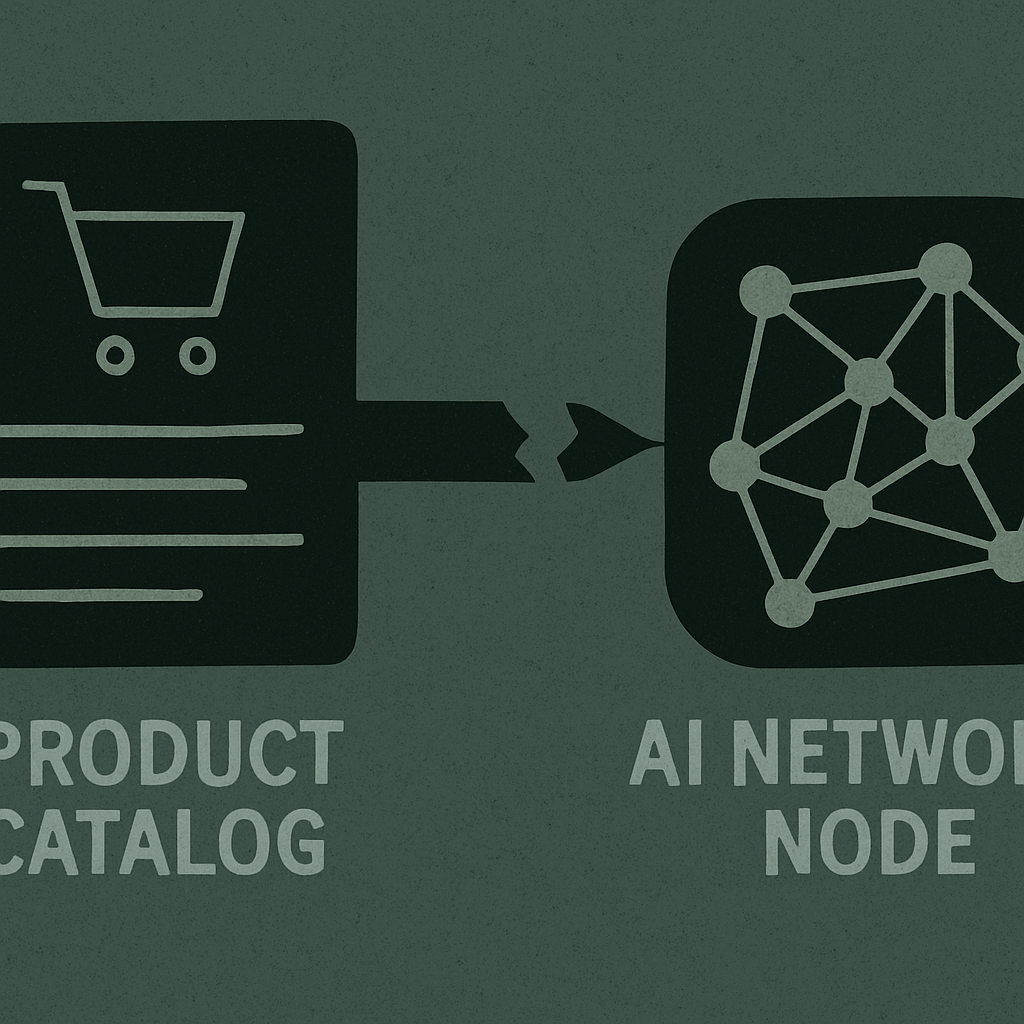
When an AI system cross-references your product and finds a price on your Shopify store that conflicts with a price on Google Shopping, or an availability status that differs from your structured data, trust drops. The AI either omits your product from recommendations or adds a qualifier that deprioritizes it. Inconsistency is a reliability signal — and AI agents are designed to recommend reliable sources.
Shopify Catalog, which is now enabled by default on all Shopify stores following the Spring ’26 Edition, syndicates your product details to ChatGPT, Copilot, the Shop app, and other AI surfaces without extra feeds. But “available” isn’t the same as “optimized.” Shopify notes that AI searches powered by clean, structured Catalog data convert at 2x the rate of those using scraped data. Clean means consistent: prices, availability, descriptions, and attributes that match across every surface.
Gap 5: No mechanism for AI agents to complete a transaction
This one is newer and moves fast. The Universal Commerce Protocol (UCP), co-developed by Shopify and Google, is now the open standard for how AI agents interact with commerce — from product discovery all the way through checkout. Shopify merchants are UCP-enabled by default. But enabled doesn’t mean configured correctly.
AI agents using UCP can read your catalog, build carts, and in some cases complete purchases on a buyer’s behalf. If your checkout has broken discount logic (which was a real issue for stores that didn’t complete their Shopify Scripts migration before the June 30 deadline — we wrote about that in detail in Shopify Scripts Die June 30. Most Plus Stores Aren’t Ready.), agents may encounter errors that flag your store as unreliable. That signal compounds over time.
The Objection: “SEO-First Is Still Enough”
A number of agencies — and a few well-trafficked Shopify blogs — are still telling founders that solid traditional SEO covers AI visibility. The claim is that if you rank on Google, you’ll surface in AI Overviews, and that’s enough. We’ve watched this thinking cost brands real revenue, so let me be direct about where it breaks.
First, the overlap problem. Research indicates that there is only about a 16.7% overlap between the pages AI tools cite and the pages that rank in traditional organic results. Ranking on page one for a keyword does not predict whether an AI assistant will cite you when someone asks a related question. The algorithms optimize for different signals.
Second, the intent gap. AI-referred sessions start on product pages at more than 2.5x the rate of organic search sessions. That means AI is sending buyers who already know what they want. Traditional SEO optimization — which optimizes heavily for category and collection pages — doesn’t capture that buyer at the point of entry the AI is creating.
Third, and most important: the stores leaning on “SEO is enough” are making a decision on 2023 data. AI referral sessions on Shopify storefronts grew more than 8x year-over-year as of Q1 2026. The channel that’s “not big enough to worry about yet” is compounding at a rate that makes the wait expensive.
We’re not suggesting you abandon SEO. We’re saying AI visibility is a distinct discipline with distinct requirements — and conflating the two is a mistake that a growing number of well-ranked stores are paying for.
What to Do About It Monday Morning
These are the five moves worth making first. None of them require a developer.
1. Audit your top-20 product pages for question-answering.** Pull your 20 highest-revenue product pages. For each one, ask: if a buyer types “what’s the best [product type] for [use case]” into ChatGPT, does my description give the AI enough information to recommend this product? If the description is feature-heavy and use-case-light, rewrite the lead paragraph to answer the buyer’s question before describing the product.
2. Run your Product schema through Google’s Rich Results Test. Go to search.google.com/test/rich-results. Paste in your top product page URLs. Look for missing aggregateRating, incomplete offers data, and absent Organization schema. Prioritize fixing these — they’re the signals AI systems use to trust your data. Apps like JSON-LD for SEO can fill schema gaps without requiring custom dev work.
3. Check your Shopify Catalog data for consistency. In your Shopify admin, go to the new “Agentic” section (added in the Summer ’26 Editions). Review how your products surface to AI agents. Cross-reference your prices, availability, and key attributes against what appears on Google Shopping and any third-party listing surfaces. Inconsistencies here suppress AI recommendations even when your schema is clean.
4. Start building off-site brand signal deliberately. This is the longer-horizon move. Identify three to five publications, forums, or review platforms where buyers in your category research purchases. Get mentioned there — through PR, review generation, guest editorial, or product seeding. Every third-party citation your brand earns is a training-data signal that makes AI more likely to recognize you as a trustworthy recommendation. This isn’t a shortcut. It’s what organic brand authority has always required, now with a more direct revenue connection.
5. Establish a baseline for AI referral traffic. Go into Google Analytics and segment sessions by source. Pull referral traffic from chatgpt.com, perplexity.ai, and gemini.google.com. Note the conversion rate and AOV compared to your organic baseline. If you’re at near-zero AI referral traffic today, that’s the benchmark — and you now have a real number to measure improvement against. What gets measured gets managed.
If you want to go deeper on which specific point in the AI decision sequence your store is losing — and how to test it with a replicable protocol — we’ve since formalized this into a full diagnostic framework: The AI Visibility Gap: A Diagnostic Framework and Open Research Protocol →
If you want a structured framework for this kind of SEO and content architecture review, our Metro School Uniforms case study shows exactly how design decisions and brand positioning decisions drive organic and AI visibility simultaneously. It’s also worth understanding how AI visibility connects to your broader retention economics — if you’re not already thinking about this, You Have Klaviyo. You Don’t Have a Retention System. covers the downstream problem that compounds when acquisition gets expensive.
The Close
The founder we started with — the $3.2M apparel brand with the flattening organic traffic — spent six months optimizing the wrong thing. Their Google rankings were fine. Their AI presence was nonexistent. The gap wasn’t a technical failure. It was a failure to recognize that a new discovery layer had appeared and that their store hadn’t been built to be readable by it.
That’s the pattern we keep watching. Smart operators, solid stores, and a blind spot that’s costing them compounding ground every month they don’t address it. If your store is well-ranked and still struggling to grow acquisition efficiently, AI search visibility is almost certainly part of the answer. The brands building for it now are the ones whose organic channels will look inexplicably strong twelve months from now. If you want to talk through where your store sits, we’re easy to reach.
The buyers are already there. The question is whether your store speaks the language they’re searching in.
FAQ
What is AI search visibility for Shopify stores, and why does it matter now?
AI search visibility refers to whether your products get recommended by AI assistants like ChatGPT, Perplexity, and Google AI Overviews when buyers ask shopping questions. It matters now because AI-referred shoppers convert at nearly 50% higher rates than organic search visitors, with 14% higher average order values, according to Shopify’s Q1 2026 commerce data. AI referral sessions on Shopify stores grew more than 8x year-over-year in Q1 2026 — the channel is compounding fast.
Does ranking on Google already cover AI search visibility?
No. Research shows only about a 16.7% overlap between pages AI tools cite and pages that rank in traditional organic search results. AI systems optimize for different signals than Google — specifically data quality, structured markup accuracy, and off-site brand authority. A store can rank on page one for core keywords and still be nearly invisible to AI shopping recommendations.
What’s the single biggest reason Shopify stores don’t appear in AI recommendations?
In our experience across Plus store audits, thin product descriptions are the most common culprit. AI search engines use query fan-out — breaking a user’s question into multiple sub-questions — to find the best match for a buyer’s need. If your product pages describe attributes but don’t answer the use-case questions a buyer would actually ask, the AI can’t match your product to their intent. Rewriting product copy to lead with buyer context rather than feature lists addresses this directly.
Does Shopify Catalog automatically make my products visible to AI agents?
Shopify Catalog and the Universal Commerce Protocol (UCP) are enabled by default on all Shopify stores, which means your products are technically discoverable by AI agents. But availability is not the same as being recommended. Shopify’s own data shows AI searches using clean, structured Catalog data convert at 2x the rate of those using scraped data — meaning data quality is what determines whether AI agents cite you confidently or skip over you for a competitor whose data is cleaner.
Get a free Shopify store audit — delivered as a Loom video
Our team will review your store and record a 12–18 minute Loom walkthrough with specific recommendations. No sales call required.

