

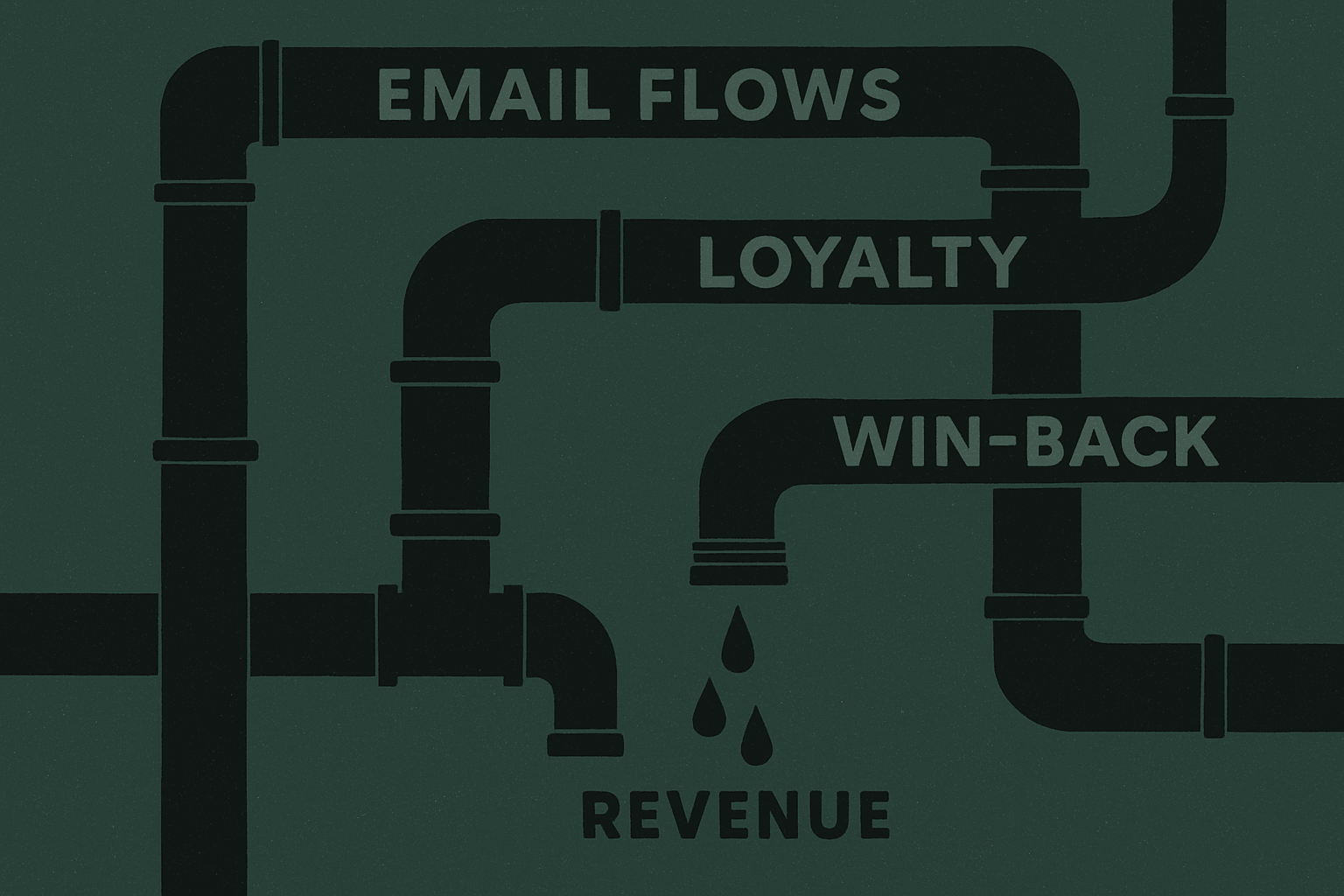
The tool is installed. The welcome flow is live. There’s probably an abandoned cart sequence doing something. The founder checks the Klaviyo dashboard, sees “email attributed revenue,” nods, and moves on to the next problem.
I’ve audited hundreds of Shopify funnels. The pattern repeats so reliably that I can almost call it before I log in: Klaviyo is there, but it’s functioning as a broadcast channel with automations stapled on. It is not a retention system. And the gap between those two things is, conservatively, six figures in annual revenue the brand has already earned the right to collect.
TL;DR: Most Shopify Plus stores treat Klaviyo as a tool they have, not a system they run. The average Shopify store loses 70–75% of its customer base every year — yet repeat buyers drive 44% of total revenue despite being only 21% of customers. The fix isn’t more flows. It’s building the architecture that turns a first purchase into a second, a second into a pattern, and a pattern into a customer who refers others. Here’s what that actually looks like.
The Retention Problem Nobody Wants to Say Out Loud
The average repeat purchase rate across Shopify stores sits at 28.2%, which means roughly 7 out of 10 customers never come back after their first order. That’s the industry average — not the floor. And yet most $3M–$8M Shopify Plus founders I talk to haven’t looked at that number in their own analytics in the past 90 days.
Here’s why this matters more than almost any other metric on your dashboard: a 10-percentage-point improvement in repeat purchase rate — from 25% to 35% — can double your store’s profitability on the same traffic, the same ad spend, the same SKU count. The incremental revenue from those additional repeat buyers drops almost entirely to profit because there’s no acquisition cost attached. The customer is already yours.
Customer acquisition cost in ecommerce is averaging $45–$65 per new customer in 2026. The cost to retain an existing one through email, post-purchase touchpoints, and loyalty programs runs $7–$12 per customer. That gap is widening as paid media costs continue climbing 15–20% annually. The math on retention has never been better. The execution has never been more neglected.
The founders who are beating the market aren’t spending more on Meta. They’re running tighter retention architecture than their competitors. I want to show you what that looks like — and name every structural gap we find in the stores that aren’t there yet.
What “Having Klaviyo” Actually Gets You
Klaviyo is a first-party data engine. It pulls real purchase behavior, browsing history, and lifecycle signals directly from your Shopify store and lets you act on that data in email and SMS. When it’s configured properly, it catches customers at exactly the right moment with exactly the right message — and the revenue attribution is real, not modeled.
But “having Klaviyo” — as in, paying the subscription, connecting the integration, and turning on the three flows that the onboarding wizard prompts — gets you about 20% of what the platform can do. The welcome series runs. The abandoned cart fires. The order confirmation goes out. And then the customer is mostly ignored.
The order confirmation email is opened by more than 70% of recipients — the highest open rate of any email you will ever send — and almost no one uses it to drive a second purchase. That’s the single biggest missed opportunity in Shopify retention, and it’s sitting inside a flow that every store has already built.
The question I ask in every retention audit isn’t “do you have Klaviyo?” It’s “what happens to a customer 30 days after their first order if they haven’t bought again?” Most founders can’t answer that. Some of them have never thought about it. That silence is where the revenue is leaking.
The Four Structural Gaps We Find in Almost Every Store
Gap 1: No post-purchase sequence beyond day one
A real post-purchase sequence is a structured series of touchpoints timed to the natural customer journey — not a single confirmation email with a discount code buried at the bottom. Day one covers order confirmation plus a soft cross-sell. Days three to five follow with educational content about the product they bought — how to use it, how to get the most from it, what works well alongside it. Days ten to fourteen bring a social proof moment: reviews, UGC, community. Days twenty-one to twenty-eight introduce a replenishment or complementary product prompt, timed to when usage patterns suggest the first item is running low or the initial experience has peaked.
Stores with a full post-purchase sequence in place typically see 8–15 percentage point improvements in repeat purchase rate compared to stores that only send the order confirmation. That’s not a marginal gain. That’s the difference between a 25% repeat purchase rate and a 35–40% one — and as I described above, that difference compounds into six figures on a $3M–$5M store.
Gap 2: Segmentation that stopped at “customers” and “non-customers”
One-time buyers, lapsed customers, high-frequency repeat buyers, and category-specific buyers all have different economics and different reasons they haven’t bought again. Running the same campaign to all of them is not email marketing — it’s announcement distribution. And it trains your best customers to tune you out at the exact moment they’re most valuable.
We work with a $5M apparel brand that was treating their one-time buyer segment and their 5-purchase loyalists identically in every campaign. The loyalists were getting 20%-off emails every other week. We stopped discounting to that segment entirely, shifted to early access and product storytelling, and open rates went up because the emails meant something again. Revenue per send on that segment increased in the first 60 days — without eroding margin.
Gap 3: No win-back system with a real trigger
A win-back flow that fires at 90 days of inactivity is table stakes. What most stores are missing is a win-back system that uses actual behavioral signals — not just time elapsed. A customer who browsed three times without buying in the past 30 days is not the same as a customer who went completely dark. The first needs a different message than the second. The first is still in market. The second needs a reintroduction.
Klaviyo’s predictive analytics can tell you which customers are likely to churn before they actually do. Most stores don’t have that signal wired to any flow. They find out a customer has lapsed 90 days after the fact, when win-back rates drop from roughly 25–30% (at 45-day outreach) to under 10%.
Gap 4: Loyalty infrastructure that’s invisible to the customer
Loyalty programs work because they change where a customer defaults when they need to reorder. Once someone has 200 points toward a reward they actually want, a competitor who is slightly cheaper stops being relevant. That “locked-in” effect is one of the most durable forces in retail retention — loyalty program members make purchases roughly 90% more frequently and spend more per transaction than non-members.
But loyalty infrastructure only works if customers know they’re in a program and can see their progress. We regularly audit stores where a loyalty app is installed, accruing points, and never surfaced to the customer anywhere except a single email they received when they signed up fourteen months ago. The points are accumulating. The customer doesn’t know. The retention benefit is zero.
The fix isn’t a better loyalty app. It’s weaving the program status into the post-purchase flow, the order confirmation, the win-back email, and ideally a persistent account page element that makes balance visible at every return visit. The app is the mechanic. The design and the messaging are what make it function.
The Pattern We’ve Watched Cost Founders the Most
Take a $4M skincare brand we worked with last year. Strong product, good traffic, solid paid acquisition operation — and a repeat purchase rate sitting at 22% in a category where consumable beauty brands typically run 38–45%. When we audited the Klaviyo account, the flows were there. Welcome, abandoned cart, post-purchase, win-back. All live. All firing.
The problem wasn’t the flows. It was what was inside them. The post-purchase sequence sent the order confirmation on day one, a review request on day seven, and nothing else. The win-back fired at 120 days — well past the window where most lapsed customers can be recovered. The segmentation was binary: people who’d bought, and people who hadn’t. Every campaign blast went to the full list.
We rebuilt the post-purchase sequence to seven touchpoints over thirty days, each tied to where a customer realistically is in their product experience. We moved the win-back trigger to 45 days and built two versions: one for customers who’d browsed recently, one for those who’d gone fully dark. We created three campaign segments — one-timers, two-plus purchasers, and loyalists — with different creative and offer logic for each.
In the first six months, their repeat purchase rate moved from 22% to 31%. That 9-point improvement on their customer base translated directly to retained revenue they would have otherwise spent paid media budget trying to recapture. The Klaviyo subscription cost hadn’t changed. The team size hadn’t changed. The product hadn’t changed. The system had.
What Most Agencies Get Wrong About Retention
The retention agency playbook in 2026 is: build more flows, add SMS, layer in push notifications, and report attributed revenue that includes anyone who received an email and then bought within a five-day window. The result looks impressive in a monthly report. It often isn’t.
Adding channels before fixing the architecture is how you get a fragmented customer experience where someone receives the same 20%-off offer via email, SMS, and retargeting ad within 48 hours — and learns that your brand’s default mode is desperation discounting. That pattern erodes the margin you needed retention to protect in the first place.
We’re not against SMS. It’s a real channel with real utility — especially for time-sensitive messages like flash sales, back-in-stock alerts, and cart recovery nudges where speed matters. But it should layer on top of a functioning email retention architecture, not substitute for one. Email is where you educate, tell the brand story, and build the relationship. SMS is the nudge. Running SMS without a working email foundation is like installing a sprinkler system in a house that doesn’t have plumbing.
If you’re evaluating your current retention setup — or wondering whether the app stack underneath it is actually earning its cost — our four-question app stack audit framework is a useful place to start before you add anything new.
What to Do About It Monday Morning
These are the five things we’d do in the first week if we were taking over a Shopify Plus retention program from scratch:
1. Pull your repeat purchase rate. Shopify Analytics → Reports → Customer behavior → Returning customer rate. If it’s below 30%, the structural gaps above almost certainly exist. If it’s below 20%, this is your highest-leverage problem in the business right now.
2. Open your Klaviyo post-purchase flow and count the touchpoints. If you have fewer than four emails after the order confirmation, you have a gap. Map out where a customer realistically is in their product experience at days 3, 7, 14, and 21. Build to that calendar, not to what was easy to set up during onboarding.
3. Segment your list into three groups and run separate campaign logic for each. One-time buyers. Two-plus purchasers. Five-plus purchasers (your loyalists). The message, offer, and creative for each group should be meaningfully different. If you’re sending the same email to all three, you’re discounting your best customers and not doing enough for your most recoverable ones.
4. Move your win-back trigger earlier. If it’s set to 90 days or 120 days, pull it back to 45 days. Build two versions — one for recently-browsed customers (still in market), one for fully dark customers (needs reintroduction). The 45-day recovery rate is three times the 120-day rate. The window matters.
5. Audit your loyalty program visibility. If a customer can’t see their balance in the order confirmation email, the post-purchase sequence, and their account page — the program is functionally invisible. Make the balance prominent. Make the next reward concrete. The mechanics don’t work if the customer doesn’t know they’re in the game.
And if you want to see what the full architecture looks like from a design and customer experience angle — not just the flow logic — the design work behind Metro School Uniforms’ 138.7% organic lift is a good case for how decisions about who you’re speaking to, and how the store is built around that answer, shape every channel downstream — including retention.
The Real Cost of Treating This as a Tool Problem
Shopify Plus founders in the $3M–$8M range are often running a sophisticated acquisition engine and a primitive retention operation in the same store. The paid media team is optimizing to the dollar. The Klaviyo account is on autopilot. The gap compounds every month, because every customer who doesn’t come back is a customer the acquisition engine has to replace — at $45–$65 a head.
Biltmore Family Dentistry went from $850K to $3M in two years. That outcome didn’t happen because they found more new patients — it happened because the brand-focused infrastructure we built around existing relationships changed the retention curve. The same principle holds for product ecommerce: growth that compounds is growth where existing customers do more of the heavy lifting. That only happens when someone has built the system that makes it possible.
The tool is not the system. The system is the architecture, the timing, the segmentation, and the design that makes every post-purchase touchpoint feel like it was written for that specific customer at that specific moment. If you’d like to talk through what that looks like for your store, we’re straightforward to reach — and we start every retention conversation with your actual data, not a generic audit template.
Klaviyo is a prerequisite. A retention system is the work that comes after you install it.
FAQ
What’s a good repeat purchase rate for a Shopify Plus store?
The industry average across Shopify stores sits at 28.2%, with top-performing stores reaching 40–60% through structured post-purchase sequences and loyalty programs. For consumable categories like skincare, supplements, and beauty, the benchmark is higher — 38–45% is achievable. If your repeat purchase rate is below 20%, fixing retention is almost certainly the highest-leverage revenue move available to you right now, ahead of any new acquisition spend.
How is a Klaviyo retention system different from just having Klaviyo flows?
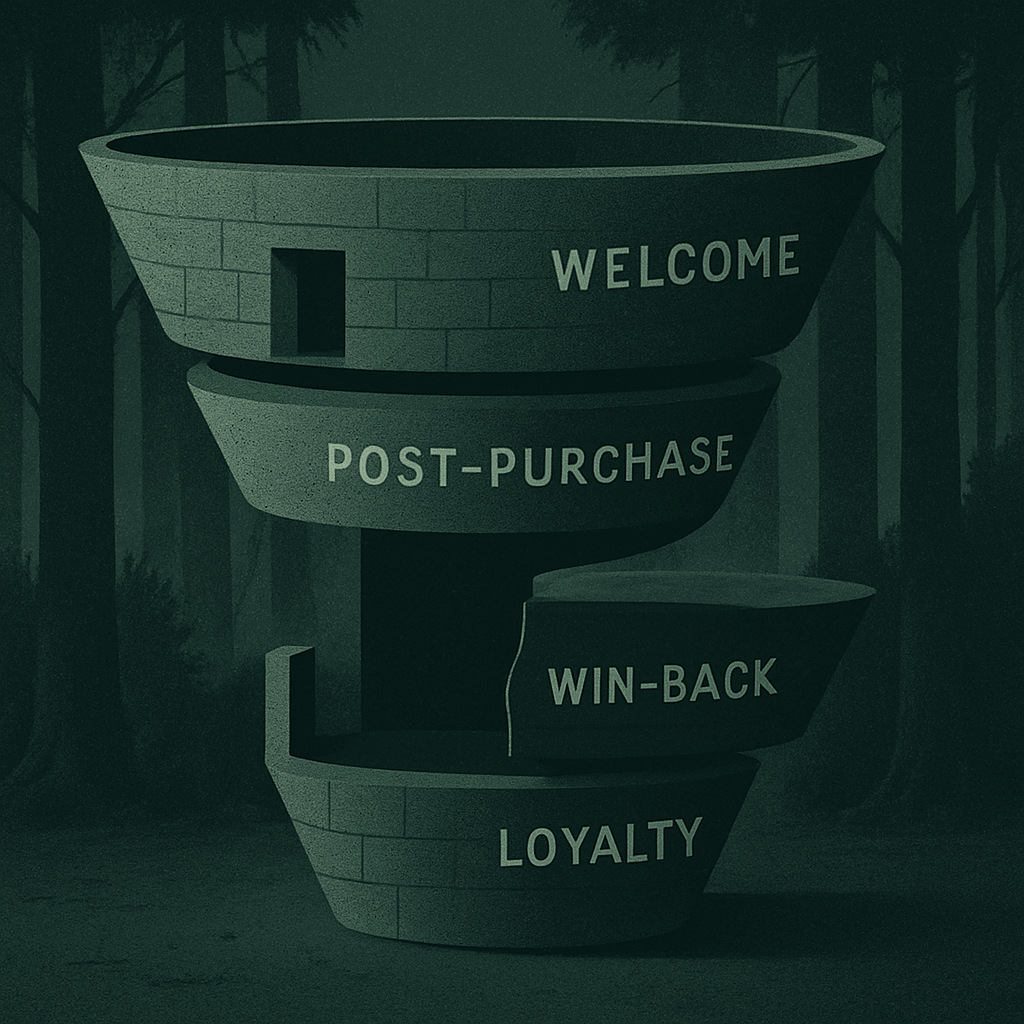
A retention system has four components working together: a post-purchase sequence timed to actual customer behavior (not just calendar days), segmentation that separates one-time buyers, repeat buyers, and loyalists, a win-back architecture with behavioral triggers instead of just elapsed time, and loyalty visibility that surfaces program status at every return touchpoint. Most stores have some flows. A system is when all four components are connected and each one is informed by what the others are doing.
When should I add SMS to my retention stack?
Add SMS after your email retention architecture is functioning — not before. SMS earns its place for time-sensitive moments: cart recovery, back-in-stock alerts, and flash sale windows where speed is the point. Email is where you educate, build the relationship, and tell the product story. If you run SMS without a working email foundation underneath it, you end up with a fragmented experience where the same offer hits a customer on three channels in 48 hours — which trains them to wait for the discount rather than buy on intent.
How long does it take to see results from a rebuilt retention program?
In our experience, the first meaningful signal — post-purchase sequence open rates, click-through on cross-sell recommendations, win-back recovery rates — is visible within 30 days of launch. Repeat purchase rate improvement shows in cohort data at the 60–90 day mark, because you need to observe what percentage of that cohort returns within a natural repurchase window. The 9-point repeat purchase rate improvement we saw with the $4M skincare brand showed clearly in month five of the rebuilt program. This is not a quick fix — it’s a compounding investment.

