


Over 60 percent of american consumers say they are more likely to buy from online stores that feel tailored to their preferences. As e-commerce becomes increasingly competitive, generic one-size-fits-all experiences often leave potential customers feeling disconnected. Businesses looking to expand must understand why authentic localization goes far beyond just translating words. This guide breaks down how true ecommerce localization can set your online store apart in ways that drive trust, engagement, and lasting growth.
Table of Contents
- Defining Ecommerce Localization And Its Purpose
- Core Elements Of Ecommerce Localization
- Types Of Localization Strategies For Ecommerce
- Benefits And Challenges For Online Stores
- Critical Risks, Costs, And Common Pitfalls
Key Takeaways
| Point | Details |
|---|---|
| Importance of Ecommerce Localization | Ecommerce localization transforms online stores by adapting them to meet the cultural expectations of local markets, enhancing customer engagement. |
| Core Elements of Localization | Successful localization involves language translation, currency conversion, payment method integration, and compliance with local regulations. |
| Types of Localization Strategies | Businesses can adopt standardization, adaptation, or hybrid strategies to effectively engage with diverse markets, balancing brand consistency and cultural relevance. |
| Benefits and Challenges | Effective localization can increase market share and customer trust, but it also presents challenges such as financial risks and maintaining brand consistency across markets. |
Defining Ecommerce Localization and Its Purpose
Ecommerce localization is a strategic approach that transforms online stores from generic platforms into culturally attuned digital experiences. At its core, localization goes far beyond simple translation, representing a comprehensive adaptation of an online business to meet the nuanced expectations of specific target markets. Ecommerce localization involves meticulously tailoring every aspect of an online shopping experience to resonate authentically with local customers.
The fundamental purpose of ecommerce localization is to create a seamless, culturally relevant shopping journey that feels native to each specific market. This process encompasses multiple critical dimensions, including language translation, currency conversion, payment method customization, and understanding local design preferences. Adapting content for specific regions allows businesses to communicate more effectively, build trust, and significantly enhance customer engagement.
Research indicates that successful localization directly impacts market penetration and revenue growth. By understanding e-commerce regulations and local consumer behaviors, companies can design experiences that feel intuitive and welcoming. This approach transforms potential friction points into opportunities for connection, making customers feel understood rather than served by a generic, one-size-fits-all platform.
Key elements of effective ecommerce localization include:
- Precise language translation that captures cultural nuances
- Local currency and payment method integration
- Region-specific product descriptions and imagery
- Compliance with local legal and regulatory requirements
- Culturally appropriate design and user experience elements
By investing in comprehensive localization strategies, businesses can expand their global reach, build meaningful connections with diverse customer bases, and unlock significant growth potential in international markets.
Core Elements of Ecommerce Localization
Ecommerce localization represents a comprehensive strategy that transforms digital storefronts into culturally intelligent platforms. At its core, successful localization requires a multifaceted approach that addresses numerous interconnected elements designed to create seamless, authentic customer experiences across different markets. Language adaptation serves as the foundational element, extending far beyond simple word-for-word translation to capture cultural nuances and regional communication styles.

Research reveals critical components that businesses must carefully consider when developing localization strategies. Developing effective e-commerce content involves intricate layers of cultural understanding and strategic adaptation. These components include precise linguistic translation, visual design modifications, payment method customization, and alignment with local consumer expectations. Each element plays a crucial role in creating an experience that feels native and intuitive to local customers.
The most sophisticated localization efforts go beyond surface-level modifications, diving deep into cultural context and user experience design. Businesses must meticulously adapt multiple dimensions of their online presence, ensuring that every interaction feels personalized and relevant. Key elements of comprehensive ecommerce localization include:
- Language Translation: Accurate, culturally sensitive linguistic adaptation
- Currency Conversion: Real-time exchange rates and local monetary representations
- Payment Method Integration: Supporting region-specific payment systems
- Visual Design: Culturally appropriate color schemes, imagery, and layout
- Legal Compliance: Adhering to local regulations and consumer protection standards
- Product Descriptions: Tailored content that resonates with local market preferences
- Customer Support: Localized communication channels and support infrastructure
By embracing these core elements, businesses can create truly global digital experiences that transcend geographical boundaries, build meaningful connections, and drive international growth.
Types of Localization Strategies for Ecommerce
Ecommerce localization strategies are not one-size-fits-all solutions but complex, nuanced approaches tailored to specific market characteristics and business objectives. Comprehensive localization requires businesses to develop sophisticated strategies that go beyond simple translation, creating deeply integrated experiences that resonate with local audiences. These strategies can be categorized into several distinct approaches, each addressing unique aspects of international market engagement.
Developing global e-commerce growth strategies demands a strategic understanding of different localization methodologies. Research reveals multiple strategic frameworks that businesses can employ, ranging from minimal adaptation to full cultural reimagination. The primary localization strategies include:
- Standardization Strategy
- Minimal local modifications
- Consistent global brand experience
- Limited cultural customization
- Lower implementation costs
- Adaptation Strategy
- Significant local market customization
- Tailored product offerings
- Cultural design and content modifications
- Higher engagement potential
- Hybrid Strategy
- Balanced approach between standardization and adaptation
- Core brand elements remain consistent
- Selective localization of critical user touchpoints
- Flexible implementation across markets
Each strategy offers unique advantages and challenges. The standardization approach maintains brand consistency but risks feeling generic, while full adaptation requires substantial investment but potentially yields higher market resonance. Sophisticated businesses often leverage a hybrid approach, creating a balanced framework that preserves brand identity while demonstrating genuine cultural understanding and respect.
Benefits and Challenges for Online Stores
Ecommerce localization presents a complex landscape of transformative opportunities and significant operational challenges for online businesses seeking global expansion. Market penetration represents the most compelling benefit, allowing businesses to connect authentically with diverse customer bases by transcending linguistic and cultural barriers. When executed strategically, localization can dramatically enhance customer engagement and create meaningful connections that drive sustainable international growth.
Exploring multichannel strategies reveals the nuanced advantages and potential pitfalls of international market expansion. Research indicates that businesses implementing comprehensive localization strategies can experience substantial benefits, including:
Key Benefits:
- Increased market share and revenue potential
- Enhanced customer trust and satisfaction
- Improved conversion rates in target markets
- Competitive differentiation in global landscapes
- Deeper cultural understanding and brand resonance
Primary Challenges:
- Complex translation and cultural adaptation processes
- Significant financial and operational investments
- Maintaining brand consistency across diverse markets
- Managing technical complexities of multilingual platforms
- Navigating local regulatory and compliance requirements
Successful localization demands a sophisticated approach that balances strategic investment with nuanced cultural intelligence. Online stores must carefully evaluate their capacity to develop authentic, meaningful experiences that genuinely resonate with international audiences while maintaining core brand identity and operational efficiency.
Critical Risks, Costs, and Common Pitfalls
Ecommerce localization represents a sophisticated strategic endeavor fraught with potential operational and financial complexities that can dramatically impact international business success. Financial risk management becomes paramount as businesses navigate the intricate landscape of global market expansion, where seemingly minor miscalculations can lead to substantial economic consequences and brand reputation challenges.
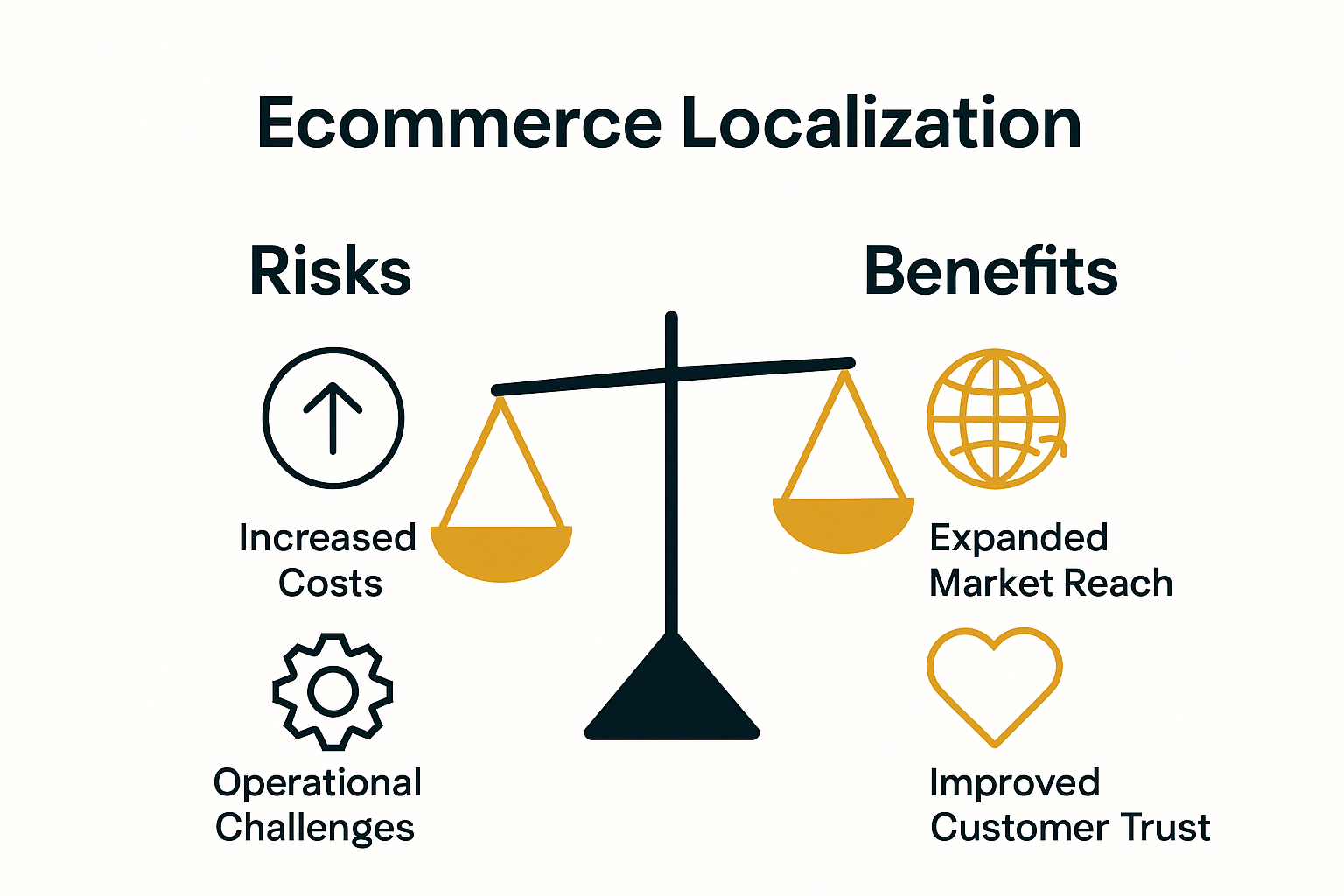
Optimizing ecommerce store performance requires a comprehensive understanding of the multifaceted risks inherent in cross-cultural digital commerce. The most critical risks and associated costs include:
Financial Risks:
- Substantial initial investment requirements
- Ongoing maintenance and adaptation expenses
- Potential revenue loss from ineffective localization
- Technology infrastructure modification costs
- Legal compliance and regulatory adaptation expenses
Operational Pitfalls:
- Inaccurate cultural translation and interpretation
- Inconsistent brand messaging across markets
- Technical integration challenges with multilingual platforms
- Complex supply chain and logistics modifications
- Customer support infrastructure complexity
Successful localization demands a strategic, nuanced approach that anticipates potential challenges and develops robust mitigation strategies. Businesses must cultivate a deep understanding of target markets, invest in comprehensive research, and remain agile in their implementation to minimize risks and maximize international growth potential.
Unlock Your Global Potential with Expert Ecommerce Localization Support
Struggling with the challenges of ecommerce localization such as payment method integration, culturally sensitive language translation, and legal compliance You are not alone in wanting to connect authentically with international customers while maintaining your brand identity. These pain points require more than just technical fixes They demand tailored solutions that consider your unique market goals and complex operational needs.
At Blackbelt Commerce we specialize in delivering custom Shopify store development and optimization crafted to tackle exactly these challenges Our expertise in multi-language integrations and advanced ecommerce capabilities ensures your store feels local no matter the market. Benefit from our proven process demonstrated in detailed case studies that showcase real traffic growth and revenue increases Explore Blackbelt Commerce solutions and see how we align with your localization goals.

Take the step to transform your Shopify store into a culturally intelligent platform that builds trust and drives conversions. Visit Blackbelt Commerce today and let us help you unlock new international markets with precision and confidence. The world is ready for your business and so are we.
Frequently Asked Questions
What is ecommerce localization?
Ecommerce localization is the process of adapting an online store to meet the specific linguistic, cultural, and regulatory expectations of target markets, going beyond simple translation to create a culturally relevant shopping experience.
Why is ecommerce localization important?
Ecommerce localization is essential because it enhances customer engagement, builds trust, and significantly improves market penetration and revenue growth by providing a shopping experience that feels native to local audiences.
What are the core elements of effective ecommerce localization?
The core elements of effective ecommerce localization include language translation, currency conversion, payment method integration, visual design adaptations, legal compliance, tailored product descriptions, and localized customer support.
What challenges do businesses face when localizing their ecommerce platforms?
Businesses face several challenges when localizing ecommerce platforms, including complex translation processes, maintaining brand consistency, significant investment costs, navigating local regulations, and managing the technical complexities of multilingual websites.
Recommended
- Translating Your Shopify Storefront: Real Life Assessment of Options
- Why Optimize Ecommerce Stores: Complete Guide – Shopify Experts: Grow Your eCommerce Revenue
- Role of Support in Ecommerce: Complete Expert Guide – Shopify Experts: Grow Your eCommerce Revenue
- Canadian French and English Website – One Modern Day method (Shopify + Bilingual Theme)
Quick Answer: what is ecommerce localization
Ecommerce localization means adapting an online store for customers in different markets, including language, currency, product information, checkout expectations, and post-purchase communication. For Shopify merchants, the goal is not just translation; it is making the buying journey feel trustworthy and natural for each market while keeping operations manageable.
Want a sharper Shopify growth plan?
If this article connects to a current store decision, use the calendar to book a strategy call and turn the idea into a practical plan.
Key Takeaways
- Start with the search intent behind what is ecommerce localization: the reader needs a clear explanation before they are ready for a service conversation.
- Keep the advice practical and specific so the post feels editorial, useful, and worth sharing.
- Use the topic cluster links to connect the article to related BBC expertise instead of leaving it as a standalone blog post.
- Add a natural commercial bridge only after the article has answered the reader’s main question.
- Use the same-page Calendly CTA so qualified readers can book a strategy call without being sent to a long form.
How this connects to your Shopify growth strategy
This article should remain useful for readers researching what is ecommerce localization, but it also needs to show when the topic becomes a business decision. For the Shopify Migration & International Growth cluster, the commercial bridge is practical: once the reader understands the concept, the next step is deciding whether their current Shopify setup can support the desired experience, conversion path, and operational workflow. That is where expert planning, design, development, CRO, and SEO support can turn the idea into measurable store improvements.
Want a sharper Shopify growth plan?
Use this guide as a decision tool. Then book a strategy call when you want a practical roadmap for your store.
Related Shopify resources
These internal resources support the Shopify Migration & International Growth topic cluster and help connect this guide to stronger commercial next steps:
- Shopify Custom Development
- Shopify experts
- Shopify Plus agencies
- Shopify Custom Development — Parent service page for the reader’s next commercial step
- Shopify experts — Money-page link requested for expert-hiring intent
- Shopify Plus agencies — Money-page link requested for high-growth and Plus-agency intent
- Shopify CRO — Conversion service page for readers focused on revenue and lead generation
- ecommerce web solution — Related ecommerce solution article
- custom e-commerce solution — Related custom ecommerce article
Questions store owners ask before taking action
What does what is ecommerce localization mean for a Shopify merchant?
For a Shopify merchant, what is ecommerce localization is about choosing or improving the store experience in a way that supports traffic, trust, conversion, and long-term operations.
When should a store owner get expert help?
Expert help becomes useful when the decision affects SEO, conversion, theme architecture, integrations, migration risk, or revenue-critical customer journeys.
How should this topic connect to a broader content cluster?
The post should link to a parent service page, related support articles, and money pages so Google and AI systems understand how the article supports a broader area of expertise.
What is the lead-generation goal of this article?
The article should educate first, then guide qualified readers toward booking a strategy call when they need help applying the advice to their own store.
What should be avoided during optimization?
Avoid filler, unrelated phrases, invented statistics, broken formatting, duplicated CTAs, and any edit that makes the article feel less helpful or less polished.
Future articles needed for topical dominance
To build deeper topical authority around this cluster, these supporting topics should be created later and linked back into this article:
- What Is Ecommerce Localization Checklist for Shopify Store Owners: Creates a practical support article that turns the Shopify Migration & International Growth topic into an actionable review tool.
- Common What Is Ecommerce Localization Mistakes and How to Avoid Them: Captures problem-aware searches and gives BBC a natural place to explain implementation risks without hard selling.
- When to Hire Shopify Experts for What Is Ecommerce Localization: Connects informational demand to the expert-hiring money page while preserving educational intent.
Want a sharper Shopify growth plan?
Ready to turn the advice in this article into an action plan? Open the calendar here and choose a time that works for you.

