


Nearly half of american online shoppers say slow websites make them abandon their carts. With eCommerce competition climbing every year, even small frustrations can mean lost sales and fading brand trust. Shopify store optimization gives american store owners the tools to transform slow, cluttered shops into seamless, revenue-driving platforms that meet the fast-changing expectations of today’s customers.
Table of Contents
- Defining Shopify Store Optimization And Its Purpose
- Types Of Shopify Optimization Approaches
- Key Benefits For Shopify Store Owners
- Risks And Missed Opportunities Of Poor Optimization
- Cost Implications And Common Optimization Pitfalls
Key Takeaways
| Point | Details |
|---|---|
| Holistic Store Optimization | Shopify store optimization enhances various elements like product management, site speed, and SEO to drive revenue and improve user experience. |
| Diverse Optimization Approaches | Strategies like performance optimization, conversion rate optimization, and SEO are critical for enhancing store performance and achieving business growth. |
| Significant Benefits | Effective optimization leads to improved customer experience, higher conversion rates, and better search visibility, ultimately benefiting the bottom line. |
| Cost Implications | Investing in optimization is essential; poor execution can lead to increased costs, lost revenue, and a weakened competitive position. |
Defining Shopify Store Optimization and Its Purpose
Shopify store optimization is a comprehensive strategy designed to enhance every aspect of an online eCommerce environment. According to research from Web URI, this process involves systematically improving various critical components including product management, shipping processes, payment systems, marketing approaches, and analytical tracking.
Store optimization goes far beyond simple website tweaks. It represents a holistic approach to transforming an online store into a high-performing digital sales machine. The core purpose is multifaceted: increase conversion rates, improve user experience, reduce friction in the purchasing journey, and ultimately drive more revenue for the business.
Key areas of Shopify store optimization typically include:
- Site Speed: Ensuring rapid page load times
- Mobile Responsiveness: Creating seamless experiences across devices
- Product Presentation: Crafting compelling product descriptions and images
- Checkout Process: Streamlining purchase pathways
- SEO Configuration: Improving organic search visibility
By implementing strategic optimization techniques, Shopify store owners can create more engaging, user-friendly environments that not only attract potential customers but also effectively convert browsing interest into actual sales. The goal is to transform your digital storefront from a simple online catalog into a powerful, revenue-generating platform that continually adapts to customer needs and market trends.

For store owners seeking deeper insights, our guide on store optimization practices offers comprehensive strategies to elevate your Shopify performance.
Types of Shopify Optimization Approaches
Shopify optimization encompasses several strategic approaches designed to enhance online store performance and drive business growth. These approaches can be categorized into distinct yet interconnected methods that target different aspects of eCommerce success.
Performance Optimization focuses on technical improvements that directly impact user experience and site functionality. This includes:
- Improving page load speeds
- Enhancing mobile responsiveness
- Minimizing server response times
- Optimizing image and media files
- Implementing efficient caching mechanisms
Conversion Rate Optimization (CRO) represents another critical approach targeting the transformation of website visitors into paying customers. Key strategies include:
- Streamlining checkout processes
- Creating compelling product descriptions
- Designing intuitive navigation
- Implementing persuasive call-to-action buttons
- Using strategic pricing and discount techniques
SEO Optimization remains a fundamental approach for increasing organic visibility and attracting potential customers. This method involves:
- Keyword research and implementation
- Metadata optimization
- Creating high-quality content
- Building internal and external link structures
- Improving site architecture
By integrating these optimization approaches, Shopify store owners can create a comprehensive strategy that addresses technical performance, user experience, and marketing effectiveness.
Our Shopify best practices guide provides deeper insights into implementing these advanced optimization techniques effectively.
Key Benefits for Shopify Store Owners
Optimizing a Shopify store delivers transformative advantages that extend far beyond simple website improvements. According to research from Web URI, strategic optimization offers critical benefits including improved user experience, increased traffic, higher conversion rates, and enhanced security through advanced features like SSL encryption and PCI compliance.
The financial and operational benefits are substantial. As highlighted by NSGA, unified commerce through optimization leads to remarkable outcomes such as:
- Cost efficiency
- Faster business implementation
- Enhanced operational workflows
- Accelerated sales growth
- Centralized cross-channel management
Key benefits for Shopify store owners include:
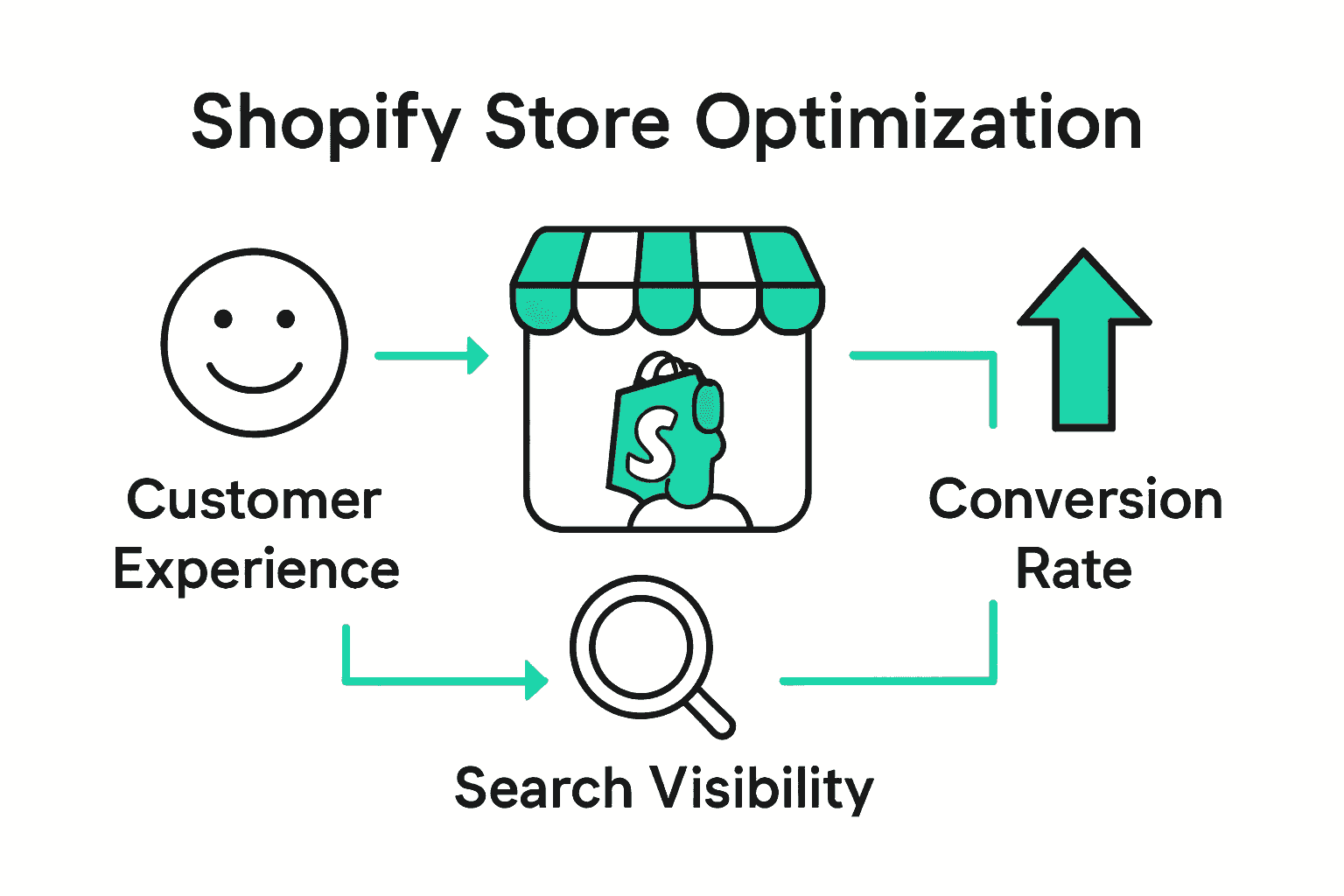
- Improved Customer Experience: Smoother navigation and intuitive design
- Higher Conversion Rates: More effective sales funnels
- Better Search Visibility: Improved organic search rankings
- Reduced Operational Friction: Streamlined backend processes
- Scalable Infrastructure: Easy expansion capabilities
These optimization strategies provide a competitive edge in the rapidly evolving digital marketplace. By continuously refining your Shopify store, you transform it from a basic online storefront into a sophisticated, high-performing sales engine. Our multichannel strategy guide offers advanced insights into maximizing these optimization benefits for sustained business growth.
Risks and Missed Opportunities of Poor Optimization
Poor Shopify store optimization can create devastating consequences for online businesses. According to research from Midriff Info Solution, neglecting optimization leads to significant missed opportunities, including reduced customer engagement, lower sales, and diminished brand credibility resulting from subpar user experiences.
Performance Risks associated with inadequate optimization include:
- Slow page load times
- High bounce rates
- Decreased search engine rankings
- Poor mobile responsiveness
- Complicated navigation structures
Financial Consequences of neglecting store optimization are particularly severe:
- Potential revenue losses
- Increased customer acquisition costs
- Lower conversion rates
- Reduced customer lifetime value
- Weakened competitive positioning
Moreover, unoptimized stores suffer from critical user experience challenges that directly impact bottom-line performance. Customers today expect seamless, intuitive online shopping experiences. When stores fail to meet these expectations, potential buyers quickly abandon their journey, often migrating to more professionally designed competitors. Store owners who ignore optimization essentially create barriers that prevent potential customers from completing purchases.
To understand how to avoid these pitfalls and transform your digital storefront, our comprehensive guide on eCommerce optimization provides strategic insights for sustainable online success.
Cost Implications and Common Optimization Pitfalls
Optimizing a Shopify store involves strategic financial considerations that extend beyond simple website improvements. According to research from NSGA, implementing unified commerce can lead to significant cost efficiencies by reducing the need for complex middleware, custom integrations, and extensive development work while simultaneously accelerating implementation speed.
Common Optimization Pitfalls that can escalate costs include:
- Over-investing in unnecessary apps and plugins
- Neglecting mobile responsiveness
- Ignoring performance optimization
- Failing to implement proper SEO strategies
- Underestimating ongoing maintenance requirements
Financial Considerations for Optimization:
- Initial investment in professional optimization services
- Ongoing maintenance and update costs
- Potential short-term revenue disruption during implementation
- Training and skill development for team members
- Technology and tool acquisition expenses
Smart store owners recognize that optimization is not a one-time expense but a continuous investment in digital infrastructure. While upfront costs might seem challenging, the long-term benefits of a well-optimized Shopify store far outweigh the initial financial commitments. Strategically allocated resources can transform your digital storefront from a basic online presence into a high-performing sales engine.
To navigate these complex optimization strategies effectively, store owners can benefit from expert guidance and strategic planning. Our eCommerce optimization guide offers comprehensive insights into managing these financial considerations while maximizing your Shopify store’s potential.
Take Your Shopify Store to the Next Level with Expert Optimization
The challenges of slow site speed, poor mobile responsiveness, and low conversion rates can hold your Shopify store back from its full potential. You need a partner who understands the importance of comprehensive Shopify store optimization—from improving user experience and SEO to streamlining checkout processes and boosting revenue. At Blackbelt Commerce, we specialize in transforming these pain points into growth opportunities by applying proven strategies tailored to your unique business needs.

Unlock the power of a fully optimized Shopify store with our expert services. Visit Blackbelt Commerce to explore our detailed case studies and learn how our custom Shopify solutions and advanced eCommerce capabilities have helped clients increase traffic and sales. Don’t let poor optimization stand in the way of your success. Discover our shopify best practices and why optimize ecommerce stores guides to start improving your online store today. Contact us now to get a personalized consultation and turn your Shopify storefront into a high-performing sales engine.
Frequently Asked Questions
What is Shopify store optimization?
Shopify store optimization refers to a comprehensive strategy aimed at enhancing various aspects of an online eCommerce store, including product management, shipping processes, payment systems, marketing efforts, and analytical tracking, ultimately improving user experience and increasing conversion rates.
What are the key benefits of optimizing a Shopify store?
Key benefits include improved customer experience, higher conversion rates, enhanced search visibility, reduced operational friction, and scalable infrastructure that supports business growth and adaptability in the digital marketplace.
What are common pitfalls to avoid when optimizing a Shopify store?
Common pitfalls include over-investing in unnecessary apps and plugins, neglecting mobile responsiveness, ignoring performance optimization, not implementing proper SEO strategies, and underestimating ongoing maintenance requirements.
How can poor optimization impact my Shopify store?
Poor optimization can lead to slow page load times, high bounce rates, decreased search engine rankings, lower conversion rates, and ultimately result in significant revenue losses and diminished brand credibility.
Recommended
- Why Optimize Ecommerce Stores: Complete Guide – Shopify Experts: Grow Your eCommerce Revenue
- 5 Best Practices for Optimizing Your Shopify Store – Shopify Experts: Grow Your eCommerce Revenue
- 7 Essential Shopify Marketing Tips for Store Growth Success – Shopify Experts: Grow Your eCommerce Revenue
- Shopify SEO Explained: Optimizing for Traffic Growth
Quick Answer: Why optimize shopify stores
To optimize a Shopify store, merchants should improve the parts of the buying journey that most directly affect trust, speed, product discovery, checkout confidence, and conversion. The strongest improvements usually come from combining better UX, cleaner navigation, faster pages, stronger product content, reliable analytics, and conversion-focused testing instead of treating optimization as a one-time design cleanup.
Want a sharper Shopify growth plan?
If this article connects to a current store decision, use the calendar to book a strategy call and turn the idea into a practical plan.
Key Takeaways
- Shopify store optimization should prioritize speed, navigation, product clarity, trust, checkout flow, and measurable conversion improvements.
- The best optimization work starts with analytics and customer behavior rather than guessing which design changes will matter.
- Strong internal links connect this topic to Shopify custom development, CRO, expert hiring, and Shopify Plus agency support.
- Optimization becomes a lead-generation opportunity when readers can see what to fix but need expert help applying it safely.
- Use the same-page Calendly CTA so qualified merchants can book a strategy call without being pushed into a long form.
How this connects to your Shopify growth strategy
This article should remain useful for readers researching Why optimize shopify stores, but it also needs to show when the topic becomes a business decision. For the Shopify Growth, CRO, and Store Optimization cluster, the commercial bridge is practical: once the reader understands the concept, the next step is deciding whether their current Shopify setup can support the desired experience, conversion path, and operational workflow. That is where expert planning, design, development, CRO, and SEO support can turn the idea into measurable store improvements.
Want a sharper Shopify growth plan?
Use this guide as a decision tool. Then book a strategy call when you want a practical roadmap for your store.
Related Shopify resources
These internal resources support the Shopify Growth, CRO, and Store Optimization topic cluster and help connect this guide to stronger commercial next steps:
- Shopify CRO
- Shopify experts
- Shopify Plus agencies
- Shopify CRO — Parent service page for the reader’s next commercial step
- Blackbelt Commerce — Home-page authority link for brand and core Shopify expertise
- Shopify experts — Money-page link requested for expert-hiring intent
- Shopify Plus agencies — Money-page link requested for high-growth and Plus-agency intent
- Shopify custom development — Development service page for implementation and technical help
- Shopify checkout optimization — Related conversion article
- Shopify conversion optimization — Related CRO article
Questions store owners ask before taking action
What is the best way to optimize a Shopify store?
Start with the parts of the customer journey that affect revenue most: page speed, navigation, product pages, trust signals, search, checkout flow, analytics, and mobile usability.
How do I know which Shopify optimization work to prioritize?
Use analytics, customer behavior, conversion data, and operational pain points to identify the changes most likely to improve sales, lead generation, or customer experience.
When should a merchant hire Shopify experts for optimization?
Expert help is useful when the store has technical debt, conversion issues, app conflicts, theme limitations, SEO risk, or revenue-critical changes that need careful implementation.
Can Shopify optimization help lead generation?
Yes. A clearer site structure, stronger trust signals, better calls to action, and a lower-friction booking path can help qualified visitors take the next step.
What should be avoided during Shopify optimization?
Avoid random design changes, unnecessary apps, broken formatting, slow scripts, duplicated content, and edits that make the buying journey harder to understand.
Future articles needed for topical dominance
To build deeper topical authority around this cluster, these supporting topics should be created later and linked back into this article:
- Why Optimize Shopify Stores Checklist for Shopify Store Owners: Creates a practical support article that turns the Shopify Growth, CRO, and Store Optimization topic into an actionable review tool.
- Common Why Optimize Shopify Stores Mistakes and How to Avoid Them: Captures problem-aware searches and gives BBC a natural place to explain implementation risks without hard selling.
- When to Hire Shopify Experts for Why Optimize Shopify Stores: Connects informational demand to the expert-hiring money page while preserving educational intent.
Want a sharper Shopify growth plan?
Ready to turn the advice in this article into an action plan? Open the calendar here and choose a time that works for you.

