

Blog updated with the most recent Shopify and eCommerce strategies on 05/02/2026.
Shopify vs. Magento: Which E-Commerce Platform Delivers Superior SEO for Your Online Store?
To truly conquer the online marketplace, your store needs to be found. Choosing the right e-commerce platform is a game-changer for your search engine visibility. This deep dive pits two titans against each other—Shopify and Magento—through the critical lens of search engine optimization. We’re here to help ambitious online entrepreneurs pinpoint which platform equips them with the ultimate SEO advantage. Get ready to explore essential SEO principles, dissect built-in platform features, understand customization boundaries, leverage app ecosystems, master technical controls, refine content strategies, weigh costs, navigate migrations, and look ahead to game-changing trends like AI and headless commerce. By the time we’re done, you’ll have a clear roadmap to selecting the platform that fuels your business goals and how to harness expert services to dominate search rankings.
What Are the Core SEO Pillars for E-Commerce Platforms?
At its heart, e-commerce SEO is built on three fundamental pillars: technical prowess, on-page relevance, and off-page authority. These elements work in concert to drive organic traffic to your product and category pages. Technical SEO ensures search engines can effortlessly discover, index, and render your site. On-page SEO hones in on optimizing your metadata, content structure, and keyword targeting. Off-page SEO builds your brand’s credibility and domain authority through valuable backlinks, social signals, and brand mentions. Together, these pillars form the bedrock for sustained organic growth.
The Cornerstones of E-commerce SEO
Search engine optimization (SEO) is non-negotiable for e-commerce success. It hinges on robust technical performance, compelling on-page relevance, and strong off-page authority to drive organic visibility for your product and category pages. Mastering these elements is key to climbing search rankings and enhancing the user experience.
This foundational resource provides the essential knowledge underpinning the core concepts we’ll explore throughout this article.
What Technical SEO Elements Drive Online Store Rankings?
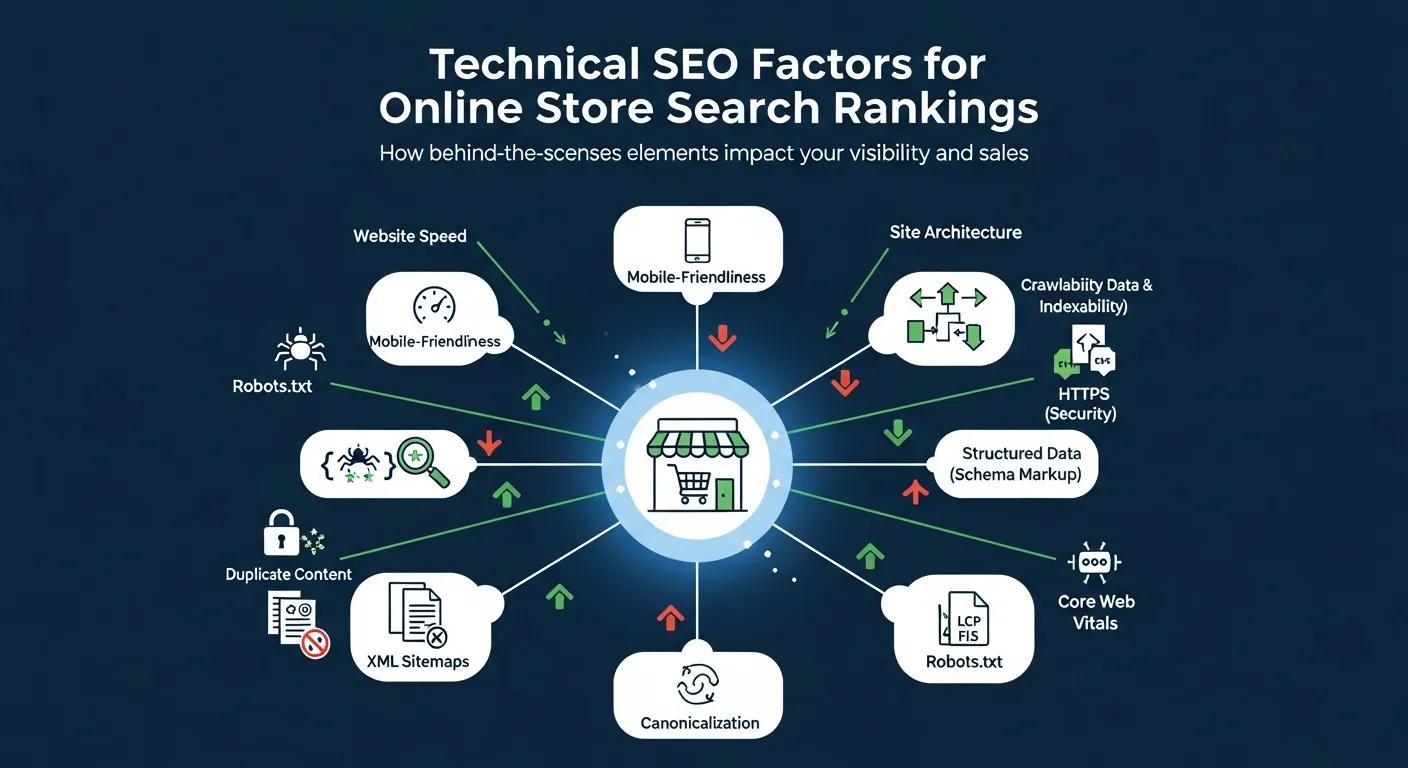
Technical SEO dictates how search engines interact with and evaluate your online store. It encompasses your site’s architecture, loading speed, mobile-friendliness, crawl directives, and error management—all critical factors influencing indexation and user experience.
- Craft concise, keyword-rich URL structures to boost click-through rates and provide clear contextual signals to search engines.
- Prioritize Core Web Vitals (Largest Contentful Paint, First Input Delay, Cumulative Layout Shift) to measure page speed and visual stability, directly impacting rankings and conversion rates.
- Implement sitemap.xml and robots.txt files to guide search engine crawlers on which pages to index and which to exclude, effectively preventing duplicate content issues.
Each of these technical controls is vital for ensuring rapid page rendering and efficient crawling, paving the way for a superior user journey and elevated search engine placement.
How Do On-Page and Content SEO Shape E-Commerce Visibility?
On-page optimization is all about precision: meticulously crafted metadata, well-structured headings, compelling product descriptions, and strategic internal linking. A product page that features optimized title tags, H1 headings infused with target keywords, clearly formatted bullet points, and user-focused descriptions not only guides potential customers but also provides unambiguous context for search engines.
- Title Tags & Meta Descriptions – These elements define your page’s topic and are crucial for enticing clicks from the search results page.
- Heading Hierarchy – Effectively organizing your content into semantic clusters enhances readability for users and comprehension for search engine algorithms.
- Unique Product Descriptions – Crafting original descriptions minimizes duplicate content issues while powerfully highlighting your product’s unique selling propositions.
By strategically weaving relevant keywords into clear, benefit-driven content, your store can capture high-intent search queries and increase dwell time, further solidifying your topical authority.
Why Is Off-Page SEO Absolutely Critical for E-Commerce Success?
Off-page SEO is the engine that drives your domain’s reputation through external signals like backlinks, social mentions, and publisher relationships. High-quality inbound links from authoritative blogs, industry publications, and trusted partner sites serve as powerful endorsements, signaling credibility and trustworthiness to search engines.
- Proactively conduct outreach to secure high-quality backlinks for your valuable product guides and insightful blog articles.
- Cultivate social proof through influential reviews that strategically link back to your product pages.
- Contribute guest posts to relevant publications to showcase your brand’s expertise and build authority.
A robust backlink profile is instrumental in elevating your domain authority, leading to improved rankings for competitive keywords and a significant boost in overall site visibility.
What Are Shopify’s SEO Strengths and Limitations?

Shopify shines when it comes to rapid deployment and user-friendliness, offering a suite of built-in SEO tools that serve small and mid-sized businesses exceptionally well. However, its Software-as-a-Service (SaaS) architecture can present limitations for deep-level customization. Understanding Shopify’s native features and effective workarounds is key to maximizing your search engine performance.
Which Built-In SEO Features Does Shopify Offer?
Shopify automatically generates sitemaps, provides easy-to-edit title tags, meta descriptions, and alt text fields, streamlining essential SEO tasks right out of the box.
Mastering Shopify SEO: Best Practices
Shopify equips merchants with essential built-in SEO tools, such as automatic sitemaps and editable meta fields, designed to help small and mid-sized businesses elevate their search performance. These features simplify core SEO tasks, enabling merchants to concentrate more on content creation and promotional strategies.
This official resource highlights the specific SEO functionalities integrated within the Shopify platform, which are central to our discussion.
How User-Friendly Is Shopify for SEO Management?
Shopify’s intuitive dashboard presents SEO settings in a clear, accessible interface, making it incredibly user-friendly even for those without extensive developer knowledge.
- On-page SEO editors allow for instant modifications to metadata and URL handles.
- Theme customization panels enable visual adjustments without needing to touch code.
- The integrated app marketplace offers one-click installations for a wide array of advanced SEO features.
This inherent simplicity accelerates the time-to-market for new stores and ensures that fundamental SEO tasks don’t require specialized technical expertise, although more complex technical adjustments might still necessitate developer assistance.
What Are Shopify’s Customization Limits for Advanced SEO?
As a hosted platform, Shopify inherently restricts direct server-level access, which can pose challenges for implementing highly advanced SEO techniques.
- Direct editing of robots.txt is not permitted beyond the default rules provided.
- Control over canonical tag placement can be limited within certain theme structures.
- URL structures are fixed, typically requiring prefixes like “/collections/” or “/products/”.
These constraints mean that enterprises seeking granular control over crawl directives, international URL parameters, or custom server responses may need to explore workarounds or rely on third-party applications to achieve their desired level of optimization.
Which Shopify SEO Apps and Integrations Enhance Performance?
Shopify’s extensive app ecosystem empowers merchants to extend native capabilities with specialized tools designed for schema markup, speed optimization, and sophisticated link management.
- Schema Booster – Seamlessly adds structured data markup for products, FAQs, and more.
- Image Optimizer – Compresses images effectively without compromising quality, leading to faster load times.
- Link Manager – Provides intelligent internal linking suggestions and actively monitors for broken links.
Integrating these powerful apps can effectively bridge any gaps in Shopify’s built-in features, supporting robust rich snippet eligibility and fine-tuning your site’s performance.
How Does Shopify Plus Elevate SEO for Enterprise Stores?
Shopify Plus unlocks advanced API access, checkout customization capabilities, and higher traffic bandwidth—features specifically designed to bolster SEO performance at an enterprise scale.
- Enables the implementation of headless storefronts for exceptionally fast Progressive Web App (PWA) experiences.
- Offers Multipass login and robust international storefront capabilities for tailored regional experiences.
- Provides an expanded analytics API for deeper, more actionable performance insights.
These enterprise-grade enhancements empower larger merchants to execute complex, cutting-edge SEO strategies while still benefiting from the streamlined ease of Shopify’s hosted environment.
How Does Magento Excel in SEO Capabilities and Customization?
Magento, now part of Adobe Commerce, offers unparalleled flexibility for technical SEO, empowering enterprises to implement bespoke optimizations across their site architecture, navigation, and metadata systems. This level of power demands skilled development resources but rewards sites with ultimate granular control.
What Technical SEO Controls Does Magento Provide?
Magento’s open-source foundation exposes fundamental SEO controls, facilitating deep and intricate customizations.
- URL Rewrite Management allows for the creation of completely custom, keyword-optimized URL paths.
- Advanced Canonical Tag configuration provides precise control to effectively prevent duplicate content issues.
- Layered Navigation SEO leverages query parameters and filters to enhance discoverability and user experience.
Unlocking Magento’s SEO Potential
Magento delivers extensive technical SEO controls, including powerful URL rewrite management and advanced canonical tag configuration, enabling enterprises to craft highly bespoke optimizations. This inherent flexibility grants granular command over site architecture and metadata systems.
This authoritative source details the sophisticated technical SEO capabilities inherent in Magento, which we will contrast with Shopify’s features throughout this article.
How Scalable Is Magento for Large and International SEO?
Magento’s inherently modular architecture is built to effortlessly support tens of thousands of SKUs, multiple languages, and distinct region-specific stores.
This exceptional scalability ensures consistent, high-performance SEO as your product lines expand and your global reach grows.
What Are the Resource Requirements for Magento SEO?
Achieving deep customization on Magento necessitates dedicated technical expertise and significant human resources.
- Requires skilled developers proficient in modifying XML layout, template files, and module configurations.
- Demands DevOps support for managing server performance, optimizing caching layers, and integrating Content Delivery Networks (CDNs).
- Involves ongoing maintenance to apply security patches and implement platform updates promptly.
While this level of investment is resource-intensive, these commitments yield complete control over critical SEO elements, which is often a non-negotiable requirement for large enterprises.
Which Magento SEO Extensions Are Essential?
The Magento Marketplace is a treasure trove of extensions designed to streamline core SEO tasks and introduce advanced functionalities.
- MetaTag Manager – Facilitates bulk editing of metadata across thousands of product and category pages.
- Schema Enhancer – Effortlessly implements rich snippet markup for products, customer reviews, and breadcrumbs.
- Lazy Load Pro – Optimizes Core Web Vitals by deferring the loading of offscreen images.
Selecting the right combination of these powerful extensions empowers technical teams to optimize performance, markup, and content without the need to reinvent foundational code.
How Does Adobe Commerce Enhance Magento’s SEO Features?
Adobe Commerce builds upon Magento’s robust open-source foundation by integrating additional enterprise-grade services and cutting-edge AI-powered tools.
- Content Staging and Preview enables A/B testing of critical elements like title tags and meta descriptions.
- Provides advanced Business Intelligence reports for accurate SEO performance forecasting.
- Incorporates AI-driven product recommendations designed to boost user engagement and increase dwell time.
These proprietary enhancements deliver predictive insights and streamlined workflows, essential for managing large-scale, sophisticated SEO programs.
How Do Shopify and Magento Compare in Technical SEO Features?
A direct, side-by-side comparison of URL control, speed optimization capabilities, structured data implementation, and crawl directive management reveals where each platform truly excels from a technical SEO standpoint.
How Do URL Structures and Site Architecture Differ?
Shopify’s URL paths are somewhat predetermined—products and variants inherently use fixed prefixes—whereas Magento empowers developers to forge virtually any directory structure or parameter scheme. Custom URL rewrites in Magento allow SEO teams to align every link with targeted keywords and content hierarchies. In contrast, Shopify often necessitates the use of apps or URL redirects to implement nonstandard pathways.
What Are the Differences in Site Speed and Core Web Vitals?
Shopify themes are generally optimized for speed right out of the box. However, achieving deeper performance enhancements—such as HTTP/2 push, Redis caching, and advanced code bundling—often lies beyond the direct control of the merchant. Magento environments, on the other hand, leverage powerful server-level optimizations, Varnish cache, and granular asset management, enabling significant improvements in Largest Contentful Paint and interaction metrics when expertly configured.
How Is Structured Data Implemented on Each Platform?
Shopify typically relies on theme templates and third-party applications to inject JSON-LD for essential schemas like Product, FAQ, or Breadcrumb. Magento’s core architecture natively supports structured data through layout XML definitions and extension APIs, facilitating seamless integration of rich snippet markup across categories, search results, and blog posts without external dependencies.
What Are the Customization Options for Robots.txt and Sitemaps?
Shopify automatically generates a sitemap.xml file and restricts robots.txt edits to a single default file. Magento grants unrestricted filesystem access, allowing for comprehensive customization of both files. This enables the exclusion of staging attributes, filter query strings, or internal search pages, ensuring complete alignment between crawl directives and your site’s structure.
How Do Shopify and Magento Compare in Content SEO and Marketing?
Beyond technical controls, sustained e-commerce success is deeply intertwined with content practices—effective blogging, compelling product storytelling, and strategic international targeting. Each platform offers distinct approaches to content creation and optimization.
What Content SEO Strategies Work Best on Shopify?
Shopify’s integrated blog editor makes it incredibly easy to quickly publish articles and helpful guides. Merchants can seamlessly integrate apps that automate internal linking to their top-selling products, generate dynamic related article feeds, and optimize for featured snippets through structured FAQ blocks. By leveraging Shopify’s user-friendly Content Management System (CMS), store owners can maintain consistent content calendars without encountering developer bottlenecks.
How Does Magento Support Advanced Content SEO Practices?
Magento’s robust Page Builder and intuitive WYSIWYG editor empower marketers to craft sophisticated landing pages featuring dynamic content blocks, embedded videos, and integrated cross-sell sections. Content staging workflows allow for precise A/B testing of headlines and call-to-action placements, while rule-based widgets intelligently surface contextually relevant products to significantly boost engagement and dwell time on high-value pages.
Which Platform Offers Better Support for International SEO?
Magento’s powerful multi-store architecture natively supports domain, subdomain, and subdirectory strategies for global storefronts, complete with integrated language and currency selectors. Shopify utilizes a “Markets” feature that essentially duplicates a single store for each region, often requiring manual translation and URL mapping. Magento’s granular control over hreflang tags and geo-targeting rules ensures truly robust international SEO for enterprise-level operations.
What Are the Cost and Resource Considerations for SEO on Shopify vs. Magento?
The allocation of budget and human capital varies significantly between these two platforms. Understanding these differences is crucial for making cost-effective strategic decisions.
How Do SEO Service Costs Differ Between Shopify and Magento?
Engagements focused on Shopify SEO typically center on content optimization, app integration, and theme adjustments, often involving moderate monthly retainers suitable for small to medium-sized businesses. Magento SEO services, however, demand in-depth technical audits, custom development sprints, and ongoing server management, leading to higher project costs that align with enterprise budgets focused on substantial long-term ROI.
What Are the Development and Maintenance Requirements?
Shopify’s hosted environment significantly reduces server maintenance overhead, as platform updates are managed entirely by the provider. Magento, conversely, requires dedicated infrastructure or robust cloud hosting, along with regular security patching, module updates, and vigilant developer oversight to maintain optimal security and performance. These substantial resource commitments must be carefully factored into your total cost of ownership calculations.
How Does Business Size Influence Platform SEO Cost-Effectiveness?
For businesses managing fewer than 1,000 SKUs and possessing limited in-house technical expertise, Shopify’s lower entry costs and managed services deliver immediate and tangible SEO benefits. Enterprises with extensive product catalogs, multiple international markets, and dedicated in-house development teams will find Magento’s limitless customization capabilities more cost-effective at scale, despite higher upfront and operational expenses.
When Should You Choose Shopify or Magento for Superior SEO?
The optimal platform choice hinges on your store’s current size, available technical resources, ambitious growth objectives, and budget constraints. This decision guide is designed to help you pinpoint the ideal match for a wide spectrum of e-commerce scenarios.
Which Platform Is Best for Small to Medium-Sized Businesses?
Shopify’s straightforward setup process, secure hosted environment, and intuitive SEO tools make it the premier choice for SMBs prioritizing rapid time-to-market, ease of use, and minimal technical overhead. Merchants can concentrate on expanding their catalog and executing marketing strategies without requiring extensive developer involvement.
Which Platform Suits Large Enterprises with Complex SEO Needs?
Enterprises that require comprehensive multi-store support, extensive customization of site navigation, and direct server-level control should strongly consider Magento. Its open-source core, enhanced by Adobe Commerce, is perfectly engineered to accommodate intricate SEO strategies and manage exceptionally high SKU counts.
What SEO Migration Considerations Are Important When Switching Platforms?
Migrating your e-commerce store from one platform to another demands meticulous attention to preserving URL structures, metadata, internal links, and implementing comprehensive 301 redirect maps. Both Shopify and Magento migrations should incorporate thorough pre-migration audits, carefully staged redirects, and diligent post-migration performance monitoring to safeguard your organic traffic and search rankings.
How Has Blackbelt Commerce Delivered SEO Success on Shopify and Magento?
Book a strategy call with us dedicated e-commerce development and specialized SEO teams have consistently driven measurable, impactful gains for clients across both Shopify and Magento platforms. Their bespoke approach masterfully balances technical excellence with strategic content implementation to foster sustainable organic growth.
What SEO Improvements Have Clients Achieved on Shopify?
One lifestyle retailer experienced a remarkable 75% surge in organic traffic within just six months by optimizing their Shopify theme code, implementing structured FAQ markup, and significantly enhancing product descriptions. Conversion rates saw a substantial 30% improvement following streamlined metadata and refined internal linking strategies.
How Has Magento SEO Helped Enterprise Clients Grow?
An international electronics brand successfully leveraged Magento’s powerful multi-store architecture and custom URL rewrites to launch highly effective region-specific domains. Through meticulous layered navigation optimizations and advanced caching strategies, page load times were slashed by 50%, while targeted keyword rankings climbed by an impressive average of 40 positions.
What Specialized SEO Services Does Blackbelt Commerce Offer?
Blackbelt Commerce provides comprehensive, end-to-end solutions encompassing technical audits, expert schema implementation, strategic content optimization, meticulous performance tuning, and continuous monitoring. Their profound expertise across both Shopify Plus and Adobe Commerce ensures that online shops achieve top-tier search visibility and exceptional conversion outcomes.
What Emerging SEO Trends Will Impact Shopify and Magento Platforms?
Staying ahead of the curve in the ever-evolving landscape of SEO is absolutely vital for sustained success. These emerging trends are poised to significantly shape e-commerce search strategies in the coming years.
How Will AI and Voice Search Impact E-Commerce SEO?
AI-driven content generation tools and the increasing prevalence of voice-enabled queries are fundamentally reshaping keyword research methodologies and site architecture requirements. Optimizing product descriptions for natural, conversational search phrases and implementing sophisticated semantic structured data will be paramount to capturing voice traffic and maintaining a competitive edge.
What Are the SEO Benefits of Headless Commerce Architectures?
Decoupling the front-end presentation layer from the back-end e-commerce engine through headless setups empowers brands to build exceptionally fast Progressive Web App (PWA) experiences and customize rendering for richer, more semantically meaningful markup. Both Shopify and Magento readily support headless integrations, enabling maximal performance and unique user experiences without compromising core SEO controls.
How Can Structured Data and Rich Snippets Boost Visibility?
Implementing structured data schemas for Products, Reviews, FAQs, and Breadcrumbs provides search engines with a deeper understanding of your content’s context, leading to the display of enhanced, more informative listings in search results. These rich snippets are proven to drive higher click-through rates and offer significant competitive differentiation in crowded search engine results pages (SERPs).
What Are the Latest Google Algorithm Updates Relevant to E-Commerce SEO?
Recent Google updates have placed a strong emphasis on page experience, mobile usability, and spam reduction, underscoring the critical need for fast, secure, and user-centric storefronts. Adapting to Core Web Vitals benchmarks, embracing Accelerated Mobile Pages (AMP) where appropriate, and adhering to Expertise, Authoritativeness, and Trustworthiness (E-A-T) guidelines will remain top priorities for e-commerce SEO success.
Blackbelt Commerce’s deep comparative expertise in Shopify and Magento SEO empowers store owners to make informed, data-driven platform decisions and execute effective growth plans. By strategically aligning technical performance, content strategies, and emerging trends, you can secure lasting organic growth and maximize your online sales potential.
Quick Answer: Shopify vs Magento SEO optimization
A Magento ecommerce agency can help with complex builds, integrations, maintenance, and platform decisions. However, the better strategic question is whether Magento still supports the merchant’s growth goals, or whether a Shopify migration would reduce complexity and improve speed to market.
Key Takeaways
- Start with the search intent behind Shopify vs Magento SEO optimization: the reader needs a clear explanation before they are ready for a service conversation.
- Keep the advice practical and specific so the post feels editorial, useful, and worth sharing.
- Use the topic cluster links to connect the article to related BBC expertise instead of leaving it as a standalone blog post.
- Add a natural commercial bridge only after the article has answered the reader’s main question.
- Use the same-page Calendly CTA so qualified readers can book a strategy call without being sent to a long form.
How this connects to your Shopify growth strategy
This article should remain useful for readers researching Shopify vs Magento SEO optimization, but it also needs to show when the topic becomes a business decision. For the Shopify Platform Comparisons cluster, the commercial bridge is practical: once the reader understands the concept, the next step is deciding whether their current Shopify setup can support the desired experience, conversion path, and operational workflow. That is where expert planning, design, development, CRO, and SEO support can turn the idea into measurable store improvements.
Related Shopify resources
These internal resources support the Shopify Platform Comparisons topic cluster and help connect this guide to stronger commercial next steps:
- Shopify Platform Comparisons
- Shopify experts
- Shopify Plus agencies
- Shopify Platform Comparisons — Parent service page for the reader’s next commercial step
- Blackbelt Commerce — Home-page authority link for brand and core Shopify expertise
- Shopify experts — Money-page link requested for expert-hiring intent
- Shopify custom development — Development service page for implementation and technical help
- Shopify CRO — Conversion service page for readers focused on revenue and lead generation
Questions store owners ask before taking action
What does Shopify vs Magento SEO optimization mean for a Shopify merchant?
For a Shopify merchant, Shopify vs Magento SEO optimization is about choosing or improving the store experience in a way that supports traffic, trust, conversion, and long-term operations.
When should a store owner get expert help?
Expert help becomes useful when the decision affects SEO, conversion, theme architecture, integrations, migration risk, or revenue-critical customer journeys.
How should this topic connect to a broader content cluster?
The post should link to a parent service page, related support articles, and money pages so Google and AI systems understand how the article supports a broader area of expertise.
What is the lead-generation goal of this article?
The article should educate first, then guide qualified readers toward booking a strategy call when they need help applying the advice to their own store.
What should be avoided during optimization?
Avoid filler, unrelated phrases, invented statistics, broken formatting, duplicated CTAs, and any edit that makes the article feel less helpful or less polished.
Future articles needed for topical dominance
To build deeper topical authority around this cluster, these supporting topics should be created later and linked back into this article:
- Shopify Vs Magento Seo Optimization Checklist for Shopify Store Owners: Creates a practical support article that turns the Shopify Platform Comparisons topic into an actionable review tool.
- Common Shopify Vs Magento Seo Optimization Mistakes and How to Avoid Them: Captures problem-aware searches and gives BBC a natural place to explain implementation risks without hard selling.
- When to Hire Shopify Experts for Shopify Vs Magento Seo Optimization: Connects informational demand to the expert-hiring money page while preserving educational intent.

