


Over 80 percent of online shoppers begin their product searches on search engines, yet many American businesses still struggle to reach the top of those crucial search results. E-commerce SEO has become a make-or-break factor for online stores competing in the crowded digital marketplace. Unlocking strategies that actually boost organic visibility and drive sales can be the missing link between a hidden product and a thriving American brand.
Table of Contents
- Defining Ecommerce SEO for Online Stores
- How SEO Drives Traffic and Revenue
- Key Elements of Effective Ecommerce SEO
- Common Pitfalls and Costly SEO Mistakes
- Comparing SEO to Paid Digital Marketing
Key Takeaways
| Point | Details |
|---|---|
| E-commerce SEO Focus | Tailoring SEO strategies specifically for online stores enhances visibility and drives organic traffic. |
| Impact on Revenue | Effective SEO builds credibility and connects businesses with high-intent customers, translating into increased sales. |
| Technical and Content Balance | A comprehensive approach that integrates technical optimization and compelling content is essential for e-commerce success. |
| Ongoing Optimization | Continuous performance monitoring and adjustment are crucial to stay competitive in the dynamic online market. |
Defining Ecommerce SEO for Online Stores
E-commerce SEO represents a strategic approach to enhancing online store visibility through search engine optimization techniques specifically tailored for digital retail environments. At its core, this process involves systematically improving website elements to rank higher in unpaid search results, ultimately driving more organic traffic to online stores.
Understanding e-commerce SEO means recognizing how search engines evaluate and rank online retail websites. Search engine optimization involves enhancing website quality and traffic from search results, with e-commerce platforms requiring specialized optimization strategies. These techniques go beyond generic website SEO by focusing on product pages, category structures, metadata, site speed, mobile responsiveness, and content relevance specific to online shopping experiences.
Successful e-commerce SEO integrates multiple technical and content-based optimization strategies. This includes keyword research targeting buyer intent, creating compelling product descriptions, optimizing image alt texts, improving site architecture, generating user reviews, and ensuring seamless navigation. Effective implementations can transform an online store from being virtually invisible to becoming a prominent destination for potential customers searching for specific products or solutions.
Pro Tip – SEO Strategy: Conduct monthly keyword audits to track your online store’s search performance and continuously refine your optimization approach based on emerging search trends and customer search behaviors.
How SEO Drives Traffic and Revenue
E-commerce businesses rely on strategic search engine optimization to generate consistent, high-quality traffic and transform online visibility into tangible revenue streams. SEO attracts high-intent prospects by connecting businesses with buyers actively searching for solutions, creating a powerful mechanism for driving targeted customer acquisition.
The revenue impact of robust SEO strategies extends far beyond simple website traffic. Effective optimization techniques help online stores capture organic search potential by improving search rankings, increasing click-through rates, and establishing credibility with potential customers. When implemented strategically, SEO transforms websites from passive digital brochures into active customer acquisition platforms that consistently deliver qualified leads and sales opportunities.
Successful SEO implementation involves multiple interconnected tactics designed to enhance online store performance. These include precise keyword targeting, technical website optimization, content development aligned with user search intent, link building, and continuous performance analysis. Each of these elements works synergistically to improve search engine rankings, attract more qualified traffic, and ultimately convert visitors into paying customers.
Pro Tip – Revenue Optimization: Regularly analyze your website’s search performance metrics and adjust your SEO strategy based on real-time data, focusing on keywords and content that demonstrate the highest conversion potential.
Key Elements of Effective Ecommerce SEO
Successful e-commerce SEO requires a comprehensive approach that integrates technical optimization, content strategy, and user experience design. Effective optimization begins with precise keyword management and strategic URL structuring, ensuring search engines can easily understand and rank product pages and website content.

The core technical elements of e-commerce SEO encompass multiple critical components. Site architecture plays a crucial role in search engine performance, demanding clean, logical navigation that allows both users and search engine crawlers to move seamlessly through product categories. This includes creating intuitive URL structures, implementing robust internal linking strategies, ensuring mobile responsiveness, and maintaining fast page load speeds across all device types.
Content optimization represents another fundamental pillar of e-commerce SEO success. This involves developing high-quality, keyword-rich product descriptions, creating informative category pages, generating customer-focused blog content, and implementing structured data markup. Compelling content not only improves search rankings but also increases user engagement, builds brand authority, and provides valuable information that supports potential customer purchase decisions.
Pro Tip – SEO Content Strategy: Develop a consistent content creation workflow that prioritizes user intent, incorporates targeted keywords naturally, and focuses on solving genuine customer problems while simultaneously improving search engine visibility.
Here’s a summary of key technical and content aspects of e-commerce SEO and their business impact:
| Aspect | Focus Area | Business Impact |
|---|---|---|
| Technical SEO | Site speed, architecture, mobile readiness | Improves crawling, boosts search ranking |
| Content Strategy | Product descriptions, blogs, customer reviews | Increases engagement, builds authority |
| Metadata Optimization | Titles, meta descriptions, alt text | Raises click-through rate in search |
| Performance Tracking | Keyword audits, analytics review | Informs ongoing strategy, maximizes ROI |
Common Pitfalls and Costly SEO Mistakes
E-commerce businesses frequently encounter critical SEO challenges that can significantly undermine their online performance and revenue potential. Neglecting strategic content development can lead to missed opportunities in reputation management and brand building, resulting in decreased customer confidence and diminished search engine visibility.
One of the most prevalent technical SEO mistakes involves poor website structure and ineffective keyword implementation. Many online stores create duplicate content, use generic product descriptions, ignore mobile optimization, and fail to implement proper header hierarchies. These fundamental errors confuse search engine algorithms, reduce crawlability, and ultimately push potential customers toward competitors with more sophisticated digital strategies.
Another significant pitfall stems from inadequate performance tracking and reactive rather than proactive optimization approaches. Successful e-commerce SEO requires continuous monitoring of search rankings, user behavior metrics, and conversion rates. Businesses that treat SEO as a one-time project instead of an ongoing strategic process often find themselves falling behind more agile competitors who understand the dynamic nature of search engine algorithms and consumer search behaviors.
Pro Tip – SEO Risk Management: Conduct quarterly comprehensive SEO audits to systematically identify and address potential optimization gaps, ensuring your online store remains competitive and aligned with current search engine best practices.
Comparing SEO to Paid Digital Marketing
E-commerce businesses often face a critical decision between investing in search engine optimization and paid digital marketing strategies. Unlike paid advertising, where costs are ongoing, SEO’s impact compounds over time, systematically lowering customer acquisition costs and increasing marketing ROI, creating a more sustainable long-term growth approach.
Paid digital marketing provides immediate visibility through targeted advertisements, allowing businesses to quickly reach potential customers. However, organic search strategies offer more sustainable and credible outcomes. Search engine optimization builds lasting digital assets, creates persistent website authority, and generates consistent traffic without the continuous financial drain associated with pay-per-click campaigns. Each organic search ranking improvement represents a cumulative benefit that continues delivering value well beyond the initial investment.
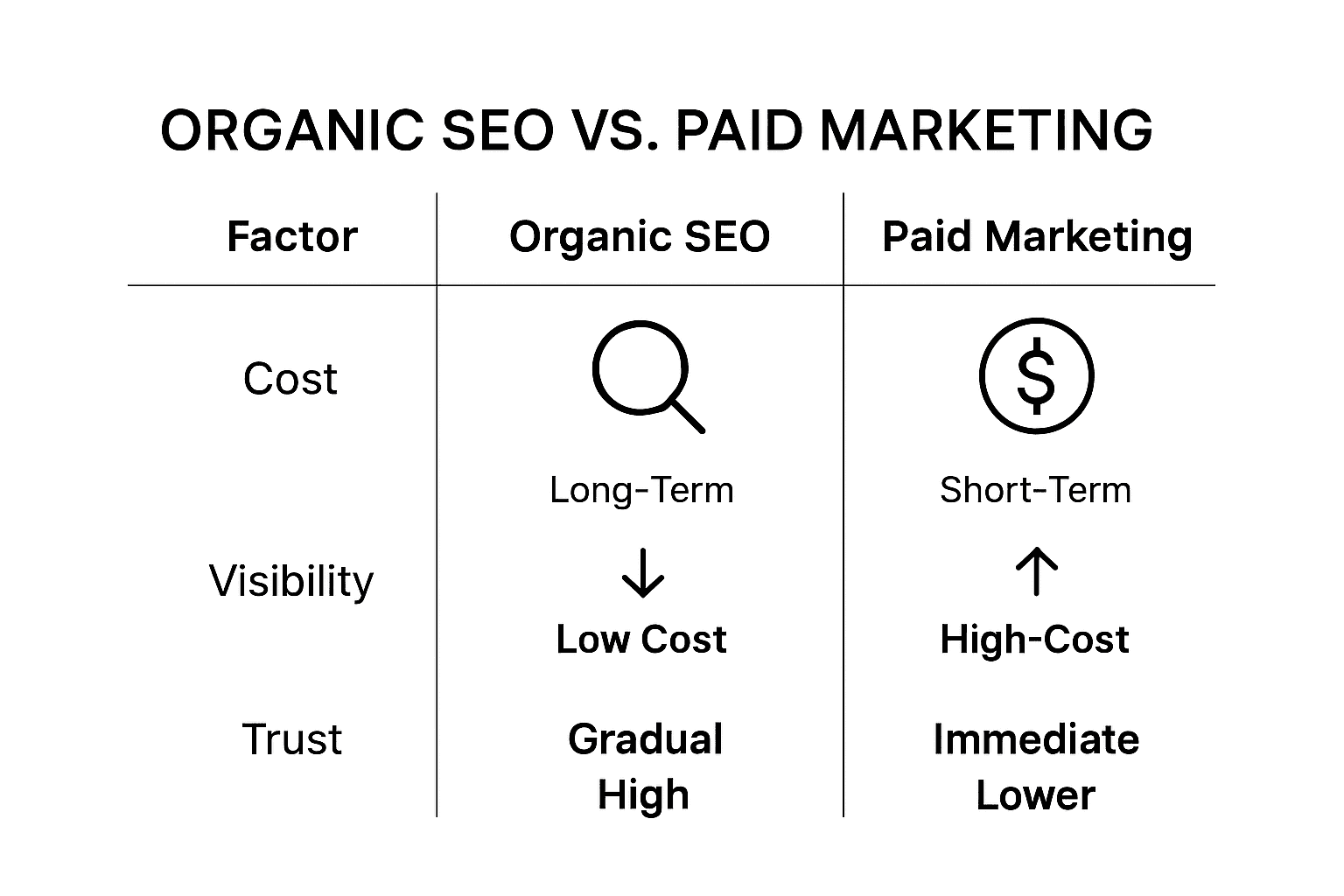
The fundamental difference between SEO and paid marketing lies in user perception and trust. While paid advertisements are clearly marked as promotional content, organic search results carry significantly more credibility with potential customers. Businesses that successfully implement comprehensive SEO strategies can establish deeper trust, create more meaningful connections with their target audience, and develop a reputation as authoritative sources within their specific market segments.
Compare organic SEO to paid digital marketing for e-commerce:
| Factor | Organic SEO | Paid Digital Marketing |
|---|---|---|
| Cost Over Time | Low ongoing, initial investment | Continuous spend required |
| Trust & Credibility | High, perceived as unbiased | Lower, marked as ads |
| Longevity of Results | Long-term lasting impact | Ends when budget stops |
| Speed of Results | Slow buildup, lasting | Immediate, short-lived |
Pro Tip – Marketing Strategy Balance: Develop an integrated approach that leverages both SEO and paid marketing, using organic optimization as your foundational long-term strategy while utilizing paid campaigns for targeted, short-term visibility and market testing.
Unlock the Full Potential of Your Shopify Store with Expert Ecommerce SEO
The article highlights critical challenges like poor site architecture and ineffective keyword strategies that can hold back Shopify stores from achieving top search rankings and driving real revenue. If you want to avoid costly SEO mistakes and build lasting organic traffic, you need specialized solutions that address both technical SEO and content optimization tailored to Shopify’s unique environment.
At Blackbelt Commerce, we understand the power of precise keyword management, custom theme development, and advanced Shopify Plus features to elevate your store’s visibility and conversion rates. Our proven process combines deep SEO expertise with Shopify-specific development, helping you transform your online store into a high-performance selling platform. Discover how our custom Shopify solutions and comprehensive support can help you overcome SEO pitfalls and achieve sustainable growth.
Ready to boost your Shopify store with SEO that drives traffic and revenue now?

Explore our portfolio and services at Blackbelt Commerce and take the first step toward optimized Shopify success. Contact us today to start your free consultation and experience measurable growth through expert eCommerce SEO and Shopify development.
Frequently Asked Questions
What is e-commerce SEO, and why is it important for Shopify stores?
E-commerce SEO is a strategy that enhances the visibility of online stores in search engine results. It’s crucial for Shopify stores because optimized product pages and content drive more organic traffic, improve search rankings, and increase revenue potential.
How can e-commerce SEO drive more traffic to my Shopify store?
E-commerce SEO drives traffic by targeting keywords related to buyer intent, optimizing product descriptions, improving site architecture, and ensuring a seamless navigation experience. This ultimately leads to better visibility in search engine results.
What are some common SEO mistakes to avoid for my Shopify store?
Common mistakes include poor website structure, duplicate content, generic product descriptions, and neglecting mobile optimization. Addressing these areas can greatly enhance your store’s search engine performance and user experience.
How does e-commerce SEO compare to paid digital marketing for Shopify stores?
E-commerce SEO tends to provide more sustainable long-term benefits with lower ongoing costs compared to paid digital marketing. While paid ads can generate immediate visibility, SEO builds lasting authority and consistent traffic without continuous spending.
Recommended
- Shopify SEO Explained: Optimizing for Traffic Growth
- Why Optimize Ecommerce Stores: Complete Guide – Shopify Experts: Grow Your eCommerce Revenue
- Ventajas del SEO en Ecommerce para Tiendas Shopify
- Overcoming E-Commerce Video Marketing Challenges
Quick Answer: Why ecommerce seo matters
Why ecommerce seo matters should help Shopify merchants turn search visibility into qualified traffic, trust, and revenue. The strongest approach connects technical SEO, content, internal links, performance, authority, and conversion paths so organic traffic has a clear commercial next step.
Want a sharper Shopify growth plan?
Want to turn Why ecommerce seo matters into a practical Shopify growth plan? Book a strategy call and we will help you clarify the next move.
Key Takeaways
- Use Why ecommerce seo matters to clarify the business problem and the highest-impact next step for a Shopify store.
- Connect recommendations to customer trust, UX, conversion, SEO, analytics, operations, and revenue.
- Link naturally to Blackbelt Commerce money pages and the home page without weakening editorial trust.
- Avoid generic ecommerce advice; make the guidance specific to Shopify constraints and opportunities.
- Use the same-page Calendly CTA only after the post has delivered useful guidance.
How this connects to your Shopify growth strategy
For the Shopify SEO, Audits, and Organic Growth cluster, this article should make Why ecommerce seo matters practical, specific, and commercially useful while protecting editorial trust. The bridge to Blackbelt Commerce should show when expert planning, implementation, SEO/CRO discipline, or Shopify Plus support can reduce risk and turn the reader’s next decision into measurable progress.
Want a sharper Shopify growth plan?
Use this guide as a decision tool. Then book a strategy call when you want a practical roadmap for your store.
Related Shopify resources
These internal resources support the Shopify SEO, Audits, and Organic Growth topic cluster and help connect this guide to stronger commercial next steps:
- Shopify SEO services
- Shopify experts
- Shopify Plus agencies
- Shopify SEO services — Primary money/service page for this search intent
- Blackbelt Commerce — Home-page authority link for brand and core Shopify expertise
- Shopify experts — Money-page link requested for expert-hiring intent
- Shopify custom development — Development service page for implementation and technical help
- Shopify app SEO — Related SEO tooling article
Questions store owners ask before taking action
Why does Why ecommerce seo matters matter for Shopify merchants?
It matters when the topic affects customer trust, conversion, operations, SEO, analytics, or the team’s ability to scale the store cleanly.
How should the article guide the reader?
It should answer the search intent first, then connect the topic to practical next steps, related resources, and expert support when that next step is useful.
What is the lead-generation goal?
The goal is a qualified strategy-call booking after the article has delivered enough value for the reader to trust Blackbelt Commerce with the next decision.
Future articles needed for topical dominance
To build deeper topical authority around this cluster, these supporting topics should be created later and linked back into this article:
- Why ecommerce seo matters Checklist for Shopify Stores: Creates an actionable support article that can earn long-tail searches and link back to relevant money pages.
- Common Why ecommerce seo matters Mistakes That Hurt Shopify Revenue: Targets problem-aware readers and explains UX, SEO, conversion, and implementation risk.
- How Shopify Experts Prioritize Why ecommerce seo matters: Links informational intent to expert support without turning the main article into a sales pitch.
Want a sharper Shopify growth plan?
Ready to turn the advice in this article into an action plan? Open the calendar here and choose a time that works for you.

