


Blog updated with the most recent Shopify and eCommerce strategies on 05/02/2026.
Shopify Website Builder Pricing Explained: What You Need to Know About Costs and Plans
Getting a solid grip on Shopify’s pricing structure is absolutely crucial for e-commerce success, whether you’re just kicking off a new venture or looking to scale a well-established brand. Having crystal-clear insights into subscription tiers, those sneaky hidden expenses, and smart optimization strategies will empower you to budget effectively and squeeze every drop of value from your investment. This guide dives deep into every cost element—from the Basic plan all the way up to Plus—explores those extra fees, puts Shopify head-to-head with other platforms, and reveals how expert development and consulting can actually slash your overall ownership costs. You’ll walk away knowing:
- The core Shopify plans and what they bring to the table
- The additional costs that pop up beyond the monthly subscription
- How Shopify’s pricing stacks up against WooCommerce, BigCommerce, and Squarespace
- Strategies to boost your ROI and scale without breaking the bank
- Answers to those burning questions about pricing
- Specific pricing scenarios for dropshipping and wholesale models
- How BlackBelt Commerce’s know-how can supercharge your Shopify investment
What Are the Core Shopify Pricing Plans and Their Features?

Shopify rolls out a range of subscription tiers, each crafted to support businesses at various stages of their journey. Every plan strikes a balance between monthly fees and the features designed to amp up your store’s functionality, security, and growth potential. Pinpointing the right tier means aligning it with your revenue, traffic volume, and operational demands.
What Does the Shopify Basic Plan Include and How Much Does It Cost?
The Shopify Basic plan is your go-to for essential e-commerce tools, offering an accessible entry point for new businesses. It equips you with everything needed for storefront creation, payment processing, and basic reporting to get your online shop up and running smoothly.
These foundational features empower startups to launch fast and test their product-market fit before diving into more advanced capabilities.
How Does the Shopify Plan Support Growing E-commerce Stores?
Stepping up to the mid-tier Shopify plan, priced at $79 per month, unlocks scalability features perfect for stores experiencing a surge in traffic and sales. Enhanced reporting and customer segmentation tools are key to accelerating your growth trajectory.
Investing in this plan gives you access to powerful analytics and marketing tools designed to boost repeat purchases and increase your average order value.
What Are the Advantages and Costs of the Shopify Advanced Plan?
The Advanced Shopify plan, at $299 per month, is engineered for businesses ready to scale operations, offering sophisticated automation and robust third-party integration capabilities. It further reduces transaction fees and introduces advanced shipping tools to streamline logistics.
These enterprise-grade features are designed to optimize logistics and reporting, ensuring that high-volume stores maintain peak efficiency and profitability.
How Is Shopify Plus Priced for Enterprise-Level Businesses?
Shopify Plus is a bespoke enterprise solution crafted for merchants generating significant revenue. It encompasses all the features of the Advanced plan, plus dedicated support, expanded API call limits, and access to a rich partner ecosystem.
- Pricing Model: Kicks off around $2,000 per month, with pricing adjusted based on revenue and specific needs
- Key Benefits: Unlimited staff accounts, dedicated launch support, platform-level automation (Flow), enhanced API capacity
- Enterprise Support: 24/7 priority assistance, a dedicated merchant success manager, and a launch engineer
High-volume merchants gain access to tailored SLAs, custom integrations, and a supportive partner network that facilitates global expansion and complex operational workflows.
Shopify Pricing Plans
Shopify provides a spectrum of pricing plans to cater to diverse business requirements, from nascent startups to large enterprises. The Basic plan is the perfect starting point for those launching their inaugural online store, while the Shopify plan is geared towards businesses on a growth trajectory. The Advanced plan is built for scaling operations, and Shopify Plus offers a custom-priced enterprise solution.
This resource offers a comprehensive overview of Shopify’s various plans and their suitability for different business phases, which is fundamental to grasping the core pricing structure.
What Are the Additional Costs Beyond Shopify Subscription Fees?
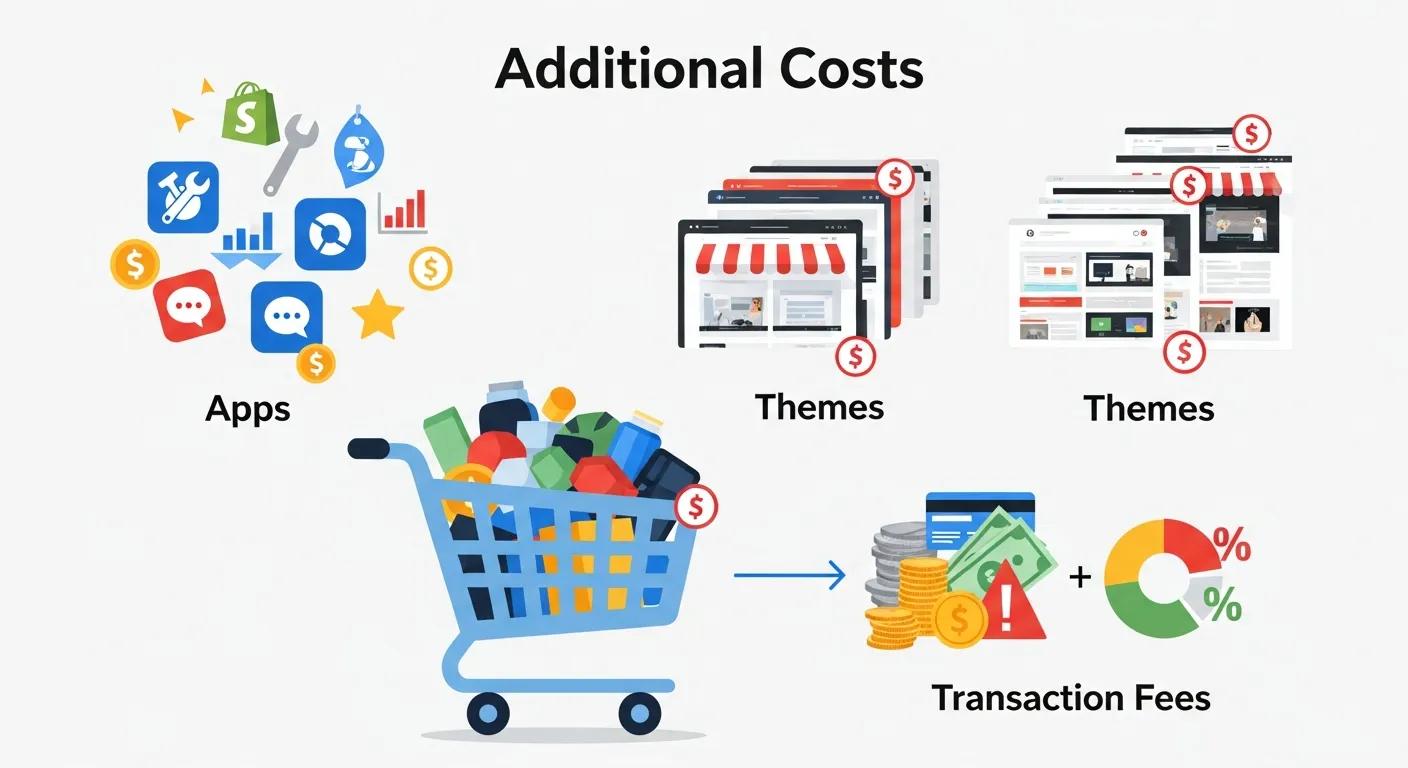
While your subscription fee covers the platform’s core functionality, the total cost of ownership extends to essential add-ons like apps, themes, transaction fees, and potential development work. Being aware of these expenses is key to avoiding budget overruns and enabling strategic financial planning.
Which Shopify Apps and Themes Affect Your Store Budget?
Premium apps and themes are fantastic for extending functionality, but their recurring charges can add up significantly over time. Here’s a look at popular app categories and their typical monthly price ranges:
- Marketing Automation Apps: $20–$100
- Inventory Management Integrations: $30–$80
- Customer Reviews and Loyalty Programs: $10–$50
- Premium Theme Licenses: $150–$350 (one-time fee)
Selecting apps that demonstrate a clear return on investment and themes optimized for conversion will help maintain profitability without compromising the user experience.
Shopify App Costs
Shopify apps can dramatically enhance a store’s capabilities, but their costs can accumulate quickly. Prices span a wide range, from free options to those costing hundreds per month, depending on the features and usage levels. Email marketing apps, for instance, often charge based on the number of contacts or emails dispatched.
This source sheds light on the expenses tied to Shopify apps, a critical component of the overall cost of ownership.
How Do Payment Processing and Transaction Fees Impact Your Profit Margins?
Payment processing fees fluctuate based on your chosen plan and the payment gateway you utilize. Shopify Payments eliminates extra transaction fees but still applies standard credit card processing rates.
Optimizing your payment setup and making the most of Shopify Payments wherever possible helps prevent surcharge stacking and protects your profit margins as your sales volume climbs.
Shopify Transaction Fees
Shopify levies transaction fees on every sale, with the rate varying according to the selected plan. The Basic plan incurs a 2.9% + $0.30 fee per online transaction, the Shopify plan has a 2.6% + $0.30 fee, and the Advanced plan features a 2.4% + $0.30 fee.
This citation underscores the transaction fees associated with different Shopify plans, a vital element of the overall expenditure.
When Should You Consider Custom Shopify Development and What Does It Cost?
Opting for custom development opens the door to advanced features, unique user experience designs, and performance optimizations precisely tailored to your brand. Typical project scopes and their associated budgets include:
- Theme CustomizationMechanism: Adapting premium templates to perfectly match brand guidelinesInvestment: $2,000–$6,000, depending on the complexity involved
- Custom App IntegrationsMechanism: Developing private apps to handle unique operational workflowsInvestment: $5,000–$15,000
- Full Store BuildMechanism: Comprehensive design, development, and migration servicesInvestment: $10,000–$25,000
Collaborating with seasoned experts ensures high-quality code, robust scalability, and a faster path to revenue generation. Discover how BlackBelt Commerce’s custom Shopify development services can align your costs with your ambitious growth objectives.
Shopify Website Development Costs
The expense of building a Shopify website can fluctuate dramatically, ranging from virtually free when utilizing a trial and a free theme to upwards of $20,000, contingent on the project’s complexity, design intricacies, and desired functionalities. Custom Shopify website design typically commences in the $10,000–$20,000 range.
This source offers valuable insights into the costs associated with Shopify website development, a key consideration for any business.
How Does Shopify Pricing Compare to Other E-commerce Platforms?
Taking a look at the alternatives helps clarify where Shopify’s blend of subscription fees and features provides a competitive edge or presents potential trade-offs.
What Are the Key Differences Between Shopify and WooCommerce Pricing?
Juxtaposing Shopify’s all-inclusive hosted model with WooCommerce’s self-hosted approach highlights significant differences in their cost structures:
Shopify simplifies the complexities of hosting, security, and updates, whereas WooCommerce offers a lower initial cost but demands more ongoing maintenance effort.
Shopify vs. WooCommerce Pricing
Shopify’s pricing model involves consistent monthly subscription fees, whereas WooCommerce is a free plugin that necessitates separate expenditures for hosting, domain registration, and other essential components. Shopify’s integrated pricing can offer superior value for users less comfortable with technical aspects, while WooCommerce can prove more economical for those possessing technical proficiency.
This source provides a direct comparison of Shopify and WooCommerce pricing models, crucial for understanding Shopify’s cost relative to its competitors.
How Does Shopify Stack Up Against BigCommerce and Squarespace in Terms of Cost?
While BigCommerce and Squarespace offer comparable hosted solutions, their pricing structures and transaction fee policies present distinct differences:
- BigCommerce: $29.95–$299.95/mo, no transaction fees, with annual sales volume thresholds
- Squarespace Commerce: $27–$49/mo, a 3% transaction fee on the lower-tier plan, and integrated design flexibility
For merchants who prioritize extensive extensibility and advanced marketing capabilities, Shopify’s feature set and robust app ecosystem often justify its slightly higher price point compared to these competitors.
How Can You Maximize Your ROI When Investing in Shopify?
Smart budgeting and strategic optimization are your keys to ensuring every dollar spent fuels growth and boosts profitability.
What Are the Best Practices for Scaling Your Shopify Store Cost-Effectively?
- Audit Apps Quarterly – Ruthlessly remove any integrations you’re not actively using and renegotiate plans to eliminate redundant charges.
- Optimize Theme Performance – Minimize custom code bloat and compress assets to slash page-load times and improve user experience.
- Negotiate Payment Rates – Proactively share higher volume forecasts with payment providers to secure reduced processing rates.
- Leverage Free Marketing Tools – Maximize built-in SEO features and organic social media channels before committing to paid apps.
- Automate Repetitive Tasks – Implement automated workflows for order processing to significantly cut down on labor costs.
Conducting regular cost reviews is essential to prevent unexpected budget spikes as your sales volume and operational complexity increase.
How Does Custom Development Enhance Shopify Store Performance and Profitability?
Tailored code and strategically implemented integrations are proven methods for elevating user experience, boosting conversion rates, and streamlining operational efficiency. For instance, a custom-built checkout app can demonstrably reduce cart abandonment by as much as 15%, directly impacting revenue. Engaging experienced developers ensures that new features align perfectly with your business logic and can scale seamlessly without disrupting core functionality.
What Are Common Questions About Shopify Pricing?
This section tackles the most frequent pricing queries, offering clear explanations of cost structures to guide merchants in making well-informed decisions.
How Much Does Shopify Cost Per Month Across Different Plans?
Shopify’s monthly subscription fees are standardized for each plan:
- Basic: $29/mo
- Shopify: $79/mo
- Advanced: $299/mo
Additionally, Shopify Plus offers custom enterprise pricing starting around $2,000/mo. It’s important to remember that these rates do not include supplementary costs for transaction processing, apps, or any custom development work.
Are There Hidden Fees or Extra Charges With Shopify?
While the core subscription rates are transparently listed, you should always factor in potential additional costs such as:
- Premium app subscriptions ($10–$100+/mo)
- Paid themes ($150–$350 one-time purchase)
- Third-party gateway surcharges (ranging from 0.5% to 2.0%)
- Development and design projects ($2,000–$25,000+, depending on scope)
Incorporating these into your total cost of ownership projections is key to avoiding unexpected expenses as your business expands.
Is Shopify Affordable for Small Businesses and Startups?
Absolutely. Shopify’s entry-level plan at $29/mo is perfectly suited for budget-conscious merchants. Minimal setup expenses and the availability of free themes allow for lean, cost-effective launches, with the option to incrementally add paid apps and upgrades as revenue streams grow.
How Much Does It Cost to Build a Shopify Website From Scratch?
A comprehensive build—encompassing design, development, data migration, and the final launch—typically falls within the $10,000 to $25,000 range. This cost is influenced by the complexity of custom features, required integrations, and the overall intricacy of your brand’s requirements. More incremental approaches, like partial design overhauls or template customizations, can start as low as $2,000.
What Specific Shopify Pricing Scenarios Should You Consider?
Different business models present unique cost drivers that can significantly impact your choice of plan and overall budget allocation.
How Does Shopify Pricing Work for Dropshipping Businesses?
Dropshipping merchants typically prioritize minimal upfront investment and robust automation:
- The Basic or Shopify plan usually covers essential needs
- Budget for apps that sync with suppliers ($20–$50/mo)
- Utilize abandoned cart recovery tools to recapture lost sales
- Transaction fees can be offset by volume discounts as revenue increases
What Are the Pricing Factors for Wholesale Shopify Stores?
Wholesale operations necessitate features like custom pricing tiers, bulk discount options, and dedicated B2B portals:
- Consider Shopify Advanced or Plus for custom scripts and specialized workflows
- Explore the Wholesale Channel add-on ($39/mo on the Shopify plan)
- Factor in custom app development ($5,000–$15,000) for implementing tiered pricing logic
- Look for capabilities in automated order approval and net payment terms management
How Does BlackBelt Commerce Help You Understand and Optimize Shopify Pricing?
BlackBelt Commerce equips merchants with transparent cost breakdowns and expertly tailored solutions designed to boost profitability and streamline operations.
What Custom Shopify Development Services Does BlackBelt Commerce Offer?
BlackBelt Commerce provides a full spectrum of services, including end-to-end store builds, meticulous theme customization, bespoke private app creation, and advanced performance optimization. Their deep expertise ensures your Shopify investment perfectly aligns with your brand’s vision—discover more about BlackBelt Commerce’s custom Shopify development services here.
How Can Expert Consulting Reduce Your Total Shopify Ownership Costs?
Strategic consulting involves a thorough audit of your existing app ecosystem, optimization of payment and shipping configurations, and the implementation of cost-saving automation strategies. By focusing on high-impact improvements, expert consulting often proves its value many times over through reduced fees and enhanced conversion rates.
Where Can You Find Case Studies Demonstrating Shopify Cost Savings?
Real-world success stories highlight how optimized app selections and streamlined custom workflows have led to cost reductions of up to 20% for rapidly growing retailers. Dive into BlackBelt Commerce’s portfolio to witness these transformative success stories firsthand.
BlackBelt Commerce masterfully blends profound Shopify expertise with clear, straightforward pricing guidance to guarantee your e-commerce investment yields maximum value. By thoroughly understanding every cost element—from the foundational subscription tiers right through to intricate custom development—you can establish predictable budgets, sidestep hidden fees, and scale your business with confidence and efficiency. Partner with BlackBelt Commerce and transform Shopify pricing from a potential hurdle into a powerful strategic advantage for your business.
Quick Answer: Shopify website builder pricing
Shopify website builder pricing includes more than the platform subscription because a revenue-ready store often needs planning, theme configuration, content, product structure, apps, analytics, SEO basics, QA, and sometimes expert design or development. Merchants should compare the cost of building quickly with the cost of launching a store that does not support conversion, operations, or future growth.
Key Takeaways
- Shopify website builder pricing should include the practical work required to turn a builder into a polished ecommerce experience.
- The article should help readers understand platform, theme, content, apps, product structure, SEO, analytics, QA, and expert support at a high level.
- Internal links should connect builder-pricing questions to Cost of Shopify website, Shopify experts, Shopify Plus agencies, custom development, and CRO resources.
- The commercial bridge should show when a do-it-yourself builder path needs expert help to protect quality and conversion.
- Use the same-page Calendly CTA so qualified merchants can book a strategy call without being pushed into a long form.
How this connects to your Shopify growth strategy
This article should remain useful for readers researching Shopify website builder pricing, but it also needs to show when the topic becomes a business decision. For the Shopify Cost & Pricing cluster, the commercial bridge is practical: once the reader understands the concept, the next step is deciding whether their current Shopify setup can support the desired experience, conversion path, and operational workflow. That is where expert planning, design, development, CRO, and SEO support can turn the idea into measurable store improvements.
Related Shopify resources
These internal resources support the Shopify Cost & Pricing topic cluster and help connect this guide to stronger commercial next steps:
- Shopify Cost & Pricing
- Shopify experts
- Shopify Plus agencies
- Shopify Cost & Pricing — Parent service page for the reader’s next commercial step
- Blackbelt Commerce — Home-page authority link for brand and core Shopify expertise
- Shopify experts — Money-page link requested for expert-hiring intent
- Shopify Plus agencies — Money-page link requested for high-growth and Plus-agency intent
- Shopify custom development — Development service page for implementation and technical help
- Shopify CRO — Conversion service page for readers focused on revenue and lead generation
- Shopify Plus checkout customization — Related Shopify Plus implementation guide for readers evaluating advanced Plus costs and capabilities
Questions store owners ask before taking action
What is included in Shopify website builder pricing?
The budget can include the platform plan, theme work, content, products, collections, apps, analytics, SEO basics, QA, launch support, and any expert design or development.
Is a website builder cheaper than hiring Shopify experts?
It can be cheaper upfront, but expert support may reduce rework and improve quality when the store needs stronger UX, integrations, CRO, SEO, or custom development.
What should merchants avoid when using a builder?
Avoid launching with unclear navigation, weak product content, too many apps, poor mobile UX, missing analytics, or no plan for SEO and conversion.
Should the article include exact current Shopify prices?
It should not rely on unsupported current prices. Readers should verify current Shopify pricing and use the article to understand the broader build budget.
How should this article lead to a call?
It should help readers understand the real work behind a builder-based store, then invite them to book a strategy call if they need a better launch plan.
Future articles needed for topical dominance
To build deeper topical authority around this cluster, these supporting topics should be created later and linked back into this article:
- Shopify Website Builder Pricing Budget Checklist for Shopify Merchants: Creates a practical support article that turns the Shopify Cost & Pricing topic into an actionable planning worksheet without relying on stale price claims.
- Hidden Cost Drivers Behind Shopify Website Builder Pricing: Captures cost-aware searches and explains apps, design, content, SEO, integrations, QA, and rework risks without hard selling.
- When to Hire Shopify Experts for Shopify Website Builder Pricing: Connects pricing research to the expert-hiring money page while preserving educational intent and lead-generation flow.

