


Blog updated with the most recent Shopify and eCommerce strategies on 05/02/2026.
If you’re running a Shopify store and you’ve ever stared at Google Analytics wondering why organic traffic looks like a flatline on a heart monitor, this is for you. Over the last decade, I’ve watched hundreds of founders pour money into Meta ads, influencer campaigns, and discount codes — all while their Shopify SEO strategy sits dormant in some forgotten tab labeled “we’ll get to it next quarter.” Then Q4 comes, ad costs spike, ROAS tanks, and suddenly organic search becomes an emergency. This playbook is about avoiding that emergency entirely — and it’s the same Shopify SEO strategy we’ve run for brands at every scale.
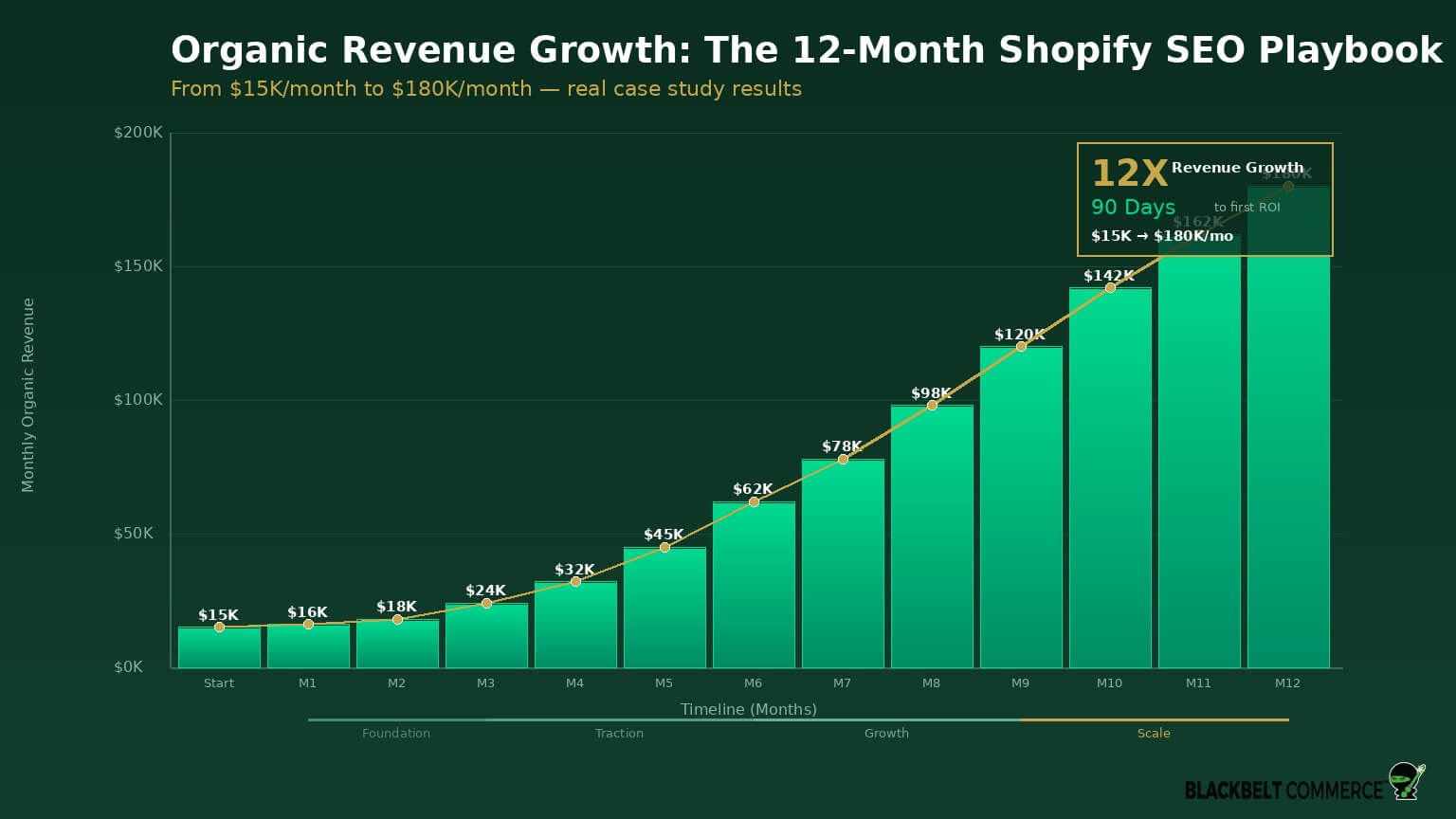
What follows is the exact 90-day framework we used to take a mid-sized Shopify store from roughly $15,000 per month in organic revenue to $180,000 per month — a 12x lift — over the course of a year. The first three months set the foundation. Months four through twelve are where compounding kicks in. I’ll walk you through every phase, every mistake we watched competitors make along the way, and the uncomfortable numbers behind what it actually costs to do this right.
I’m not going to pretend this is magic. It isn’t. It’s a repeatable system, and by the end you’ll have enough detail to either run it yourself or know exactly what to look for when you hire a Shopify SEO expert to run it for you. Let’s get into it.
The Problem Most Shopify Store Owners Don’t See Coming
Here’s the uncomfortable truth: most Shopify stores are built on rented land. When 70% of your revenue comes from paid social, and Meta decides to “update” its attribution model, or iOS 14 breaks your pixel, or your CPMs double in Q4 because every other store is bidding against you — your business doesn’t just wobble. It cracks. I’ve sat across the table from eight-figure founders who couldn’t sleep because a single ad account suspension was threatening payroll.
The root cause isn’t that paid ads are bad. Paid ads are a fantastic accelerant. The problem is that most founders treat paid as the foundation and organic as a “nice to have.” That’s backwards. Organic search drives 43% of all ecommerce traffic and accounts for 23.6% of ecommerce orders, according to industry data compiled across dozens of studies. It’s the single largest acquisition channel in ecommerce, and it’s the one most Shopify stores fundamentally neglect.
Why? Because Shopify makes it easy to launch and sell, but it’s genuinely hostile to Shopify SEO out of the box. The default URL structures create duplicate content. Collection pagination generates thin pages that dilute authority. Product descriptions get copy-pasted from manufacturers and instantly flagged as duplicates across the entire web. The blog feature is buried in a corner of the admin panel like an afterthought. And the theme’s default schema markup, if it exists at all, is often incomplete.
On top of the platform issues, there’s a psychological trap. Founders are wired for short feedback loops. You launch an ad, you see sales within 48 hours. Dopamine hits. Meanwhile, SEO is a three-to-six month commitment before you see meaningful movement, and twelve months before it really compounds. Most founders don’t have the patience or the cash cushion to wait. So they keep feeding the ad machine, keep shrinking their margins, and keep wondering why the business isn’t scaling the way they projected.
“If your store gets 10,000 organic visits a month at a 2.8% conversion rate and an $80 average order value, that’s $22,400 in monthly revenue — with zero marginal customer acquisition cost. That’s not a side channel. That’s a business.”
The founders who break out of the plateau are the ones who stop treating Shopify SEO as an IT task or a budget line item and start treating it as a core profit center. Acquirers pay premiums for organic revenue because it doesn’t evaporate the day you turn off the ad spend, and stores with a real Shopify SEO strategy exit at meaningfully higher multiples than stores that live and die on paid.
Key takeaway: If your store relies on paid ads for more than 60% of revenue, you don’t have a business — you have a subscription to Meta. Fix that first by building an organic foundation.
The 90-Day Framework We Used to 12X Organic Revenue
Let me introduce the case study without naming the client, because we’ve signed an NDA and honestly, the specific vertical doesn’t matter — the framework does. Picture a mid-market Shopify store in a considered-purchase category: average order value around $140, product catalog of roughly 400 SKUs, decent brand recognition within a niche community, doing about $15K per month in organic revenue when they came to us. They were spending roughly $80K per month on Meta and Google Ads, and their blended ROAS had dropped from 3.2x to 1.8x over eighteen months. They were profitable, but barely, and they knew they couldn’t outrun rising ad costs forever.
When we audited the site, the diagnosis was typical: the technical foundation was leaking authority in twelve different ways, the keyword targeting was built around brand terms they already ranked for and generic head terms they had no shot at, and the content strategy consisted of six blog posts from 2019 about “how to style” their products. The link profile was thin. Product pages read like they’d been written by a committee of lawyers.
So we built a 90-day plan. Not a 30-day miracle, not a “six months to double your traffic” fantasy. Ninety days to lay the foundation, then nine more months of disciplined execution. Here’s how the phases map:
- Phase 1 (Weeks 1–3): Technical foundation — fix the plumbing before you turn on the water.
- Phase 2 (Weeks 3–6): Keyword architecture — map every commercially valuable search to a specific URL.
- Phase 3 (Weeks 4–10): Content that converts — optimize product and collection pages, then build clusters around buyer intent.
- Phase 4 (Weeks 6–12): Authority building — earn links from places that actually move the needle.
- Phase 5 (Ongoing): Conversion optimization — where SEO meets CRO, because rankings without revenue are just vanity.
Notice how the phases overlap. This isn’t a waterfall. By week four you’re doing technical cleanup, keyword mapping, and drafting your first optimized product pages simultaneously. The overlap is intentional — it’s how you compress a year of work into a quarter.
Phase 1 — Technical Foundation (Weeks 1–3)
You cannot out-content a broken site. I’ve watched stores publish beautiful blog posts for eighteen months and see zero ranking improvement because Googlebot couldn’t crawl half the pages, or because duplicate content was splitting their authority across five variants of the same URL. Technical Shopify SEO isn’t glamorous, but it’s the prerequisite for everything else.
On our case study store, the first week was pure audit. We ran the site through Screaming Frog, Ahrefs Site Audit, and Google Search Console’s Coverage report in parallel. Here’s what the inventory of problems looked like, and it’s almost identical to what we find on most Shopify stores:
- Duplicate URLs from collection filters: Shopify generates a unique URL every time a user filters a collection (
?sort_by=price-ascending,?filter.v.color=blue, etc.). Without proper canonical tags, Google indexes dozens of near-identical pages per collection. - Product URLs duplicated across collections: The same product accessible at
/products/widget,/collections/bestsellers/products/widget, and/collections/new-arrivals/products/widgetcreates three URLs competing for the same query. - Thin collection pages: Collections with two or three products and no descriptive copy, ranked nowhere because Google saw them as low-value.
- Slow mobile performance: LCP over 4 seconds, CLS jumping all over the place because of lazy-loaded images without dimension attributes.
- Missing or broken schema: No Product schema on product pages, no BreadcrumbList, no Organization — all of which help Google understand context and enable rich results.
- Orphaned pages: Dozens of products not linked from any collection, effectively invisible to both users and crawlers.
The fixes, in order of impact: first, we set site-wide canonical rules so every product URL canonicalized to /products/[handle] regardless of which collection path the user entered from. This alone consolidated authority across hundreds of duplicate URLs. Second, we added faceted navigation rules via robots.txt and meta robots tags so filtered collection URLs were noindexed but still crawlable for internal link equity. Third, we rewrote every collection page over 20 products to include a 250–400 word intro above the product grid, with H1s mapped to commercial keywords. Collections with fewer than five products were either consolidated or noindexed.
On the speed side, we moved to a lighter theme (the store had been on a heavy, image-bloated template), compressed every above-the-fold image to WebP, deferred non-critical JavaScript, and pruned four apps that were loading render-blocking scripts on every page. LCP dropped from 4.2 seconds to 1.9 seconds on mobile. According to Google, a delay of just one second in page load time can reduce conversions by 7% — so we weren’t just fixing SEO, we were unlocking conversion revenue we were already paying ads to drive.
Schema markup was the last piece. We implemented Product, Offer, AggregateRating, Review, BreadcrumbList, and Organization schema site-wide. Within four weeks, rich snippets (price, stars, availability) started appearing in search results for the store’s product pages. CTR on those results lifted by roughly 22% based on Search Console data, which means we were earning more traffic from the same rankings before we’d even published new content.
One note specific to Shopify: the platform’s limitations on robots.txt and the /a/ subdirectory can make advanced technical work painful. For stores that need deeper customization — custom metafield-driven schema, headless architecture, multi-storefront internationalization — you often need custom Shopify development to push past the platform’s defaults. Most stores don’t need to go that far, but the larger you get, the more those limitations start to matter.
Key takeaway: Don’t publish a single blog post until your technical foundation is audited and fixed. You’re leaking authority every day you wait.
Phase 2 — Keyword Architecture (Weeks 3–6)
Most keyword research I see from founders (and, honestly, from a lot of agencies) is fundamentally broken. They pull a list of 10,000 keywords from Ahrefs, sort by volume, and call it a Shopify SEO strategy. That’s not a strategy. That’s a spreadsheet.
The shift we made with our case study client — and the shift every serious Shopify SEO expert should make — is moving from traffic-based keyword selection to revenue-based keyword selection. Not all traffic is equal. A search for “best running shoes for flat feet” is worth orders of magnitude more to a shoe retailer than “history of running shoes,” even if the latter has ten times the volume. Intent is everything.
We classify keywords across three layers of intent:
- Transactional / commercial: Searches where the user is ready to buy or evaluating options to buy. These are money terms — “[product category] + [modifier],” “best [product] for [use case],” “[brand] vs [competitor],” “[product] under $[price].” These map to product and collection pages.
- Commercial investigation: Searches where the user is pre-purchase, doing research. “How to choose [product],” “what to look for in [product],” “[product] buying guide.” These map to buying guides and comparison content that links to your product pages.
- Informational: Searches where the user has a problem your product might solve. “How to fix [problem],” “why does [thing] happen.” These are top-of-funnel, slower to convert, but critical for building topical authority.
For the case study store, the keyword map followed a 70/20/10 split: 70% of effort into commercial keywords mapped to product and collection pages, 20% into buying guides and comparison content, and 10% into broader informational content that built topical relevance and attracted links.
The competitor gap analysis is where this gets interesting. We took the top five competitors, ran them through Ahrefs’ Content Gap tool, and pulled every keyword where at least three of the five ranked in the top 20 but our client did not. That surfaced roughly 1,400 keywords. We filtered for commercial intent (modifiers like “best,” “buy,” “review,” “vs,” “under $”) and monthly volume over 50, which narrowed it to about 320 high-priority keywords.
Then comes the mapping. Every keyword on that list gets assigned to exactly one URL — either an existing page or a new page we planned to create. No keyword cannibalization. If “best waterproof hiking boots” was going to be the target for /collections/waterproof-hiking-boots, then no product page, no blog post, and no other collection was allowed to target that phrase. We track the master map in a single spreadsheet with columns for URL, primary keyword, secondary keywords, search volume, current ranking, target ranking, and owner.
“Ranking #1 for a keyword with 200 monthly searches and commercial intent is worth more than ranking #1 for a keyword with 20,000 monthly searches and zero buying intent. Revenue, not traffic, is the metric that matters.”
The long-tail strategy deserves a special mention. The average ecommerce brand ranks for 1,783 keywords organically, but the bulk of that traffic is almost always concentrated in long-tail commercial terms, not the head terms founders fixate on. Trying to rank for “running shoes” is a multi-year, seven-figure undertaking. Ranking for “zero drop trail running shoes for wide feet” is achievable in three months with focused content, and the searcher is dramatically more likely to convert.
Key takeaway: Before you write a single piece of content, build a keyword map where every commercially valuable search in your niche is assigned to exactly one URL on your site. If you can’t name the page that targets a given keyword, you don’t have a strategy — you have a wishlist.
Phase 3 — Content That Converts (Weeks 4–10)
Content strategy for Shopify is not “write four blog posts a month and hope something ranks.” That’s spray-and-pray SEO, and it’s why most stores give up after six months with nothing to show for it. Real content strategy for ecommerce is layered: optimize the pages that directly generate revenue, build clusters of content that capture buyers earlier in their journey, and link those clusters back to the money pages.
Product page optimization. On the case study store, every product page got rewritten from scratch. The template has seven components: a benefit-led H1 with the primary keyword; a sub-headline about the specific use case; a three-bullet “why this is different” block above the fold; detailed specs; a “who this is for” section; a FAQ with 4–6 questions targeting long-tail variants; and SEO-supporting copy below the fold. Every FAQ was marked up with FAQPage schema. Average product pages went from 180 words of recycled manufacturer copy to 750–900 words of original, use-case-driven writing.
Collection page optimization. Collections are Shopify’s most underutilized SEO asset. Every collection that targeted a commercial keyword got a 400–600 word intro above the product grid, structured as: H1 with target keyword, two paragraphs of category context, a short “how to choose” section with 3–4 bullet points, and internal links to related collections and buying guides. Below the product grid, we added another 200–300 words of supporting copy that went deeper on the category — often answering the “People Also Ask” questions we pulled from the SERPs.
Content clusters around purchase intent. Around each of the top ten commercial collections, we built a content cluster: one pillar buying guide, three to five comparison articles, and two to three “how to choose” pieces. For example, if the collection was “merino wool base layers,” the cluster included a pillar “The Complete Guide to Merino Wool Base Layers,” comparisons like “Merino vs Synthetic Base Layers” and “Icebreaker vs Smartwool,” and how-to pieces like “How to Choose the Right Merino Weight” and “How to Care for Merino Wool.” Every article in the cluster linked to the pillar, to each other where relevant, and — most importantly — back to the commercial collection.
Comparison and buying guide content. These pieces did the heaviest lifting for BOFU traffic. A well-executed “Brand A vs Brand B” article targeting users in the consideration phase can convert at 5–8% — double or triple a typical blog post. Template: intro framing the decision, side-by-side comparison table, sections for key differentiators, a “who should buy each” recommendation, and an internal link to the store’s curated collection. Not manipulative — actually useful — and the rankings and conversions followed.
The writing itself matters. Manufacturer copy and AI-generated filler don’t work in the AI-overview era. Google’s systems are increasingly good at identifying original, experiential content versus regurgitated copy. The stores winning in AI search results are the ones publishing content with clear point of view, specific examples, and genuine expertise. If you’re leveraging AI in your workflow, do it as an acceleration layer — not a replacement for voice. That’s something we cover on our AI-powered SEO page.
By week ten, the case study store had rewritten 180 product pages, optimized the top 40 collection pages, and published 22 cluster pieces. Organic traffic had lifted 28% month-over-month, and 340 keywords had moved into the top 20 for the first time. That’s compounding starting to kick in.
Key takeaway: Content for Shopify isn’t a blog. It’s a system where every piece of writing — on a product page, a collection page, or a blog post — either directly converts or links to a page that does.
Phase 4 — Authority Building (Weeks 6–12)
Let’s talk about links, because this is where most ecommerce SEO goes sideways. Outdated tactics — guest posts on irrelevant blogs, link exchanges, buying from shady networks — are at best ineffective and at worst actively dangerous. Google’s spam updates have gotten brutal about penalizing sites with unnatural link profiles. A modern Shopify SEO strategy for authority looks different.
Here’s the framework we use, in rough order of ROI:
- Supplier and partner links. Nearly every branded supplier has a “Where to Buy” page. Most stores never ask to be listed. For our client, we requested 32 supplier listings and got 21. High-authority, contextually perfect links with zero risk.
- Digital PR and thought leadership. We pitched the founder as an expert source through HARO (now Connectively), Qwoted, and direct pitches to niche writers. Six months produced 14 editorial mentions including two Tier 1 publications, averaging DA 72. One feature drove 2,800 referral visits in its first month and still passes authority years later.
- Resource page link building. We identified curated resource pages in the niche and pitched the client’s buying guides as additions. Of 120 outreach emails, we secured 18 placements. Slow to scale but extremely durable.
- Original data and research. We mined the client’s anonymized purchase data for industry trends, produced a 2,000-word report with five original data points, and earned 23 links over three months. Data-driven content is the highest-ROI link bait format in ecommerce.
- Community and forum presence. Not for links directly, but for topical relevance and brand searches. The founder contributed genuinely in Reddit and niche Discord servers. Branded search volume increased 47% over six months.
What we deliberately did not do: no bought links, no mass guest posting, no PBN campaigns, no random link exchanges. Every link was from a page with actual topical relevance and human editorial review.
The math on link building is harsh. A high-quality editorial placement from a DA 60+ publication in your niche can cost $200–$500 in outreach and content production, if you’re doing it efficiently with internal resources. If you’re buying placements from aggregator networks, you’re paying $300–$1,500 per link, and the quality varies wildly. A serious Shopify SEO strategy treats authority building as a slow, compounding investment — not a one-time campaign.
Key takeaway: Stop thinking about “link building” and start thinking about “authority building.” The byproduct of being genuinely notable in your niche is links. Chase the cause, not the effect.
Phase 5 — Conversion Optimization (Ongoing)
Here’s the part most SEO agencies skip, and it’s the part that determines whether your organic investment actually turns into cash. Rankings are not revenue. A page at #3 converting at 0.4% is worth a fraction of a page at #6 converting at 3.2%. This is where Shopify SEO and CRO have to merge.
On our case study store, once a page hit the top 10 and started pulling consistent organic traffic, it moved into our CRO cycle. Four steps:
- Instrument it. Heatmaps (Hotjar or Microsoft Clarity), scroll-depth tracking, session recordings, and event tracking for every meaningful interaction (add to cart, size selector used, FAQ expanded, etc.). You cannot optimize what you don’t measure.
- Identify the friction. Watch 15–20 session recordings of users who didn’t convert. Ninety percent of the time, the problem is obvious: they hit a price objection, they can’t find shipping information, they get confused by variant selection, they bounce on a slow mobile page.
- Hypothesize and test. Build a hypothesis framed as “If we change X, then Y will happen because Z.” Run the test for long enough to hit statistical significance — usually 2–4 weeks for a page with steady traffic.
- Roll out or roll back. Only ship changes that move the primary metric meaningfully. If a test is flat, don’t ship it just because it’s “prettier.”
The wins came from unsexy changes. A shipping threshold indicator on product pages lifted AOV 14%. Moving trust badges from footer to above the add-to-cart button lifted conversion 11%. Rewriting the “why this is different” block on the 40 highest-traffic products lifted conversion 23% on average. Not rocket science — just the discipline of treating every high-traffic page as an experiment.
The measurement framework matters more than any individual test. We tracked revenue per organic session — not traffic, not rankings, not even conversion rate in isolation — as the north star metric. Revenue per session integrates everything: traffic quality, conversion rate, and AOV. If revenue per session is going up, the business is winning. If it’s flat while traffic grows, you’re buying eyeballs that don’t matter. This is the intersection where technical SEO meets the craft of conversion rate optimization, and it’s the intersection where compounding returns live.
Key takeaway: SEO that doesn’t convert is an expensive hobby. Every ranking win should trigger a CRO cycle on that page. Measure revenue per session, not rankings.
The 7 SEO Mistakes That Keep Shopify Stores Invisible
Every engagement starts with an audit, and after hundreds of audits we see the same seven mistakes with almost suspicious consistency. If you fix nothing else after reading this, fix these.
1. Ignoring Shopify’s duplicate content problem. Shopify creates duplicates three ways: products accessible through multiple collection paths, filtered collection URLs with query parameters, and tag pages mirroring collections. Each duplicate splits Google’s understanding of which URL should rank. The fix combines canonical tags, meta robots directives for filtered URLs, and consolidating tag pages. Most themes handle this partially. Very few handle it correctly out of the box.
2. Writing product descriptions that are just manufacturer copy. If your description is identical to what’s on the manufacturer’s site and every other retailer’s site, Google has no reason to rank your page over theirs. It’s the single most common reason product pages don’t rank. Original copy — even 300 words of genuinely differentiated writing about who the product is for and how to use it — will outperform recycled manufacturer specs every time.
3. Treating the blog as an afterthought. Shopify’s blog feature is hidden in the admin for a reason — Shopify is a commerce platform, not a content platform. But the blog still matters. For a properly optimized store, blog content can drive 30–50% of organic traffic and feed buyers into commercial pages. Treating it as a quarterly checkbox leaves the highest-leverage content asset on the table.
4. Not building internal links between blog and product pages. The biggest missed opportunity I see. Stores publish great blog content, rank it reasonably, and then fail to link from that content to the commercial pages that would convert the traffic. Every blog post should have at least two or three contextual links to relevant collections or products. Internal linking is free authority flow, and most stores leave it on the floor.
5. Chasing vanity keywords instead of buyer-intent terms. Ranking for “sneakers” will take five years and a war chest. Ranking for “minimalist running sneakers for narrow feet” will take three months and convert at 4x the rate. Buyer-intent long-tail keywords are where ecommerce Shopify SEO pays the bills.
6. Neglecting mobile page experience. Google uses mobile-first indexing. If your mobile experience is slow, janky, or broken on older devices, you’re losing rankings and conversions simultaneously. Only 47% of websites currently pass Google’s Core Web Vitals assessment, according to recent industry data. That means more than half your competitors are as vulnerable on this axis as you are. Fix it and you pass most of them. The Core Web Vitals — LCP (loading), INP (interactivity), and CLS (visual stability) — are not optional.
7. No measurement framework — flying blind without GSC + GA4. If you can’t tell me your organic sessions, organic revenue, top ten landing pages by organic traffic, and top ten queries driving clicks in the last 28 days, you are flying blind. Google Search Console and GA4 are free. The minimum viable dashboard is a weekly pull of organic sessions, organic conversion rate, revenue per session, and position changes on your top 20 keywords. Without measurement, you can’t improve, and you can’t tell whether what you’re doing is working or wasting time.
Key takeaway: None of these mistakes are hard to fix in isolation. The problem is that they compound. Fix them as a system, not one at a time.
What Does It Actually Cost to Do Shopify SEO Right?
This is the section most agency blogs skip, and that evasiveness is exactly why founders end up burned. Let me give you the honest breakdown, because the “real” cost of SEO depends almost entirely on who’s doing the work.
The DIY tier — $200 to $1,000 per month. If you have the time and the technical curiosity, you can do meaningful Shopify SEO on your own store. You’ll need an Ahrefs or Semrush subscription ($129–$449/mo), a technical audit tool like Screaming Frog ($259/year), and a premium Shopify SEO app like Smart SEO or Yoast ($20–$50/mo). Your real cost is time — 10–15 hours a week. At a conservative $100/hour opportunity cost, that’s $4,000–$6,000/month of your own time. DIY is cheapest only if you ignore the value of your hours.
The freelancer tier — $1,500 to $5,000 per month. A competent Shopify SEO freelancer handles keyword research, on-page optimization, and some content. Quality varies enormously. At the low end you’re getting a generalist applying the same playbook to every client. At the high end, you can find real ecommerce specialists. Upside: flexibility, low commitment. Downside: limited capacity and no bench strength.
The agency tier — $5,000 to $25,000+ per month. A specialized Shopify SEO agency brings a full team: technical SEO, content strategy, content production, link acquisition, reporting. At $5K–$8K you’re getting a templated service with shared resources. At $8K–$15K, a dedicated strategist and proper cadence. At $15K–$25K+, senior strategic input, bespoke content, and the execution velocity that moves seven and eight-figure businesses.
For context, our team typically works with 7-8 figure Shopify brands where SEO is a core growth channel. Those engagements are meaningful, but they’re rounding errors compared to what those brands spend on paid — and they compound for years. If you’re earlier stage, we’ve written a deeper breakdown on how much a Shopify expert costs that walks through the math.
“The cheapest SEO is the SEO that works. A $2,000/month freelancer who delivers nothing in twelve months is infinitely more expensive than a $12,000/month agency that takes you from $15K to $180K in organic revenue.”
The honest framing: Shopify SEO pricing correlates with execution velocity and strategic depth, not brand-name prestige. A good test is to ask any prospective partner to walk you through a real client outcome — specific numbers, specific tactics, specific timeline. If they can’t or won’t, you’re buying slide decks, not growth.
Key takeaway: You get what you pay for in SEO. The question isn’t “what’s the cheapest option,” it’s “what level of investment matches the size of the opportunity in my business.”
The Shopify SEO Timeline: When to Expect Results
I’m going to be blunt because I’m tired of watching founders churn out of SEO engagements at month four because nobody set expectations properly. SEO is a compounding asset. It looks flat, then slow, then like a rocket. Here’s the honest month-by-month picture.
Months 1–3: Foundation. Technical audit gets fixed, keyword architecture gets built, first wave of pages rewritten, initial cluster content goes live. Don’t expect traffic lift yet. What you should see: technical issues resolved in GSC, new pages indexed, a handful of rankings moving from page 5 toward page 2. Any agency promising big traffic gains in month two is either lying or doing something that will get your site penalized.
Months 3–6: Traction. Content from months two and three starts to rank. Rewritten product pages pull in long-tail traffic. Link building produces placements. Month four to five is typically where you see visible inflection — 40–80% organic traffic growth from baseline. Revenue follows traffic with a short lag. The case study store crossed $45K in monthly organic revenue around month six.
Months 6–12: Compounding. This is where Shopify SEO becomes an unfair advantage. Content from months one through six is mature, ranking top 5–10 for target keywords. New content builds on established authority and ranks faster. Internal links are indexed and flowing authority. The link profile compounds, lifting the entire domain. For the case study, months 6–12 took us from $45K to $180K in monthly organic revenue, with 15–25% month-over-month growth.
Months 12+: The moat. Organic revenue at this scale becomes a defensive moat. Competitors can copy tactics but not eighteen months of compounding. In the right category, sustained investment can take a brand from $200K to $500K+ in monthly organic revenue over a second year — at which point organic becomes the largest, most profitable channel in the business.
This is the hockey stick pattern that gets misunderstood. The first six months look disappointing if you only measure traffic. By month twelve the curve has bent, and by month eighteen the business has fundamentally changed shape. Founders who quit at month four never see the payoff of the work they already paid for.
Key takeaway: SEO is a minimum twelve-month commitment. If you don’t have the patience or the cash cushion to stay in the game for a year, you’re better off putting the money into paid channels and revisiting SEO when the business can afford the runway.
How to Choose the Right Shopify SEO Partner
When a founder asks me how to evaluate a Shopify SEO expert or agency, I give them a short list of questions that separate real operators from slide-deck merchants. Ask every prospective partner these, and pay attention to how they answer.
- “Walk me through a client outcome with specific numbers, tactics, and timeline.” A legitimate partner has case studies with real revenue lifts, not just “traffic up 300%.” They can tell you what they did in week three, what worked, what didn’t, and how they adjusted. If they dodge, you have your answer.
- “How do you measure success — rankings, traffic, or revenue?” The right answer is revenue, with rankings and traffic as leading indicators. If they lead with rankings, they’re optimizing for the wrong thing.
- “Who will actually do the work?” Some agencies sell a senior strategist in the pitch and deliver a junior on the account. Ask to meet the executors. Ask how many clients each carries. 15+ clients per strategist means templated work.
- “What’s your link building approach?” If they mention PBNs, link exchanges, or “high-DA guest posts on 500 sites,” run. Digital PR, supplier relationships, resource pages, and original research — that’s modern SEO.
- “How do you handle Shopify’s specific limitations?” A real Shopify SEO expert will rattle off duplicate content handling, Liquid-based schema, app-induced bloat, metafield strategy, and headless considerations. If they talk about Shopify exactly like WordPress, they don’t know Shopify.
- “What does your reporting look like?” Good reporting connects activity to outcomes: here’s what we did, here’s what ranked, here’s the revenue impact. Bad reporting is a screenshot of GA with no narrative.
Red flags: guaranteed #1 rankings (impossible to promise), flat fees with no defined scope, refusal to share references, a sales process that feels like a used car lot, proposals copy-pasted from a template. If your gut twitches on the sales call, it gets worse once the contract is signed.
Our approach at Black Belt Commerce is deliberately boring: we scope every engagement around specific revenue outcomes, assign a dedicated senior strategist, report monthly against revenue rather than vanity numbers, and treat the client’s marketing team as partners. Not revolutionary — just the work, done seriously. Our Shopify SEO experts page walks through the engagement model, and our broader agency work is summarized on our Shopify Plus agency overview.
Shopify SEO rarely lives in a vacuum. A store that needs serious SEO work almost always also needs better conversion optimization and technical development capacity. Choose a partner who can handle the adjacent work or has a trusted network. If you’re evaluating whether to hire a Shopify expert for multiple disciplines versus stacking specialists: smaller stores benefit from a single integrated partner, larger stores can afford best-in-class specialists for each function.
Key takeaway: The right partner is the one who talks about revenue, shows you specific outcomes, and refuses to promise things nobody can guarantee. The wrong partner is the one who makes you feel great on the sales call.
Your Next Move
If you’ve read this far, you have the framework. Technical foundation first, keyword architecture built around revenue not traffic, content as a system of product pages and clusters, authority building that compounds slowly, and Shopify SEO that only matters if it converts. Three months to foundation, six to traction, twelve to compounding. You know the mistakes to avoid and what good and bad partners look like.
Next step: audit your own store against everything we covered. Open Google Search Console, Google Analytics, and your Shopify admin. Go through the seven mistakes and score yourself honestly. Pull your top 20 keywords and ask whether they’re buyer-intent or vanity. Look at your top ten product pages — original or recycled copy? Does your blog link to commercial pages? Run PageSpeed Insights on your homepage, top collection, and top product and see how close you are to Core Web Vitals thresholds.
You’ll probably find ten to twenty things you can fix this week without hiring anyone. Fix them. That alone might move your organic revenue noticeably in ninety days. Shopify SEO isn’t witchcraft — it’s a discipline, and the founders who treat it as such are the ones who build businesses that don’t live and die on the next ad platform update.
And if you want an expert team to implement this for your store — because the opportunity cost of a founder running Shopify SEO is usually higher than the cost of hiring it out — we’ve helped hundreds of Shopify brands run exactly this playbook. If that’s the conversation you want to have, take a look at our Shopify SEO team and how we engage. No pitch, no pressure — just a framework for figuring out whether we’re the right partner.
The best time to invest in Shopify SEO was two years ago. The second-best time is this week. Twelve months from now, you’ll either have an organic channel that compounds quietly while you sleep, or you’ll still be staring at your dashboard wondering why the flatline hasn’t moved. The difference is a decision you can make today.
Last updated: May 1, 2026
Quick Answer: The Shopify SEO Playbook: How We Took a $15K/Month Store to $180K in O
Shopify SEO helps merchants make product, collection, blog, and technical pages easier for search engines and AI answer engines to understand. The strongest SEO work connects search intent, crawlable structure, internal links, useful content, page speed, and conversion paths so organic traffic can turn into customers or qualified strategy-call leads.
Key Takeaways
- Shopify SEO should improve crawlability, content depth, internal links, collection structure, and conversion paths together.
- Search intent matters because a visitor looking for definitions, audits, or expert help needs different next steps.
- Yoast green indicators are useful, but the article still needs editorial depth, topical authority, and lead-generation flow.
- Related resources connect SEO guidance to Shopify SEO services, Shopify experts, Shopify Plus agencies, and technical implementation pages.
- The same-page Calendly CTA should appear after useful guidance so qualified readers can ask for help applying the SEO roadmap.
How this connects to your Shopify growth strategy
Readers researching The Shopify SEO Playbook: How We Took a $15K/Month Store to $180K in O usually want more than a definition; they want to know whether the idea can improve the store without creating new problems. For the Shopify SEO and expert evaluation cluster, the business decision is practical: can the current Shopify setup support the desired experience, conversion path, and operational workflow? When the answer is uncertain, expert planning, design, development, CRO, and SEO support can turn the idea into safer, measurable store improvements.
Related Shopify resources
These internal resources support the Shopify SEO and expert evaluation topic cluster and help connect this guide to stronger commercial next steps:
- Shopify SEO and expert evaluation
- Shopify experts
- Shopify Plus agencies
- Shopify SEO and expert evaluation — Parent service page for the reader’s next commercial step
- Blackbelt Commerce — Home-page authority link for brand and core Shopify expertise
- Shopify experts — Money-page link requested for expert-hiring intent
- Shopify Plus agencies — Money-page link requested for high-growth and Plus-agency intent
- Shopify custom development — Development service page for implementation and technical help
- Shopify CRO — Conversion service page for readers focused on revenue and lead generation
- Shopify app SEO — Related SEO tooling article
Questions store owners ask before taking action
What does Shopify SEO include?
It includes technical structure, collection and product optimization, content strategy, metadata, internal links, page speed, structured answers, and conversion-aware improvements.
Is a green Yoast score enough for Shopify SEO?
No. Yoast can help with on-page basics, but rankings and leads also depend on search intent, authority, content quality, technical health, and internal linking.
When should a store hire Shopify SEO help?
Expert help is useful when SEO affects revenue-critical pages, migrations, technical fixes, competitive rankings, or lead-generation content strategy.
How do blog posts support Shopify SEO?
Blog posts can answer informational searches, build topical authority, support internal links, and guide qualified readers toward product pages, service pages, or a strategy call.
How should SEO content generate leads?
It should answer the query first, then show the reader where expert support can help them apply the advice to their own Shopify store.
Future articles needed for topical dominance
To build deeper topical authority around this cluster, these supporting topics should be created later and linked back into this article:
- The Shopify Seo Playbook: How We Took A $15K/Month Store To $180K In O Checklist for Shopify Store Owners: Creates a practical support article that turns the Shopify SEO and expert evaluation topic into an actionable review tool.
- Common The Shopify Seo Playbook: How We Took A $15K/Month Store To $180K In O Mistakes and How to Avoid Them: Captures problem-aware searches and gives BBC a natural place to explain implementation risks without hard selling.
- When to Hire Shopify Experts for The Shopify Seo Playbook: How We Took A $15K/Month Store To $180K In O: Connects informational demand to the expert-hiring money page while preserving educational intent.

