

Blog updated with the most recent Shopify and eCommerce strategies on 05/02/2026.
Let’s talk about money. Specifically, let’s talk about the uncomfortable reality of Shopify SEO cost — the number nobody in this industry wants to put in writing because doing so would cost them clients. If you’ve spent any time shopping for SEO help, you already know the drill: one agency quotes $800 a month, the next quotes $18,000, and both claim to do “the same thing.” The only thing that’s certain is that someone is lying to you.
Most Shopify store owners fall into one of two traps. They either overspend on SEO retainers that produce beautiful monthly reports and zero revenue, or they underspend on a cheap freelancer and watch six months evaporate with nothing to show for it. Both groups end up with the same conclusion: “SEO doesn’t work for Shopify.” It does. You just bought the wrong version of it. The question founders should actually be asking isn’t “does SEO work?” — it’s how much a Shopify expert costs for a store at their specific revenue stage, and what that investment should actually produce.
This is the honest pricing guide nobody wants to write, because writing it requires admitting that a lot of agencies are charging enterprise prices for freelancer work. What follows is a founder-to-founder breakdown of what Shopify SEO actually costs at every revenue stage, what you should expect at each price point, and how to tell — before you sign a contract — whether you’re about to make a smart investment or an expensive mistake. By the end, you’ll know exactly what to budget for your store’s current stage, what milestones to expect in six and twelve months, and the nine red flags that signal you’re about to be overcharged.
Why Shopify SEO Pricing Is So Confusing (And How Agencies Exploit That)
The first thing to understand about Shopify SEO pricing is that the confusion is not accidental. It’s the business model. Agencies benefit from opaque pricing the same way airlines benefit from complicated fare structures — when buyers can’t compare apples to apples, sellers charge whatever the market will bear based on how sophisticated each customer is.
A $500-a-month quote and a $15,000-a-month quote might both include “keyword research, on-page optimization, content creation, link building, and monthly reporting.” The bullet points look identical on the sales page. Inside those bullet points, the delta between cheap and premium work is enormous. Cheap keyword research means running your domain through a free tool and exporting a spreadsheet. Premium keyword research means a senior strategist spending fifteen hours mapping your category, analyzing competitor gaps, clustering search intent, and building a roadmap tied to your product margins. Cheap content means a $30 article from an offshore writer who’s never touched a Shopify store. Premium content means a subject-matter expert writing from experience, producing something that actually ranks and converts.
When founders ask how much a Shopify expert costs, the honest answer is anywhere from $75 to $400 an hour for work that carries the same label — because the label is meaningless. What matters is what’s underneath it. Four variables explain 95% of Shopify SEO pricing variance:
- Scope. How many pages are optimized, how much content is produced, how many technical issues are fixed. A retainer that covers ten blog posts, five product rewrites, and weekly technical audits costs materially more than one covering a monthly report and two hours of tweaks.
- Execution quality. Where cheap SEO silently kills stores. A $500-a-month provider might technically “build backlinks” — but the links come from private blog networks that get deindexed, leave footprints on your domain, and eventually trigger manual penalties.
- Strategic depth. Is someone thinking about how SEO integrates with your paid media, your email flows, your conversion rate optimization, and your product launches? Or are you paying for a checklist executor doing the same twelve things every month?
- Team seniority. The person who sold you the retainer is almost never the person doing the work. At cheap agencies, the day-to-day operator is a six-months-experience junior. At premium agencies, a senior strategist makes decisions and a team executes under their direction. The cost difference between those staffing models is roughly 5x.
The delta between a $1,000-a-month SEO retainer and a $10,000-a-month retainer is not ten times more work. It’s ten times more judgment. The person deciding what to do matters more than the person doing it.
Once you internalize those four variables, every confusing quote starts making sense. The cheap agency isn’t “a better deal.” It’s a different product. Sometimes that’s the right product for your stage. Sometimes it’s a catastrophe waiting to happen.
Key takeaway: Variance in Shopify SEO cost isn’t random — it reflects real differences in scope, execution quality, strategic depth, and team seniority. Before you compare quotes, ask what’s underneath the bullet points.
The Four Tiers of Shopify SEO Investment
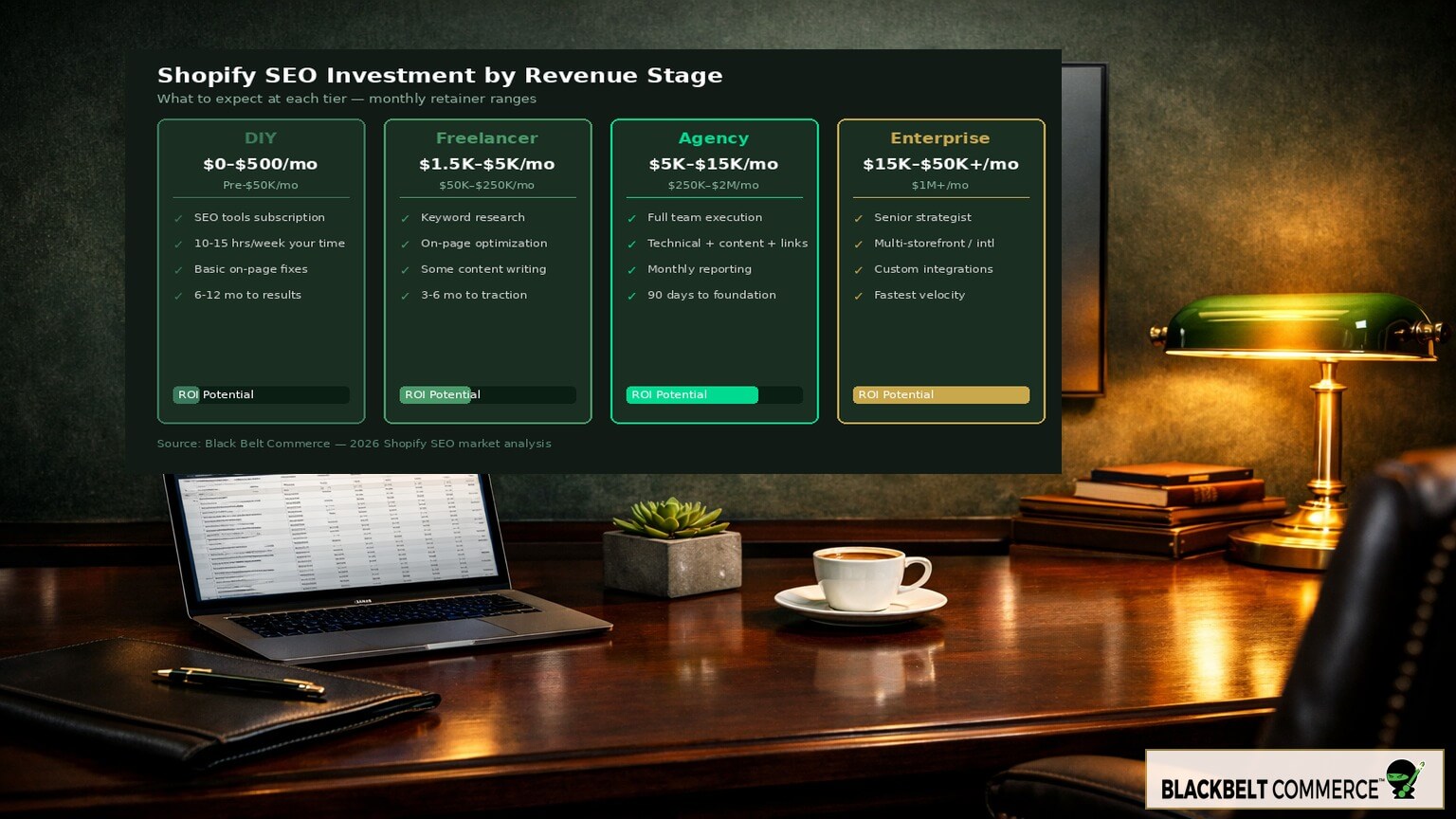
After working with hundreds of Shopify stores across every revenue band — from pre-launch Etsy graduates to $50M Shopify Plus brands — we’ve found that Shopify SEO cost clusters into four distinct tiers. Each tier solves a specific problem for a specific stage. Buying the wrong tier for your stage is how founders waste money in both directions: paying enterprise prices for a store that can’t absorb the work, or paying freelancer prices for a business that’s already outgrown what a freelancer can deliver.
Tier 1 — The DIY Foundation ($0–$500/month)
The first tier isn’t really an agency tier at all. It’s you, your time, and a small stack of tools. Most Shopify founders start here, and honestly, most should. If you’re pre-revenue or under roughly $50,000 a month in sales, spending $5,000 a month on SEO is almost always wrong. You don’t have enough traffic data, catalog depth, or margin to justify the investment.
At this tier, monthly spend looks like $30 for an SEO tool (Ahrefs Lite or Semrush Starter), $10 for a Shopify meta-tag app, and maybe $200 to $400 for occasional one-off content or a contractor audit. Call it $250 to $500 a month, with most of it being your time.
What you can realistically accomplish is more than most founders think. You can fix basic technical issues — broken redirects, missing alt tags, thin collection pages, ugly URLs. You can write product descriptions that target buying-intent keywords. You can publish one useful blog article a week. You can set up Search Console, GA4, and a basic rank tracker. You can earn your first legitimate backlinks from niche publishers.
What you’ll miss is everything that requires senior judgment or serious execution bandwidth. You won’t do sophisticated keyword clustering or build topical authority at speed. You won’t have anyone stress-testing your technical setup against Shopify’s quirks — duplicate content from collection filters, canonical mess from product variants, indexation bloat from tag pages. You’ll make mistakes you won’t discover for months.
The opportunity cost is real: you’re trading cash for time. If you can carve out ten hours a week and actually enjoy the work, DIY is rational up to about $50K/month. If you can’t, every week you spend avoiding a real hire is a week competitors pull further ahead. The smartest move for DIY founders is usually to supplement with a one-time audit from a senior practitioner. For $1,500 to $3,000, you get a 40-hour deep dive that turns scattershot effort into a prioritized six-month roadmap.
Key takeaway: Tier 1 works for stores under $50K/month in revenue when the founder has ten hours a week and a willingness to learn. Budget $0–$500/month, supplement with a one-time $1,500–$3,000 audit, and don’t upgrade tiers until revenue justifies it.
Tier 2 — The Freelancer Sprint ($1,500–$5,000/month)
Tier 2 is where most Shopify stores make their first real SEO hire. You’ve crossed roughly $50,000 a month, the catalog is stabilizing, and you’ve accepted that you can’t keep wearing the SEO hat. A senior freelancer — or a very small boutique — is often the best value in the entire industry at this stage.
The range is wide because freelancer quality is wide. A solid mid-career Shopify SEO freelancer charges $100 to $200 an hour and works 15 to 30 hours a month, putting you at $1,500 to $5,000. That overlaps with what cheap “agencies” charge, but the economics are different. A freelancer at $3,000 a month gives you 20 hours of senior attention. A cheap agency at the same price gives you three hours of senior attention and twelve hours of junior or offshore execution.
A good Tier 2 freelancer owns your technical SEO, rewrites your top 30 to 50 pages over a quarter, produces four to six content pieces a month, manages relationship-based link building, and sends a monthly report that actually explains what happened and why. The best ones function like a fractional head of SEO. A bad one runs your site through a tool, hands you an export, produces thin content, and disappears for weeks.
How do you vet without getting burned? Ask for three case studies with specific revenue numbers, not “ranking improvements.” Ask to see a real sample monthly report. Ask them to explain, in plain English, the three biggest technical issues they’d fix on your site after fifteen minutes of looking around. Someone competent has an answer. Someone who isn’t will hedge. If they promise guaranteed rankings or can’t discuss Shopify’s canonical behavior on product variants, they’re a generalist who’ll make expensive mistakes on your store.
Realistic timeline: three months for meaningful on-page improvements to show in search, six months for a measurable traffic lift, nine to twelve months for clear revenue impact. Anyone promising substantially faster on a site without catastrophic existing problems is either sandbagging the scope or lying.
Key takeaway: Tier 2 works for stores between $50K and $250K/month. A senior freelancer at $3,000–$5,000/month delivers better value than a cheap agency at the same price, because you’re paying for senior judgment rather than diluted junior execution.
Tier 3 — The Agency Engine ($5,000–$15,000/month)
At some point, the freelancer model breaks. Usually around $250,000 a month in revenue, when the store has more surface area than one person can cover — a blog producing content weekly, a catalog growing by dozens of SKUs a quarter, international expansion on the horizon, and a paid media program that needs organic to keep pace. This is where the full-service agency tier earns its premium.
Shopify SEO cost at Tier 3 lives between $5,000 and $15,000 a month, and what you’re buying isn’t “more of what the freelancer did.” You’re buying a team. A typical $10,000 retainer covers roughly:
- Strategy (10–15 hours): A senior strategist who owns your roadmap, reviews performance weekly, and coordinates across content, technical, and link building.
- Technical SEO (15–20 hours): A developer or technical SEO specialist handling Shopify-specific implementation — schema, Core Web Vitals, crawl budget, international hreflang, app conflicts.
- Content (30–40 hours): A content lead plus one or two writers producing six to ten pieces a month, including blog posts, category page rewrites, and buyer’s guides tied to your product catalog.
- Link building and digital PR (10–15 hours): Relationship-based outreach, digital PR campaigns, and niche placements — not PBN links.
- Reporting and account management (5–10 hours): A real monthly review, not just a screenshot of Ahrefs.
That’s 70 to 100 hours of senior-led work per month, executed by a small pod of specialists. A single freelancer can’t produce 80 hours a month — they’re one person. A cheap agency technically can, but the hours are padded with junior execution that produces output without impact.
This is where Shopify SEO experts who specialize exclusively in the platform start to significantly outperform generalist digital marketing agencies. Shopify has enough platform-specific quirks that a team who has spent years inside Shopify admin panels will catch issues a generalist won’t know to look for. That specialization is the biggest lever you’re pulling when you hire a platform-specific agency.
Why do cheaper agencies fail at this tier? The math doesn’t work. A $500K/month store getting a 15% organic lift sees $75,000 a month in new gross margin. A $10,000 retainer that reliably produces that pays back in the first month. A $3,000 retainer that doesn’t is still $36,000 a year in pure cost. Founders who hire a Tier 2 provider for a Tier 3 problem almost always switch within a year — after wasting eight to twelve months first.
The most expensive SEO mistake at $250K–$2M in monthly revenue is hiring a cheaper agency because the quote is lower. You’re not buying hours. You’re buying the opportunity cost of the growth you didn’t capture.
As we documented in our Shopify SEO Playbook, the 90-day framework that actually produces organic revenue growth requires parallel execution across technical, content, and authority. One person can’t run all three workstreams at speed. A proper agency pod can.
Key takeaway: Tier 3 works for stores between $250K and $2M/month. At $5,000–$15,000/month, you’re buying a specialist pod running parallel workstreams. Cheaper options at this stage don’t save money — they cost you the growth you didn’t capture.
Tier 4 — The Enterprise Program ($15,000–$50,000+/month)
The top tier is where Shopify Plus brands live — stores doing $2 million a month or more, often with international storefronts, complex catalog architectures, headless front-ends, and B2B alongside DTC. At this level, Shopify SEO pricing changes shape entirely. You’re no longer asking “how much does SEO cost?” You’re asking “how much does a fully-resourced organic growth program cost on a business doing $50 million a year, and what does it return?”
The answer is usually $15,000 to $50,000 a month, occasionally more for complex global brands. The price jump from Tier 3 is roughly 2x to 4x, but scope jumps further. Enterprise programs typically include:
- International SEO: Managing five to fifteen country storefronts, with proper hreflang, localized content at scale, and country-specific link building.
- Multi-storefront strategy: Some operators run three to ten separate Shopify Plus stores, each needing its own strategy while sharing infrastructure.
- Headless and custom integrations: Brands on Hydrogen or Next.js front-ends have different technical SEO surface area — rendering strategy, edge caching, and meta tag management become engineering problems.
- Enterprise content operations: 40 to 100 pieces a month across geographies, coordinated with an in-house editorial team.
- Dedicated senior leadership: A director-level strategist embedded with the client, attending weekly leadership meetings and quarterly planning.
Why is the price jump justified? Do the math. A Shopify Plus brand doing $40 million a year at 20% operating margin has $8 million of operating profit. A 10% lift in organic revenue is $4 million top line and roughly $800,000 bottom line. A $30,000-a-month program — $360,000 a year — producing that lift is a 2.2x return on that spend alone, and enterprise SEO compounds over multiple years. Underspending to save $15,000 a month is one of the most expensive decisions a CFO can make at this scale.
If you’re evaluating a Shopify Plus agency at this tier, the vetting criteria differ from Tier 3. You want teams that have shipped international programs, have senior technical SEO talent on staff, can prove revenue attribution inside Shopify Plus reporting, and have worked with brands at your scale. A great Tier 3 agency is not automatically a great Tier 4 agency.
Key takeaway: Tier 4 is for Shopify Plus brands above $2M/month. The $15,000–$50,000+/month investment is justified by ROI math — at enterprise scale, underspending on SEO leaves seven-figure sums on the table.
The Hidden Costs Nobody Tells You About
The retainer on your agency contract is not your total Shopify SEO cost. It’s the headline number most founders fixate on. The honest accounting includes five more categories that sales decks quietly omit.
Content production on top of retainer. Many Tier 2 and some Tier 3 agencies quote retainers that don’t include content creation, or include only a minimal amount. Real content at scale — 8 to 15 pieces a month — costs another $3,000 to $10,000 a month depending on format and expertise required. If your quote looks unusually low for what it promises, check whether content is a separate line item.
Tool subscriptions. Some agencies include tools in the retainer. Others pass through Ahrefs, Screaming Frog, Surfer, rank trackers, and Shopify apps as separate line items — typically $300 to $1,000 a month.
Developer time for technical fixes. The sneaky one. Your agency identifies that your Shopify theme has a speed issue, an app is blocking crawlers, or collection pages need schema. Unless the agency has in-house Shopify developers — most don’t — someone has to implement the fix. That’s either your internal dev team or a Shopify developer at $125 to $250 an hour. Budget $1,000 to $4,000 a month for development support, especially in the first six months when there’s usually technical debt to clear.
Opportunity cost of delayed execution. Every month your agency ships slowly is a month of revenue you didn’t earn. A fast agency at $12,000 that gets you to a revenue lift in six months is cheaper than a slow one at $7,000 that takes fourteen months.
Switching agencies mid-engagement. Always more expensive than founders expect. You lose three to six months of continuity, any in-flight link building, and often access to historical reporting. Budget three months of dead time plus onboarding fees of $2,500 to $10,000 when you switch. This is why choosing correctly the first time matters.
Cheap SEO that damages your site. The one that sinks stores. A $500-a-month provider builds 200 spammy backlinks over six months, Google identifies the pattern, your rankings collapse, and now you need a disavow cleanup at $5,000 to $15,000 just to get back to where you started — plus six to twelve months of recovery. We’ve seen stores lose 80% of organic traffic overnight from link-based manual actions triggered by cheap outsourced SEO. The cheap retainer turned out to be the most expensive decision in the store’s history.
The two most expensive words in Shopify SEO are “cheap retainer.” Bad SEO doesn’t just fail to produce results — it can actively damage the asset you’ve spent years building.
Key takeaway: Add 20% to 40% to your retainer quote to approximate true all-in Shopify SEO cost. And treat cheap SEO not as a bargain but as a risk — the downside scenarios are genuinely catastrophic.
How to Calculate Your Shopify SEO ROI Before You Spend a Dollar
Here’s the exercise nobody walks founders through, which is wild given that it’s the only one that actually matters. Before you commit to any tier, you should be able to model the payback yourself, in your own numbers, in about fifteen minutes.
Step one: find your current organic revenue. Open GA4, filter sessions by “organic search,” look at the last twelve months. Find the revenue attributed to organic. If you don’t have GA4 set up properly, approximate by multiplying organic sessions by your site-wide conversion rate and average order value from Shopify’s channel reports.
Step two: calculate organic as a percentage of total revenue. If you’re doing $2M/year and organic is driving $300K, organic is 15% of revenue. Most healthy DTC Shopify brands run 20% to 40% organic share — if you’re well under 20%, there’s usually significant room to grow.
Step three: estimate realistic growth at each tier. Based on what we’ve seen across hundreds of engagements:
- Tier 1 (DIY): Typical organic growth of 10% to 30% in year one, assuming the founder actually executes consistently. Many founders don’t, and growth is 0%.
- Tier 2 (Freelancer): Typical organic growth of 30% to 80% in year one with a strong freelancer. Results usually start showing in months four to six.
- Tier 3 (Agency): Typical organic growth of 60% to 150% in year one with a strong specialist agency. Results usually start showing in months three to five and compound into year two.
- Tier 4 (Enterprise): Typical organic growth of 30% to 80% in year one — the percentages are lower because the base is bigger, but the absolute dollar impact is far larger.
Step four: calculate payback period. Take your current organic revenue, apply a conservative growth estimate for the tier, multiply by gross margin, compare to annualized retainer cost.
Worked example: A Shopify store doing $1.2M in annual revenue, with organic driving 18% — $216,000 a year in organic revenue. Gross margin 55%. Considering a Tier 3 agency at $8,000/month, or $96,000/year all-in with content and development support. Conservative growth: 70% organic lift in year one. That’s $151,000 additional organic revenue, or $83,000 in additional gross margin. Against $96,000 invested, basically breakeven in year one — but the compounding is where the ROI lives. Year two typically produces another 30% to 60% lift on the new baseline with less incremental work. By end of year two: roughly $550,000 in organic revenue, $300,000+ in attributable gross margin, against $190,000 cumulative SEO investment. Net 1.6x in 24 months, with the asset compounding afterward.
Run the same math for a store that tries to save money with a Tier 2 freelancer at $2,500/month. Annualized: $30,000. Conservative growth estimate: 40%. That’s $86,000 in additional organic revenue, $47,000 in gross margin. Against $30,000 in spend, 1.6x in year one — actually a better first-year ROI than Tier 3. The surprising insight: at certain revenue levels, a strong freelancer can produce better first-year ROI than an agency. Where the agency wins is year two and beyond, and in ceiling. The freelancer tops out. The agency keeps compounding. Choose the tier based on your three-year trajectory, not just your first-year payback.
Key takeaway: Do this math before you sign anything. If the tier you’re considering can’t plausibly return 1.5x in year one and 3x over two years based on conservative growth estimates, either the tier is wrong for your stage or the agency isn’t the right fit.
The Revenue-Stage Framework: What to Invest and When
Let’s put this into a single framework you can apply to your store today. This is how we think about matching Shopify SEO cost to business stage when founders ask how much a Shopify expert costs for their situation.
Pre-revenue or new store ($0–$10K/month). Budget $0–$500/month in tools and time, plus a one-time audit of $500–$2,000 near launch. Don’t hire a retainer agency. Spend energy on product-market fit, brand, and paid media tests. SEO at this stage is about not screwing up the foundation — proper URL structure, clean theme, indexable product pages, basic schema. Six-month milestone: technically clean site. Twelve-month: baseline organic traffic and a clear sense of which categories deserve real investment next year.
Early growth ($10K–$50K/month). Budget $500–$2,000/month, split between a part-time freelancer (5–10 hours/month) and tools. Founder is still primary SEO operator, but starts outsourcing. Freelancer does monthly technical audits and four blog posts; you handle product pages and internal linking. Six months: better on-page SEO, first five to ten ranked pages. Twelve months: organic driving 15% to 25% of revenue.
Scaling ($50K–$250K/month). Budget $2,000–$5,000/month for a senior freelancer or small boutique. Tier 2 sweet spot. Senior judgment owns the program; freelancer produces content, owns technical SEO, manages modest link building. Six months: organic traffic up 40% to 60%. Twelve months: 30% to 50% more organic revenue than you started, with a clear roadmap for Tier 3.
Established ($250K–$1M/month). Budget $5,000–$10,000/month for a mid-tier specialist agency. Jump from freelancer to team, buying strategic depth and execution bandwidth. Six months: measurable lift in organic revenue — not just traffic. Twelve months: 60% to 100% organic growth versus baseline, organic at 25% to 35% of total revenue.
Mature ($1M–$5M/month). Budget $10,000–$20,000/month for a senior agency with proven Shopify Plus experience. Evaluate whether to hire a Shopify expert in-house alongside the agency. SEO is now a meaningful P&L line and deserves senior ownership on your side. Six months: agency integrated with paid, email, and product. Twelve months: organic a predictable, forecastable growth lever.
Enterprise ($5M+/month). Budget $20,000–$50,000+/month for a dedicated enterprise program, often augmented with AI-powered SEO workflows for content at scale. Likely running international, multi-storefront, and B2B alongside DTC. In-house team of 1 to 3 minimum. Six months: agency embedded in leadership cadence. Twelve months: organic is the largest or second-largest revenue channel and a genuine moat.
Key takeaway: The right Shopify SEO pricing for your store is the one that matches your current revenue stage plus a small stretch. When founders ask how much a Shopify expert costs at their stage, the answer is the tier that matches their revenue band — not the most expensive option they can afford. Upgrading one tier early is fine. Skipping two tiers is almost always a waste.
9 Red Flags That Mean You’re Overpaying for Shopify SEO
Whether you’re evaluating a $2,000-a-month freelancer or a $30,000-a-month enterprise agency, the same patterns separate professionals from pretenders. These nine red flags on Shopify SEO cost will save you more money than any other section of this article.
1. Guaranteed rankings. Nobody — not the best agency in the world, not Google’s own engineers — can guarantee rankings. The algorithm is an adversarial system with thousands of signals that change weekly. Any provider promising you a #1 ranking for a specific keyword by a specific date is either uninformed or lying. Both are disqualifying.
2. No custom strategy — same playbook for every client. Ask how their approach for a $500K/month supplements store differs from their approach for a $500K/month furniture store. If the answer is “we do the same things, they work everywhere,” they have a checklist, not a strategy. Your product category, margin structure, and customer journey materially change what good SEO looks like.
3. Monthly reports with no revenue attribution. If your report shows “rankings improved,” “backlinks acquired,” “traffic up 12%” — but never connects to dollars — that’s a problem. Senior operators tie their work to revenue because that’s the only number the business cares about. If they can’t or won’t attribute revenue, either they can’t set up the analytics or they don’t want to be held to that standard.
4. Link building from “500+ sites” (PBN networks). When someone sells you “50 backlinks from DA 30+ sites per month,” run. That’s a private blog network or link farm — both violate Google’s guidelines and can trigger manual actions. Legitimate link building is slow, expensive, relationship-based. Nobody produces 50 quality links a month for $1,500 unless the links are garbage.
5. No technical SEO capability. Ask who owns technical SEO on the team. If the answer is vague, or the “technical SEO” person also writes content, they don’t have real capability. Shopify has enough platform-specific quirks — canonical handling, collection pagination, variant indexation, speed issues from app bloat — that technical SEO requires specialist attention. An agency without a real technical SEO lead is missing a third of the job.
6. Content that reads like AI slop. Ask for three recent samples. Read them out loud. If they sound like generic, keyword-stuffed explainers that could have been written by anyone about anything — that’s what’s going on your site. Google has gotten remarkably good at detecting low-quality AI-generated content, and bad content now has a negative ranking impact. Great content should sound like a subject-matter expert wrote it, because one did.
7. No Shopify-specific expertise. A generalist can deliver results on Shopify, but a specialist outperforms consistently because they’ve already solved the problems your store is about to hit. Ask about canonical behavior on product variants. Ask how they handle collection SEO when the store uses tags. Ask about Shopify’s robots.txt limitations. Hand-wavy answers mean you’re paying specialist prices for generalist work.
8. Long-term contracts with no performance clauses. Agencies that require 12-month contracts with no escape clauses and no milestones have structured the deal to protect themselves. Good agencies offer 3-month starters or month-to-month after onboarding, and they’ll define milestones in writing because they expect to hit them.
9. They can’t explain what they did last month in plain English. The ultimate gut check. Ask: “In plain English, what did you do for my store last month, and why?” A competent operator answers in five minutes without jargon. An incompetent one retreats into vocabulary — “we leveraged our proprietary process to optimize domain authority through strategic content amplification.” That sentence means nothing. If you get it, you’re being charged for work that isn’t happening.
The single best SEO vetting question is: “Explain in plain English what you did for me last month and why it mattered.” If the answer takes more than five minutes or contains the word “synergy,” you have your answer.
Key takeaway: Run every current or prospective SEO provider through these nine filters. Any two red flags and you should be actively looking for an alternative. Any four and you’re likely damaging your store by staying.
Your SEO Budget Decision Framework
Let’s close with a framework you can use today. By now you have everything you need to make a confident decision about Shopify SEO pricing — you just need to put the pieces together.
Start with your current monthly revenue. That single number places you into a tier. Under $50K: Tier 1. $50K–$250K: Tier 2. $250K–$2M: Tier 3. Above $2M: Tier 4. On a boundary? Default to the lower tier plus a stretch audit — it’s cheaper to upgrade than to unwind a bad engagement.
Calculate your 24-month payback. Use the math we walked through. If payback doesn’t show 1.5x in year one and 3x over two years using conservative numbers, the tier or the provider is wrong. Don’t sign.
Run the nine-red-flag vet. Before committing to any retainer, run the provider through the checklist. Any two flags and you walk.
Demand a 90-day proof period. Don’t sign 12 months on day one. Structure as a 90-day phase with defined milestones — audit complete, top pages rewritten, content calendar live, first three pieces published, link pipeline built. If they can’t hit 90-day milestones, they won’t hit 12-month milestones either.
Keep your own scoreboard. Even with a great agency, maintain a monthly dashboard: organic sessions, organic revenue, ranked keywords in positions 1–10, new linking domains, Core Web Vitals. When your agency’s report contradicts your scoreboard, you have the data to push back.
Every week you delay is a week competitors invest in their own organic moat. Shopify SEO is a compounding asset, and the compounding starts the day you begin — not the day you pick the perfect provider. At the same time, picking wrong can set you back six to twelve months. The goal is thoughtful speed: decide in two to three weeks, not two to three months.
If you want to understand exactly what Shopify SEO cost looks like for your specific store — based on your revenue, catalog, competitive landscape, and goals — we offer a free 30-minute audit call where we walk through the numbers. No pitch deck, no pressure. The same honest analysis we’d do if you were already a client. You can learn more about how much a Shopify expert costs for your stage, or meet our SEO team directly.
Whatever you decide — DIY, freelancer, agency, or enterprise — decide with clear eyes. The founders who win with SEO aren’t the ones who spend the most. They’re the ones who match the right investment to the right stage, vet the right partner, and execute relentlessly for the 18 months it takes for compounding to become obvious. Now you know what that looks like at every revenue band. Go make a decision.
Last updated: May 1, 2026
Quick Answer: The Real Cost of Shopify SEO: What to Budget and What to Expect at Eac
Shopify SEO helps merchants make product, collection, blog, and technical pages easier for search engines and AI answer engines to understand. The strongest SEO work connects search intent, crawlable structure, internal links, useful content, page speed, and conversion paths so organic traffic can turn into customers or qualified strategy-call leads.
Key Takeaways
- Shopify SEO should improve crawlability, content depth, internal links, collection structure, and conversion paths together.
- Search intent matters because a visitor looking for definitions, audits, or expert help needs different next steps.
- Yoast green indicators are useful, but the article still needs editorial depth, topical authority, and lead-generation flow.
- Related resources connect SEO guidance to Shopify SEO services, Shopify experts, Shopify Plus agencies, and technical implementation pages.
- The same-page Calendly CTA should appear after useful guidance so qualified readers can ask for help applying the SEO roadmap.
How this connects to your Shopify growth strategy
Readers researching The Real Cost of Shopify SEO: What to Budget and What to Expect at Eac usually want more than a definition; they want to know whether the idea can improve the store without creating new problems. For the Shopify SEO and expert evaluation cluster, the business decision is practical: can the current Shopify setup support the desired experience, conversion path, and operational workflow? When the answer is uncertain, expert planning, design, development, CRO, and SEO support can turn the idea into safer, measurable store improvements.
Related Shopify resources
These internal resources support the Shopify SEO and expert evaluation topic cluster and help connect this guide to stronger commercial next steps:
- Shopify SEO and expert evaluation
- Shopify experts
- Shopify Plus agencies
- Shopify SEO and expert evaluation — Parent service page for the reader’s next commercial step
- Blackbelt Commerce — Home-page authority link for brand and core Shopify expertise
- Shopify experts — Money-page link requested for expert-hiring intent
- Shopify Plus agencies — Money-page link requested for high-growth and Plus-agency intent
- Shopify custom development — Development service page for implementation and technical help
- Shopify CRO — Conversion service page for readers focused on revenue and lead generation
- Shopify app SEO — Related SEO tooling article
Questions store owners ask before taking action
What does Shopify SEO include?
It includes technical structure, collection and product optimization, content strategy, metadata, internal links, page speed, structured answers, and conversion-aware improvements.
Is a green Yoast score enough for Shopify SEO?
No. Yoast can help with on-page basics, but rankings and leads also depend on search intent, authority, content quality, technical health, and internal linking.
When should a store hire Shopify SEO help?
Expert help is useful when SEO affects revenue-critical pages, migrations, technical fixes, competitive rankings, or lead-generation content strategy.
How do blog posts support Shopify SEO?
Blog posts can answer informational searches, build topical authority, support internal links, and guide qualified readers toward product pages, service pages, or a strategy call.
How should SEO content generate leads?
It should answer the query first, then show the reader where expert support can help them apply the advice to their own Shopify store.
Future articles needed for topical dominance
To build deeper topical authority around this cluster, these supporting topics should be created later and linked back into this article:
- The Real Cost Of Shopify Seo: What To Budget And What To Expect At Eac Checklist for Shopify Store Owners: Creates a practical support article that turns the Shopify SEO and expert evaluation topic into an actionable review tool.
- Common The Real Cost Of Shopify Seo: What To Budget And What To Expect At Eac Mistakes and How to Avoid Them: Captures problem-aware searches and gives BBC a natural place to explain implementation risks without hard selling.
- When to Hire Shopify Experts for The Real Cost Of Shopify Seo: What To Budget And What To Expect At Eac: Connects informational demand to the expert-hiring money page while preserving educational intent.

