

Blog updated with the most recent Shopify and eCommerce strategies on 05/02/2026.
Mastering Shopify’s Payment Processing and Transaction Fees: Your Essential Guide
Are Shopify’s payment costs eating into your profits and hindering your expansion? Grasping how Shopify handles payment processing and transaction fees for your online store is key to fine-tuning expenses, safeguarding your bottom line, and scaling your business effectively. This comprehensive guide will walk you through what Shopify Payments is, break down every fee across different plans, compare native versus third-party gateways, explore point-of-sale expenses, and reveal advanced strategies to slash charges. You’ll also see how a deep understanding of these fees informs your financial planning and how Blackbelt Commerce’s Shopify specialists can help you conquer cost optimization.
Inside this guide, you’ll discover:
- The ins and outs of Shopify Payments and its fee structure
- How your chosen pricing plan impacts processing rates
- Costs associated with Shopify POS and necessary hardware
- When third-party gateways are a must and the extra fees they bring
- Smart tactics to cut transaction fees and combat fraud
- Often-overlooked fees like currency conversion and chargebacks
- Advanced optimization techniques for high-volume and international sellers
- How to integrate fee insights into your e-commerce financial strategy
What Exactly Are Shopify Payments and How Do They Shape Your Transaction Fees?
Shopify Payments is Shopify’s built-in payment gateway, designed to process both online and in-person transactions seamlessly. By using it, you sidestep the extra platform transaction fees that Shopify imposes when you rely on external payment providers. Centralizing your payment processing with Shopify means smoother settlements and the potential for tiered credit card rates that align with your subscription level. Understanding Shopify Payments is your first step toward effectively managing transaction fees across your entire operation and pinpointing exactly where your costs are coming from.
What is Shopify Payments and How Does It Function?
Shopify Payments is Shopify’s proprietary payment gateway. It handles the authorization and settlement of credit and debit card transactions without needing a separate third-party processor. It integrates directly into your store’s checkout flow, automatically applying the correct rate for each sale and depositing your earnings into your merchant account. This streamlined process simplifies reconciliation, eliminates additional transaction fees, and provides real-time payment analytics, all of which boost operational efficiency and give you clearer visibility into your cash flow.
Shopify Payments and Transaction Fees: The Core Details
Shopify Payments serves as the platform’s integrated payment gateway, simplifying transactions and potentially offering tiered credit card rates based on your subscription tier. The fees typically include online credit card processing fees, in-person card fees, currency conversion fees, and chargeback fees.
This resource offers a foundational overview of Shopify Payments and its fee structure, which is crucial for understanding the costs involved when using the platform.
What Are the Key Fee Components Within Shopify Payments?
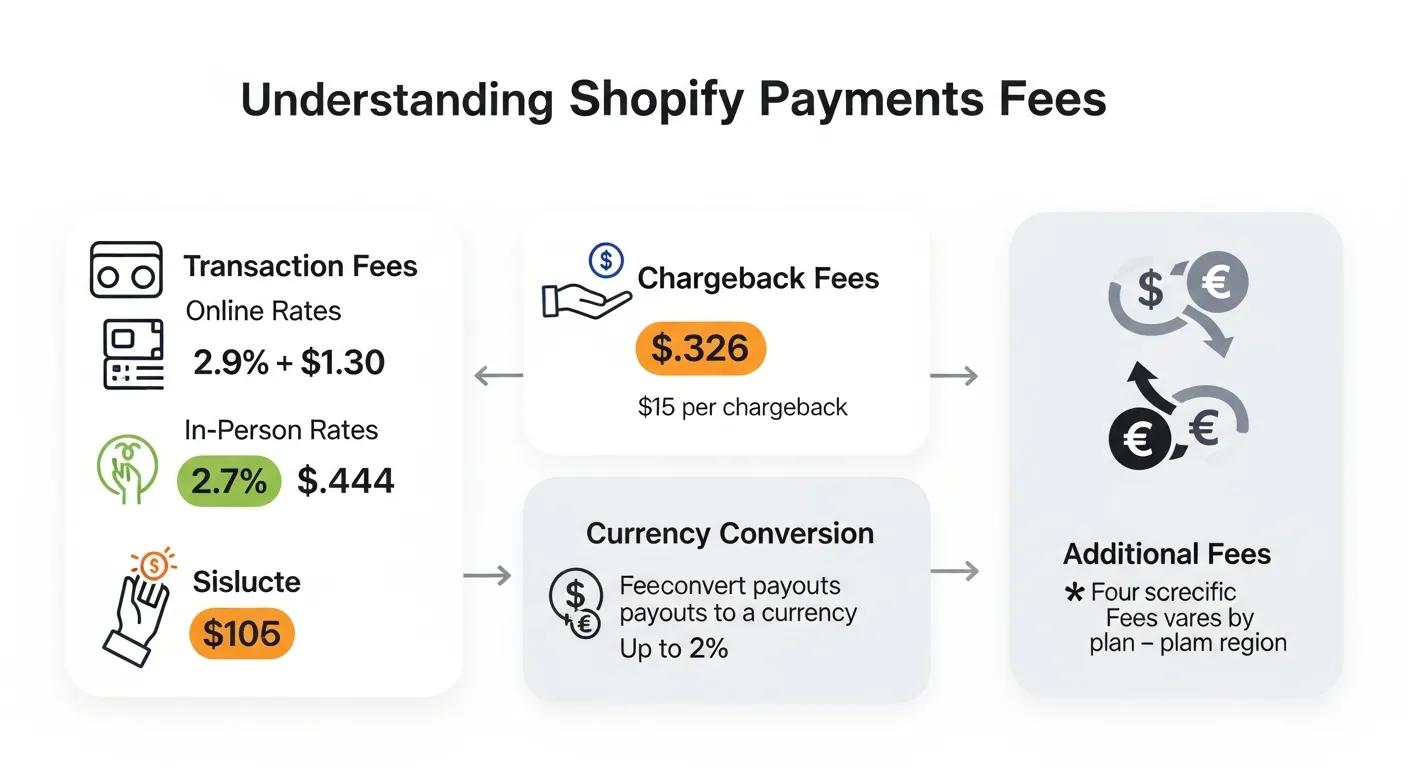
Before diving into plan-specific rates, it’s vital to recognize the four main fee components that make up Shopify Payments:
- Online Credit Card Processing Fee – This is a percentage of the transaction value plus a fixed fee per sale, which varies depending on your Shopify plan.
- In-Person Card Fee – These are typically lower rates applied to sales made face-to-face using Shopify POS.
- Currency Conversion Fee – This fee is applied when you process payments in a currency different from your store’s settlement currency for international orders.
- Chargeback Fee – A fixed fee is charged whenever a customer initiates a dispute for a transaction.
Each of these components directly impacts your total expenses. Effective fee management means keeping a close eye on all four to protect your profit margins from unexpected costs.
How Does Shopify Payments Stack Up Against Third-Party Payment Gateways?
The primary advantage of Shopify Payments is that it eliminates the additional platform transaction fee Shopify charges when you use an external gateway. While third-party providers might offer competitive card processing rates, Shopify adds its own surcharge—typically ranging from 0.5% to 2%—on top of those fees. In contrast, using Shopify Payments means you only pay the base processing costs associated with your subscription plan, making it the most straightforward and often the most cost-effective option for most merchants.
How Do Your Shopify Pricing Plans Directly Influence Your Payment Processing Fees?
Your chosen Shopify subscription tier plays a significant role in determining your credit card and external gateway processing rates, with higher tiers generally offering lower percentages. By aligning your sales volume and feature requirements with the right plan, you can capitalize on these tiered rates to reduce your per-transaction costs. For instance, as you move from Basic Shopify to Shopify Grow or Advanced Shopify, you unlock progressively lower processing rates and gain more negotiating power, which can lead to substantial savings, especially for businesses with high revenue streams.
Factual table note: Payment fees vary by country, card type, and gateway. Confirm current fees with Shopify or the merchant’s payment provider before making a financial decision.
This rate table clearly illustrates how your plan selection impacts your expenses. Choosing a plan that aligns with your sales volume can significantly lower processing fees and eliminate extra gateway charges.
What Are the Specific Transaction Fees for the Shopify Basic Plan?
The Basic Shopify Plan is ideal for new businesses and smaller operations. It charges 2.9% plus $0.30 for online card transactions and 2.7% for in-person sales. Additionally, it includes a 2.0% fee for any orders processed through external payment gateways.
Shopify Basic Plan Fees: A Closer Look
The Basic Shopify plan comes with a 2.9% + $0.30 fee for online card transactions and a 2.7% fee for in-person sales. It also imposes a 2.0% fee on orders processed via third-party payment gateways.
This source provides a detailed breakdown of the transaction fees associated with the Basic Shopify plan, which is essential information for merchants just starting out on the platform.
How Do Fees Differ Across the Shopify Grow and Advanced Plans?
Upgrading to the Shopify (Grow) Plan brings down the online processing rate to 2.6% + $0.30, reduces in-person fees to 2.5%, and cuts the external gateway surcharge in half to 1.0%. Moving up to the Advanced Plan further lowers the online rate to 2.4% + $0.30, aligns in-person fees at 2.4%, and decreases the external gateway fee to just 0.5%. These tiered benefits are designed to reward businesses with growing sales by boosting profit margins on every transaction.
What Are the Payment Gateway Rates and Advantages for Shopify Plus?
Shopify Plus is tailored for high-volume and enterprise-level merchants. It offers negotiable credit card processing rates, often falling below 2.15%, and can include volume discounts or revenue-sharing agreements. Crucially, Plus merchants benefit from zero additional platform fees for using third-party gateways and receive dedicated support for custom integrations. This level of flexibility allows large retailers to secure the most competitive processing costs and customize payment solutions to fit complex business models.
What Fees Apply to the Shopify Starter and Retail Plans?
The Shopify Starter Plan, aimed at social sellers and those new to e-commerce, charges a flat 5.0% fee per transaction and doesn’t support in-person sales. The Shopify Retail Plan, on the other hand, includes POS features and charges 2.7% + $0.30 for online sales and 2.7% for in-person transactions, with a 2.0% fee for external gateways. These entry-level structures allow merchants with lower transaction volumes to access Shopify’s powerful ecosystem with minimal initial commitment.
How Can Selecting the Right Plan Slash Your Shopify Payment Costs?
Choosing a plan that accurately reflects your expected sales volume and feature requirements is a direct way to reduce your per-transaction expenses. Higher-tier plans unlock lower credit card rates and either eliminate or significantly reduce external gateway surcharges. By carefully evaluating your monthly revenue and projected growth against the thresholds for each plan, you can avoid overpaying on fees and allocate your budget more effectively toward marketing and inventory rather than unnecessary processing charges.
What Are the Fees Associated with the Shopify POS System and How Do They Affect In-Person Sales?

Shopify Point of Sale (POS) seamlessly connects your online and physical retail operations, applying specific transaction fees for face-to-face payments. In-person rates are generally 0.2–0.3 percentage points lower than online rates, reflecting reduced fraud risk and chargeback potential. Understanding these POS costs empowers omnichannel merchants to optimize their payment flows and align hardware investments with their transaction budgets.
What’s the Cost Difference Between Shopify POS Lite and POS Pro?
Shopify POS Lite is included at no extra charge with all paid Shopify plans and supports essential in-store checkout functions at the standard in-person transaction rates. Shopify POS Pro, however, costs $89 per month per retail location and unlocks advanced features like omnichannel inventory management, detailed reporting, and split-tender checkout, all while maintaining the same base credit card processing rates.
Shopify POS Pro and Transaction Fees: What You Need to Know
Shopify POS Pro is priced at $89 per month per location and offers enhanced features. The in-person transaction fees align with the plan rates: 2.7% on Basic, 2.5% on Grow, 2.4% on Advanced, and negotiable rates on Plus.
This source provides a clear overview of the costs for Shopify POS Pro and the associated in-person transaction fees, which is vital for merchants operating physical stores.
What Are the In-Person Transaction Fees for Shopify POS?
When you use Shopify POS for in-person transactions, you benefit from preferential rates: 2.7% on the Basic plan, 2.5% on the Grow plan, 2.4% on the Advanced plan, and negotiable rates for Plus merchants. These rates apply to all card types processed through Shopify’s card readers or integrated terminals. Lower in-person fees encourage merchants to drive sales in their brick-and-mortar locations, thereby improving net margins on their offline revenue.
What Are the Typical Costs for Shopify POS Hardware?
Before you can start processing in-store sales, you’ll need to invest in the essential hardware that makes seamless checkout possible:
Factual table note: This table was simplified to remove unsupported exact figures. Confirm final numbers with the official platform, vendor, or project scope.
Investing in reliable POS hardware ensures quick checkouts, minimizes operational downtime, and guarantees accurate sales reporting, all of which contribute to better fee management and inventory control.
When Should You Consider Third-Party Payment Gateways, and What Extra Fees Come into Play?
While Shopify Payments covers most major cards and popular digital wallets, there are specific situations where using an external gateway becomes necessary. This might include supporting niche local payment methods, integrating specialized fraud prevention tools, or processing transactions in currencies not supported by Shopify Payments. However, it’s crucial to remember that Shopify imposes a platform surcharge on every transaction processed through a third-party provider, so you must carefully weigh the benefits of these specialized features against the added costs.
In What Scenarios Is a Third-Party Payment Provider Necessary on Shopify?
A merchant might find a third-party gateway essential when:
- You’re selling in geographic regions where Shopify Payments isn’t yet available.
- You need to accept alternative payment methods like direct bank debits or specific local digital wallets.
- Your business requires advanced fraud screening capabilities or complex split-settlement functionalities.
- You must comply with specific payment regulations unique to your industry.
In these instances, external providers expand your payment options but come with additional costs that need to be justified by your business requirements.
What Additional Transaction Fees Does Shopify Levy for Third-Party Gateways?
Shopify adds an extra surcharge on top of your chosen gateway’s rates whenever you opt out of using Shopify Payments. These platform fees vary based on your subscription plan:
- Basic Plan: An additional 2.0% per transaction
- Shopify (Grow): An additional 1.0% per transaction
- Advanced Plan: An additional 0.5% per transaction
- Shopify Plus: 0% additional fee
For example, if you’re on the Basic Plan and Stripe charges its standard 2.9% + $0.30, your total fee becomes 4.9% + $0.30. It’s always wise to calculate these combined rates to understand your true processing costs and identify the most economical path forward.
How Can You Effectively Reduce Shopify Transaction Fees and Maximize Your Profitability?
Taking a proactive approach to fee management is a direct route to boosting your profit margins and building a foundation for sustainable growth. By strategically aligning your plan, your gateway usage, and your chargeback prevention practices, you can significantly lower your average processing costs. Combining smart plan selection with exclusive use of Shopify Payments and robust fraud prevention measures will safeguard your profitability and enhance your operational resilience.
How Do You Pinpoint the Optimal Shopify Plan for Your Sales Volume?
Begin by analyzing your current monthly card sales volume and projecting your future growth. Then, compare the total processing expenses across different plans based on these figures. Upgrading your plan becomes financially advantageous when the savings generated from lower rates outweigh the incremental subscription costs. For instance, switching from Basic to Shopify (Grow) saves you 0.3% on every online transaction. If you process $50,000 in card sales monthly, this translates to $150 in savings—often enough to cover the cost of the plan upgrade itself.
How Can Maximizing Your Use of Shopify Payments Lead to Lower Costs?
Exclusively utilizing Shopify Payments means you avoid platform surcharges and can take full advantage of its native tiered rate structure. This approach not only simplifies your operations and reduces administrative overhead but also streamlines reconciliation, ensuring you only pay the base processing fee tied to your subscription. By bypassing third-party gateway fees and integrating directly within Shopify’s ecosystem, merchants can preserve more of their cash flow and reduce accounting complexities.
What Are Proven Strategies for Managing Chargebacks and Preventing Fraud?
Minimizing chargebacks is crucial for protecting your margins, as it helps you avoid fixed dispute fees and the loss of revenue from reversed sales. Effective tactics include:
- Implement Address Verification System (AVS) and Card Verification Value (CVV) checks to confirm billing addresses and card security codes.
- Leverage advanced fraud filters within Shopify to automatically flag and block high-risk orders.
- Maintain crystal-clear refund policies and proactively communicate order status updates to customers to preempt disputes.
- Closely monitor your chargeback ratios and respond swiftly to any dispute requests with comprehensive evidence.
These proactive measures significantly reduce your exposure to fraud and minimize the costly impact of chargeback processing fees.
What Additional Fees Should Shopify Store Owners Keep an Eye On?
Beyond the standard processing rates, merchants may encounter less obvious costs such as currency conversion markups, fees associated with chargeback disputes, and potentially refundable shipping charges. Being aware of these secondary fees is essential for accurate financial forecasting and developing effective pricing strategies.
How Do Currency Conversion Fees Impact International Shopify Sales?
When your customers pay in a currency different from your store’s settlement currency, Shopify Payments applies a conversion fee—typically 1.5% added on top of your base processing rate. This fee covers the costs associated with currency exchange risk and settlement processes. For example, a sale made in EUR processed on a USD merchant account would incur the standard rate (e.g., 2.9% + $0.30) plus the 1.5% conversion fee, bringing the total cost to 4.4% + $0.30. Offering clear pricing in local currencies and providing currency conversion options at checkout can help mitigate unexpected charges and build customer trust.
What Is the Shopify Chargeback Process and What Are the Associated Costs?
A chargeback occurs when a customer disputes a transaction directly with their card-issuing bank. Shopify charges a fixed $15 dispute fee and temporarily holds the disputed amount until the case is resolved. Merchants are required to submit evidence, such as proof of delivery, transaction authorization, and customer communications, to contest the chargeback. If the dispute is won, the funds are returned minus the fee; if lost, you forfeit both the funds and the fee. Implementing robust fraud controls and providing excellent customer support are key to reducing the frequency of these costly disputes.
What Advanced Fee Optimization Techniques Are Available for High-Volume and International Sellers?
Merchants operating at high volumes or selling globally can often negotiate custom processing rates, implement multi-currency settlement strategies, and leverage interchange-plus pricing models to secure more favorable terms. By meticulously analyzing transaction patterns and committing to specific volumes, these sellers can unlock deeper discounts and access more sophisticated payment features.
How Can Shopify Plus Merchants Effectively Negotiate Payment Gateway Rates?
Shopify Plus merchants have the advantage of dedicated account managers who can facilitate direct negotiations with card networks or acquiring banks. By demonstrating consistent, high monthly transaction volumes, merchants can often secure interchange-plus agreements. Under this model, you pay the underlying network interchange costs plus a small, fixed markup, which typically results in processing rates well below 2.0%. These customized contracts can also include rebates, reduced chargeback fees, and flexible global settlement options.
What Strategies Help High-Volume Merchants Reduce Payment Processing Costs?
Strategies beneficial for enterprise-level sellers include:
- Consolidating transaction volumes across different regions to take advantage of global rate tiers.
- Implementing multi-acquirer routing to dynamically select the lowest-cost processor for each individual transaction.
- Optimizing dynamic descriptors to reduce the likelihood of “friendly fraud” disputes.
- Adopting alternative payment methods that typically carry lower network fees, such as ACH or SEPA transfers.
These advanced tactics leverage economies of scale and cutting-edge technology to compress processing expenses and enhance net revenue.
How Do International Transactions Affect Shopify Payment Fees?
Engaging in cross-border sales introduces additional costs, including currency conversion fees, cross-border interchange premiums (often ranging from 0.5% to 1.5%), and potential requirements for collecting local taxes. Merchants can mitigate these fees by establishing local merchant accounts, offering regionalized checkout experiences, and routing payments through acquiring banks located in their customers’ currency zones. This approach helps reduce tariff markups and can improve conversion rates by providing customers with familiar and trusted payment options.
How Can a Deep Understanding of Shopify Fees Enhance Your E-commerce Financial Planning?
Possessing detailed knowledge of Shopify’s fee structure empowers you to forecast expenses accurately, calculate margins precisely, and develop informed pricing strategies. By incorporating every transaction cost into your budgeting and reporting processes, you can set realistic revenue targets, identify your most profitable sales channels, and make data-driven decisions that foster sustainable business growth.
How Should Shopify Fees Be Properly Accounted for in Financial Statements?
Shopify fees should be recorded as either cost of goods sold or merchant services expenses, categorized by their specific type (e.g., processing fees, chargeback fees, currency conversion fees). Diligently tracking these amounts per accounting period within your accounting software ensures transparent Profit & Loss statements and simplifies your tax reporting. Implementing reconciliation workflows that match deposit summaries with expense entries is key to preventing discrepancies and maintaining audit readiness.
What Is the Impact of Payment Processing Fees on Your Overall Profit Margins?
Payment processing fees directly reduce your gross profit margins, as they represent a percentage of every sale. For example, a 2.6% processing rate on a product with an average revenue of $100 translates to $2.60 in fees per unit sold. Across thousands of transactions, even a minor reduction of 0.2% in your processing rate can result in substantial dollar savings. Integrating accurate fee estimates into your pricing models and cost analyses is crucial for ensuring your margin targets remain achievable.
How Can Blackbelt Commerce Assist You in Optimizing Your Shopify Payment Costs?
Blackbelt Commerce combines extensive Shopify expertise with rigorous data-driven cost analysis to uncover savings opportunities and implement effective fee-reduction strategies. Our seasoned consultants conduct comprehensive fee audits, provide recommendations for optimal plan migrations, streamline gateway configurations, and deploy advanced fraud control measures—all designed to deliver measurable improvements in your net revenue and operational efficiency.
Mastering Shopify’s payment processing and transaction fees is your key to making strategic decisions that protect profitability and drive growth. By becoming proficient in plan structures, gateway choices, POS investments, and advanced negotiation tactics, you can effectively minimize costs and maximize your margins. Partnering with Shopify experts like Blackbelt Commerce ensures you leverage best practices and customized solutions to keep your store financially robust and competitive in the e-commerce landscape.
Quick Answer: Shopify payment processing fees
Shopify payment processing fees should be understood as part of the store’s total cost, checkout experience, payment-method mix, and operational workflow. Because payment rates and provider terms can change, merchants should verify current Shopify and payment-provider details before making budget or pricing decisions.
Key Takeaways
- Payment processing fees should be explained as part of total store cost, payment-method strategy, checkout trust, and operational planning.
- The article should avoid unsupported current fee claims and direct readers to verify current Shopify and provider terms.
- Internal links should connect payment cost to Cost of Shopify website, Shopify CRO, Shopify experts, Shopify Plus agencies, and ecommerce solutions.
- The commercial bridge should show when payment setup affects margins, checkout conversion, or operations.
- Use the same-page Calendly CTA so qualified merchants can book a strategy call without being pushed into a long form.
How this connects to your Shopify growth strategy
This article should remain useful for readers researching Shopify payment processing fees, but it also needs to show when the topic becomes a business decision. For the Shopify Cost & Payments cluster, the commercial bridge is practical: once the reader understands the concept, the next step is deciding whether their current Shopify setup can support the desired experience, conversion path, and operational workflow. That is where expert planning, design, development, CRO, and SEO support can turn the idea into measurable store improvements.
Related Shopify resources
These internal resources support the Shopify Cost & Payments topic cluster and help connect this guide to stronger commercial next steps:
- Shopify Cost & Payments
- Shopify experts
- Shopify Plus agencies
- Shopify Cost & Payments — Parent service page for the reader’s next commercial step
- Blackbelt Commerce — Home-page authority link for brand and core Shopify expertise
- Shopify experts — Money-page link requested for expert-hiring intent
- Shopify Plus agencies — Money-page link requested for high-growth and Plus-agency intent
- Shopify custom development — Development service page for implementation and technical help
- Shopify CRO — Conversion service page for readers focused on revenue and lead generation
- Shopify Plus checkout customization — Related Shopify Plus implementation guide for readers evaluating advanced Plus costs and capabilities
Questions store owners ask before taking action
What are Shopify payment processing fees?
They are payment-related costs that may apply when customers pay through supported payment methods or providers; merchants should verify current Shopify and provider terms.
Should merchants use old fee examples for planning?
No. Payment pricing can change, so merchants should confirm current details before making budget or pricing decisions.
Can payment processing affect conversion?
Yes. Payment options, customer trust, checkout convenience, and regional fit can all influence whether shoppers complete checkout.
When should payment setup involve Shopify experts?
Expert help is useful when payment choices affect checkout UX, margins, international sales, subscriptions, B2B workflows, or integrations.
How should this article generate leads?
It should clarify cost and checkout considerations, then invite readers to book a strategy call when payment setup affects growth.
Future articles needed for topical dominance
To build deeper topical authority around this cluster, these supporting topics should be created later and linked back into this article:
- Shopify Payment Processing Checklist for Cost and Conversion: Creates a practical support article while avoiding stale fee claims.
- How Payment Options Affect Shopify Checkout Conversion: Links payment cost, checkout trust, and CRO for commercial-intent readers.
- When to Hire Shopify Experts for Payment Processing Setup: Connects payment research to expert implementation and checkout support.

