

One of the things I have learned leading client services at Blackbelt Commerce is that pricing confusion costs founders more than the work itself. As someone who oversees both our retainer engagements and project-based scopes, I want to give you the same straightforward breakdown I would share on a discovery call — so you can budget intelligently and pick the model that actually fits your stage.
The True Cost of a Shopify Expert: Retainer vs. Project Pricing

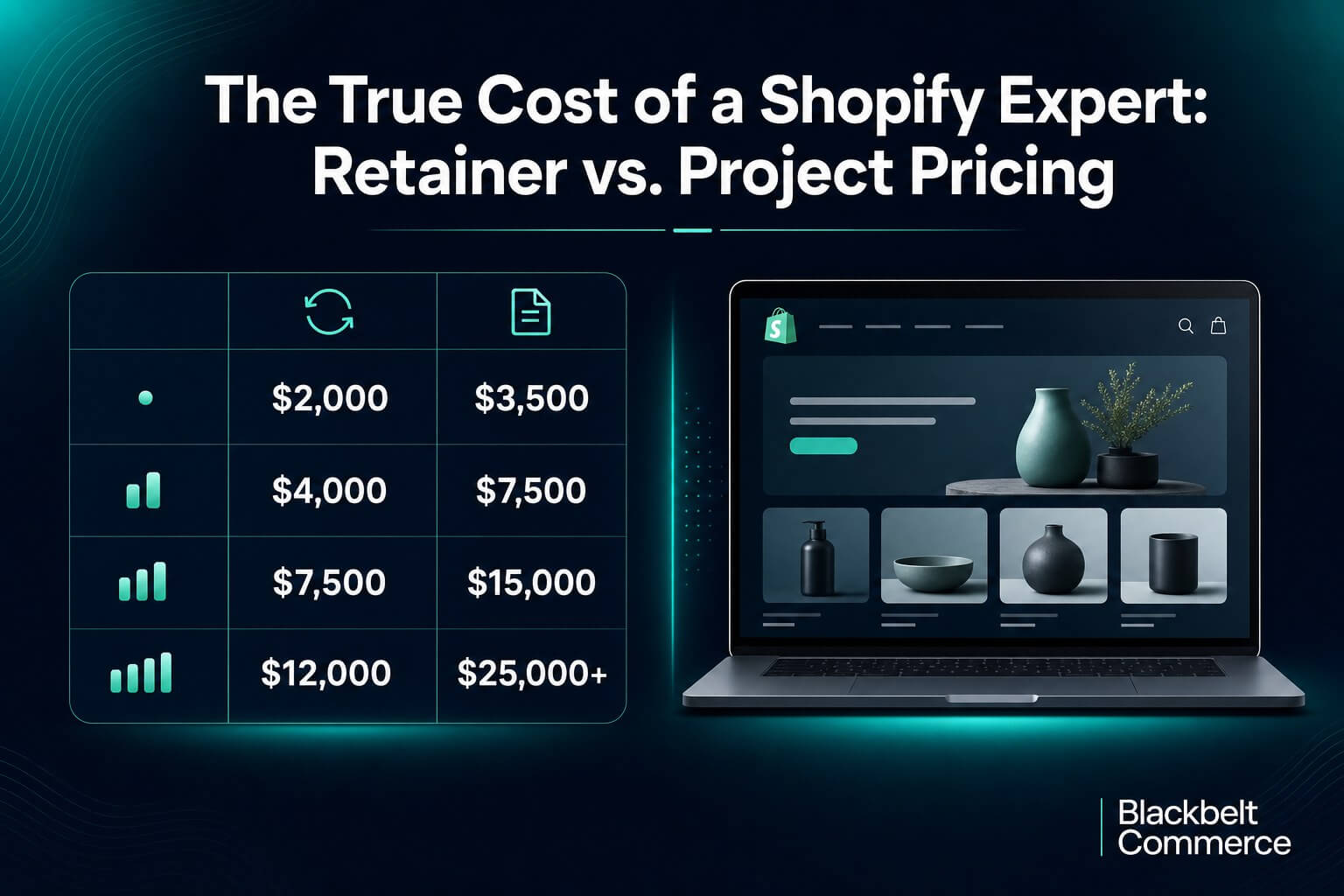
If you’ve been searching for real numbers on shopify expert cost, you’ve probably landed on articles that either hedge every figure into uselessness or quote fantasy budgets that have nothing to do with what professionals actually charge. So I’m going to do something most agencies won’t: I’ll tell you what we charge, what others charge, and — importantly — when each pricing model makes sense for your stage. Shopify expert cost is not one number. It is a range that spans from $75 an hour for a solid freelancer to $30,000 a month for a Shopify Plus Certified Partner retainer, and where you land in that range depends entirely on what you need, how complex it is, and who is qualified to do it.
At Blackbelt Commerce, we’ve been running a Shopify agency since 2015. We’ve seen the full spectrum — founders who overpay for work that wasn’t worth the invoice and founders who underpay for commodity-tier help that cost them six months of stalled growth. This article is a practical pricing guide. By the end, you’ll know what every engagement model actually costs, what drives prices up, when retainers beat project pricing, and when they don’t. I’ll also share our own pricing at the end, because transparency is how we earn the right to ask for your business.
The 4 Ways Shopify Experts Price Their Work
Before we get into specific numbers, let’s talk structure. Shopify expert pricing comes in four models: retainer, project, hourly, and performance-based. Each one makes sense in a different context, and the wrong model can cost you significantly more than the wrong price per hour. Understanding the model is more important than negotiating the rate.
Retainer pricing means you pay a fixed monthly fee for an agreed amount of work or capacity. The expert (or agency) reserves time for you every month, regardless of whether you use every hour. In exchange, you get predictable access, continuity, and — with a good agency — ongoing strategic accountability. Retainers work well when you have a steady, recurring stream of Shopify work that doesn’t fit neatly into one-time projects. Most Shopify operators at $100K per month and above are working this way.
Project pricing means a fixed price for a defined scope. You want a theme redesign, a platform migration, or a specific integration built. The expert scopes the work, quotes a total, and delivers against that scope. Project pricing protects you from scope creep when managed correctly, and it makes the ROI math simple — you spend X, you get Y. However, project pricing can create misaligned incentives when the scope is unclear. Experienced experts build assumptions documents and change-order processes to manage this; less experienced ones quote low and invoice high.
Hourly pricing is exactly what it sounds like. You pay per hour worked, either with a deposit or against a monthly invoice. Hourly is most common for smaller freelancers and for overflow or advisory work that’s hard to scope in advance. It’s also the model most susceptible to budget overruns if you don’t track hours closely. Some operators prefer hourly because it feels transparent — but that transparency cuts both ways. Hourly pricing puts the estimation risk entirely on you, not on the vendor.
Performance-based pricing ties some portion of fees to results — usually conversion rate improvements, revenue lift, or SEO ranking gains. It sounds appealing in theory, but it comes with significant caveats that most agencies won’t discuss upfront. We’ll cover that model in its own section below, because it deserves more nuance than a paragraph.
In practice, most mature agency relationships blend models. You might pay a monthly retainer for ongoing SEO and CRO work, a separate project fee for a theme overhaul, and hourly for ad hoc advisory calls. Understanding the structure of your engagement is often more valuable than hunting for the lowest rate in any one model.
Shopify Expert Cost: Retainer Pricing With Real Ranges
Retainer shopify expert cost is the number founders argue about most, because it’s the most visible ongoing line item in their vendor budget. Here are real ranges, organized by the type of vendor you’re working with.
Solo freelancer retainer: $1,500 to $6,000 per month. A solid solo Shopify developer on retainer typically charges $3,000 to $5,000 per month for 25 to 40 hours of committed monthly capacity. Below $2,000 per month, you’re getting 10 to 15 hours — enough for maintenance and minor iterations, not enough for meaningful growth work. The upper end of solo retainers, $5,000 to $6,000 per month, typically reflects a highly specialized freelancer with deep Liquid development or Klaviyo architecture expertise. These people deliver real value but carry the structural risk of any solo operator: they get sick, they take vacations, and they sometimes disappear entirely when a better-paying client shows up.
Boutique agency retainer: $4,000 to $15,000 per month. A boutique Shopify agency — typically 4 to 12 people with defined processes and account management — will usually start retainers at $4,000 to $5,000 per month and scale to $12,000 to $15,000 depending on scope and team size. This range covers multi-discipline work: a developer, a designer, and a strategist can all be contributing to your account each month under this model. The key question when evaluating a boutique agency retainer is what the deliverables commitment actually is — how many hours, which disciplines, and what is the escalation process when deliverables are missed.
Mid-tier to established Shopify Partner agency: $10,000 to $30,000 per month. At this tier you’re working with agencies that have 15 to 40 people, vertical-specific case studies, and documented processes for complex Shopify Plus implementations. Retainers in this range typically cover dedicated team capacity — meaning specific named developers and strategists assigned to your account — plus project management, QA, and regular executive review. Operators in the $500K to $3M per month revenue range typically work in this tier.
Shopify Plus Certified Partner: $15,000 to $50,000 per month. There are roughly 250 Shopify Plus Certified Partners globally. They command premium rates because they’ve demonstrated volume, technical depth, and client outcomes at the highest level of the platform. However, not every brand at this tier needs a Plus Certified Partner. If your Shopify setup is not particularly complex — you’re running a standard storefront without headless builds, custom checkout extensions, or international multi-currency complexity — you’re paying a premium for capability you’re not using. For a detailed breakdown of whether you’re at the stage that warrants this level of shopify expert pricing, our Hire Shopify Expert Guide walks through the qualification framework.
One more number worth knowing: the market median for a Shopify agency retainer across all tiers is roughly $6,000 to $8,000 per month, based on published rate cards and industry benchmarks from Clutch’s Shopify agency directory. If someone is quoting you $1,200 a month for “full Shopify management,” that is not a professional retainer — that’s a maintenance package, and you should understand exactly what you are and are not getting.
Shopify Expert Cost: Project Pricing for Theme Builds, Integrations, and Migrations
Project-based shopify expert cost is easier to benchmark than retainer pricing because the deliverable is concrete. For each engagement type below, the shopify expert project cost depends on scope, vendor tier, and catalog complexity. Here are real ranges across the most common project categories.
Theme customization (existing theme, light-to-medium custom work): $1,500 to $8,000. If you purchased a Shopify theme and need it configured, branded, and customized with 10 to 30 hours of Liquid and CSS work, this is the right range. A freelancer will be on the lower end; a boutique agency will be on the higher end. This is also the project type where hiring an agency is often overkill — a competent freelancer with five or more years of Shopify Liquid experience will deliver the same output at lower cost for work that’s primarily executional rather than strategic.
Custom theme build from scratch: $12,000 to $45,000. A fully custom theme — built to your brand’s design system, with custom section architecture, mobile-first UX, and Shopify 2.0 block structure — is a significant engineering project. At the lower end of this range, you’re getting a lean custom theme from a boutique shop. At the higher end, you’re getting a fully designed and engineered theme with custom Liquid components, performance optimization, and QA testing across browsers and devices. The cost of shopify website build — including design, development, content migration, and launch — typically runs $20,000 to $60,000 when you factor in all the surrounding work beyond just the theme code.
Third-party app integration: $800 to $10,000. Integrating a single app like Gorgias or LoyaltyLion into an existing theme typically runs $800 to $2,500. However, complex ERP integrations — connecting Shopify to NetSuite, SAP, or a custom order management system through a bi-directional API — can run $5,000 to $10,000 or more. The complexity multiplier is data volume, field mapping depth, error handling requirements, and whether you need real-time sync or batch processing. Get a clear scope document before committing to a fixed project fee on any integration work.
Platform migration (WooCommerce, BigCommerce, or Magento to Shopify): $5,000 to $35,000. Migration cost depends heavily on catalog size, data complexity, URL redirect requirements for SEO preservation, and whether you’re also redesigning the storefront as part of the move. A small catalog migration — under 500 SKUs, simple product data, basic redirect mapping — runs $5,000 to $10,000. A large catalog migration with complex product variants, customer account data, order history, and a full redesign can push $25,000 to $35,000. The SEO side of migrations is consistently underestimated; preserving your organic traffic requires careful redirect mapping and structured data implementation, which adds significant hours. Our real cost of Shopify SEO guide covers what post-migration SEO work actually requires.
Shopify Plus configuration project: $8,000 to $25,000. If you’re moving to Shopify Plus and need B2B configuration, custom checkout extensions, Flow automations, and Markets setup, budget for a structured implementation project. The scope varies enormously based on how many Plus features you’re activating, but a typical mid-complexity Plus implementation project — custom checkout branding, B2B pricing rules, flow automation stack, and multi-market configuration — runs $12,000 to $20,000 in professional services.
Shopify Expert Cost: Hourly Rates Across the Full Skill Spectrum
Hourly rates are the most transparent way to benchmark shopify expert cost, and they also reveal the widest range. Here’s what each tier of expertise actually costs per hour, and what that buys you.
$50 to $75 per hour: Entry-level to mid-level freelancers, typically on platforms like Codeable, Upwork, or Fiverr Pro. This tier covers competent theme configuration, basic app setup, and straightforward CSS customizations. You’re not getting strategic thinking or deep architectural experience at this rate — you’re getting execution on clearly defined, well-scoped tasks. If you know exactly what you need and the scope is concrete, this tier delivers real value. However, if you hire at this rate for complex work — a migration, a custom integration, or a performance optimization project — you will likely spend more correcting mistakes than you would have paid a higher-rate developer to do it correctly the first time.
$75 to $125 per hour: Senior freelancers and boutique agency developers. This is where you’re getting five-plus years of Shopify-specific experience, the ability to work through ambiguity, and someone who will flag problems you didn’t know you had. For most operators in the $50K to $500K per month revenue range, this hourly band represents the best risk-adjusted value. A senior Shopify developer at $100 per hour who delivers 40 hours of clean, documented, performant work is a better investment than a $55 per hour developer who requires 80 hours to do the same project and leaves behind technical debt that costs you months later.
$125 to $175 per hour: Established agency rates for mid-to-senior level technical work. At this tier, you’re paying for the agency’s process infrastructure — project management, QA, documentation standards — in addition to the individual developer’s expertise. This rate is appropriate when the work is complex enough that you genuinely need that infrastructure, not just individual skills. Examples: a Shopify Plus checkout extension build, a headless architecture project, or an international market setup with multi-currency logic. Additionally, strategy and consulting work at established agencies typically bills in this range even when the underlying deliverable is advisory rather than hands-on development.
$175 to $300 per hour: Shopify Plus Certified Partners, specialized headless/Hydrogen developers, and senior Shopify Plus solution architects. At the top end of this range, you’re working with people who have shipped high-volume Shopify Plus stores at scale — brands doing $10M per month or more, with custom integrations, headless front-ends, and complex international configurations. The rate reflects both expertise and platform-level accountability. A Shopify Plus Certified Partner’s senior architect will catch architectural problems during the design phase that a junior developer would discover only after building the wrong thing for six weeks.
One important note on shopify expert pricing by hour: hourly billing transparency requires active management from your side. If you’re on an hourly engagement without a defined cap, require weekly hour tracking reports and review them. Scope creep on hourly engagements is how $5,000 projects become $12,000 invoices. That is not always the expert’s fault — often it’s underdefined scope — but it is always your problem.
Performance-Based Shopify Expert Pricing — When It Works, When It Doesn’t
Performance-based pricing is the model founders often ask about first, because it sounds like the safest bet: you only pay if they deliver results. In practice, it’s the most complicated model and the most frequently misapplied. Here is an honest assessment of when it makes sense and when it creates more problems than it solves.
When performance pricing works: The model functions best when the outcome is clearly attributable to the expert’s work and measurable against a reliable baseline. A CRO agency running A/B tests on a high-traffic Shopify store — 50,000-plus sessions per month — can tie specific conversion improvements directly to their experimental variants. If the store’s conversion rate goes from 2.1% to 2.6% and that test was designed, run, and analyzed by the agency, a performance bonus on top of a base retainer is a fair and motivating structure. Similarly, an SEO agency working on organic rankings can benchmark against a 12-week baseline and tie traffic-driven revenue increases to their work.
When performance pricing doesn’t work: Attribution problems kill this model when work spans multiple disciplines simultaneously. If you’re running paid ads, launching new products, improving email flows, and working with a Shopify development agency all in the same quarter, isolating which variable drove revenue improvement is nearly impossible. A vendor will reasonably claim credit for results that had multiple contributing causes. Additionally, performance pricing works only on a solid base retainer that covers the expert’s real costs. A pure performance arrangement with no base fee attracts vendors who will take the work only when conversion rates are already trending upward — which is how you end up paying a bonus for improvement that was happening anyway.
My honest take: performance bonuses are a useful motivating supplement to a fair base retainer, not a replacement for it. If an agency is willing to work entirely on performance with no base fee, they are either very confident you have a store with obvious low-hanging fruit, or they have cash flow needs that should concern you. The shopify expert retainer model — stable base plus results bonus — is the structure I’d push for if performance-based pricing appeals to you. It aligns incentives without eliminating the expert’s foundation.
What Drives Shopify Expert Cost Up — The Real Complexity Factors
Two brands at the same revenue level can have wildly different shopify expert project cost because the underlying technical complexity of their stores differs dramatically. Here are the factors that consistently add cost to any Shopify engagement, regardless of pricing model.
Custom theme architecture: If your store runs a heavily customized theme — particularly if it was built by a previous developer and has accumulated three years of undocumented modifications — every new development task costs more because the developer must first understand what’s already there. A custom theme audit before any new engagement typically runs $1,500 to $3,000 but saves that amount several times over in reduced debugging time downstream. Well-documented custom themes have a lower ongoing cost of development than messy ones, even when the original custom build was more expensive.
App stack complexity: Every additional app in your Shopify ecosystem is a potential integration point that a new developer must understand and work around. A store running 25 to 30 apps — a common condition for brands that have iterated over several years — takes significantly longer to modify safely than a store running 10 apps with clean integration logic. This is particularly acute during theme updates or platform migrations: the developer must test against every active app integration to ensure nothing breaks. More apps equals more cost per development hour, directly.
Catalog size and complexity: A store with 10,000 SKUs, complex product variants, and metafield-driven product data has meaningfully higher development cost than a store with 50 products. Every storefront component — filtering, search, collection pages, product display — must handle edge cases that exist only in large, complex catalogs. Additionally, SEO and redirect work scales with catalog size in ways that make large catalogs significantly more expensive to migrate or restructure.
International and multi-currency setup: Shopify Markets and international configurations add an entire layer of complexity to every development task. Localization of content, currency rounding rules, tax configuration by jurisdiction, translated storefront logic, and hreflang SEO implementation all require platform-specific expertise that not every Shopify developer has. Expect 20 to 30 percent higher rates for agencies with demonstrated international Shopify expertise.
Headless or custom front-end architecture: If your store runs a Hydrogen or custom React front-end decoupled from Shopify’s theme layer, your developer pool shrinks significantly and your hourly rates increase accordingly. Headless Shopify development requires both Shopify expertise and React/GraphQL expertise simultaneously — a combination that commands $150 to $250 per hour minimum in the current market.
Speed and priority: Rush work costs more, full stop. If you need a critical fix in 24 hours, you’re not just paying for the hours — you’re paying for the disruption to everything else your expert had scheduled. Build this into your planning. Our Shopify expert vs freelancer guide covers how different vendor types handle urgent work differently.
Shopify Plus Expert Cost — What the Premium Tier Actually Looks Like
Shopify Plus is a different platform in meaningful ways — not just a higher price tier of the same product. Understanding Shopify Plus expert cost requires understanding what Plus actually unlocks and why that expertise costs more.
Shopify Plus gives you access to checkout extensibility (replacing the previously locked checkout.liquid with customizable Checkout UI Extensions), Shopify Functions (replacing hard-coded discount logic with developer-customizable functions), Shopify Flow for advanced automation, B2B features, Markets for international, and dedicated API rate limits. Each of these is a distinct technical discipline. An expert who can configure all of them correctly — and integrate them cleanly with your existing app stack — is not a generalist Shopify developer. They are a Shopify Plus specialist, and that specialist commands a premium.
Shopify Plus retainer cost: $8,000 to $30,000 per month. The wide range reflects the scope of active work. A Plus brand with a steady stream of development and optimization work runs a $10,000 to $15,000 monthly retainer with a certified agency. A Plus brand running headless architecture, international markets, and B2B simultaneously — with multiple workstreams in flight — can easily run $20,000 to $30,000 per month. At the top end, you have teams of five to eight specialists all working your account in parallel.
Shopify Plus implementation project: $25,000 to $100,000. A full Plus migration — moving from standard Shopify to Plus, implementing custom checkout extensions, configuring Flow automations, setting up B2B, and building out the international market structure — is a multi-month professional services engagement. The wide cost range reflects scope depth. A lean Plus setup focusing on checkout customization and basic B2B runs the lower end; a full enterprise implementation with ERP integration and headless front-end runs the upper end.
Shopify Plus Certified Partner rates: $175 to $300 per hour. As noted earlier, roughly 250 agencies worldwide carry this designation. What the certification actually indicates is volume — these agencies have completed a significant number of Plus projects and passed Shopify’s technical and client satisfaction assessments. If your store is operating above $1M per month in Shopify revenue, you should be evaluating Plus Certified Partners. For those assessing whether their current SEO strategy is matched to their revenue tier, our guide to evaluating a Shopify SEO expert covers the vetting questions that apply at the Plus tier as well.
Red Flags: Shopify Expert Pricing Patterns That Signal a Bad Fit
We’ve seen plenty of bad vendor relationships over the years, and most of them had warning signs in the pricing conversation that the founder missed or ignored. Here are the specific pricing patterns that should give you pause.
The too-low retainer: If an agency quotes you $800 to $1,500 per month for “full Shopify management,” understand what you’re actually getting. That is not a retainer for a professional team — it’s an offshore task farm that executes on tickets. There is no proactive strategy, no account ownership, and no accountability structure at that price point. You’ll get what you pay for: reactive, commoditized execution with no one thinking about your business growth. For operators who genuinely only need maintenance tasks, that’s fine — but don’t call it Shopify growth work.
No scope document on project work: Any agency or freelancer who quotes a fixed project price without providing a written scope of work is setting you up for a dispute. A scope document defines what is and isn’t included, what the change-order process is, and what the assumptions underlying the estimate are. Without it, “scope creep” is just a polite term for a project that grows unbounded because neither party defined what done looks like. Require a scope document before signing anything.
Hourly billing with no cap or weekly reporting: Hourly engagements without a defined budget ceiling and mandatory weekly hour tracking are a structural billing risk. Some vendors — not all, but enough — will pad hours on open-ended hourly arrangements. Even when they’re not being dishonest, the lack of a cap removes the incentive to work efficiently. Require a monthly hour ceiling and weekly summaries on any hourly retainer.
Performance-only pricing with no base: As discussed above, a vendor willing to work entirely on performance with no base retainer is either cherry-picking easy wins or has a business model you don’t fully understand yet. Real performance-based arrangements require a minimum base that covers the expert’s actual costs. If there’s no base, ask detailed questions about how the performance measurement and attribution work. The answers will tell you everything.
Vague deliverables in retainer contracts: A retainer contract that describes deliverables as “ongoing Shopify support and optimization” without specifying hours, disciplines, or output metrics is a contract that will feel like a bad deal in month three. Before signing, push for specific monthly deliverables: X hours of development, X CRO tests per quarter, X SEO-optimized pages per month, monthly performance report. Vague retainers favor the vendor; specific retainers favor you. Our Shopify conversion optimization playbook includes examples of what a results-oriented retainer structure looks like in practice.
How to Budget for Your First 12 Months With a Shopify Expert
The first 12 months of a professional Shopify expert relationship have a predictable financial shape. Understanding that shape helps you budget correctly and avoid the trap of underfunding the engagement in month one and then overspending in month six to fix what got missed.
Months 1 to 2 typically carry higher cost than the steady-state retainer because of onboarding and audit work. Any serious expert will spend the first four to eight weeks doing a technical audit of your store — theme code review, app stack assessment, analytics configuration, SEO baseline — before beginning active optimization. Budget for this as a project fee layered on top of your monthly retainer, or as elevated hours in the first two months. Expect to spend 1.5x to 2x your steady-state monthly retainer during the onboarding phase.
Months 3 to 6 are where the core retainer rhythm establishes. This is when the regular development sprint cycle, CRO testing cadence, and SEO content production find their groove. Budget your standard retainer amount for these months and track whether the deliverables match what was promised. If month four comes around and you can’t articulate what the retainer purchased, that’s a vendor communication problem worth addressing directly before it becomes a contract cancellation.
Months 7 to 12 often include a mid-term project that falls outside the retainer scope. A theme overhaul, a new feature build, a platform upgrade, or a major SEO content push — something emerges as a strategic priority that needs dedicated project budget beyond the retainer. Plan for one significant out-of-retainer project in this period, budgeted at $5,000 to $20,000 depending on your tier. This is normal and healthy — it means the retainer relationship is surfacing growth opportunities worth investing in.
A reasonable 12-month total for a professional shopify expert retainer relationship at the boutique agency tier — $6,000 to $10,000 per month base, plus onboarding and one mid-year project — runs $85,000 to $140,000 for the full year. That is real money. Before committing, be certain the work is tied to measurable revenue outcomes, and have an explicit conversation with your expert about the revenue growth they are targeting and how they will measure their contribution to it.
For context on how that budget compares to SEO investment specifically, our Shopify SEO budget guide breaks down what a serious organic search investment looks like as a standalone line item within a broader Shopify growth budget.
The Retainer vs. Project Decision Framework
The retainer versus project decision is one of the most consequential choices you’ll make in a Shopify expert relationship. Getting it wrong costs you money either through overpaying for committed capacity you don’t use, or through churning through disjointed project engagements when what you really needed was continuity.
Choose project pricing when your needs are discrete, bounded, and infrequent. If you need a theme redesign, a specific integration built, or a platform migration completed, that’s project work. The scope is definable, the outcome is binary, and once it’s done, you don’t need the same vendor on retainer unless new work emerges. Project engagements are also appropriate when you’re evaluating a new agency — starting with a paid discovery project or a bounded initial engagement is how you test chemistry and quality before committing to a long-term relationship.
Choose retainer pricing when your needs are recurring, evolving, and strategic. If you have a continuous stream of development tasks, an ongoing CRO testing program, or an SEO strategy that requires monthly output, a retainer makes economic sense. Beyond the economic logic, retainers create accountability and knowledge continuity that project engagements don’t. After six months on retainer, your expert knows your codebase, your brand, and your business priorities in a way that no project-based vendor ever will. That institutional knowledge has compounding value that’s hard to quantify but easy to lose when you churn through project engagements.
A hybrid approach works well for many operators: a lighter base retainer — covering strategy, SEO, and minor development maintenance — supplemented by project-based fees for larger discrete initiatives. This structure gives you continuity without overpaying for unused retainer hours during quiet months. It also makes the ROI conversation cleaner: the retainer covers the ongoing optimization baseline, and each project has its own clearly defined business case.
One practical rule of thumb: if you’re generating more than 15 to 20 hours of Shopify development and optimization tasks per month consistently, a retainer will almost always be more cost-effective than individual project engagements. Below that threshold, project-based work is almost always the better structure — retainers cost more than the work they cover when the volume isn’t there to justify them.
What You Should NOT Pay Extra For in Any Shopify Expert Engagement
Not everything a Shopify expert does deserves a premium, and knowing the difference between specialized work and commodity work will help you negotiate smarter and allocate budget to the things that actually move the needle.
Basic theme configuration: Adjusting font sizes, changing color variables, setting up navigation menus, and updating homepage section content in a Shopify 2.0 theme are tasks you can — and in many cases should — handle yourself, or delegate to a junior team member with basic Shopify training. Paying agency rates for this work is like hiring a licensed architect to hang a picture frame. Any vendor who charges premium rates for tasks inside the Shopify admin without any code modifications is billing you for commodity work at specialist pricing. Push back, or train your own team.
Generic app installs: Installing most Shopify apps and completing the initial setup wizard is a task the app vendor’s own support team will help you with for free. You should not pay $500 in development fees to have an app installed unless the installation requires custom code integration with your specific theme. If there’s no code involved, the install is not billable professional services work.
Performance reports without analysis: A monthly PDF showing you Google Analytics numbers with no accompanying interpretation, recommendations, or action items is not a deliverable — it’s an alibi. Any retainer that includes “monthly reporting” as a deliverable should specify that reports come with analyst commentary, prioritized recommendations, and a connection to the upcoming month’s work plan. Data without analysis is just overhead.
Duplicate effort on standard SEO tasks: Meta title and description updates, basic image alt text, and sitemap pings on new pages are either handled by Shopify natively or by your content team. You should not be paying agency rates for these tasks on an ongoing basis. They belong in a documented internal process, not on an hourly invoice. Our Shopify A/B testing guide is a good example of what genuinely specialist work looks like — the kind of analysis and execution that can’t be templated or commoditized.
Blackbelt Commerce Pricing — Transparent Numbers and When We’re Not the Right Fit
I said at the start of this article that I’d tell you what we charge. Here it is.
Blackbelt Commerce is a Shopify Plus agency that has been operating since 2015. Our work covers shopify expert retainer engagements for SEO, CRO, and development, as well as project-based engagements for theme builds, migrations, and Plus implementations.
Our entry-level shopify expert retainer starts at $3,000 per month. At this tier, you’re getting a focused scope — typically monthly SEO execution, technical audit coverage, and strategic advisory — from a team that has been in the Shopify ecosystem for over a decade. This is an above-median entry point compared to solo freelancers, and it reflects professional-grade work rather than task-farm execution. It is not appropriate for brands doing under $50K per month in Shopify revenue — the math simply doesn’t work at that stage, and we’ll tell you that directly rather than sign you and deliver disappointing ROI.
Our mid-tier retainers run $6,000 to $12,000 per month, covering multi-discipline work — development, SEO, and CRO — for brands in the $200K to $1M per month range. At the upper end of our engagement range, we work with Shopify Plus merchants on dedicated team arrangements that scale to match the scope of active initiatives.
We are not the right fit if you need a task executor for $1,000 per month. We are not the right fit if you’re under $50K per month and haven’t yet validated your product-market fit. We’re also not the right fit if you want a passive vendor — we work best with founders who want a growth partner who will challenge their assumptions, bring data to every conversation, and hold both sides accountable to measurable outcomes.
If you’re evaluating shopify expert cost across multiple agencies, the right question is not who is cheapest. It’s who will tell you the truth about what your store needs and hold themselves accountable to delivering it. That is the standard we hold ourselves to, and it’s the standard you should hold anyone you hire to.
For more on how to evaluate any Shopify expert before you hire them — not just us — our guide to evaluating a Shopify SEO expert covers the specific questions, case study requirements, and reference-check protocols that separate serious agencies from directory listings.

