

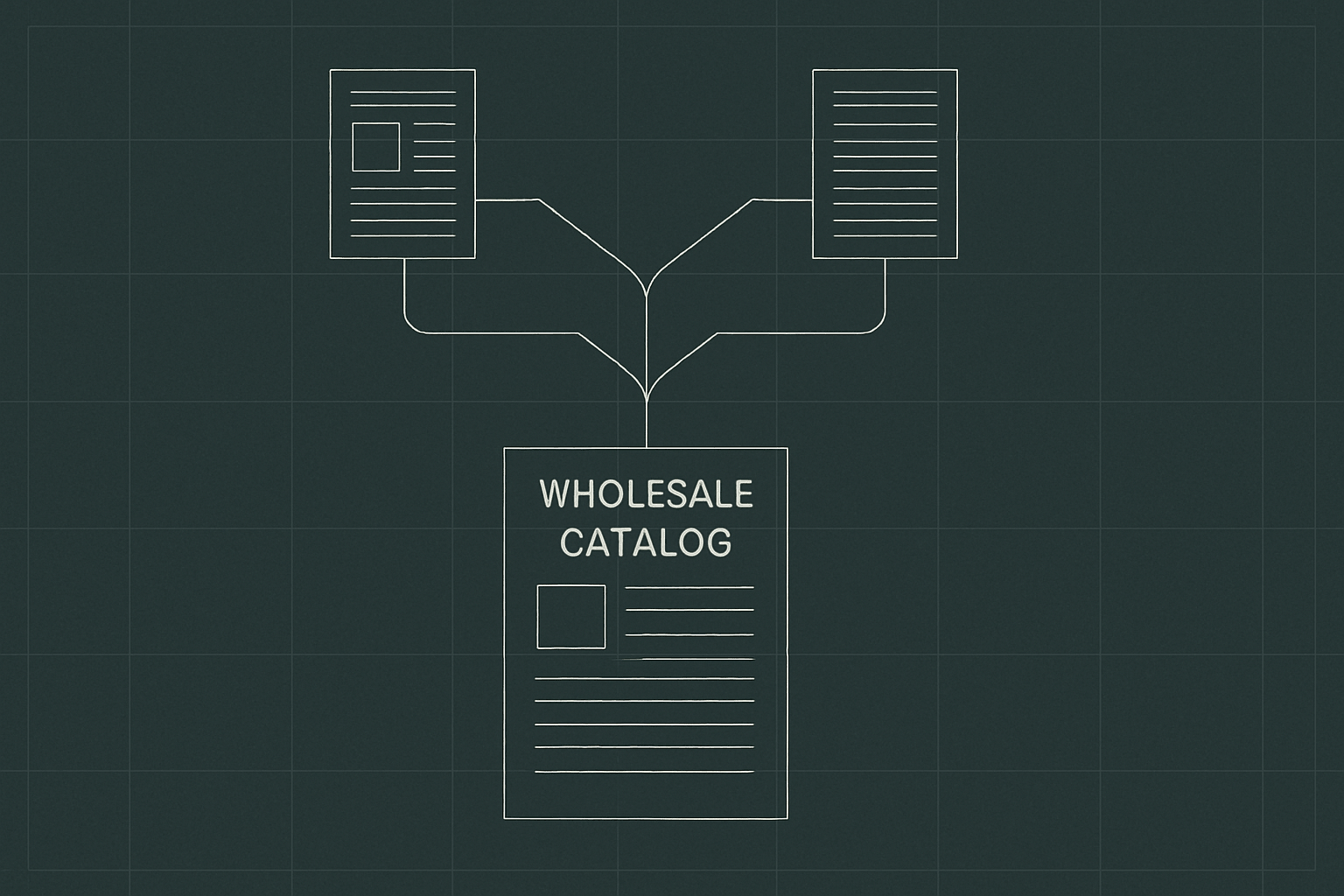
A $3.8M outdoor goods brand came to us in May with a genuinely reasonable question: should they upgrade to Shopify Plus for their new wholesale program? They had 40 wholesale accounts in play, net-30 terms with six of them, three pricing tiers by region, and a 700-SKU catalog. A sales rep at another agency had already told them the answer was yes, and quoted them a Plus migration plus setup for $28,000.
We told them to slow down. Not because Plus is wrong — we run Plus builds every week. Because the question itself had changed three months earlier, and almost nobody had caught up to it yet. Since April 2, 2026, that exact wholesale setup — company profiles, volume pricing, net payment terms, up to three catalogs — runs natively on Shopify Advanced without a Plus contract. They were about to pay $28,000 for features their current plan now included for free.
TL;DR: Shopify opened native B2B to every paid plan in April 2026. Most $1M–$10M wholesale brands launching their first buyer program don’t need Plus to do it. Plus earns its cost when your operation crosses specific thresholds: more than three customer-specific catalogs, partial payment or deposit workflows, or checkout logic that requires Shopify Functions. Below those thresholds, you’re buying headroom you won’t use for years.
The Question Everyone Is Asking Wrong
The search query most founders type is: “Do I need Shopify Plus for B2B?” Every article ranking for that question was written between 2022 and 2024, when the answer was an unambiguous yes. Before April 2026, if you wanted company accounts, custom pricing catalogs, and net payment terms on Shopify, you needed a Plus contract. That’s just how it worked.
Then Shopify moved the foundational B2B feature set to every paid plan — Basic, Grow, Advanced — at no extra cost. The right question now isn’t whether you need Plus for B2B. It’s whether your specific B2B operation needs what Plus exclusively provides. That distinction sounds subtle. The $2,300/month difference in platform cost is not subtle at all.
What Non-Plus Plans Can Actually Do Now
The April 2026 expansion was not a minor update. Every paid Shopify plan now includes: company profiles for wholesale buyers, up to three custom pricing catalogs with tailored pricing per account, volume discounts and quantity rules, net payment terms (Net 15/30/60/90), purchase order numbers, self-serve buyer ordering, quick order lists, vaulted credit cards, and ACH payments for US merchants. That list covers the entire wholesale workflow for the majority of brands launching a B2B channel.
To put it plainly: a brand doing 20 to 40 wholesale accounts, with two or three distinct pricing tiers, can run their entire B2B operation on Shopify Advanced. For most DTC brands adding a wholesale arm for the first time, this is genuinely enough. We’ve watched founders pay $2,300/month for Plus — plus setup costs — to access features they could have had on their existing plan. That money compounds. Over 18 months, you’re talking $41,400 in platform fees before a single line of development.
The Real Plus-Only List (It’s Shorter Than You Think)
Here is what actually stays exclusive to Shopify Plus, and why it matters at scale.
What requires Plus for B2B?
Five capabilities remain Plus-only and they cluster around one theme: operational scale above roughly 500 wholesale accounts, or complex pricing architecture that breaks the three-catalog cap. Specifically: unlimited pricing catalogs (non-Plus caps at three), direct catalog assignment to individual company locations, partial payments and deposit workflows, sales rep permission scoping, and checkout extensibility via Shopify Functions. If your operation doesn’t need any of those five, Plus is not required for B2B today.
The three-catalog ceiling is the real trip wire. Three catalogs sounds like a lot until you model a mid-market wholesale business with regional pricing, key account pricing, and a distributor tier — that’s three catalogs consumed before you’ve even handled international accounts. A brand selling into retail chains in three regions with negotiated rates per chain hits the wall fast. Below that complexity, non-Plus B2B works cleanly.
Partial payments and deposits are the second threshold. If your wholesale program runs standard net terms on invoices and buyers pay in full, you don’t need Plus for payment workflows. The moment you introduce split payments — 50% on order, 50% on delivery — you’re in Plus territory. We see this pattern almost exclusively in furniture, large-format goods, and seasonal wholesale programs where buyers want deposit structures.
When does the three-catalog cap actually break you?
The honest answer: faster than founders expect, but only in specific catalog architectures. If your pricing model is essentially percentage-based tiers (Tier 1 gets 30% off, Tier 2 gets 40% off), you can handle this with volume discount rules and quantity tiers inside a single catalog. If your pricing is truly customer-specific — Account A gets different line-item pricing from Account B, full stop — you’ll exhaust three catalogs the moment you have four key accounts with negotiated rates.
We worked with a $2.2M gift and stationery brand in Q1 this year that thought they needed Plus for their wholesale channel. Their actual pricing structure: three tiers based on minimum order volume. One catalog per tier. Three catalogs total. They’ve been running on Advanced for four months without hitting a single limitation. Contrast that with a $4.1M industrial supplies brand we spoke with in June — 300 wholesale accounts, every major account on individually negotiated pricing. They needed Plus from day one. Same revenue band. Completely different catalog architecture.
The Migration Pattern We Keep Watching
The mistake we see most often isn’t founders upgrading to Plus when they don’t need it. It’s founders staying on their current setup too long after they’ve crossed the threshold, then migrating under pressure — usually mid-peak-season, usually without adequate data cleanup, usually with their ERP integration still half-built.
The trigger point almost always looks the same. A wholesale program that launched on Advanced with 30 accounts grows to 200. Pricing exceptions start accumulating. The ops team is manually managing what should be catalog rules. Customer service is fielding complaints about buyers seeing wrong pricing because someone edited a catalog mid-cycle. At that point, the question isn’t “do we need Plus?” — it’s “how quickly can we get there without breaking active accounts?”
We’ve run this migration in both directions enough times to say this plainly: migrating from Advanced to Plus mid-growth is far less disruptive than migrating from a third-party wholesale app to native B2B. The old wholesale channel — Shopify’s previous approach to B2B, which created a second storefront with its own login — created data architecture problems that still take 6 to 10 weeks to untangle in 2026. If you’re still running on the old wholesale channel, get off it. That system is no longer the recommended path. Native B2B on whatever plan fits your scale is the right foundation.
The other migration pattern worth naming: Magento B2B to Shopify Plus. This one has real complexity that the DTC-to-Plus conversation doesn’t. Magento customer groups don’t map directly to Shopify B2B catalogs. Magento tier pricing has different logic than Shopify’s volume discount rules. Magento configurable products cap out at a different variant architecture than Shopify’s 100-variant limit. None of these are reasons to stay on Magento — the total cost argument alone makes that case — but they do mean a Magento B2B migration needs specific discovery time that a WooCommerce migration does not. Budget the data reconciliation phase twice as long as you think you’ll need.
The Objection: “But You Should Future-Proof by Starting on Plus”
We hear this from other agencies constantly. The argument goes: why not start on Plus so you never have to migrate? You’re investing in the wholesale program anyway, Plus gives you room to grow, and the cost difference is manageable.
Here’s why we push back on that framing, particularly for $1M–$5M brands. Shopify Plus at $2,300/month is not a small line item for a brand in that revenue range. Over 24 months, that’s $55,200 in platform fees alone — before agency setup, app costs, and any custom development. If your wholesale program is genuinely at the stage where it justifies that investment, the math works. If you’re launching your first 30-account B2B program and you could be on Advanced at $299–$399/month, you’re paying a $23,000–$24,000 premium for catalog capacity you won’t use for 18 months.
The “future-proof” argument also assumes the upgrade is painful. It isn’t. Moving from Advanced to Plus is a 24-to-48-hour process with no data migration, no storefront rebuild, and no downtime. You flip the plan, provision the additional Plus features, and configure what you need. Waiting until you actually need Plus — and moving then — is the financially rational call for most brands in this stage.
We’re a Shopify Plus partner agency. We build on Plus constantly. We are not incentivized to talk founders out of it. We are incentivized to tell you the truth so that when you do move to Plus, the investment makes sense and the build goes right. Paying for Plus before your operation warrants it doesn’t make the foundation stronger. It just makes the invoice bigger.
What to Do About It Monday Morning
Five concrete moves if you’re evaluating B2B on Shopify right now:
- Map your catalog architecture before touching plan tiers. Count how many distinct pricing structures you need across your buyer accounts. If it’s three or fewer, and they’re volume-based rather than account-specific, you can run on Advanced. If it’s four-plus, or if key accounts each need individually negotiated line-item pricing, model the Plus cost against that reality now.
- Audit whether you’re still on the old wholesale channel. If you set up a wholesale program on Shopify more than two years ago, there’s a meaningful chance you’re running on the deprecated wholesale channel — a separate storefront with its own login. That system has no upgrade path. Get off it and rebuild on native B2B. The clean architecture alone is worth the work, and your ops team will feel it immediately.
- List the five Plus-only features and check against your actual requirements. Unlimited catalogs. Direct catalog-to-location assignment. Partial payments and deposits. Sales rep permission scoping. Checkout extensibility via Shopify Functions. If none of these are on your near-term roadmap, your decision is made. If any of them are, cost out Plus vs. the problem you’re trying to solve with an app or workaround instead.
- Don’t treat the ERP integration as a Shopify plan question. We’ve watched founders upgrade to Plus thinking it would fix their ERP sync issues. It doesn’t. The plan decision and the integration decision are separate problems, and conflating them is expensive. ERP connections work at the API level regardless of plan tier.
- If you’re on Magento, run the catalog architecture audit before deciding on destination plan. Most Magento B2B merchants end up on Plus — the catalog complexity usually warrants it — but not all. The data cleanup phase is where timeline and budget bleed. Build in extra time there, not in platform selection. If you want a framework for that decision, our migration decision framework maps the evaluation we run before any replatform engagement.
The Founder’s Reality
The $3.8M outdoor goods brand from the opening? They launched their wholesale program on Advanced six weeks after that first call. Forty accounts, three catalogs, net-30 terms on the six accounts that needed it. The system works. They have a clear signal for when to move to Plus: the moment they have a fourth buyer who needs genuinely distinct account-specific pricing that can’t be handled by their existing tier structure. At that point, we’ll move them in 48 hours and it’ll cost them one month of the platform fee difference to do it. That’s the right sequence.
The B2B question used to be simple: you needed Plus. Now it requires an actual answer — one that looks at your catalog architecture, your account count, your payment workflow, and your growth trajectory. The agencies still telling every wholesale founder to start on Plus aren’t lying. They’re just not doing the math with your money. We do. If you want to understand what honest Plus partnership actually looks like — including when we tell founders not to buy it — that’s the conversation worth having.
FAQ
Do I need Shopify Plus to run B2B or wholesale on Shopify in 2026?
Not necessarily. Since April 2, 2026, every paid Shopify plan includes native B2B features: company profiles, up to three pricing catalogs, net payment terms, volume discounts, and ACH payments. You need Plus specifically for unlimited catalogs, partial payment workflows, sales rep scoping, and checkout customization via Shopify Functions. If your wholesale operation doesn’t require those features, Advanced is enough.
What’s the real tipping point where Shopify Plus pays off for B2B?
The most common threshold we see is catalog architecture complexity — specifically when you have four or more wholesale accounts that each need individually negotiated pricing that can’t be consolidated into shared tiers. A secondary trigger is partial payments and deposits, which are exclusive to Plus. Volume alone isn’t the driver; we’ve seen brands with 200 accounts run cleanly on Advanced because their pricing structure is tier-based rather than account-specific.
How hard is it to upgrade from Shopify Advanced to Plus when you’re ready?
Much easier than most founders expect. Moving from Advanced to Plus requires no data migration, no storefront rebuild, and no downtime. Shopify provisions the additional features within 24 to 48 hours of the plan change. This means waiting until your operation genuinely warrants Plus — rather than pre-buying it — carries almost no migration risk. The upgrade is a plan switch, not a replatform.
If I’m migrating from Magento with a B2B operation, do I automatically need Shopify Plus?
Almost always, yes — but run the catalog audit first. Magento B2B typically involves customer groups with account-specific pricing, configurable product structures, and payment term complexity that maps directly to Plus-only features like unlimited catalogs and partial payments. The migration itself also requires Plus for checkout extensibility rebuilds if your Magento checkout had custom logic. The decision is usually clear; what takes time is the data reconciliation, not the platform selection.

