Backend ecommerce is often misunderstood by American store owners, yet these hidden systems power billions in online sales every year. While a seamless shopping experience attracts customers, the real challenge lies in optimizing backend processes that can handle explosive growth without costly breakdowns. This article corrects common myths and spotlights what every American Shopify manager must know about scalable architecture, smart integration, and avoiding mistakes that threaten profits.
Table of Contents
- Backend Ecommerce Basics And Misconceptions
- Types Of Backend Architectures For Shopify
- Key Features And System Integrations
- Requirements For Secure, Scalable Operations
- Risks, Costs, And Common Mistakes To Avoid
Key Takeaways
| Point | Details |
|---|---|
| Backend ecommerce is complex | It requires deep technical expertise in server-side programming, database architecture, and security protocols to manage crucial operations. |
| Choose the right backend architecture | Select an architecture that aligns with your business needs, such as Microservices for scalability or Layered Architecture for structured organization. |
| Prioritize security and scalability | Implement comprehensive security measures and design adaptable systems to handle growth and prevent vulnerabilities. |
| Regularly assess your systems | Conduct audits and optimize system integrations every six months to enhance operational efficiency and reduce risks. |
Backend ecommerce basics and misconceptions
Backend ecommerce represents the complex technological infrastructure that powers online shopping experiences, managing critical operations invisible to customers but essential for business success. While customers see a polished storefront, the backend manages intricate processes like database management and transaction processing, ensuring seamless digital interactions.
At its core, backend ecommerce involves multiple interconnected systems that handle data flow, user authentication, inventory tracking, and payment processing. Unlike frontend design which focuses on visual appeal, backend development requires deep technical expertise in server-side programming, database architecture, and security protocols. Developers must build robust systems capable of handling high traffic volumes, protecting sensitive customer information, and maintaining real-time inventory accuracy across multiple sales channels.
Common misconceptions about backend ecommerce often stem from underestimating its technical complexity. Many store owners assume backend systems are simple plug-and-play solutions, when in reality they require sophisticated server logic and API interactions to create truly scalable platforms. Each component must communicate seamlessly: from product databases and customer management systems to payment gateways and shipping integrations. This intricate choreography demands strategic planning and expert technical implementation.
Pro tip:Invest in backend infrastructure that can scale with your business growth, prioritizing modular systems that allow easy integration of new technologies and sales channels.
Types of backend architectures for Shopify
Shopify store owners have multiple backend architectural approaches to power their ecommerce platforms, each offering unique advantages for scalability, performance, and customization. Various architectural styles provide strategic options for designing robust digital commerce solutions that can adapt to evolving business needs.
One prominent architectural approach is the Microservices Architecture, which breaks down backend systems into independent, modular services that can be developed, deployed, and scaled separately. This approach allows Shopify merchants to create highly flexible platforms where individual components like inventory management, payment processing, and customer authentication can be modified without disrupting the entire system. Another significant architectural pattern is the Backend-for-Frontend (BFF), which creates specialized backend services for different client interfaces, enabling optimized experiences across web, mobile, and other digital touchpoints.
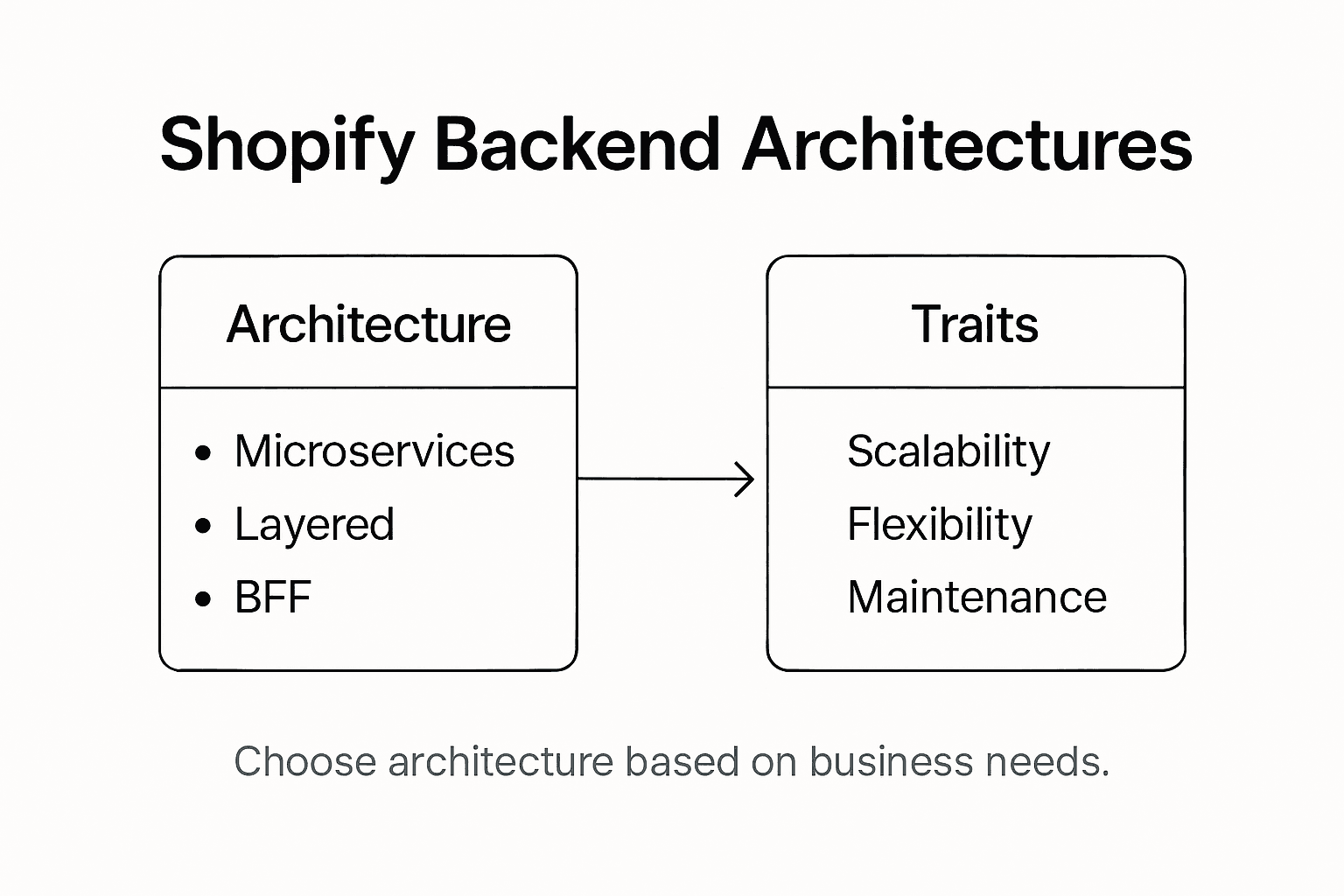
Traditional architectural models like Layered Architecture remain relevant for Shopify implementations, providing a structured approach where backend components are organized into distinct layers such as presentation, business logic, and data access. More advanced merchants might explore event-driven architectures that enable real-time data processing and seamless communication between different backend services, supporting complex ecommerce workflows and instant updates across platforms.
Here’s a comparison of common backend architectures for Shopify:
| Architecture Style | Scalability | Flexibility | Maintenance Complexity |
|---|---|---|---|
| Microservices | Highly scalable | Very flexible | Complex to maintain |
| Backend-for-Frontend | Moderate scalability | Optimized per interface | Separate backend per client |
| Layered Architecture | Limited scalability | Rigid structure | Easier but less adaptable |
| Event-Driven | Real-time scalability | Dynamic flexibility | Advanced implementation required |
Pro tip:Select a backend architecture that aligns with your current business complexity and future growth potential, ensuring you can easily adapt and scale your Shopify store’s technological infrastructure.
Key features and system integrations
Shopify’s backend infrastructure provides a comprehensive suite of features designed to empower ecommerce businesses with robust technological capabilities. Ecommerce APIs enable seamless connections between various operational systems, allowing merchants to create sophisticated, interconnected digital platforms that streamline complex business processes.
The core backend features include advanced Product Management systems that support detailed inventory tracking, variant configurations, and real-time stock updates. Customer Relationship Management (CRM) tools integrate deeply with backend systems, enabling personalized marketing, segmentation, and targeted communication strategies. Key integration capabilities span payment gateways, shipping providers, and marketing automation platforms, allowing merchants to create automated workflows that reduce manual intervention and improve operational efficiency.

Beyond basic transactional capabilities, Shopify’s backend provides sophisticated Analytics and Reporting modules that track critical business metrics, customer behaviors, and sales performance. These integrations support complex data synchronization across multiple channels, enabling merchants to make data-driven decisions, optimize marketing strategies, and understand their business ecosystem with unprecedented depth and clarity.
Below is a summary of key Shopify backend features and their business impact:
| Feature | Core Function | Business Impact |
|---|---|---|
| Product Management | Inventory control and updates | Prevents overselling |
| CRM Integration | Customer segmentation | Enables targeted marketing |
| Payment Gateway Integration | Secure transaction processing | Builds customer trust |
| Analytics and Reporting | Sales data analysis | Informs business decisions |
Pro tip:Regularly audit and optimize your system integrations, focusing on APIs that provide the most significant operational efficiency and directly contribute to revenue generation.
Requirements for secure, scalable operations
Building a robust backend infrastructure for Shopify demands a strategic approach to security and scalability that goes beyond basic protective measures. Design patterns for modern backend development emphasize the critical importance of creating adaptable, resilient systems that can withstand increasing complexity and potential security threats.
Secure backend operations require implementing comprehensive Authentication and Authorization frameworks that enforce strict access controls. This involves developing multi-layered security protocols that integrate zero trust frameworks and least privilege access principles, ensuring that only authorized personnel can access sensitive system components. Key security strategies include implementing robust encryption mechanisms, continuous security monitoring, and developing granular user permission systems that restrict access based on specific roles and responsibilities.
Scalability demands a forward-thinking architectural approach that anticipates future growth and technological shifts. Advanced backend infrastructures leverage microservices architecture, containerization technologies, and event-driven designs that allow seamless horizontal scaling. These architectural choices enable Shopify stores to dynamically adjust computational resources, handle sudden traffic spikes, and maintain consistent performance during peak shopping periods. Continuous integration and deployment (CI/CD) pipelines further support this scalability by enabling rapid, automated updates and minimizing system downtime.
Pro tip:Implement a comprehensive security and scalability audit every six months, focusing on identifying potential vulnerabilities, performance bottlenecks, and opportunities for architectural optimization.
Risks, costs, and common mistakes to avoid
Navigating the complex landscape of backend ecommerce requires a proactive approach to identifying and mitigating potential risks. Web application security risks pose significant threats to online businesses, with vulnerabilities ranging from authentication failures to data exposure that can compromise entire digital infrastructure.
The most critical risks emerge from fundamental strategic misconceptions about backend development. Common ecommerce mistakes can dramatically increase operational costs and reduce customer trust, including overcomplicating user experiences, neglecting data-driven insights, and implementing inefficient backend architectures. Injection Vulnerabilities represent a particularly dangerous risk, where malicious actors can exploit poorly designed backend systems to access sensitive customer information, manipulate databases, or execute unauthorized commands.
Financial implications extend beyond immediate security breaches, encompassing long-term reputation damage and potential regulatory penalties. Shopify store owners must develop comprehensive risk management strategies that include continuous vulnerability assessments, robust authentication protocols, and proactive monitoring systems. Key focus areas include implementing secure data encryption, maintaining strict access controls, regularly updating backend components, and developing transparent incident response plans that protect both business and customer interests.
Pro tip:Conduct quarterly comprehensive security audits and allocate at least 10% of your backend development budget specifically to security infrastructure and potential risk mitigation strategies.
Unlock Scalable Shopify Growth with Expert Backend Solutions
Understanding backend ecommerce’s complexity and its vital role in powering Shopify stores is only the first step toward sustainable growth. If you are facing challenges like integrating modular systems, securing sensitive customer data, or scaling your infrastructure to meet rising demand, you are not alone. These critical backend considerations such as microservices architectures, secure authentication, and seamless API integrations can be overwhelming but are essential for maximizing your online store’s potential.
At Blackbelt Commerce, we specialize in tackling these exact pain points with custom-developed Shopify solutions tailored for businesses ready to scale. Our expertise includes advanced backend architectures, secure payment gateway integration, and headless commerce capabilities designed to increase performance and conversion rates. We cover everything from consultation through ongoing support, ensuring your backend systems evolve with your brand’s ambitions. Explore how our custom Shopify theme development and Shopify Plus solutions have driven measurable results for clients facing backend complexities.

Ready to transform your Shopify backend into a secure, scalable powerhouse that drives real growth? Visit Blackbelt Commerce today and start your journey with a partner who understands the technical challenges and business impact of backend ecommerce development. Don’t wait—empower your Shopify store with expert solutions built for long-term success.
Frequently Asked Questions
What is backend ecommerce?
Backend ecommerce refers to the technology and systems that manage the operations of an online store, including database management, transaction processing, and backend development.
What are the common misconceptions about backend ecommerce?
Many store owners underestimate the technical complexity of backend systems, believing they are simple plug-and-play solutions, when in fact they require sophisticated server logic and integration efforts.
What are the different types of backend architectures for Shopify?
Shopify offers various backend architectures, including Microservices Architecture, Backend-for-Frontend (BFF), Layered Architecture, and Event-Driven Architecture, each with unique scalability and flexibility features.
How can I ensure the security and scalability of my Shopify backend?
To ensure security and scalability, implement comprehensive authentication frameworks, utilize microservices architecture, enforce access controls, and regularly conduct security audits and performance evaluations. Dyb Vekselheim