


Over 45 percent of American consumers now prioritize brands that create seamless digital shopping experiences, setting a new standard for e-commerce success. For ambitious American Shopify entrepreneurs and digital marketing managers, understanding what fuels this shift is no longer optional. This guide uncovers how emerging 2025 trends in personalization, technology, and compliance can position your Shopify store for higher conversion rates and sustained competitive edge in the fast-evolving digital market.
Table of Contents
- Defining 2025 Ecommerce Trends And Shopify
- Types Of Emerging Technology Shaping Commerce
- Personalization, Ar, And Mobile-First Experiences
- Social Commerce And Influencer Marketing Impact
- Navigating Us Compliance And Sustainability In 2025
- Key Mistakes And Strategies For Maximizing Growth
Key Takeaways
| Point | Details |
|---|---|
| E-commerce Evolution | E-commerce is evolving rapidly with a focus on personalized experiences, omnichannel strategies, and sustainability by 2025. |
| Technology Integration | Key technologies like AI, AR, and IoT are essential for creating competitive advantages in the digital marketplace. |
| Social Commerce Growth | Engaging with consumers through social media and influencer partnerships is becoming crucial for e-commerce success. |
| Compliance Importance | Navigating regulatory compliance and sustainability is now a strategic opportunity for building consumer trust. |
Defining 2025 ecommerce trends and Shopify
The e-commerce landscape is rapidly evolving, driven by technological advancements and shifting consumer behaviors. Global digital economy measurements reveal that platforms like Shopify are becoming critical infrastructures for businesses seeking online growth. By 2025, e-commerce is expected to transcend traditional retail boundaries, offering unprecedented opportunities for digital entrepreneurs.
According to US Census Bureau quarterly reports, retail e-commerce sales continue to demonstrate robust growth, with Shopify emerging as a key platform enabling this digital transformation. Specific trends shaping the 2025 e-commerce ecosystem include:
- Artificial Intelligence Integration: Advanced personalization and predictive shopping experiences
- Omnichannel Commerce: Seamless customer journeys across mobile, web, and physical retail
- Enhanced Mobile Commerce: Optimized shopping experiences for smartphone users
- Sustainability-Driven Purchasing: Consumer preferences for eco-friendly brands and transparent supply chains
These trends highlight the critical role of adaptable e-commerce platforms like Shopify in meeting evolving consumer expectations. Successful online businesses will leverage data-driven strategies, emerging technologies, and user-centric design to create compelling digital shopping experiences.
Pro Tip for Store Owners: Continuously invest in mobile optimization and AI-powered personalization features to stay ahead of 2025 e-commerce trends and maximize your Shopify store’s competitive potential.
Types of emerging technology shaping commerce
The future of commerce is being fundamentally reshaped by a constellation of emerging technologies that are transforming how businesses interact with consumers. McKinsey’s 2025 Technology Trends Outlook provides a comprehensive analysis of the technological innovations driving this digital revolution across multiple sectors.
Key emerging technologies fundamentally disrupting commerce include:
- Artificial Intelligence (AI): Advanced machine learning algorithms enabling hyper-personalized customer experiences
- Augmented Reality (AR): Immersive product visualization and interactive shopping experiences
- Internet of Things (IoT): Connected devices creating seamless omnichannel shopping interactions
- Blockchain Technology: Enhanced security and transparent transaction mechanisms
- Advanced Connectivity: 5G and edge computing enabling real-time digital commerce
Digital economy research indicates these technologies are not just incremental improvements but transformative forces redefining entire business models. Successful companies will strategically integrate these technologies to create more intelligent, responsive, and personalized consumer experiences.
The convergence of these technologies suggests that future commerce platforms will be adaptive, predictive, and increasingly human-centric. Businesses that can effectively leverage AI, immersive technologies, and advanced connectivity will gain substantial competitive advantages in the rapidly evolving digital marketplace.

Here’s a summary of how core technologies impact the future of digital commerce:
| Technology | Main Benefit | Example Business Impact |
|---|---|---|
| Artificial Intelligence | Real-time personalization | Higher conversion rates |
| Augmented Reality | Immersive shopping experiences | Reduced product returns |
| IoT | Connected retail channels | Seamless cross-device shopping |
| Blockchain | Secure, transparent transactions | Enhanced consumer trust |
| 5G Connectivity | Fast and responsive interfaces | Improved mobile experience |
Pro Tip for Tech Integration: Prioritize technologies that directly enhance customer experience and provide measurable business value, rather than adopting trends purely for novelty.
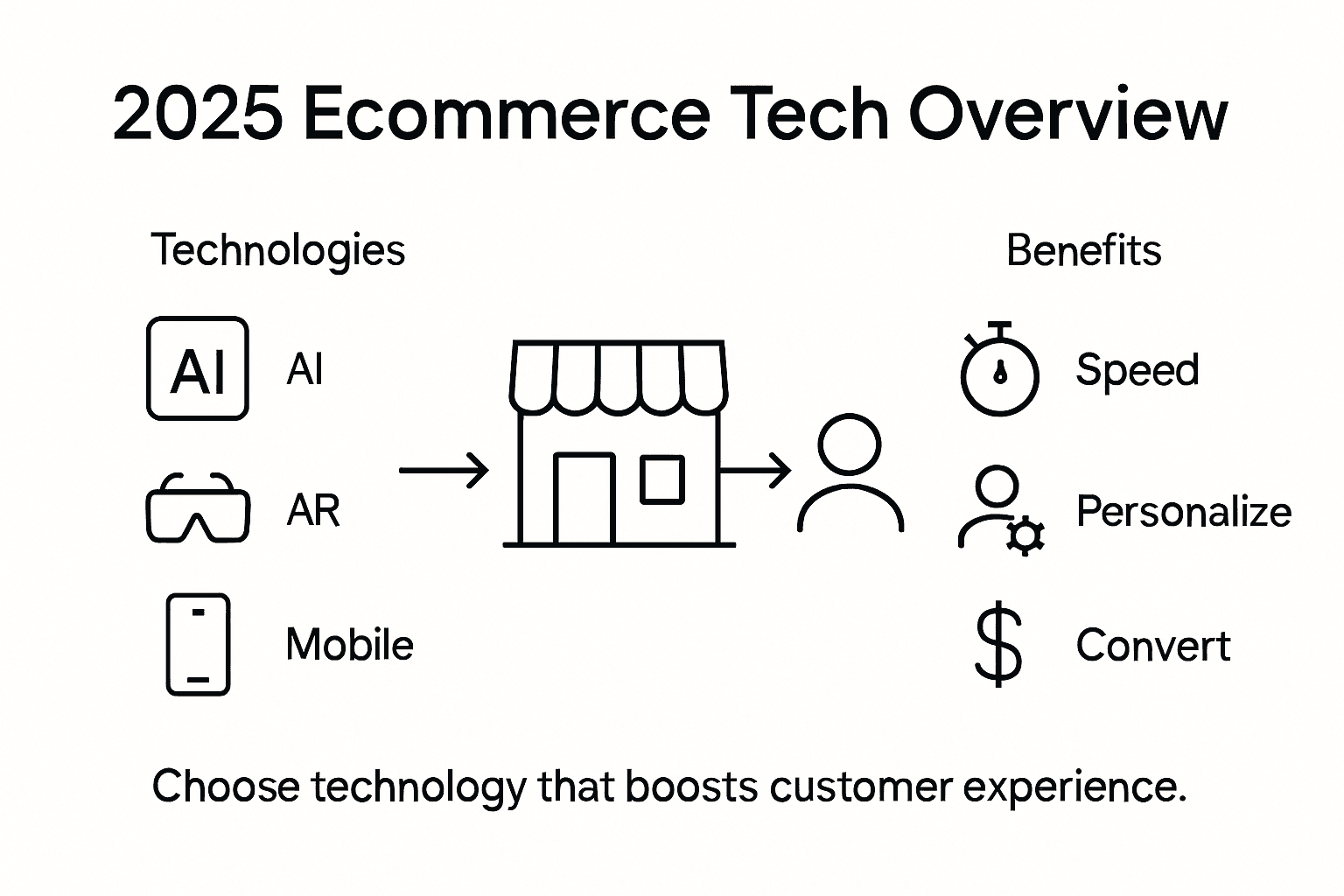
Personalization, AR, and mobile-first experiences
The future of e-commerce is being radically transformed by the convergence of personalization, augmented reality (AR), and mobile-first design strategies. Academic research on augmented reality’s role in e-commerce reveals that these technologies are no longer optional innovations but critical components of successful online retail experiences.
Key developments in this technological ecosystem include:
- Hyper-Personalized Shopping Experiences: AI-driven recommendations that adapt in real-time
- Augmented Reality Product Visualization: Enabling customers to virtually interact with products
- Mobile-Optimized Interface Design: Creating seamless, intuitive mobile shopping journeys
- Contextual User Experience: Personalization that anticipates customer needs before they arise
The 2025 AR in Retail & E-commerce Report demonstrates that these technologies are driving significant business outcomes. Merchants implementing advanced personalization and AR strategies are seeing substantial improvements in conversion rates, customer engagement, and reduced product return rates.
Shopify store owners must recognize that mobile-first experiences are no longer a trend but a fundamental requirement. Successful digital commerce strategies will prioritize creating immersive, personalized experiences that seamlessly blend technological innovation with intuitive user design. This means developing interfaces that are not just responsive, but predictive and emotionally intelligent.
Pro Tip for Digital Experience Design: Continuously test and iterate your mobile and AR experiences, focusing on creating frictionless, intuitive interactions that feel natural and enhance rather than complicate the shopping journey.
Social commerce and influencer marketing impact
The landscape of digital marketing is undergoing a radical transformation, with social commerce emerging as a pivotal channel for e-commerce growth. US Social Commerce Market Intelligence Report highlights the unprecedented potential of integrating social media platforms directly into sales strategies for Shopify merchants.
Key dynamics reshaping social commerce include:
- Platform-Specific Strategies: Tailored approaches for TikTok, Instagram, and emerging social networks
- Micro-Influencer Collaborations: Targeted partnerships delivering higher engagement rates
- Authentic Content Marketing: Building trust through genuine, relatable product narratives
- Direct Shopping Integrations: Seamless purchasing experiences within social media environments
Influencer marketing has evolved from a trendy marketing tactic to a sophisticated conversion mechanism. Modern consumers increasingly rely on trusted personalities to guide purchasing decisions, making strategic influencer partnerships critical for Shopify store success. The most effective approaches leverage authentic storytelling, demonstrating product value through real-world experiences and transparent communication.
Successful social commerce strategies in 2025 will require merchants to view social platforms not just as marketing channels, but as comprehensive customer engagement ecosystems. This means developing integrated approaches that combine compelling content, strategic influencer relationships, and frictionless purchasing experiences across multiple digital touchpoints.
Pro Tip for Social Commerce: Prioritize building genuine relationships with influencers who authentically align with your brand values and can create meaningful connections with your target audience.
Navigating US compliance and sustainability in 2025
Digital business compliance regulations are rapidly evolving, presenting complex challenges for Shopify merchants operating in the United States. The 2025 regulatory landscape demands a sophisticated, proactive approach to legal and ethical business practices, with increasing emphasis on data privacy, consumer protection, and environmental sustainability.
Key compliance considerations for Shopify store owners include:
- Data Privacy Protocols: Implementing robust consumer data protection mechanisms
- Electronic Transaction Transparency: Clear, accessible terms of service and consumer rights
- Sustainability Reporting: Demonstrating environmental and social governance commitments
- Tax Compliance: Accurate collection and reporting of digital sales taxes across jurisdictions
- Supply Chain Accountability: Verifying ethical sourcing and production practices
US Sustainability Regulations Analysis indicates that businesses must now view compliance not as a checkbox exercise, but as a strategic opportunity for building consumer trust and competitive differentiation. The most successful Shopify merchants will integrate compliance into their core business model, transforming regulatory requirements into meaningful brand narratives.
The intersection of technology, law, and ethics demands continuous learning and adaptation. Successful e-commerce businesses will invest in compliance infrastructure, leveraging advanced tools and expert guidance to navigate the increasingly complex regulatory environment. This means developing agile systems that can quickly respond to new legal requirements while maintaining operational efficiency and customer experience.
Pro Tip for Regulatory Navigation: Establish a dedicated compliance review process that includes quarterly assessments of changing regulations, ensuring your Shopify store remains ahead of legal and sustainability requirements.
Key mistakes and strategies for maximizing growth
Common e-commerce mistakes in 2025 reveal critical challenges that can derail Shopify store performance. Understanding these potential pitfalls is essential for entrepreneurs seeking sustainable growth in an increasingly competitive digital marketplace. Successful merchants must proactively identify and address strategic weaknesses before they become systemic business limitations.
Key mistakes Shopify store owners frequently encounter include:
- Neglecting Mobile Optimization: Failing to create responsive, intuitive mobile shopping experiences
- Weak Conversion Funnel Design: Complicated checkout processes that increase cart abandonment
- Inadequate Customer Persona Development: Ineffective targeting and personalization strategies
- Inconsistent Brand Messaging: Disconnected communication across marketing channels
- Underutilized Analytics: Missing critical insights for data-driven decision making
FTI Consulting’s US Online Retail Report emphasizes that scaling e-commerce businesses must develop flexible infrastructures capable of adapting to rapidly changing market dynamics. This requires a holistic approach that balances technological innovation, customer experience optimization, and strategic financial management.
Maximizing Shopify growth demands a multifaceted strategy that goes beyond traditional marketing tactics. Successful merchants will invest in sophisticated data analysis, create seamless omnichannel experiences, and continuously refine their understanding of customer behavior. The most adaptive businesses will treat their online store as a dynamic ecosystem, constantly evolving to meet emerging consumer expectations and technological capabilities.
This table contrasts common Shopify mistakes with effective growth tactics for 2025:
| Common Mistake | Impact on the Store | Proactive Strategy |
|---|---|---|
| Poor mobile optimization | Loss of mobile customers | Invest in responsive design |
| Weak analytics usage | Missed growth opportunities | Implement data analysis |
| Inconsistent branding | Erodes consumer trust | Align messaging across channels |
| Complex checkout process | Increased cart abandonment | Simplify checkout steps |
| Lack of customer insight | Ineffective personalization | Develop detailed personas |
Pro Tip for Strategic Growth: Implement a quarterly performance audit that systematically reviews your store’s conversion metrics, customer feedback, and technological capabilities to identify and proactively address potential growth barriers.
Unlock Your Shopify Store’s Full Potential With Expert Growth Strategies
Meeting the challenges of 2025 e-commerce trends requires more than basic setup. Whether it is tackling mobile optimization, integrating AI-powered personalization, or navigating complex US compliance and sustainability, Shopify store owners face real hurdles in keeping ahead of an evolving digital marketplace. If you want to avoid common pitfalls like weak analytics usage or inconsistent brand messaging, and instead capitalize on emerging opportunities such as augmented reality and seamless social commerce, expert guidance is essential.

At Blackbelt Commerce, we specialize in building custom, scalable Shopify solutions tailored to your unique business needs. Our proven process covers everything from consultation and custom theme development to advanced AI integrations and ongoing optimization. Don’t let complicated checkout processes or outdated technology hold you back. Take control of your Shopify store’s growth today—explore our detailed case studies, client testimonials, and service offerings designed to increase traffic, boost revenue, and create immersive customer experiences. Start your journey to a competitive, future-ready e-commerce store by visiting Blackbelt Commerce now.
Frequently Asked Questions
What are the key e-commerce trends for 2025?
E-commerce trends for 2025 include the integration of artificial intelligence for personalization, the rise of omnichannel commerce, enhanced mobile shopping experiences, and sustainable consumer purchasing behaviors.
How can Shopify store owners utilize AI to enhance consumer experiences?
Shopify store owners can leverage AI to provide hyper-personalized shopping experiences by using advanced algorithms for recommendations, predictive analytics, and real-time customer engagement to improve conversion rates.
What role does augmented reality (AR) play in e-commerce?
Augmented reality enhances e-commerce by allowing customers to virtually interact with products, leading to immersive shopping experiences that can increase engagement and decrease product return rates.
Why is mobile optimization crucial for e-commerce growth in 2025?
Mobile optimization is crucial because an increasing number of consumers are shopping via smartphones. A responsive, intuitive mobile interface enhances the shopping experience, reduces cart abandonment, and improves overall conversion rates.
Recommended
- Explore the Top E-Commerce Marketing Trends for 2019
- Use Trending E-Commerce Tactics to Grow Your Shopify Store
- Ecommerce Trends 2021 – Shopify Experts: Grow Your eCommerce Revenue
- Selling & Social Media – Key Insights for E-Commerce Success
Quick Answer: 2025 ecommerce trends
2025 ecommerce trends should improve how a Shopify store converts traffic into trust, customers, and revenue. The article should connect UX, store features, security, automation, performance, analytics, and conversion paths so readers understand what to fix and when expert help can accelerate results.
Want a sharper Shopify growth plan?
Want to turn 2025 ecommerce trends into a practical Shopify growth plan? Book a strategy call and we will help you clarify the next move.
Key Takeaways
- Use 2025 ecommerce trends to clarify the business problem and the highest-impact next step for a Shopify store.
- Connect recommendations to customer trust, UX, conversion, SEO, analytics, operations, and revenue.
- Link naturally to Blackbelt Commerce money pages and the home page without weakening editorial trust.
- Avoid generic ecommerce advice; make the guidance specific to Shopify constraints and opportunities.
- Use the same-page Calendly CTA only after the post has delivered useful guidance.
How this connects to your Shopify growth strategy
For the Shopify Growth, CRO, and Store Optimization cluster, this article should make 2025 ecommerce trends practical, specific, and commercially useful while protecting editorial trust. The bridge to Blackbelt Commerce should show when expert planning, implementation, SEO/CRO discipline, or Shopify Plus support can reduce risk and turn the reader’s next decision into measurable progress.
Want a sharper Shopify growth plan?
Use this guide as a decision tool. Then book a strategy call when you want a practical roadmap for your store.
Related Shopify resources
These internal resources support the Shopify Growth, CRO, and Store Optimization topic cluster and help connect this guide to stronger commercial next steps:
- Shopify CRO services
- Shopify experts
- Shopify Plus agencies
- Shopify CRO services — Primary money/service page for this search intent
- Blackbelt Commerce — Home-page authority link for brand and core Shopify expertise
- Shopify experts — Money-page link requested for expert-hiring intent
- Shopify custom development — Development service page for implementation and technical help
- Shopify checkout optimization — Related conversion article
- Shopify conversion optimization — Related CRO article
Questions store owners ask before taking action
Why does 2025 ecommerce trends matter for Shopify merchants?
It matters when the topic affects customer trust, conversion, operations, SEO, analytics, or the team’s ability to scale the store cleanly.
How should the article guide the reader?
It should answer the search intent first, then connect the topic to practical next steps, related resources, and expert support when that next step is useful.
What is the lead-generation goal?
The goal is a qualified strategy-call booking after the article has delivered enough value for the reader to trust Blackbelt Commerce with the next decision.
Future articles needed for topical dominance
To build deeper topical authority around this cluster, these supporting topics should be created later and linked back into this article:
- 2025 ecommerce trends Checklist for Shopify Stores: Creates an actionable support article that can earn long-tail searches and link back to relevant money pages.
- Common 2025 ecommerce trends Mistakes That Hurt Shopify Revenue: Targets problem-aware readers and explains UX, SEO, conversion, and implementation risk.
- How Shopify Experts Prioritize 2025 ecommerce trends: Links informational intent to expert support without turning the main article into a sales pitch.
Want a sharper Shopify growth plan?
Ready to turn the advice in this article into an action plan? Open the calendar here and choose a time that works for you.

