


Nearly ninety percent of American online shoppers expect fast, seamless experiences every time they browse or buy. As ecommerce grows more complex, staying competitive now means using smart automation to manage ever-changing demands. This guide uncovers how automation is redefining digital retail for American businesses, revealing the strategies and technologies that deliver real advantages from order fulfillment to customer communications.
Table of Contents
- Defining Automation In Ecommerce Today
- Types Of Automation Tools For Online Stores
- How Automation Streamlines Store Operations
- Boosting Revenue And Customer Experience
- Common Mistakes And How To Avoid Them
Key Takeaways
| Point | Details |
|---|---|
| Embrace Incremental Automation | Start with a few critical processes to assess performance before expanding automation strategies. |
| Personalization is Essential | Use automation tools to deliver tailored customer experiences that enhance engagement and loyalty. |
| Balance Technology and Human Interaction | Ensure that automation supports rather than replaces human oversight to maintain a personal touch. |
| Prioritize Data Quality and Security | Use accurate customer information and implement strong security measures to protect your business and customers from risks. |
Defining Automation in Ecommerce Today
Automation in ecommerce represents a strategic approach to streamlining digital business operations through intelligent technological solutions. At its core, automation transforms how online stores manage complex workflows, reduce manual interventions, and optimize customer experiences. Modern ecommerce automation goes far beyond simple task replacement—it’s about creating intelligent, responsive systems that adapt and learn.
The technological landscape of ecommerce automation encompasses multiple domains, including order processing, customer communication, inventory management, and marketing workflows. Human-automation interaction research highlights the critical importance of designing systems that seamlessly integrate technological capabilities with human oversight. Successful automation strategies leverage machine learning, artificial intelligence, and advanced programming techniques to create more efficient operational models.
Specifically, automation technologies enable online businesses to execute repetitive tasks with unprecedented speed and accuracy. From automatically sending personalized email sequences to dynamically adjusting pricing based on market conditions, these technologies help ecommerce businesses scale operations without proportionally increasing human labor. The web automation programming systems emerging today can handle increasingly complex specifications, allowing businesses to create more sophisticated and responsive digital ecosystems.
Modern automation tools provide granular control over intricate ecommerce processes, enabling merchants to design custom workflows that match their unique business requirements. These technologies not only improve operational efficiency but also enhance customer experiences through personalized, timely interactions.
Pro Tip: Implement incremental automation strategies. Start with one or two critical processes, measure their performance, and gradually expand your automation ecosystem to minimize disruption and maximize effectiveness.
Types of Automation Tools for Online Stores
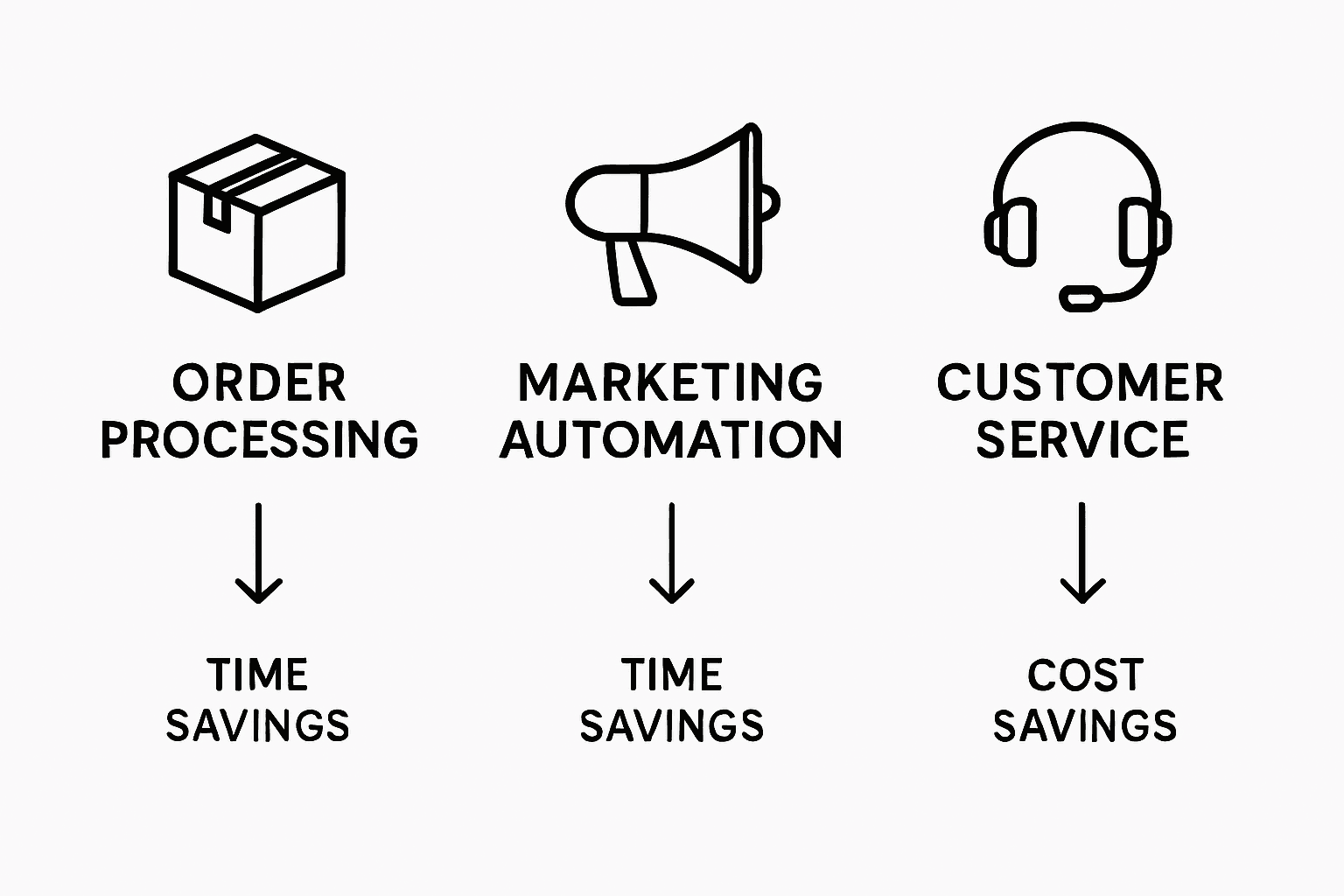
Ecommerce automation tools represent a diverse ecosystem of technological solutions designed to streamline and optimize online business operations. These tools span multiple functional domains, each addressing specific challenges faced by digital merchants in managing complex workflows and enhancing customer experiences. Top U.S. retailers are increasingly leveraging automation platforms to gain competitive advantages and operational efficiency.
The primary categories of automation tools for online stores include:
- Marketing Automation Tools: Enable personalized email campaigns, customer segmentation, and targeted advertising
- Order Processing Tools: Automate shipping, tracking, and inventory management
- Customer Service Automation: Implement chatbots, automated support tickets, and intelligent routing systems
- Inventory Management Systems: Track stock levels, predict demand, and trigger reorder processes
- Analytics and Reporting Tools: Generate real-time insights and performance metrics
Advanced AI automation applications now offer sophisticated workflow mapping and data transformation capabilities. These next-generation tools can integrate complex business logic, enabling merchants to create custom automation sequences that adapt to changing market conditions and customer behaviors.
The most effective automation strategies focus on selecting tools that not only reduce manual labor but also enhance overall customer experience. By strategically implementing these technologies, online stores can improve operational efficiency, reduce human error, and create more personalized shopping experiences that drive customer loyalty and increase revenue.
Pro Tip: Conduct a comprehensive workflow audit before implementing automation tools. Identify repetitive tasks, measure their current time and resource costs, and prioritize automation solutions that deliver the most significant operational improvements.
How Automation Streamlines Store Operations
Store operations represent the complex network of processes that keep an online business functioning efficiently. Automation transforms these intricate workflows by introducing intelligent systems that reduce manual intervention and minimize human error. Advanced ecommerce automation dramatically reduces operational lead times and enhances cost efficiency, enabling businesses to scale rapidly without proportionally increasing human resources.
The key operational domains where automation creates significant impact include:
- Order Processing: Automatic order routing, payment verification, and shipping label generation
- Inventory Management: Real-time stock tracking, automated reordering, and demand forecasting
- Customer Communication: Triggered email sequences, personalized follow-ups, and support ticket routing
- Financial Reconciliation: Automated invoicing, payment tracking, and accounting synchronization
- Marketing Workflows: Segmentation, targeted campaigns, and performance tracking
Modern automation technologies integrate machine learning and artificial intelligence to create adaptive systems that continuously optimize performance. These intelligent platforms can analyze historical data, predict potential bottlenecks, and automatically adjust workflows to maintain peak operational efficiency. By transforming repetitive tasks into automated sequences, online stores can allocate human resources toward strategic growth initiatives and creative problem-solving.

Here is a summary of how key automation features impact ecommerce stores:
| Automation Feature | Main Benefit | Typical Business Impact |
|---|---|---|
| Order Routing | Faster fulfillment | Reduces shipping delays |
| Predictive Inventory | Optimized stock levels | Fewer stockouts and overstocks |
| Personalized Communication | Higher customer engagement | Increases repeat sales |
| Dynamic Pricing | Responsive to demand | Maximizes revenue opportunities |
| Automated Reporting | Real-time insights | Informed, faster decision-making |
Successful implementation of automation requires a strategic approach that balances technological capability with human oversight. The most effective automation strategies focus on incremental improvements, carefully selecting tools that enhance rather than replace human decision-making. Online stores that master this balance can create more responsive, agile operational models that deliver exceptional customer experiences while maintaining operational flexibility.
Pro Tip: Map your current operational workflows before implementing automation. Identify repetitive tasks, document existing processes, and select automation tools that directly address your most time-consuming and error-prone activities.
Boosting Revenue and Customer Experience
Customer experience stands at the intersection of technological innovation and strategic business growth in modern ecommerce. Automation provides sophisticated tools that transform how online stores interact with customers, delivering personalized experiences that drive both satisfaction and revenue. Targeted marketing and personalized advertising through automation can potentially increase revenue by 10-15%, demonstrating the powerful connection between intelligent automation and business performance.
Key strategies for boosting revenue through automated customer experiences include:
- Personalized Product Recommendations: Using AI to analyze customer behavior and suggest relevant products
- Adaptive Pricing Strategies: Dynamic pricing models that respond to market conditions and customer segments
- Intelligent Retargeting: Automated marketing campaigns that re-engage potential customers based on browsing history
- Predictive Customer Support: Proactive assistance that anticipates and resolves customer issues before they escalate
- Segmented Communication: Tailored messaging that speaks directly to specific customer groups
Successful automation goes beyond technological implementation—it requires a holistic approach that balances technological capability with genuine human connection. Advanced systems can now track customer interactions across multiple touchpoints, creating a comprehensive understanding of individual preferences and behaviors. This enables online stores to craft experiences that feel simultaneously sophisticated and deeply personal.
The most effective automation strategies create a seamless, intuitive journey that makes customers feel understood and valued. By leveraging data-driven insights and intelligent technologies, online stores can transform standard transactions into memorable interactions that build long-term loyalty and drive sustainable growth.
Pro Tip: Implement a continuous feedback loop in your automation strategy. Regularly analyze customer interaction data, track engagement metrics, and be prepared to refine your automated systems to maintain a human-centric approach.
Common Mistakes and How to Avoid Them
Ecommerce automation presents significant opportunities for growth, but numerous pitfalls can undermine its potential effectiveness. The future of automation requires carefully navigating complex implementation challenges, particularly when businesses rush into technological solutions without strategic planning.
Common mistakes in ecommerce automation include:
- Over-Automation: Removing human touchpoints entirely, leading to impersonal customer experiences
- Inadequate Personalization: Implementing generic automated workflows that fail to address individual customer needs
- Neglecting Data Quality: Using outdated or inaccurate customer information to drive automated decisions
- Insufficient Security Measures: Overlooking critical fraud detection mechanisms that protect both customers and business
- Poor Tool Integration: Selecting automation tools that do not communicate effectively with existing systems
Successful automation requires a nuanced approach that balances technological efficiency with genuine customer connection. Businesses must view automation as a collaborative tool that enhances rather than replaces human interaction. This means carefully designing workflows that preserve the emotional intelligence and contextual understanding that only human employees can provide.
The following table compares common automation pitfalls and their business consequences:
| Mistake | Description | Negative Impact |
|---|---|---|
| Over-automation | Excessive removal of human input | Lower customer satisfaction |
| Data Negligence | Using outdated/incomplete info | Poor targeting, lost sales |
| Poor Tool Integration | Uncoordinated software ecosystem | Process disruptions, inefficiency |
| Lacking Security | Insufficient fraud protections | Financial loss, reputation risk |
| Generic Personalization | Lack of tailored customer interactions | Weaker brand loyalty |
The most sophisticated automation strategies recognize technology’s limitations. They create flexible systems that can adapt to complex scenarios, provide meaningful human intervention points, and continuously learn from customer interactions. By maintaining a dynamic, responsive approach, online stores can leverage automation to create more intelligent, empathetic customer experiences that drive long-term loyalty and sustainable growth.
Pro Tip: Implement a comprehensive testing phase for each automated workflow. Create detailed scenarios that simulate complex customer interactions, and systematically evaluate your automation’s ability to handle nuanced, unexpected situations.
Unlock the Full Potential of Ecommerce Automation with Expert Shopify Solutions
The article highlights how automation can transform ecommerce growth by streamlining complex workflows and enhancing customer experiences. If your online store struggles with inefficient order processing, inventory challenges, or lackluster personalized marketing, these pain points can slow down your business expansion and revenue gains. Concepts like adaptive pricing, predictive inventory, and dynamic customer communication all demand sophisticated technical implementation that balances automation with human insight.
At Blackbelt Commerce, we specialize in delivering custom Shopify development and optimization tailored to solve exactly these challenges. Our expertise in custom theme design, Shopify Plus solutions, and AI integrations enables ecommerce businesses to implement powerful automation systems that drive higher conversion rates and operational efficiency. Explore our proven Shopify development services and see how we bring intelligent ecommerce automation to life.
Looking to elevate your ecommerce automation strategy with expert guidance and scalable solutions

Partner with Blackbelt Commerce today to transform your online store into a cutting-edge, automated powerhouse that boosts growth and customer engagement. Visit Blackbelt Commerce now and take the first step toward smarter automation and lasting success.
Frequently Asked Questions
What is automation in ecommerce?
Automation in ecommerce refers to the use of intelligent technological solutions to streamline digital business operations, reduce manual interventions, and optimize processes such as order processing, customer communication, inventory management, and marketing workflows.
How can automation tools improve customer experience in online stores?
Automation tools can enhance customer experience by enabling personalized interactions, providing timely communication through triggered emails, and improving service with technologies like chatbots. This leads to increased engagement and customer satisfaction.
What are some common types of automation tools used in ecommerce?
Common types of automation tools in ecommerce include marketing automation tools, order processing tools, customer service automation, inventory management systems, and analytics and reporting tools, each designed to address specific challenges in online business operations.
What mistakes should businesses avoid when implementing automation in ecommerce?
Common mistakes to avoid in ecommerce automation include over-automation, inadequate personalization, neglecting data quality, insufficient security measures, and poor tool integration. Addressing these pitfalls is crucial for effective implementation and maintaining customer satisfaction.
Recommended
- E-commerce growth strategy: Top 3 Pillars
- Why Optimize Ecommerce Stores: Complete Guide – Shopify Experts: Grow Your eCommerce Revenue
- Shopify Marketing Automation Guide for Store Growth Success – Shopify Experts: Grow Your eCommerce Revenue
- The Mobile Revolution: E-Commerce Trends Shaping 2025
Quick Answer: Role of automation in ecommerce
Role of automation in ecommerce should improve how a Shopify store converts traffic into trust, customers, and revenue. The article should connect UX, store features, security, automation, performance, analytics, and conversion paths so readers understand what to fix and when expert help can accelerate results.
Want a sharper Shopify growth plan?
Want to turn Role of automation in ecommerce into a practical Shopify growth plan? Book a strategy call and we will help you clarify the next move.
Key Takeaways
- Use Role of automation in ecommerce to clarify the business problem and the highest-impact next step for a Shopify store.
- Connect recommendations to customer trust, UX, conversion, SEO, analytics, operations, and revenue.
- Link naturally to Blackbelt Commerce money pages and the home page without weakening editorial trust.
- Avoid generic ecommerce advice; make the guidance specific to Shopify constraints and opportunities.
- Use the same-page Calendly CTA only after the post has delivered useful guidance.
How this connects to your Shopify growth strategy
For the Shopify Growth, CRO, and Store Optimization cluster, this article should make Role of automation in ecommerce practical, specific, and commercially useful while protecting editorial trust. The bridge to Blackbelt Commerce should show when expert planning, implementation, SEO/CRO discipline, or Shopify Plus support can reduce risk and turn the reader’s next decision into measurable progress.
Want a sharper Shopify growth plan?
Use this guide as a decision tool. Then book a strategy call when you want a practical roadmap for your store.
Related Shopify resources
These internal resources support the Shopify Growth, CRO, and Store Optimization topic cluster and help connect this guide to stronger commercial next steps:
- Shopify CRO services
- Shopify experts
- Shopify Plus agencies
- Shopify CRO services — Primary money/service page for this search intent
- Blackbelt Commerce — Home-page authority link for brand and core Shopify expertise
- Shopify experts — Money-page link requested for expert-hiring intent
- Shopify custom development — Development service page for implementation and technical help
- Shopify checkout optimization — Related conversion article
- Shopify conversion optimization — Related CRO article
Questions store owners ask before taking action
Why does Role of automation in ecommerce matter for Shopify merchants?
It matters when the topic affects customer trust, conversion, operations, SEO, analytics, or the team’s ability to scale the store cleanly.
How should the article guide the reader?
It should answer the search intent first, then connect the topic to practical next steps, related resources, and expert support when that next step is useful.
What is the lead-generation goal?
The goal is a qualified strategy-call booking after the article has delivered enough value for the reader to trust Blackbelt Commerce with the next decision.
Future articles needed for topical dominance
To build deeper topical authority around this cluster, these supporting topics should be created later and linked back into this article:
- Role of automation in ecommerce Checklist for Shopify Stores: Creates an actionable support article that can earn long-tail searches and link back to relevant money pages.
- Common Role of automation in ecommerce Mistakes That Hurt Shopify Revenue: Targets problem-aware readers and explains UX, SEO, conversion, and implementation risk.
- How Shopify Experts Prioritize Role of automation in ecommerce: Links informational intent to expert support without turning the main article into a sales pitch.
Want a sharper Shopify growth plan?
Ready to turn the advice in this article into an action plan? Open the calendar here and choose a time that works for you.

