

Blog updated with the most recent Shopify and eCommerce strategies on 05/02/2026.
Shopify Plus vs. Standard Shopify: Your Blueprint for the Right E-commerce Platform
Deciding between Shopify Plus and standard Shopify is a critical juncture for merchants balancing budget, growth ambitions, and operational complexity. The platform you choose directly influences your conversion rates, site performance, and long-term scalability. This guide breaks down the differences in pricing, features, support, and automation between standard Shopify plans and enterprise-grade Shopify Plus. You’ll discover:
- The core distinctions in cost, performance, and customization options.
- Which merchants thrive on Basic, Shopify, and Advanced plans.
- The enterprise advantages and ROI drivers of Shopify Plus.
- Clear signs it’s time to make the upgrade.
- Strategies to maximize your long-term return on investment.
- How BlackBelt Commerce can guide your platform selection and migration.
By the end, you’ll have a clear strategy for aligning platform capabilities with your sales volume, technical needs, and growth objectives.
What Sets Shopify Plus Apart from Standard Shopify?
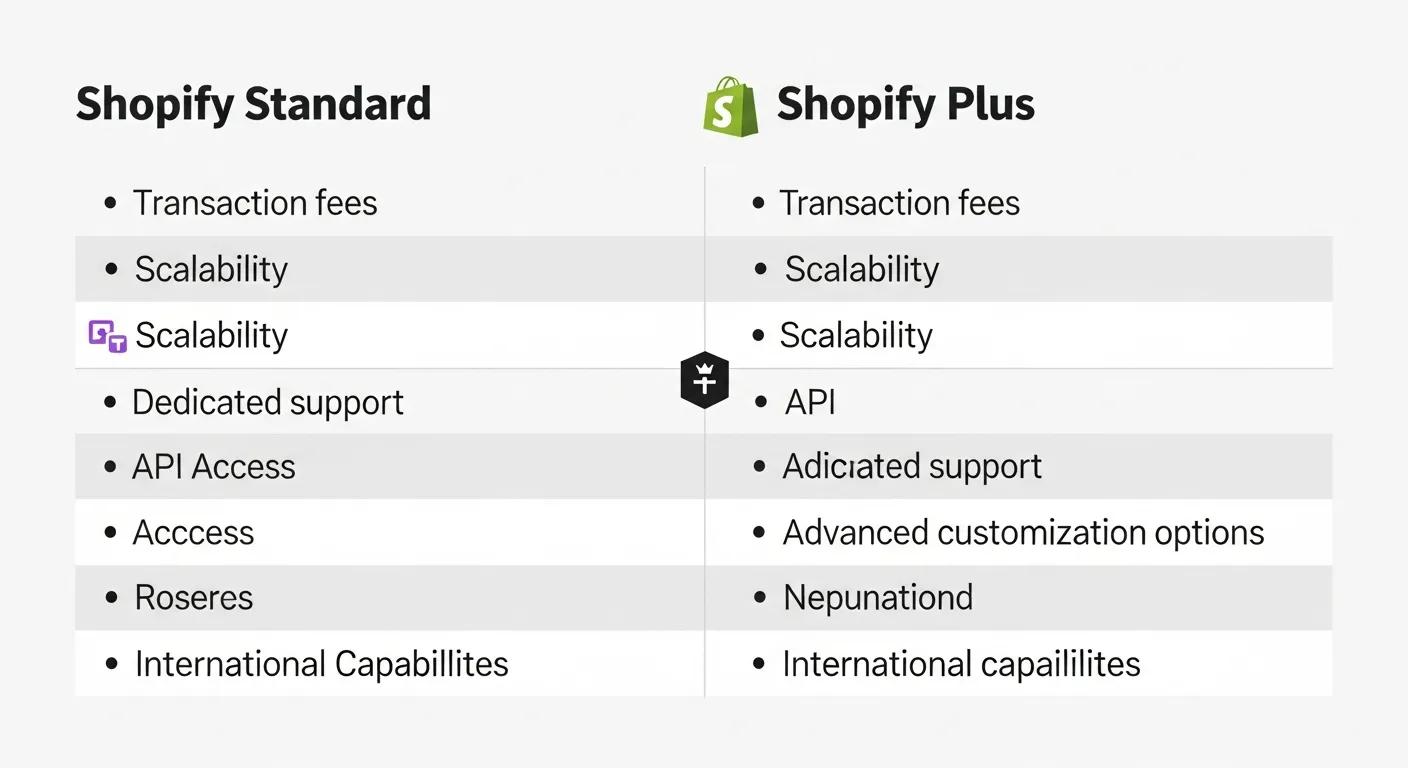
Shopify Plus and standard Shopify diverge primarily in their pricing models, enterprise-level capabilities, and dedicated support, allowing brands to select a tier that matches their current scale and future ambitions. Understanding these fundamental differences is key for merchants to choose a solution that supports both immediate operations and long-term expansion.
How Do Shopify Plus and Standard Shopify Pricing and Transaction Fees Compare?
Shopify Plus features a higher base subscription fee alongside variable, revenue-based rates, while standard Shopify plans offer more modest flat monthly costs with fixed transaction surcharges.
Factual table note: Payment fees vary by country, card type, and gateway. Confirm current fees with Shopify or the merchant’s payment provider before making a financial decision.
Variable fees are applied when monthly revenue surpasses $800,000, with a cap of $40,000. This structure ensures cost-effectiveness for high-volume businesses, reducing per-order expenses.
Shopify Pricing 2025: Which Plan is Your Best Bet? Avoid Hidden Costs!
This guide dives into Shopify’s pricing tiers, detailing transaction fees across various plans. It highlights that Shopify Plus offers significantly lower transaction fees (0.15% when not using Shopify Payments, or 2.15% + 30¢ with Shopify Payments) compared to standard plans, translating into substantial savings for businesses processing high transaction volumes.
This insight directly validates the article’s pricing table and the assertion that Shopify Plus delivers significant fee reductions for high-volume merchants.
What Are the Scalability and Performance Differences Between Shopify Plus and Standard Shopify?
Shopify Plus provides unlimited bandwidth, dedicated account oversight, and a 99.99% uptime Service Level Agreement (SLA), whereas standard Shopify plans operate on a shared, scalable infrastructure without individual uptime guarantees.
- Peak Traffic Handling – Plus effortlessly manages thousands of orders per minute without performance dips.
- Dedicated Infrastructure – Enterprise clients receive proactive capacity planning and load-balancing support.
- Global CDN – Plus includes advanced content delivery optimizations for seamless international site access.
High-traffic events and sudden surges are handled smoothly on Plus, preventing checkout delays or downtime that can impact standard Shopify sites under heavy load.
Modeling Scalability Strategies for Shopify Platforms in International Expansion
This research explores technological solutions for scaling Shopify platforms in international markets, emphasizing high service availability under increasing traffic loads. It analyzes architectural strategies like client isolation (pods), geographic server distribution, and content delivery networks (CDNs) to ensure fault tolerance and reduced latency during global operations.
This study directly supports the article’s points regarding Shopify Plus’s superior scalability, peak traffic management, and global CDN capabilities for international growth.
How Do Customization and Checkout Control Differ Between the Platforms?
Shopify Plus unlocks complete checkout extensibility and Script Editor access, enabling custom promotions, payment logic, and shipping rules, while standard Shopify limits checkout modifications to theme settings and predefined options.
- Standard Shopify checkout modifications are confined to Shopify’s theme and settings framework.
- Shopify Plus allows deep customization via the Checkout.liquid template and Shopify Scripts.
- Enterprise merchants can implement dynamic pricing, BOGO offers, and tailored payment experiences.
This level of control empowers brands to refine conversion funnels, deploy specialized loyalty programs, and integrate region-specific compliance requirements directly into the checkout process.
What Automation Tools Are Exclusive to Shopify Plus?
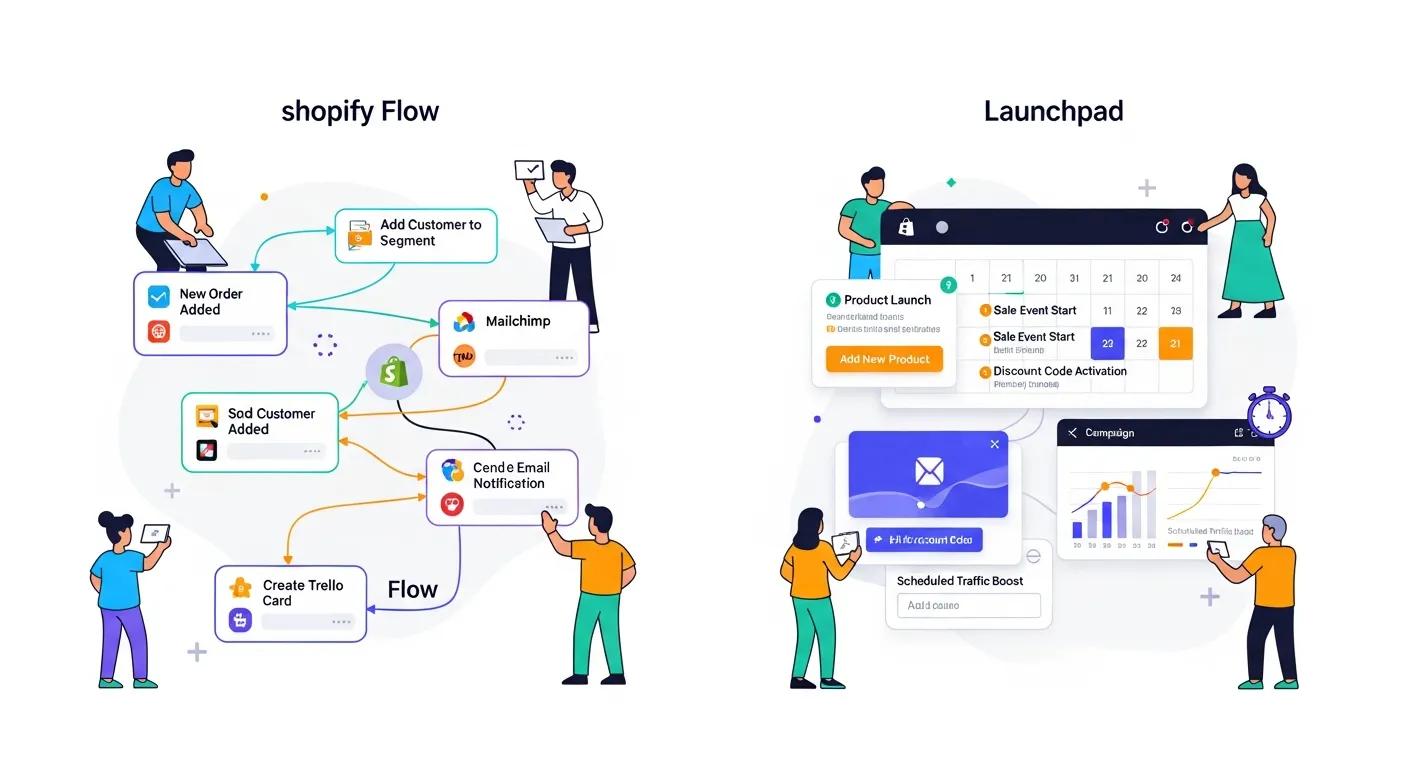
Shopify Plus integrates two powerful workflow engines—Shopify Flow for rule-based automation and Launchpad for event scheduling—whereas standard Shopify merchants typically rely on third-party apps for similar capabilities.
Key automation features available on Plus include:
- Shopify Flow: Design triggers and actions for order tagging, inventory alerts, and customer segmentation without coding.
- Launchpad: Schedule flash sales, product launches, and marketing campaigns with precise timing controls.
- Script Editor: Automate custom discount logic and shipping calculations at the point of checkout.
Enterprise platforms leverage these native tools to minimize manual effort, reduce human error, and execute complex promotions at scale.
How Do Support and Account Management Levels Compare?
Standard Shopify offers 24/7 email, chat, and community support, while Shopify Plus adds a dedicated account manager and a priority response SLA.
- Standard Support – Access to ticketing and chat support with typical response times.
- Plus Support – Personalized onboarding, strategic guidance, and priority callbacks within 15 minutes.
Brands on enterprise plans benefit from one-on-one assistance during critical periods, streamlined escalation paths, and proactive architecture reviews that reinforce uptime and performance objectives.
What Are the Multi-store and International Selling Capabilities?
Shopify Plus allows up to 10 storefronts under a single admin, perfect for global expansion and multi-brand portfolios. Standard Shopify limits you to one storefront per account.
- Plus: Manage multiple currencies, localized domains, and distinct product catalogs from one central dashboard.
- Standard: Requires separate accounts or manual workarounds for each market.
This unified multi-store approach cuts down on administrative overhead and ensures consistent branding and pricing strategies across all markets.
How Do B2B E-commerce Features Differ Between Shopify Plus and Standard Shopify?
Shopify Plus includes built-in wholesale functionality—custom pricing, customer groups, and draft orders—whereas standard Shopify merchants often need to supplement B2B features with apps and custom scripts.
- Wholesale Channel – A private storefront for verified B2B clients on Plus.
- Customer Segmentation – Tiered pricing based on order volume or specific groups.
- Purchase Orders – Facilitate net-term payment options through draft orders.
These tools enable enterprises to consolidate B2C and B2B operations on a single platform, streamlining order management and enhancing customer experiences.
Choosing Between Shopify and Shopify Plus: Features and Cost
This analysis outlines the key differences between Shopify and Shopify Plus, highlighting that Plus offers enhanced store control with unlimited staff accounts and up to nine expansion stores, advanced B2B wholesale channels, and full checkout customization via the Checkout SDK. It also notes Plus’s capacity to handle 40 times more checkouts than Advanced plans during peak traffic events.
This source corroborates the article’s detailed comparisons regarding multi-store management, B2B features, customization, and performance distinctions between Shopify and Shopify Plus.
What Are the Differences in API Access and POS System Integration?
Shopify Plus provides elevated API call limits and priority integration support, while standard Shopify operates with standard API thresholds. Additionally, Plus merchants receive Shopify POS Pro licenses.
- API Rate Limits – Plus supports up to 80 calls per second, compared to 4 calls per second on standard plans.
- POS Pro – Enterprise-grade point-of-sale features, including omnichannel inventory and staff permissions.
Enhanced API access speeds up data synchronization for ERPs and custom applications, and POS Pro ensures seamless online-to-offline customer experiences.
Who Should Opt for Standard Shopify Plans? Understanding Basic, Shopify, and Advanced Options
Standard Shopify plans are ideal for small to medium-sized businesses that require essential e-commerce tools, user-friendliness, and accessible pricing. These tiers are well-suited for merchants with predictable sales volumes and straightforward customization needs.
What Features and Pricing Define Basic Shopify for Small Businesses?
Basic Shopify is tailored for startups and micro-businesses, offering an affordable monthly fee and entry-level selling tools. It includes:
- An online store with blog functionality and an SSL certificate.
- Two staff accounts and fundamental reporting features.
- Manual order creation and discount code capabilities.
At $29 per month, it allows for market testing without significant overhead and provides a smooth transition to higher tiers as sales expand.
How Does the Standard Shopify Plan Support Growing Businesses?
The $79 Shopify plan enhances capabilities with professional reports, gift cards, and five staff accounts, enabling more sophisticated marketing and operational insights. This tier is perfect for merchants who have moved beyond initial traction and need reliable reporting to drive data-informed decisions.
What Makes Advanced Shopify Stand Out and When Is It the Right Choice?
Advanced Shopify, priced at $299 per month, offers advanced reporting, third-party calculated shipping rates, and 15 staff accounts. It’s designed for scaling stores that require:
- Custom shipping quotes through courier integrations.
- In-depth sales and customer analytics.
- Broader user access controls.
This plan serves as a crucial bridge between mid-sized operations and enterprise-level demands before transitioning to Plus.
What Are the Advantages of Standard Shopify for Small to Medium Businesses?
Standard Shopify plans empower SMBs to launch quickly and manage daily operations with minimal technical expertise. Key benefits include:
- An intuitive admin interface with drag-and-drop theme customization.
- An extensive app ecosystem for expanding functionality.
- Clear, fixed monthly pricing for predictable budgeting.
For businesses prioritizing simplicity, budget control, and reliable platform maintenance, standard Shopify provides a robust foundation without the complexities of enterprise workflows.
Why Choose Shopify Plus? Exploring Enterprise Features and Advantages
Shopify Plus is engineered for high-growth merchants who demand advanced automation, extensive customization, and strategic support. This tier delivers enterprise-grade capabilities that accelerate scaling while maintaining operational agility.
What Core Features Make Shopify Plus Ideal for High-Growth Businesses?
Shopify Plus includes unlimited staff accounts, priority API access, and an advanced service level agreement. It offers:
- Unlimited Admin Users – Empower global teams with granular, role-based permissions.
- Enhanced API Performance – Accelerate integrations and real-time data synchronization.
- Priority Uptime SLA – 99.99% availability to support critical events like flash sales and high-traffic periods.
These features are essential for managing complex operations, supporting distributed teams, and ensuring mission-critical uptime for enterprise success.
How Do Shopify Flow and Launchpad Elevate Automation on Shopify Plus?
Shopify Flow automates repetitive tasks through intuitive if-then workflows, while Launchpad schedules campaigns and flash events in advance. Together, they:
- Boost operational efficiency by reducing manual order tagging and alerts.
- Enable precise timing for sales promotions, ensuring synchronized global launches.
- Free up teams to concentrate on strategic initiatives rather than routine tasks.
This native automation suite eliminates the need for multiple third-party apps and centralizes workflow management within the admin panel.
What Checkout Customization Options Does Shopify Plus Provide?
Shopify Plus grants access to Checkout.liquid and Script Editor, offering complete control over the final purchase experience. Merchants can:
- Implement dynamic shipping and payment gateway options.
- Customize upsell and cross-sell strategies at checkout.
- Integrate trust badges, GDPR compliance scripts, or region-specific disclaimers.
These advanced capabilities directly influence conversion rates by tailoring checkout flows to specific customer segments.
How Does Shopify Plus Support B2B and Multi-store Management?
Enterprise merchants benefit from a dedicated wholesale channel for private storefronts and support for up to 10 stores within a single account. This facilitates:
- Centralized management of catalogs and inventory across different brands or regions.
- Differentiated pricing structures for wholesale versus retail customers.
- A unified admin interface for consistent policy application and consolidated analytics.
Streamlined multi-store management simplifies expansion into new markets while preserving brand integrity.
What Is the Pricing Model for Shopify Plus and How Does It Impact ROI?
Shopify Plus is priced at a base monthly rate of $2,000–$2,500, plus a variable percentage of revenue once monthly sales exceed $800,000.
- Base Fee – Covers core enterprise features and dedicated support.
- Variable Rate – 0.25%–0.4% of revenue beyond the high-volume threshold.
- Transaction Savings – Lower third-party fees (0.15%–0.2%) accelerate the breakeven point on the platform investment.
High-volume merchants recoup their base fees through transaction savings and automated efficiencies that reduce operational costs.
How Does Dedicated Support and Account Management Benefit Shopify Plus Merchants?
With Plus, merchants receive a dedicated Launch Engineer and Merchant Success Manager who provide:
- Strategic roadmap planning for feature adoption and growth.
- Proactive performance audits and optimization recommendations.
- Rapid escalation and resolution channels during peak operational periods.
This premium service ensures continuous platform enhancement aligned with evolving business objectives.
When Should You Consider Upgrading from Standard Shopify to Shopify Plus?
Upgrading to Shopify Plus becomes strategically advantageous when operational complexity, traffic volume, or automation needs surpass the capabilities of standard Shopify. Recognizing these indicators helps prevent growth bottlenecks.
What Business Growth Indicators Suggest Upgrading to Shopify Plus?
Merchants typically consider an enterprise migration when:
- Monthly Sales Exceed $80,000 – Transaction fee savings begin to outweigh the Plus base cost.
- Frequent Peak Traffic Events – High-volume periods like Black Friday or product launches risk downtime.
- Complex Checkout Requirements – Need for customized payment logic or compliance scripts arises.
- Multiple Storefronts – Managing separate regions or brands under a single administrative umbrella is desired.
These metrics signal when standard infrastructure and manual processes may be hindering revenue potential.
What Are the Key Considerations Before Migrating to Shopify Plus?
Planning a migration involves mapping data transfers, assessing theme compatibility, and evaluating app integrations. Critical factors include:
- Data Audit – Ensure clean order, customer, and product records for a seamless import.
- Theme Review – Verify that Checkout.liquid and custom scripts align with Plus requirements.
- App Compatibility – Validate third-party tools against new API limits and automation workflows.
Early identification of technical dependencies prevents post-launch delays and ensures a smooth transition.
How Can Professional Shopify Plus Partners Facilitate a Smooth Migration?
Engaging certified partners like BlackBelt Commerce brings deep expertise in:
- Developing strategic roadmaps for feature implementation.
- Creating tailored automation scripts and Flow workflows specific to your operations.
- Managing data migration, rigorous testing, and launch coordination.
Partners minimize downtime risks, accelerate time-to-value, and provide comprehensive training for your internal teams.
What Challenges Should Businesses Anticipate During Migration?
Common migration hurdles include theme inconsistencies, app reconfiguration, and potential gaps in staff training. Addressing these challenges effectively involves:
- Utilizing dedicated staging environments for iterative testing and refinement.
- Running parallel order processing and checkout scripts before the live launch.
- Implementing thorough user training and comprehensive documentation.
Anticipating these potential issues and allocating adequate resources ensures a seamless transition to Shopify Plus.
How to Maximize ROI and Long-Term Value with Shopify Plus
Shopify Plus drives significant ROI through transaction fee savings, automation efficiencies, and future-proof scalability. Strategic utilization of its enterprise features unlocks sustained profitability.
How Do Shopify Plus Transaction Fee Savings Impact Profit Margins?
Reduced third-party payment fees, ranging from 0.15% to 0.2%, can save high-volume merchants thousands of dollars monthly. For instance, a store generating $1 million in monthly sales could save up to $15,000 compared to paying 1.5% fees on standard plans. These recurring savings effectively offset base subscription costs and directly enhance net profit margins.
What Are Real-World Case Studies of Businesses Thriving with Shopify Plus?
Enterprise brands such as GymShark have leveraged Shopify Plus to manage Black Friday traffic surges of 5,000 concurrent checkouts, automate fulfillment processes using Flow, and expand into five global markets under a single admin. These success stories highlight how the platform’s performance and flexibility support exponential growth while maintaining brand integrity.
How Does Shopify Plus Future-Proof E-commerce Operations?
Shopify Plus consistently introduces framework updates, platform enhancements, and new APIs. Its modular architecture supports:
- Headless commerce implementations for highly customized front-end experiences.
- Progressive Web App (PWA) capabilities via the Storefront API.
- Adaptation to emerging payment methods and evolving compliance standards.
Merchants can avoid costly platform migrations by staying on a solution that evolves with industry demands.
What Development and Optimization Services Enhance Shopify Plus Performance?
Custom theme development, conversion rate optimization, and advanced Flow scripting accelerate the value realization from Shopify Plus. Specialized services from BlackBelt Commerce include:
- Tailored automation strategies to eliminate manual operational tasks.
- Performance audits designed to improve page speed and Core Web Vitals.
- A/B testing frameworks integrated directly into automation workflows.
These services ensure that every Plus feature delivers measurable ROI and aligns with your strategic business objectives.
What Are the Most Common Questions About Shopify Plus vs. Standard Shopify?
Merchants frequently seek clarity on platform differences, costs, ideal use cases, and the benefits of automation. The primary distinctions lie in their target audience, feature depth, and pricing structure. Standard Shopify is suited for small to medium-sized businesses looking for straightforward setup and reliable performance at predictable costs. Shopify Plus addresses enterprise needs for advanced checkout control, native automation, multi-store administration, and priority support. Investing in Plus becomes financially sensible once monthly sales volumes consistently exceed six figures and custom workflows or high-traffic events necessitate enterprise-grade reliability.
How Does BlackBelt Commerce Support Businesses Choosing Between Shopify Plus and Standard Shopify?
BlackBelt Commerce excels in providing comprehensive Shopify solutions, guiding businesses through platform selection, customization, and optimization with data-driven strategies.
What Shopify Development and Optimization Services Does BlackBelt Commerce Offer?
Our services encompass custom theme development, conversion rate optimization, API integrations, and performance engineering, all designed to maximize the potential of both standard Shopify and Shopify Plus. We architect automation workflows, deploy headless storefronts, and fine-tune site speed to boost conversions.
How Does BlackBelt Commerce Assist with Shopify Plus Migration?
We conduct thorough migration audits, data cleansing, and phased launches within staging environments. Our meticulous approach covers theme adaptation, Flow scripting, Launchpad event configuration, and staff training to ensure minimal disruption and rapid time-to-market.
What Tailored Solutions Does BlackBelt Commerce Provide for Scaling E-commerce Stores?
From multi-store management strategies to B2B wholesale channel setup, our experts design architectures that support global expansion and complex ordering models. We integrate ERP systems, automate fulfillment pipelines, and implement advanced reporting dashboards.
How Can Merchants Contact BlackBelt Commerce for Personalized Shopify Consultation?
To discuss customized Shopify development, optimization, or Plus migration plans, reach out for a consultation via our website. Discover how specialized expertise can transform your e-commerce growth trajectory.
Merchants who align platform capabilities with their sales volume, customization requirements, and expansion plans will unlock significant performance gains and operational efficiencies. Whether you’re starting with standard Shopify or scaling to Shopify Plus, strategic planning and expert implementation are key to sustainable success. Partnering with seasoned specialists ensures a smooth transition, optimized workflows, and a platform that evolves alongside your brand.
Quick Answer: Shopify Plus vs regular Shopify
Shopify Plus vs regular Shopify should be compared by business complexity, checkout needs, automation, integrations, support, governance, international selling, and growth constraints. Regular Shopify can fit many stores, while Shopify Plus becomes more relevant when scale, complexity, and strategic implementation needs increase.
Key Takeaways
- Shopify Plus vs regular Shopify should be compared by complexity, checkout needs, automation, integrations, support, international selling, and governance.
- The article should help readers recognize when regular Shopify is enough and when Plus deserves serious evaluation.
- Internal links should connect the comparison to Shopify Plus agencies, Shopify experts, Cost of Shopify website, custom development, and Plus benefits.
- The commercial bridge should show when a Plus-readiness strategy call can prevent overbuying or underbuilding.
- Use the same-page Calendly CTA so qualified merchants can book a strategy call without being pushed into a long form.
How this connects to your Shopify growth strategy
This article should remain useful for readers researching Shopify Plus vs regular Shopify, but it also needs to show when the topic becomes a business decision. For the Shopify Plus Strategy cluster, the commercial bridge is practical: once the reader understands the concept, the next step is deciding whether their current Shopify setup can support the desired experience, conversion path, and operational workflow. That is where expert planning, design, development, CRO, and SEO support can turn the idea into measurable store improvements.
Related Shopify resources
These internal resources support the Shopify Plus Strategy topic cluster and help connect this guide to stronger commercial next steps:
- Shopify Plus Strategy
- Shopify experts
- Shopify Plus agencies
- Shopify Plus Strategy — Parent service page for the reader’s next commercial step
- Blackbelt Commerce — Home-page authority link for brand and core Shopify expertise
- Shopify experts — Money-page link requested for expert-hiring intent
- Shopify custom development — Development service page for implementation and technical help
- Shopify CRO — Conversion service page for readers focused on revenue and lead generation
- Cost of Shopify website — Related pricing article that helps readers compare platform, build, and expert investment decisions
- Shopify Plus checkout customization — Related Shopify Plus implementation guide for readers evaluating advanced Plus costs and capabilities
Questions store owners ask before taking action
What is the difference between Shopify Plus and regular Shopify?
The difference usually comes down to business complexity, scale, checkout strategy, automation, integrations, governance, support needs, and growth plans.
When is regular Shopify enough?
Regular Shopify can be enough when the store’s workflows, checkout needs, integrations, and operating complexity are still manageable on standard plans.
When should a merchant consider Shopify Plus?
Merchants should consider Plus when complexity, volume, integrations, automation, or strategic growth needs outgrow the standard setup.
Should merchants upgrade before getting expert advice?
Not necessarily. Expert scoping can help avoid overbuying Plus too early or underbuilding on regular Shopify too long.
How should this article generate leads?
It should clarify the decision, then invite readers to book a strategy call for a Plus-readiness review.
Future articles needed for topical dominance
To build deeper topical authority around this cluster, these supporting topics should be created later and linked back into this article:
- Shopify Plus vs Regular Shopify Decision Checklist: Creates a practical comparison asset for merchants evaluating an upgrade.
- Signs Your Store Is Ready for Shopify Plus: Builds topical authority around Plus readiness and growth constraints.
- When to Hire Shopify Plus Agencies for Upgrade Planning: Connects Plus comparison searches to qualified agency consultation.

