


Why Your Store Needs a Winning Marketing Game Plan
A Shopify marketing strategy is your roadmap to standing out and turning visitors into loyal customers. A successful strategy blends several core components:
- Foundation: SEO and content for long-term organic growth.
- Accelerators: Paid ads, email, and SMS for immediate impact.
- Community: Influencers and user-generated content for trust.
- Measurement: Analytics to track what’s working.
With Shopify hosting over a million businesses, you need more than great products to succeed—you need a smart marketing game plan.
We’ll frame this using the AARRR model: Acquisition, Activation, Retention, Referral, and Revenue. This customer lifecycle approach focuses your efforts for the biggest impact. It’s also vital to know that your strategy is the why (long-term goals), while your tactics are the how (specific channels and campaigns).
I’m Cesar A Beltran, founder of Blackbelt Commerce. With over 15 years of experience helping 1000+ businesses, I’ve seen that the most successful stores blend a solid organic foundation with targeted acceleration tactics.
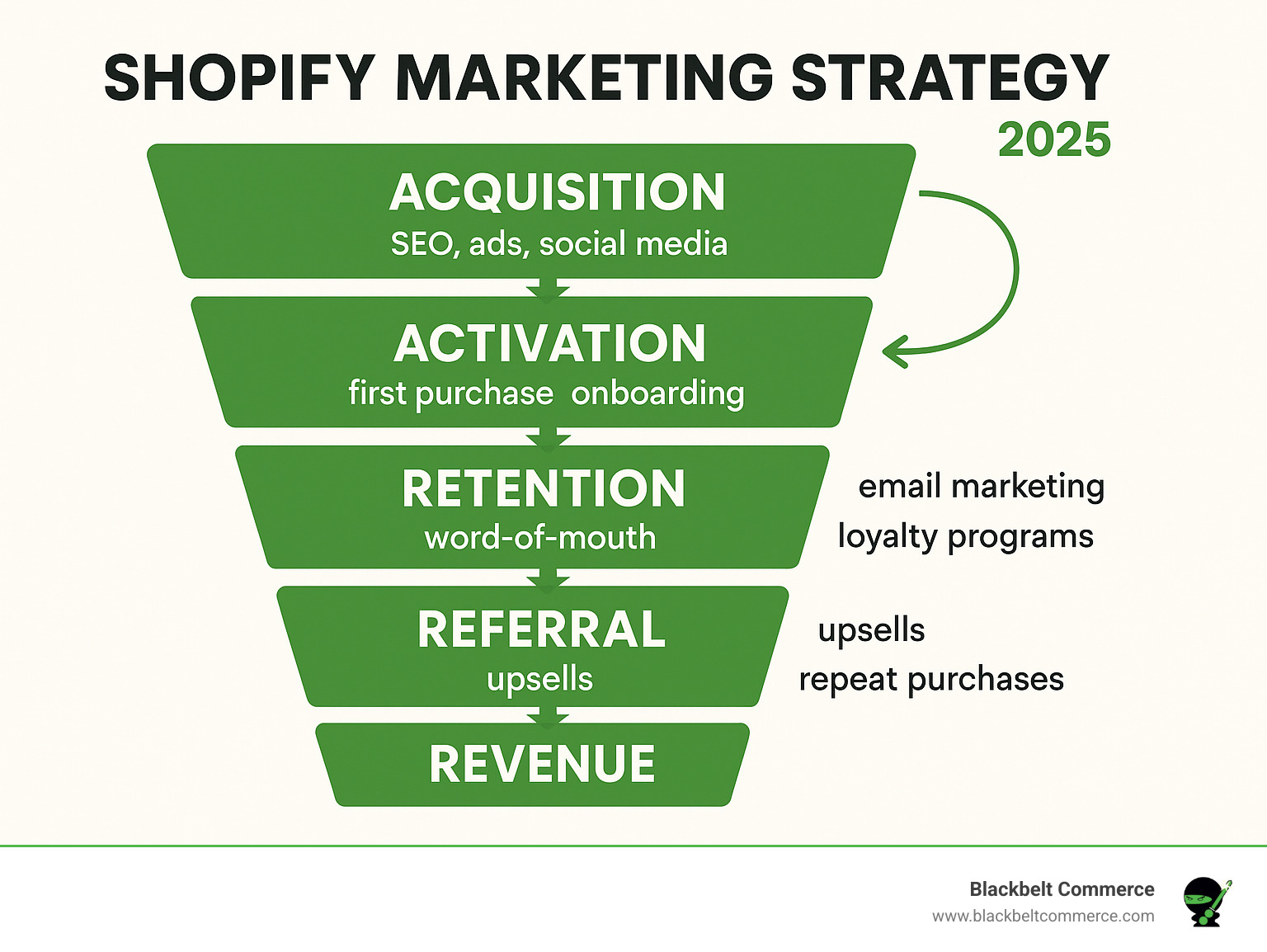
Shopify marketing strategy terms to remember:
The Foundation: Driving Long-Term Organic Growth

Organic growth is the foundation of your house; it takes time to build but creates sustainable traffic that doesn’t vanish when you stop paying for ads. This foundation rests on two pillars: SEO (getting found on Google) and content marketing (giving people a reason to care).
Developing a Long-Term Shopify Marketing Strategy with SEO
The #1 organic result is 10x more likely to receive a click than a page in the #10 spot. SEO is about making your store the best answer to a search query. Start with keyword research to understand what customers are searching for. Then, focus on on-page SEO by writing clear, keyword-rich product titles and descriptions, and using meta tags and image alt text. Technical SEO ensures your site is fast and mobile-friendly—Shopify handles much of this, but custom optimization helps. Finally, link building from reputable sites builds trust with search engines.
For example, skincare brand Biossance dominates search for terms like “clean squalane oil” by targeting specific, high-intent keywords to attract ready-to-buy customers.
If you’re ready to take your SEO seriously, learn more about our Shopify SEO services.
Content Marketing: Build Your Brand and Attract Your Tribe
Content marketing gives your SEO a personality, creating things people want to read, watch, and share. This turns your store into a trusted advisor.
- Blogging: Share expertise related to your niche. Each post can rank for new keywords.
- Video Marketing: Use tutorials or brand stories to create deeper emotional connections.
- Buying Guides: Help customers make decisions while positioning your products as the solution.
- Quizzes: Interactive quizzes can collect customer data and provide personalized recommendations.
Friday Pattern Company excels with this, using YouTube sewing tutorials to showcase their patterns. The videos are genuinely helpful, building a loyal community that sees them as teachers, not just sellers. This approach creates content customers actively seek, making you the go-to resource in your niche.
Want to see how this could work for your store? Check out our guide on How to Use Content Marketing to Boost Shopify Traffic.
The foundation takes time, but it supports everything else. While competitors buy more ads, you’ll have customers finding you naturally.
The Accelerators: Paid Channels for Immediate Impact

While your organic foundation grows, paid channels deliver immediate results for new product launches, promotions, or scaling efforts. Think of them as a turbo boost for your Shopify marketing strategy, letting you reach specific audiences and generate sales quickly.
Social Media Marketing & Ads: Meet Customers Where They Scroll
With 63% of the global population on social media, your customers are there finding brands. Meet them on the right platforms: Instagram for visual products, TikTok for creative viral content, Facebook for broad targeting, and Pinterest for users seeking buying inspiration. Blend organic posts that build community with paid ads for surgical targeting. Shoppable posts on Instagram and Facebook are game-changers, allowing customers to buy directly from your content with a few taps.
Example: Pashion Footwear
Pashion Footwear used TikTok to showcase their convertible heels, solving a real problem with creative videos that connected with a younger audience.
Dive deeper with our guide on How to Use Social Media for Your E-commerce Store.
PPC Advertising: Target Ready-to-Buy Shoppers
Pay-Per-Click (PPC) advertising connects you with customers actively searching for your products. When someone Googles “organic dog food,” your ad can appear at the top. Google estimates an ROI of $8 for every $1 spent on their platform.
Google Shopping campaigns are especially powerful for e-commerce, showing your product photos and prices directly in search results. Retargeting campaigns are also crucial; they bring back visitors who left your site without buying, reminding them of products they viewed.
Example: Caraway
Cookware brand Caraway uses Google Shopping ads to display their stylish products when users search for terms like “non-toxic pots and pans,” driving qualified traffic to their store.
Explore our Actionable Tips to Increase Shopify Sales with Innovative Methods.
Email & SMS Marketing: Nurture and Retain Your Audience
If PPC and social media find new customers, email and SMS keep them. These channels are your direct line to an interested audience, with email marketing offering an average return of $42 for every dollar spent.
Prioritize building your email and SMS lists with pop-ups and checkout opt-ins. Then, use segmentation to send relevant messages based on purchase history. Automation is key for:
- Welcome series: Introduce your brand to new subscribers.
- Abandoned cart recovery: Recoup lost sales (over 70% of carts are abandoned).
- Post-purchase flows: Thank customers and suggest related products.
Personalization makes messages feel unique. Don’t neglect SMS marketing; with open rates up to 98%, it’s perfect for flash sales and time-sensitive updates.
Example: Alex Mill
Alex Mill uses a smart, personal-feeling abandoned cart email offering a 15% discount, aligning with their approachable brand image.
Refine your approach with our guide: Email Marketing for Shopify: What You Might Be Doing Wrong.
Building a Community: Leveraging Social Proof and Advocacy

People don’t just buy products; they buy into communities. Your Shopify marketing strategy is most powerful when you harness the voices of real customers and trusted influencers. This is social proof in action, and it’s something every successful Shopify store needs to master.
Influencer & Affiliate Marketing: Partner for Authentic Reach
Over 80% of marketers find influencer marketing effective because consumers trust creators more than ads. The key is finding influencers whose audience and values align with your brand—authenticity beats reach. Micro-influencers (under 10k followers) often have higher engagement and are more affordable.
An affiliate program is a performance-based alternative where you pay commissions on actual sales driven by your partners. Shopify Collabs can help you manage your entire affiliate program from one dashboard.
Example: The Honey Pot
This feminine care brand built its foundation on authentic influencer partnerships, collaborating with creators who genuinely connected with their message to build trust and reach new audiences.
User-Generated Content (UGC) & Referrals: Let Your Customers Be Your Marketers
Your happiest customers are a goldmine of authentic marketing content. UGC is persuasive because it shows real people loving your products, which removes purchase uncertainty. In fact, 92% of people trust recommendations from friends and family over any other advertising.
Encourage UGC by running contests with branded hashtags. Then, display customer photos on your product pages and social media feeds using tools like Yotpo to build trust. A referral program turns satisfied customers into brand ambassadors by rewarding them for bringing in new business. Referred customers often have a higher lifetime value, making it a win-win strategy.
Example: QALO
The silicone ring company QALO built its success on UGC, showcasing their rings on real people living active lives. Their customers became proud ambassadors, creating an authentic marketing engine that money couldn’t buy.
Community-driven marketing creates a positive feedback loop: more social proof leads to more confident buyers, who then become new advocates for your brand.
Crafting Your Core Shopify Marketing Strategy: Tools, Budgeting, and Measurement

A brilliant Shopify marketing strategy is useless without the right tools, budget, and measurement. This is your command center for making data-driven decisions that move the needle.
Essential Tools for Your Marketing Stack
You don’t need dozens of apps from the Shopify App Store, just the right ones. Here are the essentials:
- Analytics: Shopify Analytics for dashboard insights and Google Analytics (GA4) for a deep dive into the customer journey.
- Email & SMS: Klaviyo for advanced segmentation and automation. Attentive or Postscript for high-engagement SMS campaigns.
- SEO: Ahrefs or Semrush to analyze competitors, track backlinks, and find content opportunities.
- Social Proof: Yotpo, Okendo, or Stamped to collect and display customer reviews and UGC.
- Customer Service: Gorgias or Zendesk to turn great service into a marketing tool.
How to Implement a Shopify Marketing Strategy on a Low Budget
Most successful stores start with tight budgets, which forces strategic thinking. Prioritize one or two channels where your audience spends their time. Focus on organic growth through SEO and content marketing, which require time more than money. Leverage free tools like the free tier of many social media schedulers and Shopify’s free email marketing for your first 10,000 sends.
When you’re ready for paid ads, start small with daily budgets of $5-10. Run campaigns long enough to gather data, then test and iterate. Keep what works, ditch what doesn’t, and always be learning.
Measuring Success: KPIs and Analytics
If you’re not measuring, you’re guessing. Data transforms your strategy into a growth machine. Focus on these key metrics:
- Conversion Rate: The percentage of visitors who buy. Focus on improving your own rate over time.
- Customer Acquisition Cost (CAC): How much it costs to get a new customer.
- Customer Lifetime Value (CLV): The total revenue a customer will generate.
- Return on Ad Spend (ROAS): Your revenue for every dollar spent on ads. A 4:1 ratio is a solid benchmark.
- Average Order Value (AOV): The average amount spent per order.
- Customer Retention Rate: The percentage of customers who return.
We use Shopify Analytics, often paired with Google Analytics, to get a complete picture. The goal is to use these insights to continuously refine your strategy.
Frequently Asked Questions about Shopify Marketing
Let’s tackle the questions we hear most often from store owners building their first Shopify marketing strategy.
What is the difference between a marketing strategy and a marketing plan?
Think of it this way: your strategy is the big picture vision, while your plan is the action steps.
- Your Shopify marketing strategy is the high-level “why.” It defines your long-term goals, your competitive advantage, and your target audience. It’s the blueprint for your house.
- Your marketing plan is the “how.” It details the specific tactics, channels, timelines, and budgets to execute the strategy. It’s the construction schedule.
For example, a strategy might be “become the go-to brand for eco-conscious home goods.” The plan would detail the specific Instagram campaigns and blog posts for the quarter.
How much should I budget for marketing a new Shopify store?
There’s no magic number, but a good rule of thumb is to allocate 5-15% of your projected revenue to marketing. When you’re brand new, you may not have revenue to base this on. In that case, start lean.
Focus first on low-cost, high-impact strategies like SEO, content creation, and authentic social media engagement. These require more time than money. When you’re ready for paid ads, start with small daily budgets ($5-10) on Facebook or Google Shopping. Test rigorously and scale what works.
What are the most important metrics to track for my Shopify store?
Don’t get overwhelmed by data. Focus on these core metrics that truly matter for your Shopify marketing strategy:
- Website Traffic: How many people are visiting and from where?
- Conversion Rate: What percentage of visitors make a purchase? The Shopify average is around 1.4%.
- Average Order Value (AOV): How much do customers spend per order? The global average is $144.
- Customer Acquisition Cost (CAC): How much does it cost to gain a new customer?
- Customer Lifetime Value (CLV): What is the total revenue you expect from a single customer over time?
- Return on Ad Spend (ROAS): How much revenue are you generating for every dollar spent on ads?
These six metrics provide a clear picture of your store’s health and help you make smarter investment decisions.
Conclusion: Putting Your Shopify Marketing Strategy into Action
You now have the playbook for a winning Shopify marketing strategy. We’ve covered the foundation of SEO and content, the accelerators of paid ads and email, and the power of community building through social proof.
The magic happens when these elements work together in an interconnected system. However, your marketing strategy is never truly “finished.” The e-commerce landscape is always evolving, and the most successful store owners accept this constant change.
Testing and adapting is essential. Start with one or two channels, get them working, and then expand. Your analytics will tell you what’s working—listen to them. Personalization and customer retention are your secret weapons for maximizing customer lifetime value and building a business that thrives.
If you feel overwhelmed or need an expert partner to implement a custom, conversion-focused marketing strategy, explore our Shopify web design services. We’re here to help you turn your Shopify store into a thriving online business.
Your success story starts now. What will your first step be?
Quick Answer: Shopify marketing strategy
Shopify Marketing Strategy should be explained through the lens of a real Shopify business decision: what the reader is trying to improve, what risks or tradeoffs matter, and what action would move the store forward. For the Shopify Growth, CRO, and Store Optimization cluster, the article should connect practical education to conversion, internal authority, and a clear strategy-call path without using filler or generic SEO copy.
Want a sharper Shopify growth plan?
If this article connects to a current store decision, use the calendar to book a strategy call and turn the idea into a practical plan.
Key Takeaways
- Shopify marketing should connect offer clarity, traffic sources, email capture, SEO, social proof, analytics, and conversion quality.
- More traffic will not fix weak product pages, unclear messaging, slow pages, or poor calls to action.
- Beginner and advanced tactics should be prioritized by revenue impact and learning value, not trendiness.
- Internal links should connect marketing guidance to CRO, Shopify experts, Shopify Plus agencies, and SEO support.
- The same-page Calendly CTA should help readers turn marketing ideas into a store-specific growth plan.
How this connects to your Shopify growth strategy
This article should remain useful for readers researching Shopify marketing strategy, but it also needs to show when the topic becomes a business decision. For the Shopify Growth, CRO, and Store Optimization cluster, the commercial bridge is practical: once the reader understands the concept, the next step is deciding whether their current Shopify setup can support the desired experience, conversion path, and operational workflow. That is where expert planning, design, development, CRO, and SEO support can turn the idea into measurable store improvements.
Want a sharper Shopify growth plan?
Use this guide as a decision tool. Then book a strategy call when you want a practical roadmap for your store.
Related Shopify resources
These internal resources support the Shopify Growth, CRO, and Store Optimization topic cluster and help connect this guide to stronger commercial next steps:
- Shopify CRO
- Shopify experts
- Shopify Plus agencies
- Shopify CRO — Parent service page for the reader’s next commercial step
- Blackbelt Commerce — Home-page authority link for brand and core Shopify expertise
- Shopify experts — Money-page link requested for expert-hiring intent
- Shopify Plus agencies — Money-page link requested for high-growth and Plus-agency intent
- Shopify custom development — Development service page for implementation and technical help
- Shopify checkout optimization — Related conversion article
- Shopify conversion optimization — Related CRO article
Questions store owners ask before taking action
What Shopify marketing tactics should merchants prioritize?
Priorities usually include offer clarity, SEO, email capture, product content, social proof, lifecycle flows, analytics, and campaigns tied to buyer intent.
Why do marketing tactics fail?
They fail when the store has weak messaging, slow pages, unclear products, poor trust signals, or no conversion path for qualified traffic.
How should beginners approach Shopify marketing?
Beginners should focus on a few measurable tactics first, learn what attracts qualified shoppers, and improve the store before scaling spend.
When should marketing involve Shopify experts?
Expert help is useful when campaigns require better landing pages, SEO structure, CRO, analytics, app integrations, or retention strategy.
How can this article create leads?
It should give useful marketing guidance and then let readers book a strategy call when they need help prioritizing actions.
Future articles needed for topical dominance
To build deeper topical authority around this cluster, these supporting topics should be created later and linked back into this article:
- Shopify Marketing Strategy Checklist for Shopify Store Owners: Creates a practical support article that turns the Shopify Growth, CRO, and Store Optimization topic into an actionable review tool.
- Common Shopify Marketing Strategy Mistakes and How to Avoid Them: Captures problem-aware searches and gives BBC a natural place to explain implementation risks without hard selling.
- When to Hire Shopify Experts for Shopify Marketing Strategy: Connects informational demand to the expert-hiring money page while preserving educational intent.
Want a sharper Shopify growth plan?
Ready to turn the advice in this article into an action plan? Open the calendar here and choose a time that works for you.

