

Blog updated with the most recent Shopify and eCommerce strategies on 05/02/2026.
Demystifying Shopify Plus Subscription Fees: Your Ultimate Guide to Costs and Pricing for Businesses
For enterprise e-commerce ventures, navigating the intricacies of Shopify Plus subscription fees is paramount. Understanding the structure of base monthly charges, variable platform fees tied to Gross Merchandise Value (GMV), and transaction rates is crucial for precise budgeting and maximizing your bottom line. This comprehensive guide breaks down the core pricing elements, details transaction expenses and overlooked costs, contrasts Shopify Plus with Shopify Advanced and other enterprise solutions, outlines how to calculate your Total Cost of Ownership (TCO), pinpoints the ideal moment to upgrade, and shares expert strategies for optimizing your subscription expenses. Leveraging Blackbelt Commerce’s deep expertise in Shopify Plus, this article equips ambitious online retailers with the actionable intelligence needed to manage costs effectively, fuel growth, and harness the power of enterprise-grade features.
Unpacking the Shopify Plus Pricing Model: How It Works
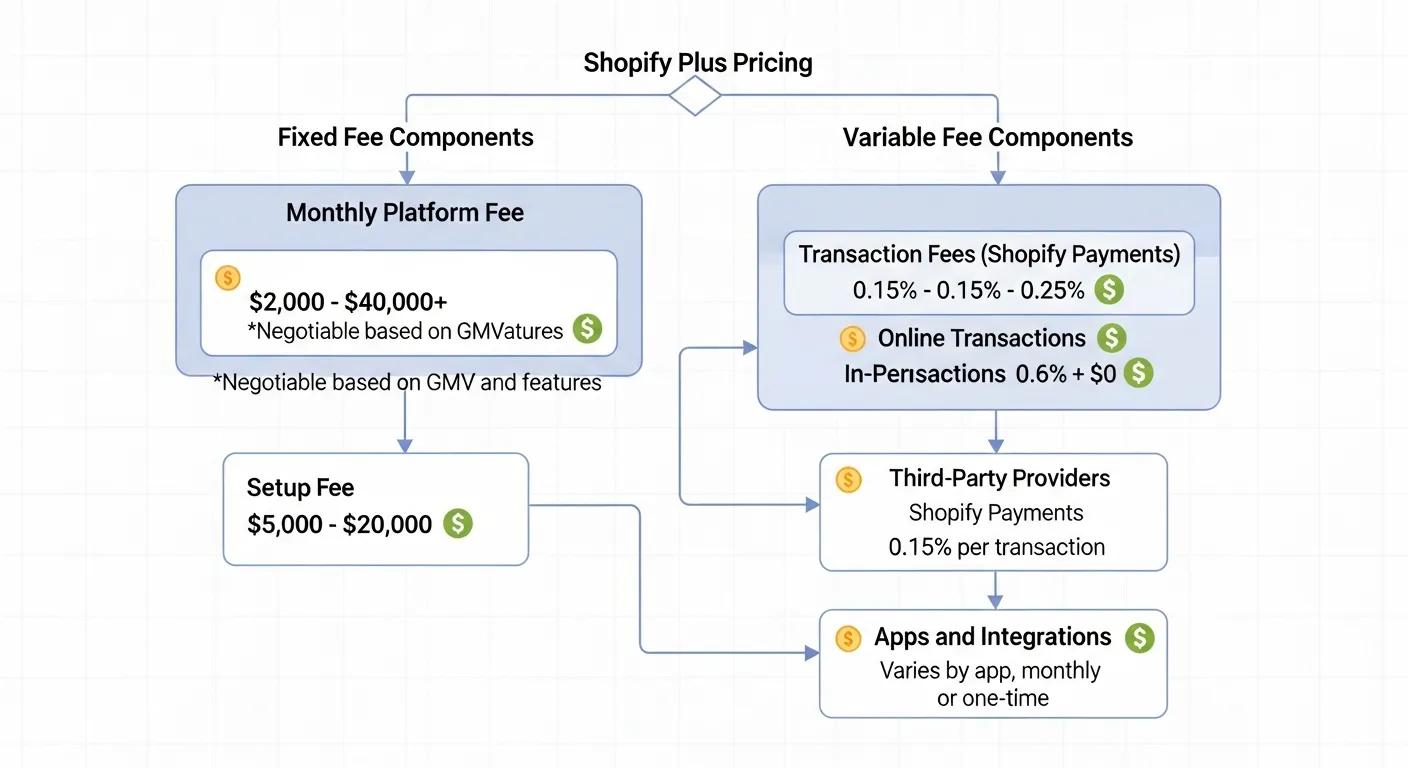
The Shopify Plus pricing model ingeniously blends a fixed monthly subscription with revenue-contingent platform fees and tailored contract incentives, delivering enterprise-level scalability while ensuring costs scale with your business performance. This hybrid approach, combining predictable monthly payments with variable GMV-based fees, means high-volume merchants pay in proportion to their success, unlocking advanced functionalities and dedicated support as their revenue climbs.
What Are the Standard Monthly Fees for Shopify Plus?
Shopify Plus mandates a consistent monthly license fee, which is influenced by your contract duration and projected sales volume.
- 1-year commitment: $2,500 per month
- 3-year commitment: $2,300 per month
Opting for longer contract terms translates to a reduced base rate, securing access to features like a customizable checkout, unlimited staff accounts, and 10 expansion stores. These foundational fees establish a predictable budget and grant essential access to Plus features, paving the way for the variable platform fees.
Shopify Plus Pricing and Total Cost of Ownership in 2025: An In-Depth Look
Based on a 2025 analysis, Shopify Plus pricing includes a base monthly subscription of $2,500 for a one-year agreement or $2,300 for a three-year term. For monthly Gross Merchandise Value (GMV) exceeding $800,000, an additional variable fee of 0.25% of revenue applies, with a monthly ceiling of $40,000.
This research directly corroborates the article’s detailed breakdown of Shopify Plus’s base monthly fees and variable platform charges, including the critical GMV thresholds and maximum caps.
How Do Variable Platform Fees Impact Shopify Plus Pricing?
Variable platform fees are calculated as a percentage of your monthly GMV once it surpasses specific threshold tiers, ensuring costs remain aligned with your business scale.
- Up to $800,000 GMV: No additional charge
- Above $800,000 GMV: 0.15–0.30% of revenue (adjusted based on volume)
- Monthly Cap: A maximum of $40,000
This revenue-driven fee structure promotes cost-effectiveness for expanding businesses and ensures your platform expenses directly reflect your sales performance, guaranteeing that enterprise-level support scales proportionally with your revenue.
Which Contract Terms Influence Your Shopify Plus Subscription Costs?
The duration of your contract and your projected annual revenue are key factors in determining your negotiated rates:
- Commitment length directly impacts the base fee discounts you receive.
- Projected GMV influences the variable fee tiers and the applicable cap thresholds.
- Renewal terms may involve annual pricing adjustments based on your growth metrics.
By committing to longer contract terms and providing realistic revenue projections, merchants can optimize their overall subscription expenditure and secure enhanced service-level agreements.
How Does Shopify Plus Pricing Measure Up Against Shopify Advanced?
Shopify Plus offers a significant step up in both cost and capabilities compared to Shopify Advanced, primarily through:
Factual table note: Payment fees vary by country, card type, and gateway. Confirm current fees with Shopify or the merchant’s payment provider before making a financial decision.
Understanding the Impact of Shopify Plus Transaction Fees on Your Business Expenses
Shopify Plus transaction fees encompass native processing rates, potential charges from third-party gateways, and compliance costs, all contributing to your total payment processing expenses. A clear grasp of each element empowers strategic payment gateway choices and significant cost savings.
What Are the Shopify Payments Transaction Rates on Shopify Plus?
When utilizing Shopify Payments on the Plus plan, you benefit from reduced transaction rates:
- Domestic card transactions: 2.15% + $0.30 per transaction
- International card transactions: 3.15% + $0.30 per transaction
By choosing Shopify Payments, you bypass third-party gateway fees, enjoying lower percentages and a streamlined reconciliation process, all while maintaining PCI DSS compliance at no additional cost.
How Do Third-Party Payment Gateway Fees Compare?
If you opt for an external payment gateway, Shopify Plus imposes an additional fee on top of the processor’s charges:
Factual table note: Payment fees vary by country, card type, and gateway. Confirm current fees with Shopify or the merchant’s payment provider before making a financial decision.
Selecting Shopify Payments eliminates this surcharge and centralizes your payment processing, leading to reduced overall costs and simplified administration.
What Are the Costs Associated with Card Processing and PCI Compliance?
Card processing and compliance fees are integral to securing your payment transactions:
- PCI DSS compliance: This is included with Shopify Payments, incurring no extra charge.
- Chargeback fees: A fee of $15 is applied per chargeback, which is fully refundable if the dispute is resolved in your favor.
By embedding security and compliance directly into the subscription costs, you eliminate variable compliance expenses, making budgeting and risk management more straightforward.
Uncovering the Hidden and Additional Costs of Shopify Plus
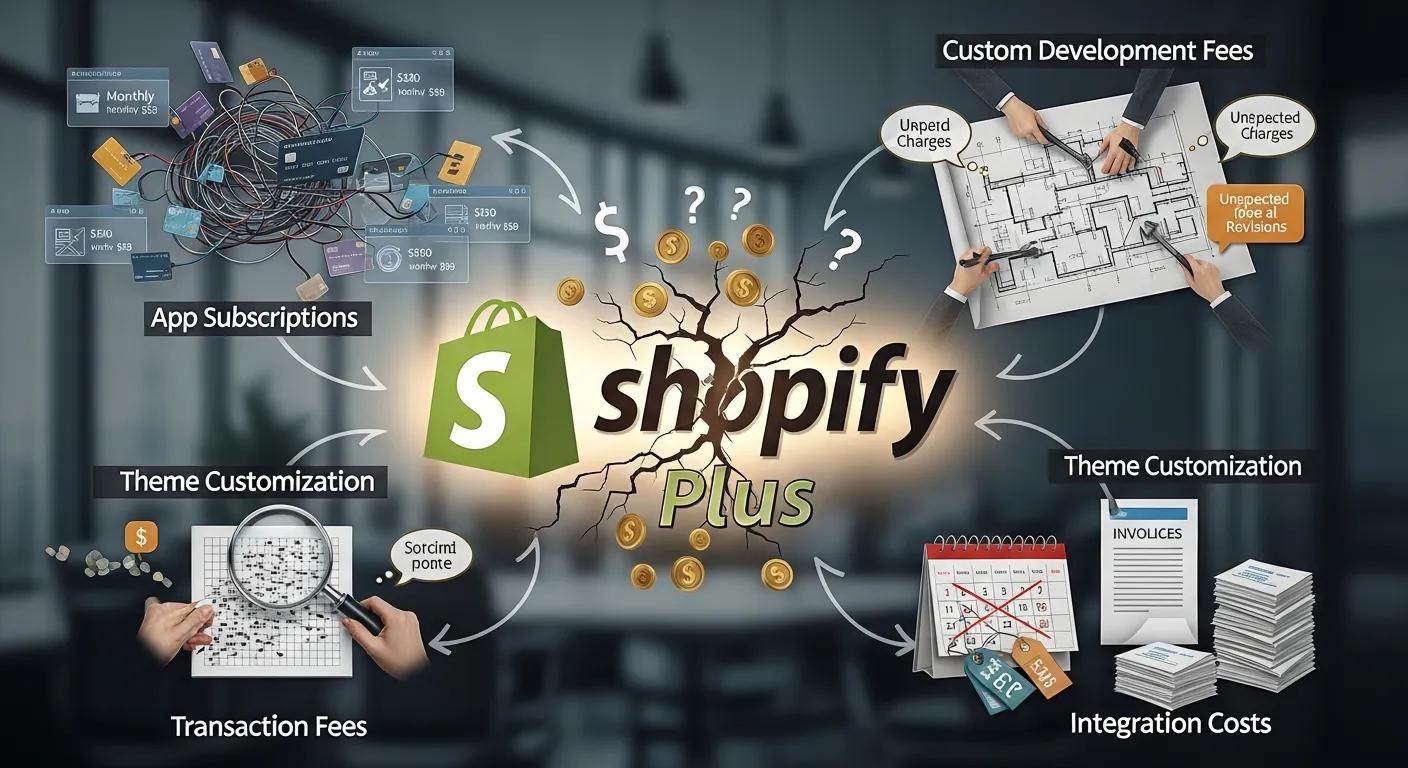
Beyond the core subscription and transaction fees, businesses must account for ecosystem expenses, including apps, custom themes, development work, migration services, and POS integrations, all of which contribute to the overall investment.
Shopify Plus Pricing: A Comprehensive Breakdown of Costs and Fees (2025 Edition)
A detailed examination of Shopify Plus costs reveals that the total investment extends well beyond the base subscription. It encompasses a range of additional expenditures such as transaction fees, third-party apps, premium themes, development services, and migration fees, all of which are critical for a complete financial understanding.
This insight strongly reinforces the article’s focus on calculating the complete Total Cost of Ownership (TCO) for Shopify Plus, detailing the various hidden and supplementary costs beyond the primary subscription.
How Do Shopify Apps and Integrations Impact Your Budget?
Apps enhance functionality but come with monthly or usage-based charges:
- Analytics and reporting tools: Typically range from $20–$200 per month.
- B2B wholesale channel solutions: Can cost between $100–$500 per month.
- Advanced fraud detection systems: Usually priced at $50–$150 per month.
Carefully selecting essential integrations and negotiating enterprise-level pricing can significantly reduce recurring app expenditures and ensure a strong return on investment for each added feature.
What Are the Typical Development and Customization Expenses?
Achieving enterprise-grade themes and backend customizations requires specialized expertise, with agency rates often falling between $10,000 and $200,000 per project, depending on factors such as:
- The complexity of custom checkout and Scripts implementation
- Integration requirements with third-party systems (ERP, CRM)
- Needs for multi-store setups and localization
Investing in Shopify Plus-certified partners ensures high-quality code, robust scalability, and a future-proof architecture.
What Is the Estimated Cost of Migrating to Shopify Plus?
Migration costs typically cover data export/import, theme reconstruction, and quality assurance:
- Standard migration: Estimated between $5,000–$15,000.
- Complex migration: Can range from $25,000–$100,000.
Key influencing factors include the volume of historical order data, the transfer of custom applications, and the consolidation of multiple stores.
Are There Additional Fees for Premium Themes and Shopify POS Pro?
Enhancements to your store’s design and in-person sales capabilities come with separate charges:
- Premium theme license: A one-time cost of $250–$500.
- Shopify POS Pro: Priced at $89 per location per month.
Accurate budgeting for theme licenses and POS subscriptions is essential for delivering a seamless experience across both your online and physical retail channels.
Calculating Your Total Cost of Ownership (TCO) for Shopify Plus
Determining your TCO involves aggregating subscription fees, transaction costs, ecosystem expenses, and operational expenditures to accurately forecast your long-term investment and potential ROI.
What Key Factors Should Be Included in a Shopify Plus TCO Calculation?
A thorough TCO model should incorporate:
- Base subscription fees (your monthly license cost)
- Variable platform fees (GMV-based percentages)
- Transaction processing costs (gateway fees and compliance)
- Subscriptions for apps and integrations
- Expenses for development, migration, and customization
- Ongoing support and maintenance
By including all relevant fee categories, you can achieve an accurate ownership projection that aligns with your revenue expectations.
How Does Your Monthly Revenue Influence Your Shopify Plus Costs?
Increased monthly GMV can trigger higher platform fee tiers and impact your overall spending:
- Economies of scale: Benefit from volume discounts on base fees with longer contracts.
- Fee predictability: Capped variable fees limit your maximum outlay as revenue expands.
Modeling potential revenue fluctuations against fee thresholds is crucial for setting strategic revenue targets and optimizing subscription negotiations.
What Tools or Methods Can Help Estimate Shopify Plus ROI?
Estimating your ROI requires combining TCO inputs with key benefit drivers such as:
- Increased conversion rates resulting from a customized checkout and automation.
- Operational cost savings achieved through Shopify Flow and Launchpad.
- Benefits of international expansion, considering Shopify Markets Pro fees.
Utilizing spreadsheet calculators and examining historical case studies can quantify net gains, reinforcing your investment decisions.
Identifying the Optimal Time to Upgrade to Shopify Plus
The decision to upgrade to Shopify Plus should be driven by your revenue scale, operational complexity, and growth aspirations, ensuring the investment delivers strategic value.
Which Business Models Stand to Gain the Most from Shopify Plus Pricing?
The advanced enterprise features of Shopify Plus are particularly beneficial for:
- High-volume Direct-to-Consumer (DTC) retailers exceeding $800k GMV monthly.
- B2B wholesalers requiring sophisticated tiered pricing and custom catalog management.
- Global sellers needing robust multi-currency support and localization tools.
These business models effectively leverage automation, expansion stores, and dedicated support to justify the subscription investment.
How Does Shopify Plus Facilitate Scalability and Business Growth?
Shopify Plus is engineered to support growth through:
- Powerful automation tools (Flow, Functions) designed to minimize manual tasks.
- Expansion stores enabling international market presence managed from a single dashboard.
- A fully customizable checkout process for creating tailored customer experiences.
These capabilities streamline operations, accelerate global expansion, and effectively manage incremental costs.
What Are the Clear Indicators That Shopify Advanced Is No Longer Sufficient?
Key signs that you’ve outgrown Shopify Advanced include:
- Frequent checkout abandonment rates due to limited customization options.
- Issues with inventory synchronization across multiple storefronts.
- An overwhelming number of apps without centralized automation capabilities.
- Resource limitations when handling significant traffic spikes.
Recognizing these pain points is a strong signal that you need the scalability and dedicated support offered by Shopify Plus.
Comparing Shopify Plus Pricing Against Other Enterprise E-commerce Platforms
An evaluation of competing platforms underscores Shopify Plus’s compelling value proposition and cost-effectiveness.
What Are the Primary Pricing Distinctions Between Shopify Plus and Magento?
Shopify Plus Pricing: Assessing Its Investment Value (2025 Outlook)
A 2025 comparative analysis of e-commerce platforms indicates that while Shopify Plus carries a higher monthly fee than Shopify Advanced, its enterprise-grade features, scalability, and dedicated support can strongly justify the investment for high-volume businesses. Moreover, the total cost of ownership for Shopify Plus often proves more economical than platforms like Magento, which typically incur substantial development and ongoing maintenance expenses.
This comparison validates the article’s assessment of Shopify Plus’s cost-effectiveness relative to major enterprise competitors like Magento and Shopify Advanced, highlighting its TCO advantages and feature-rich offering.
How Does Shopify Plus Compare to Salesforce Commerce Cloud?
Salesforce Commerce Cloud pricing typically begins at $50,000+ annually, plus a percentage of revenue. In contrast, Shopify Plus offers transparent monthly fees with GMV-based caps and no hidden infrastructure costs, simplifying budgeting and accelerating time-to-market.
What Unique Value Does Shopify Plus Deliver for Its Price Point?
Beyond its pricing structure, Shopify Plus provides significant enterprise-level benefits:
- A dedicated Launch Engineer and 24/7 priority customer support.
- Unlimited API calls, enabling extensive integrations and automation.
- Integrated fraud protection and built-in PCI compliance.
- A vibrant and active partner ecosystem for continuous platform optimization.
This comprehensive value proposition positions Plus as a highly cost-effective solution for scaling merchants.
Implementing Best Practices to Optimize Your Shopify Plus Subscription Fees
Adopting proactive strategies can lead to significant cost reductions while maximizing the utilization of platform features.
How Can Businesses Minimize Transaction Fees Using Shopify Payments?
To effectively reduce your transaction fees:
- Exclusively use Shopify Payments to eliminate external gateway surcharges.
- Promote local payment methods to take advantage of lower regional processing rates.
- Negotiate custom rates once you achieve substantial transaction volumes.
This approach consolidates your payment processing and secures the most favorable terms available.
What Strategies Can Lower Development and App Expenses?
Cost-efficient customization involves several key tactics:
- Leverage existing theme frameworks rather than undertaking complete rebuilds.
- Prioritize native Shopify features over relying heavily on third-party apps.
- Plan phased rollouts for new features to distribute development costs over time.
These strategies help optimize your budget allocation and accelerate the ROI from platform enhancements.
How Do Automation and Advanced Features Enhance ROI?
By utilizing Shopify Flow, Launchpad, and Scripts, you can significantly reduce manual tasks, implement personalized promotions, and expedite product launches. Automating processes like order routing, inventory alerts, and email workflows frees up your team to concentrate on growth initiatives, effectively translating your subscription investment into tangible operational savings.
Addressing Common Inquiries About Shopify Plus Subscription Fees
The following answers provide direct, snippet-ready responses to frequently asked questions, clarifying key pricing concerns.
What Is the Actual Monthly Cost of Shopify Plus?
Shopify Plus begins at $2,500 per month for a one-year contract or $2,300 per month for a three-year term. This is supplemented by variable fees of 0.15–0.30% on monthly GMV exceeding $800,000, capped at $40,000 per month.
Is Shopify Plus Considerably More Expensive Than Other Plans?
While Shopify Plus has a higher initial cost than Shopify Advanced ($299/mo), its reduced transaction rates, powerful automation tools, and dedicated support offer superior long-term value for high-volume merchants and global enterprises.
What Are the Transaction Fees Associated with Shopify Plus?
When using Shopify Payments, domestic card transactions are charged at 2.15% + $0.30, while international cards incur a rate of 3.15% + $0.30. Utilizing third-party gateways adds a 0.15–0.20% surcharge on top of the processor’s rate.
How Does Shopify Plus Pricing Function for International Sellers?
Shopify Markets Pro introduces per-market fees ranging from $200–$1,000 per month, depending on the features utilized. Multi-currency processing involves FX rates of 1.0%–2.0%, facilitating local payment acceptance and ensuring compliance.
What Are the Typical Development Costs for Shopify Plus Stores?
Development budgets can range from $10,000 for minor theme adjustments to over $200,000 for comprehensive custom implementations, contingent upon the complexity, required integrations, and the scale of automation needed.
How Blackbelt Commerce Empowers Businesses to Optimize Shopify Plus Costs
Blackbelt Commerce collaborates with merchants to refine every cost aspect of Shopify Plus, ensuring strategic investments and flawless execution.
What Shopify Plus Development Services Does Blackbelt Commerce Offer?
Our team of certified experts provides bespoke theme design, checkout customization, headless commerce implementations, and seamless integration with ERP/CRM systems, aligning platform capabilities with your business objectives while maintaining strict control over development budgets.
How Can Blackbelt Commerce Assist with Your Shopify Plus Migration?
We manage end-to-end migrations—encompassing data transfer, theme reconstruction, and rigorous QA—employing proven methodologies to minimize downtime, reduce migration expenses, and preserve your valuable SEO equity.
What Are the Advantages of Partnering with Shopify Plus Certified Experts?
Engaging with Plus-certified professionals grants you access to industry best practices, priority support channels, optimized platform performance, and continuous optimization strategies designed to accelerate ROI and foster sustained long-term growth.
Enterprise brands require clarity and control over every subscription expenditure. By mastering Shopify Plus’s pricing model, transaction costs, potential hidden expenses, and optimization strategies—and with the specialized support from Blackbelt Commerce—businesses can confidently invest in a scalable, feature-rich e-commerce platform engineered to deliver maximum returns.
Quick Answer: Shopify Plus subscription fees
Shopify Plus Subscription Fees should help merchants make a clearer decision about their store, customer experience, and growth priorities. A useful guide explains the concept, shows when it matters, and gives the reader a practical next step without forcing the topic into a generic template.
Key Takeaways
- Start with the search intent behind Shopify Plus subscription fees: the reader needs a clear explanation before they are ready for a service conversation.
- Keep the advice practical and specific so the post feels editorial, useful, and worth sharing.
- Use the topic cluster links to connect the article to related BBC expertise instead of leaving it as a standalone blog post.
- Add a natural commercial bridge only after the article has answered the reader’s main question.
- Use the same-page Calendly CTA so qualified readers can book a strategy call without being sent to a long form.
How this connects to your Shopify growth strategy
This article should remain useful for readers researching Shopify Plus subscription fees, but it also needs to show when the topic becomes a business decision. For the Shopify Plus Pricing and Strategy cluster, the commercial bridge is practical: once the reader understands the concept, the next step is deciding whether their current Shopify setup can support the desired experience, conversion path, and operational workflow. That is where expert planning, design, development, CRO, and SEO support can turn the idea into measurable store improvements.
Related Shopify resources
These internal resources support the Shopify Plus Pricing and Strategy topic cluster and help connect this guide to stronger commercial next steps:
- Shopify Plus Pricing and Strategy
- Shopify experts
- Shopify Plus agencies
- Shopify Plus Pricing and Strategy — Parent service page for the reader’s next commercial step
- Blackbelt Commerce — Home-page authority link for brand and core Shopify expertise
- Shopify experts — Money-page link requested for expert-hiring intent
- Shopify custom development — Development service page for implementation and technical help
- Shopify CRO — Conversion service page for readers focused on revenue and lead generation
- Cost of Shopify website — Related pricing article that helps readers compare platform, build, and expert investment decisions
- Shopify Plus checkout customization — Related Shopify Plus implementation guide for readers evaluating advanced Plus costs and capabilities
Questions store owners ask before taking action
What does Shopify Plus subscription fees mean for a Shopify merchant?
For a Shopify merchant, Shopify Plus subscription fees is about choosing or improving the store experience in a way that supports traffic, trust, conversion, and long-term operations.
When should a store owner get expert help?
Expert help becomes useful when the decision affects SEO, conversion, theme architecture, integrations, migration risk, or revenue-critical customer journeys.
How should this topic connect to a broader content cluster?
The post should link to a parent service page, related support articles, and money pages so Google and AI systems understand how the article supports a broader area of expertise.
What is the lead-generation goal of this article?
The article should educate first, then guide qualified readers toward booking a strategy call when they need help applying the advice to their own store.
What should be avoided during optimization?
Avoid filler, unrelated phrases, invented statistics, broken formatting, duplicated CTAs, and any edit that makes the article feel less helpful or less polished.
Future articles needed for topical dominance
To build deeper topical authority around this cluster, these supporting topics should be created later and linked back into this article:
- Shopify Plus Subscription Fees Checklist for Shopify Store Owners: Creates a practical support article that turns the Shopify Plus Pricing and Strategy topic into an actionable review tool.
- Common Shopify Plus Subscription Fees Mistakes and How to Avoid Them: Captures problem-aware searches and gives BBC a natural place to explain implementation risks without hard selling.
- When to Hire Shopify Experts for Shopify Plus Subscription Fees: Connects informational demand to the expert-hiring money page while preserving educational intent.

