


Over half of all American online store owners report struggling to keep up with sudden traffic spikes during peak shopping seasons. Scalability is now a critical priority as the digital marketplace grows more crowded and competition intensifies. Understanding how to build a Shopify store that not only survives but thrives through rapid change can mean the difference between lasting success and early burnout.
Table of Contents
- Defining Ecommerce Scalability For Online Stores
- Types Of Ecommerce Scalability Solutions
- Technical And Operational Requirements Explained
- Risks, Costs, And Common Scaling Mistakes
- Comparing Scalability Alternatives For Shopify
Key Takeaways
| Point | Details |
|---|---|
| Ecommerce Scalability | It enables online stores to manage increasing demand and complexity without sacrificing performance. |
| Types of Solutions | Solutions include Horizontal Scaling, Cloud-Based Infrastructure, and Microservices Architecture, facilitating growth and performance enhancement. |
| Technical and Operational Requirements | Successful scalability integrates strong technical infrastructure with strategic planning for robust business responses. |
| Risks and Mistakes | Common pitfalls include infrastructure overextension and financial miscalculations, necessitating careful planning and monitoring. |
Defining Ecommerce Scalability for Online Stores
Ecommerce scalability represents a Shopify store’s capacity to efficiently handle increasing customer demand, transaction volumes, and operational complexity without compromising performance or user experience. At its core, scalability transforms your online business from a small startup into a robust, adaptable digital enterprise capable of managing rapid growth across multiple channels and markets.
Scalability isn’t just about technical infrastructure – it’s a holistic strategy encompassing technology, processes, and strategic planning. Distributed Order Management Systems have emerged as critical solutions for online retailers seeking to expand their operational capabilities. These systems enable businesses to simultaneously manage orders from multiple sales channels, optimize inventory tracking, and enhance customer satisfaction through seamless, integrated experiences.
The COVID-19 pandemic dramatically accelerated the importance of ecommerce scalability. Recent research highlighted how online retailers must rapidly adapt to fluctuating customer engagement patterns and unprecedented demand surges. Successful scalable ecommerce strategies now require:
- Flexible technological infrastructure
- Automated inventory management
- Multichannel sales integration
- Real-time data analytics
- Responsive customer support systems
Building a scalable Shopify store means creating an ecosystem that can grow organically with your business, anticipating challenges before they emerge and designing systems that can expand without constant manual intervention. This approach transforms your online store from a simple transactional platform into a dynamic, responsive business engine ready to capitalize on emerging market opportunities.
Types of Ecommerce Scalability Solutions
Ecommerce scalability solutions range from technological architectures to strategic frameworks designed to help online stores expand seamlessly. The scale cube model provides a comprehensive blueprint for understanding how businesses can approach technological scaling across three critical dimensions: replication, segmentation, and component partitioning.

Horizontal Scaling Solutions represent the first approach, focusing on expanding a store’s capacity by adding more servers or resources to distribute workload. This method allows Shopify stores to handle increased traffic and transaction volumes without compromising performance. Headless commerce architecture emerges as a sophisticated scalability strategy, decoupling front-end presentation from back-end infrastructure. This approach enables independent updates, faster development cycles, and greater flexibility for growing ecommerce businesses.
Key scalability solutions for Shopify stores include:
- Cloud-Based Infrastructure
- Automatic resource allocation
- Elastic computing capabilities
- Pay-as-you-grow pricing models
- Microservices Architecture
- Independent service deployment
- Modular system design
- Enhanced system resilience
- API-Driven Integrations
- Seamless third-party connections
- Customizable functionality
- Rapid technological adaptation
Successful ecommerce scalability goes beyond technical solutions. It requires a holistic approach that balances technological infrastructure with strategic planning, ensuring your Shopify store can smoothly transition from a small startup to a robust, high-performance online business ready to capture emerging market opportunities.
Technical and Operational Requirements Explained
Successful Shopify store scalability demands a comprehensive approach that integrates sophisticated technical infrastructure with strategic operational planning. Distributed system architectures have emerged as critical frameworks for managing complex ecommerce environments, enabling businesses to build robust, flexible digital ecosystems capable of handling rapid growth and dynamic market demands.
Technical Requirements encompass multiple critical components that form the backbone of a scalable online store. Key technical considerations include:
- Infrastructure Optimization
- Cloud-based server configurations
- Adaptive load balancing mechanisms
- Redundant data storage systems
- Performance Engineering
- Efficient database query optimization
- Content delivery network (CDN) integration
- Caching strategies for rapid content retrieval
- Security Architecture
- Multi-layer authentication protocols
- Real-time threat detection systems
- Encrypted data transmission channels
Operational requirements extend beyond technological infrastructure, demanding a holistic approach that synchronizes technological capabilities with strategic business processes. Successful scalability requires continuous monitoring, proactive performance management, and the ability to rapidly adapt technical systems to evolving business requirements. This integrated approach transforms your Shopify store from a simple transactional platform into a dynamic, intelligent digital enterprise capable of capturing emerging market opportunities and delivering exceptional customer experiences.
Risks, Costs, and Common Scaling Mistakes
Scaling an ecommerce platform involves navigating complex technological and financial challenges that can significantly impact your Shopify store’s performance and profitability. Cloud computing scalability research reveals critical insights into the potential risks and hidden costs associated with expanding digital infrastructure, highlighting the need for strategic and measured growth approaches.
Common Scaling Mistakes can derail even the most promising online businesses. These pitfalls often emerge from inadequate planning and unrealistic expectations. Key risks include:
- Infrastructure Overextension
- Premature investment in advanced technologies
- Unnecessary complex system architectures
- Disproportionate resource allocation
- Performance Bottlenecks
- Inadequate load testing
- Poor database optimization
- Inefficient caching mechanisms
- Financial Miscalculations
- Underestimating ongoing maintenance costs
- Neglecting scalability-related expenses
- Failing to predict resource consumption patterns
Distributed computing challenges underscore the importance of understanding resource elasticity and its financial implications. Successful scaling requires a nuanced approach that balances technological capabilities with economic constraints, ensuring your Shopify store can grow efficiently without compromising financial stability or operational performance. Proactive risk management, continuous performance monitoring, and flexible infrastructure design are essential strategies for mitigating potential scaling challenges and maintaining a competitive digital presence.
Comparing Scalability Alternatives for Shopify
Technological solutions for international Shopify expansion reveal multiple strategic approaches for scaling online stores, each with distinct advantages and implementation challenges. Understanding these alternatives allows entrepreneurs to design flexible, responsive ecommerce infrastructures that adapt to changing business requirements and market dynamics.
Scalability Alternatives can be categorized into several key strategies:
- Vertical Scaling
- Upgrading existing server resources
- Increasing computational power
- Enhancing single-server capabilities
- Horizontal Scaling
- Adding multiple server instances
- Distributing workload across servers
- Creating redundant system architectures
- Hybrid Scaling
- Combining vertical and horizontal approaches
- Dynamic resource allocation
- Optimizing performance and cost efficiency
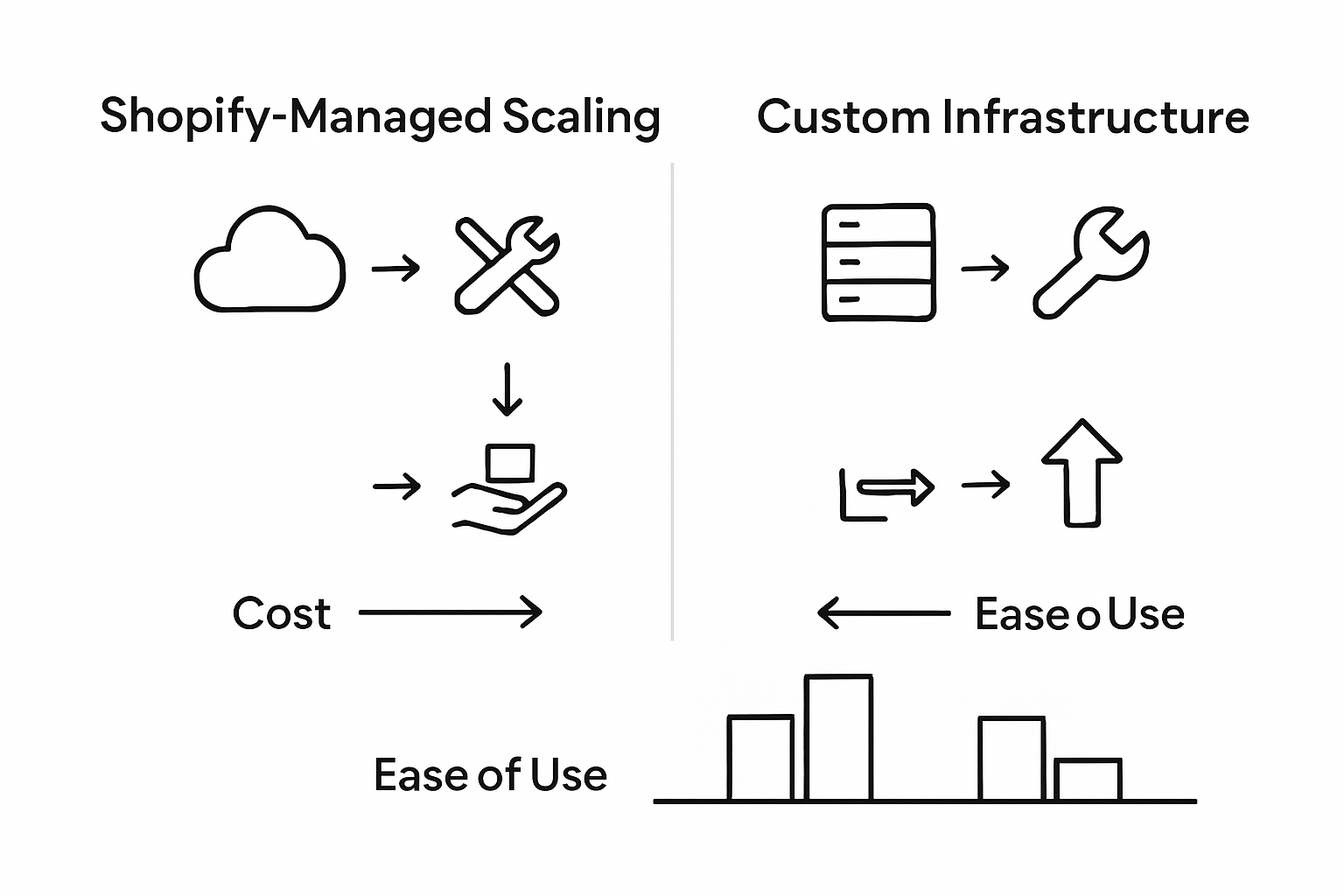
Scalable ecommerce infrastructure design emphasizes the importance of selecting a strategy that aligns with your specific business model, growth projections, and technological constraints. Successful scaling requires a nuanced approach that balances performance requirements, budget limitations, and future expansion potential, transforming your Shopify store into a robust, adaptable digital enterprise capable of meeting evolving customer demands.
Scale Your Shopify Store with Expert Solutions from Blackbelt Commerce
The journey to ecommerce scalability often reveals challenges like infrastructure overextension, performance bottlenecks, and costly miscalculations. If you are looking to build a Shopify store that can effortlessly handle growing transaction volumes and complex operational demands while delivering seamless customer experiences Blackbelt Commerce offers tailored solutions to help you succeed. We specialize in custom Shopify development including headless architectures and multi-channel integrations that align with your growth goals.

Take control of your store’s future with proven expertise. Explore our comprehensive process featuring consultation, design, development, and ongoing support to ensure your Shopify store scales efficiently and securely. Don’t risk costly scaling mistakes when you can partner with professionals who understand advanced ecommerce scalability challenges. Visit Blackbelt Commerce now to unlock your Shopify store’s full potential through custom, scalable solutions that drive measurable traffic and revenue growth.
Frequently Asked Questions
What is ecommerce scalability?
Ecommerce scalability refers to a Shopify store’s ability to handle increased customer demand, transaction volumes, and operational complexities efficiently without compromising performance or user experience.
Why is scalability important for an online store?
Scalability is crucial as it enables your online store to adapt to rapid growth, manage changing customer engagement patterns, and ensure a seamless shopping experience across multiple channels.
What are some common mistakes when scaling an ecommerce platform?
Common scaling mistakes include infrastructure overextension, inadequate load testing, poor database optimization, and underestimating ongoing maintenance costs, which can hinder performance and profitability.
What types of scalability solutions are available for Shopify stores?
Key scalability solutions include cloud-based infrastructure, microservices architecture, and API-driven integrations that allow for flexible, modular systems, enabling better performance and adaptability.
Recommended
- E-commerce growth strategy: Top 3 Pillars
- 7 Essential Shopify Marketing Tips for Store Growth Success – Shopify Experts: Grow Your eCommerce Revenue
- Why Multichannel Thinking is Key for Shopify Store Success
- Leverage Data to Scale Your Shopify Plus Store
- Top Floral Fragrance Dupes – Expert Comparison 2025
Quick Answer: What is ecommerce scalability
What is ecommerce scalability should be evaluated through scalability, implementation quality, operations, integrations, CRO, SEO protection, and post-launch support. The right Shopify Plus guidance turns platform capability into practical growth rather than unnecessary complexity.
Want a sharper Shopify growth plan?
Want to turn What is ecommerce scalability into a practical Shopify growth plan? Book a strategy call and we will help you clarify the next move.
Key Takeaways
- Use What is ecommerce scalability to clarify the business problem and the highest-impact next step for a Shopify store.
- Connect recommendations to customer trust, UX, conversion, SEO, analytics, operations, and revenue.
- Link naturally to Blackbelt Commerce money pages and the home page without weakening editorial trust.
- Avoid generic ecommerce advice; make the guidance specific to Shopify constraints and opportunities.
- Use the same-page Calendly CTA only after the post has delivered useful guidance.
How this connects to your Shopify growth strategy
For the Shopify Plus Support, Pricing, and Agency Strategy cluster, this article should make What is ecommerce scalability practical, specific, and commercially useful while protecting editorial trust. The bridge to Blackbelt Commerce should show when expert planning, implementation, SEO/CRO discipline, or Shopify Plus support can reduce risk and turn the reader’s next decision into measurable progress.
Want a sharper Shopify growth plan?
Use this guide as a decision tool. Then book a strategy call when you want a practical roadmap for your store.
Related Shopify resources
These internal resources support the Shopify Plus Support, Pricing, and Agency Strategy topic cluster and help connect this guide to stronger commercial next steps:
- Shopify Plus agencies
- Shopify experts
- Shopify Plus agencies
- Shopify Plus agencies — Primary money/service page for this search intent
- Blackbelt Commerce — Home-page authority link for brand and core Shopify expertise
- Shopify experts — Money-page link requested for expert-hiring intent
- Shopify custom development — Development service page for implementation and technical help
Questions store owners ask before taking action
Why does What is ecommerce scalability matter for Shopify merchants?
It matters when the topic affects customer trust, conversion, operations, SEO, analytics, or the team’s ability to scale the store cleanly.
How should the article guide the reader?
It should answer the search intent first, then connect the topic to practical next steps, related resources, and expert support when that next step is useful.
What is the lead-generation goal?
The goal is a qualified strategy-call booking after the article has delivered enough value for the reader to trust Blackbelt Commerce with the next decision.
Future articles needed for topical dominance
To build deeper topical authority around this cluster, these supporting topics should be created later and linked back into this article:
- What is ecommerce scalability Checklist for Shopify Stores: Creates an actionable support article that can earn long-tail searches and link back to relevant money pages.
- Common What is ecommerce scalability Mistakes That Hurt Shopify Revenue: Targets problem-aware readers and explains UX, SEO, conversion, and implementation risk.
- How Shopify Experts Prioritize What is ecommerce scalability: Links informational intent to expert support without turning the main article into a sales pitch.
Want a sharper Shopify growth plan?
Ready to turn the advice in this article into an action plan? Open the calendar here and choose a time that works for you.

