


Beyond the Basics of E-commerce
A Shopify API integration service connects your online store with essential business systems to create a seamless, automated workflow. This saves time, reduces manual errors, and unifies your operations.
Key integrations include:
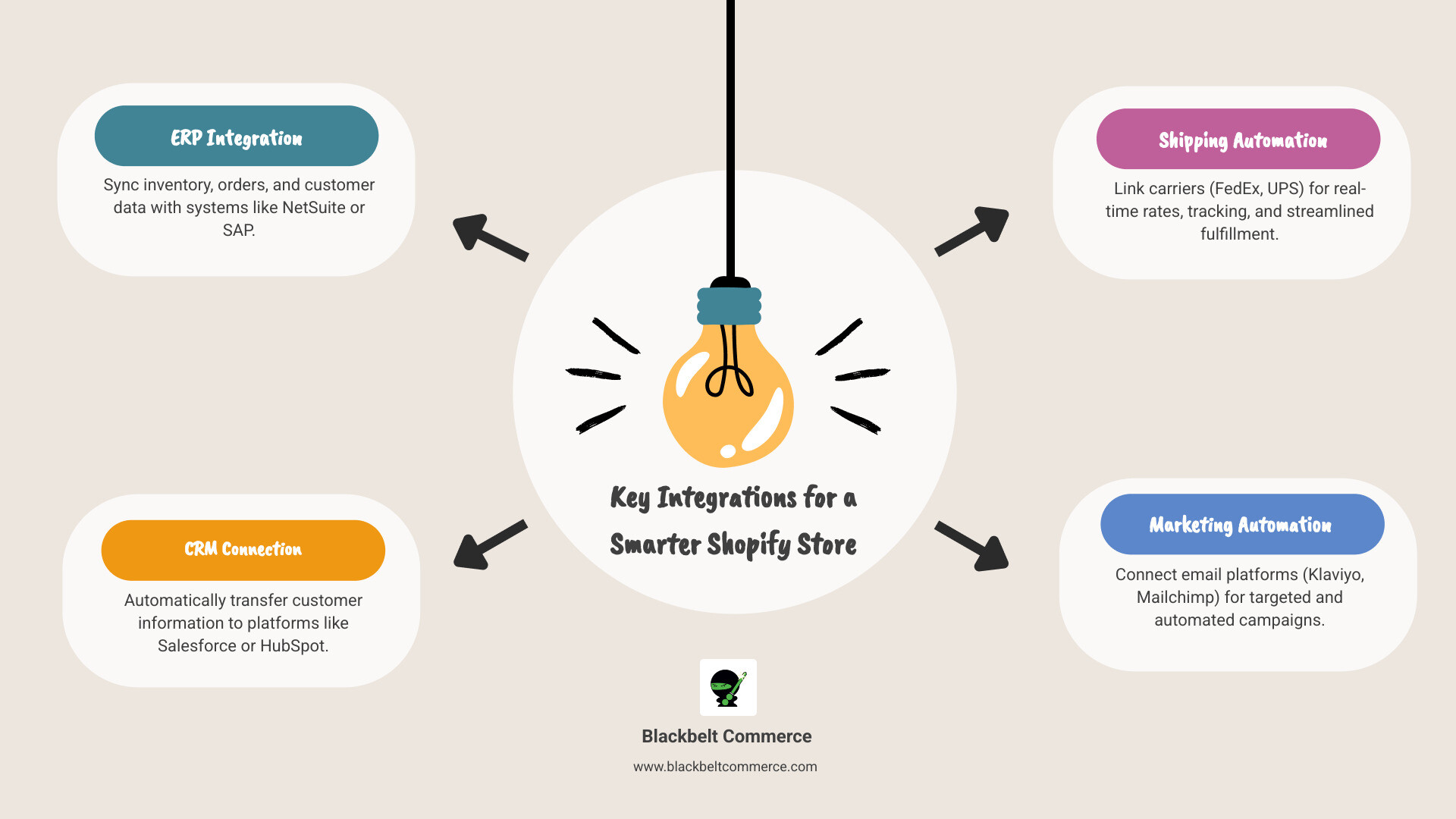
- ERP & CRM: Sync inventory, orders, and customer data with systems like NetSuite, SAP, or Salesforce.
- Shipping & Fulfillment: Automate processes with carriers like FedEx, UPS, and DHL for real-time rates and tracking.
- Multi-Channel Sales: Sync products and orders across Amazon, eBay, and social media.
- Marketing & Payments: Connect tools like Klaviyo and Mailchimp for automated campaigns and add multiple payment processors.
With global e-commerce sales projected to reach $6.86 trillion by 2025, competition is fierce. Smart store owners are creating connected systems that work 24/7. APIs are the digital bridges that let different software applications talk to each other, eliminating manual data entry. When your Shopify store automatically updates inventory in your warehouse after a sale, that’s an API at work.
However, Shopify’s shift to GraphQL APIs and complex authentication can be overwhelming. I’m Cesar A Beltran, Founder and CEO of Blackbelt Commerce. For over 15 years, my New York-based team has helped over 1000 businesses scale with strategic Shopify API integration services. We understand the technical challenges that can make or break your growth.
What is the Shopify API and What Does It Enable?
Think of a Shopify API integration service as your store’s tireless digital assistant. The Shopify API is a communication system that lets different software applications talk to your Shopify store, acting as a universal translator for your business tools.
Instead of being limited to Shopify’s built-in features, the API opens up endless possibilities. It allows your inventory to sync with a warehouse, customer data to flow into your CRM, and new, custom functionality to be added to your store. It’s the difference between a basic store and a smart store that works for you around the clock.
The Different Types of Shopify APIs
Shopify provides a toolkit of specialized APIs for different tasks.
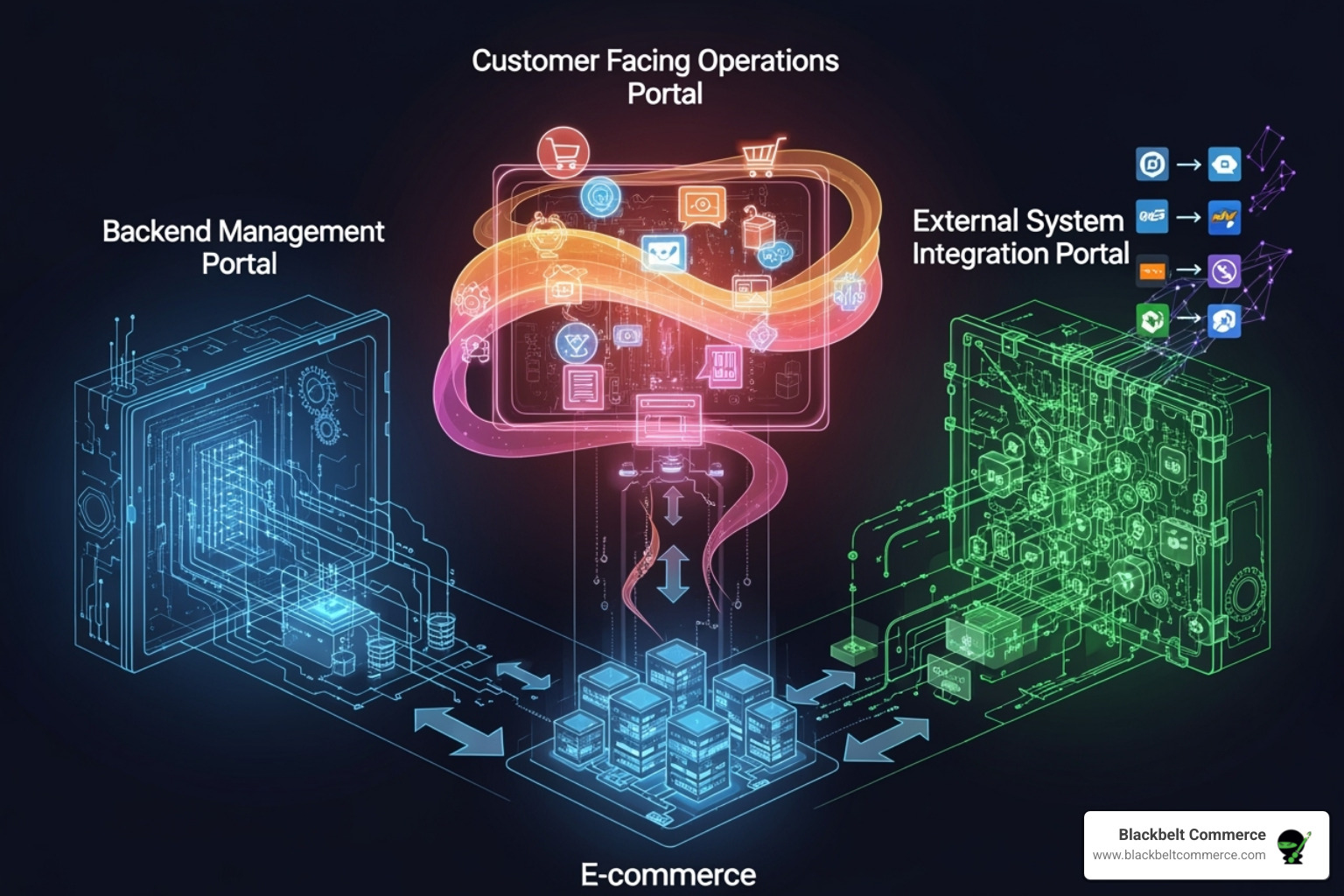
The Admin API is the powerhouse for backend operations, giving programmatic access to products, orders, customers, and inventory. It’s the master key to your store’s data and our primary tool for custom integrations.
The Storefront API is for creating custom shopping experiences, like headless commerce setups. It provides access to public data like products and carts, enabling highly personalized, fast storefronts.
Other key tools include the Partner API for managing apps and themes, the Customer Account API for personalizing customer data, and the Payments Apps API for integrating custom payment gateways.
Webhooks are also crucial for real-time data sync. Instead of an app constantly asking Shopify for updates, webhooks allow Shopify to proactively send notifications when events occur, which is far more efficient.
At Blackbelt Commerce, we leverage all these APIs to provide comprehensive solutions. More info about our Shopify services shows how we put these tools to work, always following Shopify’s official API License and Terms of Use.
Core Requirements for Using Shopify APIs
Before integration, it’s important to understand the rules of the road for security and stability.
Authentication is essential. Any app accessing your store must use unique access tokens that grant specific permissions. No token, no entry.
Rate limits prevent digital traffic jams by capping the number of API requests an app can make in a given time. We design integrations to respect these limits using techniques like batching to ensure smooth operation.
API versioning keeps integrations compatible as Shopify evolves. Shopify uses dated versions (e.g., 2024-04), and we always stay informed about API versioning to build future-proof solutions.
Scopes and permissions act like security clearances, granting an app only the access it needs (e.g., read_products or write_orders). This granular control is a key security feature.
Finally, certain advanced features or higher rate limits are tied to specific Shopify plans, like Shopify Plus. We guide you to the right plan for your integration needs to ensure you get the most value from your Shopify API integration service.
The Technical Deep Dive: How Shopify API Integration Works
Let’s look under the hood at the technical side of a Shopify API integration service. Understanding the mechanics helps appreciate why modern integrations are so much more efficient.
Shopify offers two main API architectures: REST and GraphQL. The shift to GraphQL is significant for performance.
| Feature | Shopify REST API | Shopify GraphQL API | Significance of Shift to GraphQL |
|---|---|---|---|
| Data Fetching | Over-fetching or under-fetching data is common | Fetch precisely what you need, nothing more | Reduces payload size, improves network efficiency, especially on mobile. |
| Efficiency | Often requires multiple requests to get related data | Single request can fetch complex, related data | Fewer round trips to the server, leading to faster load times and better user experience. |
| Developer Exp. | Multiple endpoints, less flexible queries | Single endpoint, powerful and flexible queries | Simplifies client-side development, reduces client-server communication complexity. |
| Versioning | Versioned by date (e.g., 2024-01) | Versioned by date, but more stable due to schema | Schema-driven approach makes changes less breaking, offers better introspection for developers. |
| Complexity | Simpler for basic CRUD operations | Steeper learning curve, but more powerful | Favors complex applications needing fine-grained control over data. |
| Primary Use | Legacy integrations, simpler apps | Modern apps, headless commerce, complex integrations | Shopify is actively investing in GraphQL, making it the preferred choice for new development and advanced use cases. |
GraphQL isn’t just a buzzword; it’s a fundamental improvement. Instead of making multiple API calls to get related product, inventory, and customer data, GraphQL lets us grab everything in one precise request. For our clients, this means faster stores, more responsive integrations, and better customer experiences that drive conversions.
Authentication: Access Tokens, Scopes, and Permissions
Security is critical for any Shopify API integration service. Shopify’s authentication system acts as a sophisticated security checkpoint.
Shopify access tokens are the digital keys that provide authenticated and authorized access for third-party apps. These tokens are generated through the OAuth process, a secure, industry-standard protocol. Instead of sharing your master password, OAuth lets you review and approve the specific permissions an app requests, generating a unique token just for that app.
This system relies on read/write permissions and scopes. Each integration requests only the minimum access it needs to function (e.g., read_products and write_inventory). We follow the principle of least privilege to ensure our integrations are secure and respect your data privacy. Handling these technical details is a key reason to work with an experienced Shopify API integration service. For more details, see Shopify’s documentation on how to generate app access tokens.
Handling API Versioning and Deprecation
Shopify continuously evolves its platform, so we must manage API versioning and deprecation to keep integrations running smoothly.
Shopify’s API lifecycle involves quarterly releases (e.g., 2024-04) that bring new features and improvements. Older versions eventually become deprecated APIs and stop working. Think of it as a highway lane closing for construction; you need a plan to merge into active lanes.
Our migration strategies are proactive. We monitor Shopify’s changelog and plan migrations well ahead of deadlines to prevent unexpected breakdowns. Maintaining compatibility requires designing flexible integrations and communicating with clients early about major changes. We execute migrations during low-traffic periods to minimize business impact. The goal is to ensure your systems improve alongside Shopify’s platform, not just maintain the status quo.
Boost Your Store: Common Use Cases for a Shopify API Integration Service
Imagine your store at 2 AM: a customer places an order, inventory updates across all channels, the warehouse is notified, a thank-you email is sent, and your accounting and CRM systems are updated. This isn’t magic—it’s a strategic Shopify API integration service at work.
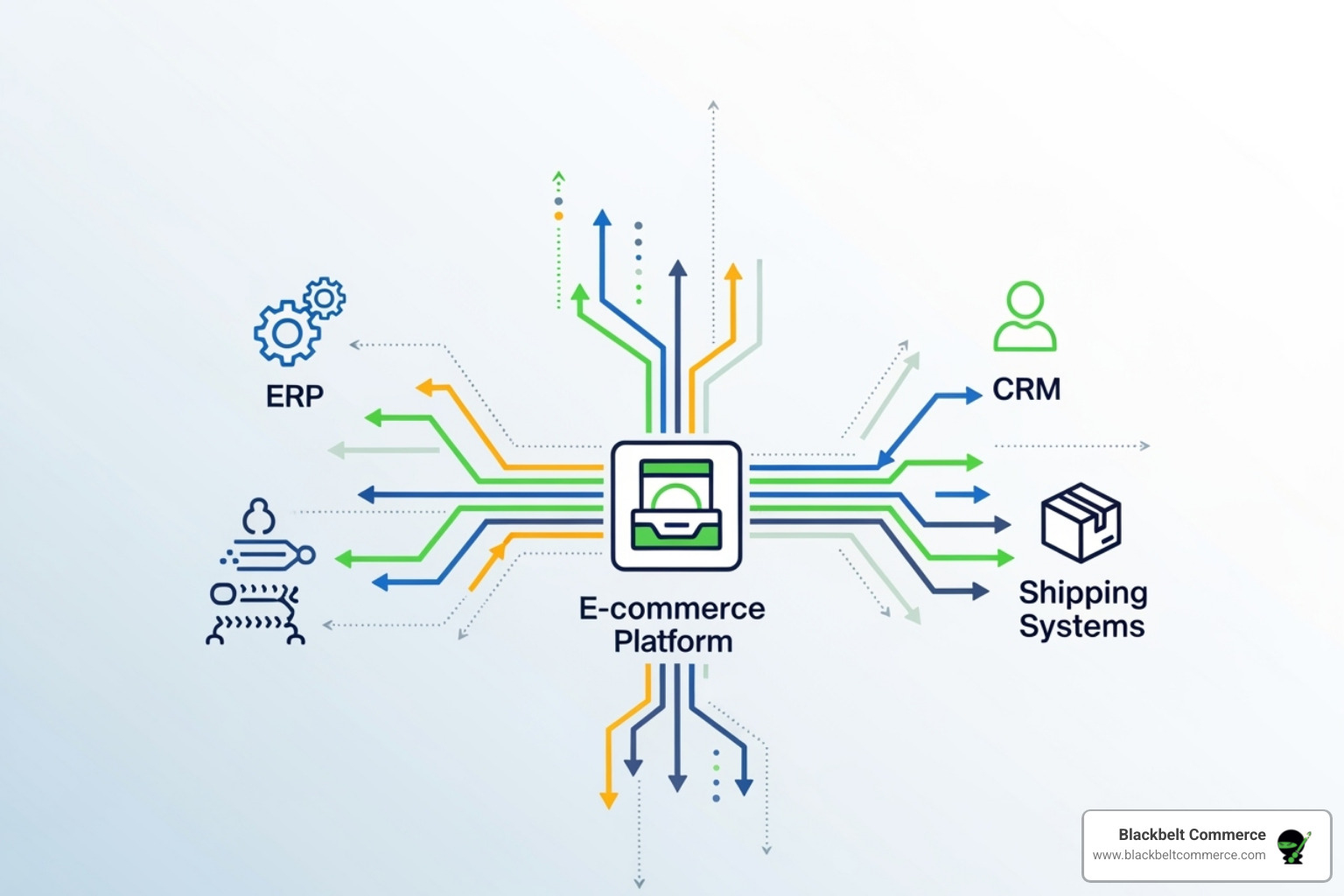
Automated workflows are how businesses scale. We’ve seen clients shift from hours of daily data entry to focusing on growth strategies. The key benefits are business process automation, real-time data synchronization, and improved operational efficiency. Your customers get a better experience with faster shipping and accurate information, turning them into loyal fans.
Key System Integrations
Certain integrations form the backbone of successful e-commerce operations.
- ERP Integration: Connecting with NetSuite, SAP, or Microsoft Dynamics means every sale instantly updates financials, triggers fulfillment, and adjusts inventory. It’s mission control for your business.
- CRM Integration: Syncing with Salesforce or HubSpot provides a complete customer story—browsing behavior, support interactions, and buying patterns—for targeted marketing.
- PIM Integration: A Product Information Management system is crucial for large catalogs, keeping product data consistent across all channels.
- POS Integration: Bridge your online and offline stores. A sale in your Manhattan showroom instantly updates online inventory, creating a true omnichannel experience.
- Shipping and Fulfillment Integration: Services like ShipStation or Shippo automate real-time rates, label generation, and tracking updates, streamlining a complex process.
All integrations are implemented and supported by Blackbelt Commerce’s expert team, ensuring seamless connectivity and ongoing support.
Multi-Channel Sales and Marketing Automation
Once your systems are connected, you can create a true commerce ecosystem.
Centralized inventory management lets you sell confidently on Amazon, eBay, and social media without overselling. When a product sells on one channel, it’s updated everywhere.
Order syncing across marketplaces brings all sales into a single dashboard. Your fulfillment and customer service teams get a unified view of all transactions, regardless of the source.
Marketing automation possibilities become endless. Automated email campaigns via Klaviyo or Mailchimp can welcome customers, recover abandoned carts, and suggest products based on past behavior.
Customer segmentation becomes more powerful with integrated data, allowing you to identify high-value customers or re-engage dormant ones. This leads to personalized marketing, where you can show different content to different visitors, significantly boosting conversion rates.
All solutions are custom-built and managed by Blackbelt Commerce, custom to your business needs.
Choosing Your Partner: In-House vs. a Shopify API Integration Service
So, you need a Shopify API integration service. The big question is: build it in-house or hire a specialized agency like Blackbelt Commerce?

Building an in-house team seems appealing, but the real costs are high. Hiring skilled Shopify developers in cities like New York can cost over $100,000 annually per person, plus benefits and overhead. A complex project requires a full team.
Beyond cost, finding developers with deep, current Shopify API expertise is difficult. While an internal team learns through trial and error, your competitors are already benefiting from integrations built by experts. A specialized agency can deliver results in weeks, not months.
When you’re ready to explore a partnership, you can start your project with our experts.
Why You Need a Professional Shopify API Integration Service
You wouldn’t hire a general contractor for heart surgery. API integrations require specialized skills from years of focused experience.
- Technical Expertise: We live and breathe Shopify’s REST and GraphQL APIs. When Shopify updates its platform, we’re already prepared with migration strategies.
- Overcoming Challenges: We’ve seen it all, from legacy ERP systems to unique data formats. What might stump an internal team is a solved problem for us.
- Scalability and Maintenance: We build systems that grow with your business and provide ongoing monitoring and support to resolve issues before they impact customers.
- Security and Performance: We implement industry-best security protocols while ensuring integrations are fast and don’t slow down your store.
Blackbelt Commerce provides end-to-end integration services, from planning to post-launch support.
Key Considerations for Your Shopify API Integration Service
Choosing the right partner is crucial. Here’s what matters most:
- Data Security: Your partner must prioritize the security of your customer and business data. Ask about their security certifications, encryption methods, and access controls.
- Performance Impact: Poorly designed integrations can cripple your store’s speed. We use asynchronous processing and efficient caching to ensure our integrations improve, not hinder, performance.
- Scalability Planning: A great provider designs solutions that handle growth in orders, products, and channels without expensive rebuilds.
- Integration Models: We offer both Fixed Price projects for clear scopes and Monthly Retainer arrangements for ongoing development and support, helping you choose the model that fits your budget.
- Vetting Developers: Look beyond marketing. Check for Shopify Partner certifications, review case studies, and ask for references. A qualified provider will welcome technical questions.
Blackbelt Commerce is a trusted Shopify Partner based in New York City, with a proven track record in complex integrations. We build conversion-focused solutions that drive real business results.
Frequently Asked Questions about Shopify API Integration
When businesses explore a Shopify API integration service, the same concerns about cost, time, and performance always come up. After helping over 1000+ businesses, I want to address these head-on.
How much does a Shopify integration cost?
Asking about integration cost is like asking about the cost of a house—it depends on the complexity. Key cost factors include the number of systems, data mapping complexity, custom logic requirements, and data volume.
- Basic Integrations: Connecting to a standard tool like Mailchimp typically costs $500 to $5,000. These projects often use existing connectors with minimal custom work.
- Complex Integrations: Connecting to an enterprise ERP like NetSuite or SAP, or building a headless solution, ranges from $5,000 to $20,000 or more. These require extensive custom development and planning.
Also, consider setup versus maintenance costs. Pre-built apps may have lower setup fees but ongoing monthly subscriptions. A custom solution has a higher upfront investment but can offer lower long-term costs and greater control.
Blackbelt Commerce offers transparent pricing and custom solutions for every business size. We believe in honest budget conversations from day one.
How long does a Shopify integration take?
Timelines vary based on project complexity, but experienced developers can work efficiently. Timeline factors include the number of API endpoints, data change needs, and the speed of decision-making.
- Simple Integrations: Connecting to a platform with a standard API can take just 1-3 days.
- Intermediate Integrations: A CRM or warehouse management system integration usually takes 1-2 weeks, involving custom data mapping.
- Complex ERP Integrations: Connecting to systems like NetSuite or SAP can take 2-6 weeks or more, as they involve careful planning and testing across multiple departments.
Our team in New York City ensures timely delivery and clear communication throughout the project. We keep you informed every step of the way.
Will a Shopify integration affect my store’s performance?
This is a common fear, but the answer is simple: a properly implemented Shopify API integration service should never slow down your store. In fact, it can often improve overall system speed.
Proper implementation is key. We design integrations to run efficiently in the background using optimized code and asynchronous operations. This means when a customer places an order, the confirmation is immediate, while the data syncs to your other systems behind the scenes without making anyone wait.
Thorough testing is non-negotiable. We stress-test integrations with high order volumes to ensure they run smoothly under pressure. The real danger comes from poorly configured apps or inexperienced developers. This is why choosing an experienced Shopify API integration service is so important.
Blackbelt Commerce prioritizes performance and reliability in every integration. We build connections thoughtfully, with your store’s speed as a top priority.
Conclusion: Build a Connected Commerce Ecosystem
The future of e-commerce is a connected commerce ecosystem where every part of your business works in harmony. When your inventory, CRM, and marketing tools are all seamlessly integrated with your Shopify store, you create the effortless experience customers expect.
The power of a Shopify API integration service lies in automation and insight. Instead of wasting hours on manual data entry, you can focus on strategic growth. Automation handles routine tasks, while integrated data provides the insights needed for smarter decisions.
Scalability becomes effortless when your systems are connected. Expanding to new marketplaces or handling seasonal demand spikes is manageable because your ecosystem adapts with you. This future-proofs your business, making it easier to adopt new tools and platforms as e-commerce evolves.
The businesses that thrive today have the smartest systems. They’ve invested in creating connected experiences that work 24/7 to reduce errors, improve customer satisfaction, and drive revenue.
At Blackbelt Commerce, our New York City-based team has seen how the right integrations transform businesses. We build smart, flexible systems that deliver real results.
Ready to turn your Shopify store into a high-performing commerce machine? View our work as official Shopify Partners and see how our Shopify API integration service can help you build a truly connected ecosystem. Your customers will notice the difference, your team will be more efficient, and your bottom line will reflect the smart investment.
Quick Answer: Shopify API integration service
Shopify Api Integration Service should be explained through the lens of a real Shopify business decision: what the reader is trying to improve, what risks or tradeoffs matter, and what action would move the store forward. For the Shopify Custom Development, Design, and Technical Implementation cluster, the article should connect practical education to conversion, internal authority, and a clear strategy-call path without using filler or generic SEO copy.
Want a sharper Shopify growth plan?
If this article connects to a current store decision, use the calendar to book a strategy call and turn the idea into a practical plan.
Key Takeaways
- Shopify API integration service should answer the reader’s immediate question and then connect the advice to a practical Shopify business decision.
- The article should feel specific, useful, and worth sharing rather than like a generic SEO insert.
- Internal links should reinforce the home page, Shopify experts, Shopify Plus agencies, and the most relevant service pages.
- The commercial bridge should connect the topic to the Shopify Custom Development, Design, and Technical Implementation cluster without interrupting the educational flow.
- The same-page Calendly CTA should let qualified readers book a strategy call without leaving the article.
How this connects to your Shopify growth strategy
This article should remain useful for readers researching Shopify API integration service, but it also needs to show when the topic becomes a business decision. For the Shopify Custom Development, Design, and Technical Implementation cluster, the commercial bridge is practical: once the reader understands the concept, the next step is deciding whether their current Shopify setup can support the desired experience, conversion path, and operational workflow. That is where expert planning, design, development, CRO, and SEO support can turn the idea into measurable store improvements.
Want a sharper Shopify growth plan?
Use this guide as a decision tool. Then book a strategy call when you want a practical roadmap for your store.
Related Shopify resources
These internal resources support the Shopify Custom Development, Design, and Technical Implementation topic cluster and help connect this guide to stronger commercial next steps:
- Shopify Custom Development
- Shopify experts
- Shopify Plus agencies
- Shopify Custom Development — Parent service page for the reader’s next commercial step
- Blackbelt Commerce — Home-page authority link for brand and core Shopify expertise
- Shopify experts — Money-page link requested for expert-hiring intent
- Shopify Plus agencies — Money-page link requested for high-growth and Plus-agency intent
- Shopify CRO — Conversion service page for readers focused on revenue and lead generation
- Shopify checkout optimization — Related conversion article
- Shopify conversion optimization — Related CRO article
Questions store owners ask before taking action
Why does Shopify API integration service matter for Shopify merchants?
Shopify API integration service matters when it affects customer trust, store performance, conversion, operations, or the ability to grow without avoidable rework.
What should the reader do first?
They should identify the business goal, review the current customer journey, and decide which improvement would have the clearest impact.
How do internal links help this article?
Internal links connect the educational topic to related service pages, Shopify experts, Shopify Plus agency support, and deeper resources.
When is expert help useful?
Expert help is useful when the decision affects revenue, SEO, conversion, integrations, technical implementation, or a high-risk store change.
How does this article support lead generation?
It educates first, then gives qualified readers a same-page option to book a strategy call when they need help applying the advice.
Future articles needed for topical dominance
To build deeper topical authority around this cluster, these supporting topics should be created later and linked back into this article:
- Shopify Api Integration Service Checklist for Shopify Store Owners: Creates a practical support article that turns the Shopify Custom Development, Design, and Technical Implementation topic into an actionable review tool.
- Common Shopify Api Integration Service Mistakes and How to Avoid Them: Captures problem-aware searches and gives BBC a natural place to explain implementation risks without hard selling.
- When to Hire Shopify Experts for Shopify Api Integration Service: Connects informational demand to the expert-hiring money page while preserving educational intent.
Want a sharper Shopify growth plan?
Ready to turn the advice in this article into an action plan? Open the calendar here and choose a time that works for you.

