


custom page template shopify: 10 Powerful Benefits in 2025
Quick Answer: custom page template shopify
A custom page template shopify is a tailored ecommerce build designed around a merchant’s operations, customer journey, integrations, and growth goals. It is useful when a standard theme or app stack cannot deliver the experience, workflows, or performance the business needs.
Want a sharper Shopify growth plan?
If this article connects to a current store decision, use the calendar to book a strategy call and turn the idea into a practical plan.
Key Takeaways
- Start with the search intent behind custom page template shopify: the reader needs a clear explanation before they are ready for a service conversation.
- Keep the advice practical and specific so the post feels editorial, useful, and worth sharing.
- Use the topic cluster links to connect the article to related BBC expertise instead of leaving it as a standalone blog post.
- Add a natural commercial bridge only after the article has answered the reader’s main question.
- Use the same-page Calendly CTA so qualified readers can book a strategy call without being sent to a long form.
How this connects to your Shopify growth strategy
This article should remain useful for readers researching custom page template shopify, but it also needs to show when the topic becomes a business decision. For the Shopify Growth Strategy cluster, the commercial bridge is practical: once the reader understands the concept, the next step is deciding whether their current Shopify setup can support the desired experience, conversion path, and operational workflow. That is where expert planning, design, development, CRO, and SEO support can turn the idea into measurable store improvements.
Want a sharper Shopify growth plan?
Use this guide as a decision tool. Then book a strategy call when you want a practical roadmap for your store.
Related Shopify resources
These internal resources support the Shopify Growth Strategy topic cluster and help connect this guide to stronger commercial next steps:
- Shopify Custom Development
- Shopify experts
- Shopify Plus agencies
- Shopify Custom Development — Parent service page for the reader’s next commercial step
- Shopify experts — Money-page link requested for expert-hiring intent
- Shopify Plus agencies — Money-page link requested for high-growth and Plus-agency intent
- Shopify CRO — Conversion service page for readers focused on revenue and lead generation
Questions store owners ask before taking action
What does custom page template shopify mean for a Shopify merchant?
For a Shopify merchant, custom page template shopify is about choosing or improving the store experience in a way that supports traffic, trust, conversion, and long-term operations.
When should a store owner get expert help?
Expert help becomes useful when the decision affects SEO, conversion, theme architecture, integrations, migration risk, or revenue-critical customer journeys.
How should this topic connect to a broader content cluster?
The post should link to a parent service page, related support articles, and money pages so Google and AI systems understand how the article supports a broader area of expertise.
What is the lead-generation goal of this article?
The article should educate first, then guide qualified readers toward booking a strategy call when they need help applying the advice to their own store.
What should be avoided during optimization?
Avoid filler, unrelated phrases, invented statistics, broken formatting, duplicated CTAs, and any edit that makes the article feel less helpful or less polished.
Future articles needed for topical dominance
To build deeper topical authority around this cluster, these supporting topics should be created later and linked back into this article:
- Custom Page Template Shopify Checklist for Shopify Store Owners: Creates a practical support article that turns the Shopify Growth Strategy topic into an actionable review tool.
- Common Custom Page Template Shopify Mistakes and How to Avoid Them: Captures problem-aware searches and gives BBC a natural place to explain implementation risks without hard selling.
- When to Hire Shopify Experts for Custom Page Template Shopify: Connects informational demand to the expert-hiring money page while preserving educational intent.
Want a sharper Shopify growth plan?
Ready to turn the advice in this article into an action plan? Open the calendar here and choose a time that works for you.
Create Custom Page Templates in Shopify: Your Quick Guide
Looking to create a custom page template Shopify for your store? Here’s a quick answer:
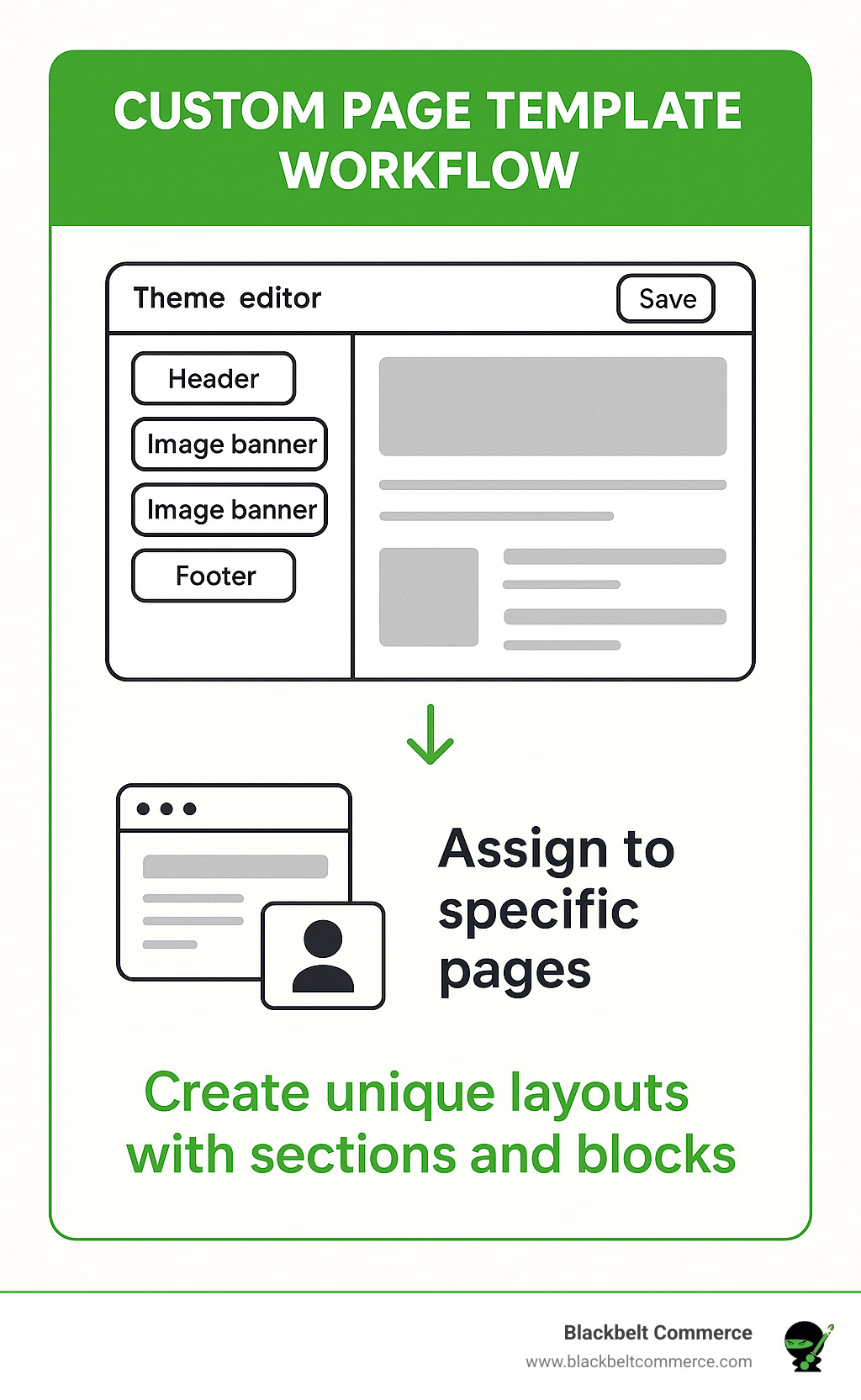
| Creating a Custom Page Template in Shopify |
|---|
| 1. Go to Online Store > Themes > Customize |
| 2. Select the page type and click “Create template” |
| 3. Name your template and customize sections as needed |
| 4. Save changes |
| 5. Assign the template to specific pages in your store |
Custom page template Shopify solutions give you the power to create unique layouts for different pages in your store without affecting your entire site design. Whether you’re building a special landing page, a detailed about page, or a unique product showcase, custom templates let you break free from your theme’s default layout.
Most store owners don’t realize they can create different layouts for specific pages without hiring a developer. With Shopify’s Online Store 2.0 themes, you can easily create and customize templates through the visual editor – no coding required!
When you create a custom template, you’re essentially telling Shopify: “This specific page needs its own unique design.” This helps maintain brand consistency while allowing flexibility for special content.
I’m Cesar A Beltran, Founder and CEO of Blackbelt Commerce with over 15 years of experience helping merchants create effective custom page template Shopify solutions that convert visitors into customers. Having worked with over 1000+ Shopify stores, I’ve seen how custom templates can transform an ordinary online store into a conversion machine.
Custom Page Template Shopify 101 & Pre-Build Checklist
Before diving into creating your first custom page template Shopify design, let’s understand what we’re working with. A template in Shopify is essentially a scaffold that determines how content is displayed on your store. Think of it as the blueprint for your page’s layout and structure.
As one Shopify merchant put it: “Templates freed us from manual coding—it’s ancient history now! What used to take days now takes minutes.”
Every Shopify theme comes with default templates for various page types:
– Product pages
– Collection pages
– Blog pages
– Standard pages
– Homepage
These default templates ensure consistency across your store. However, when you need something unique—perhaps a special landing page for a promotion or a custom about page with a unique layout—that’s when custom page templates come into play.
Default vs. Custom: What Changes & Why
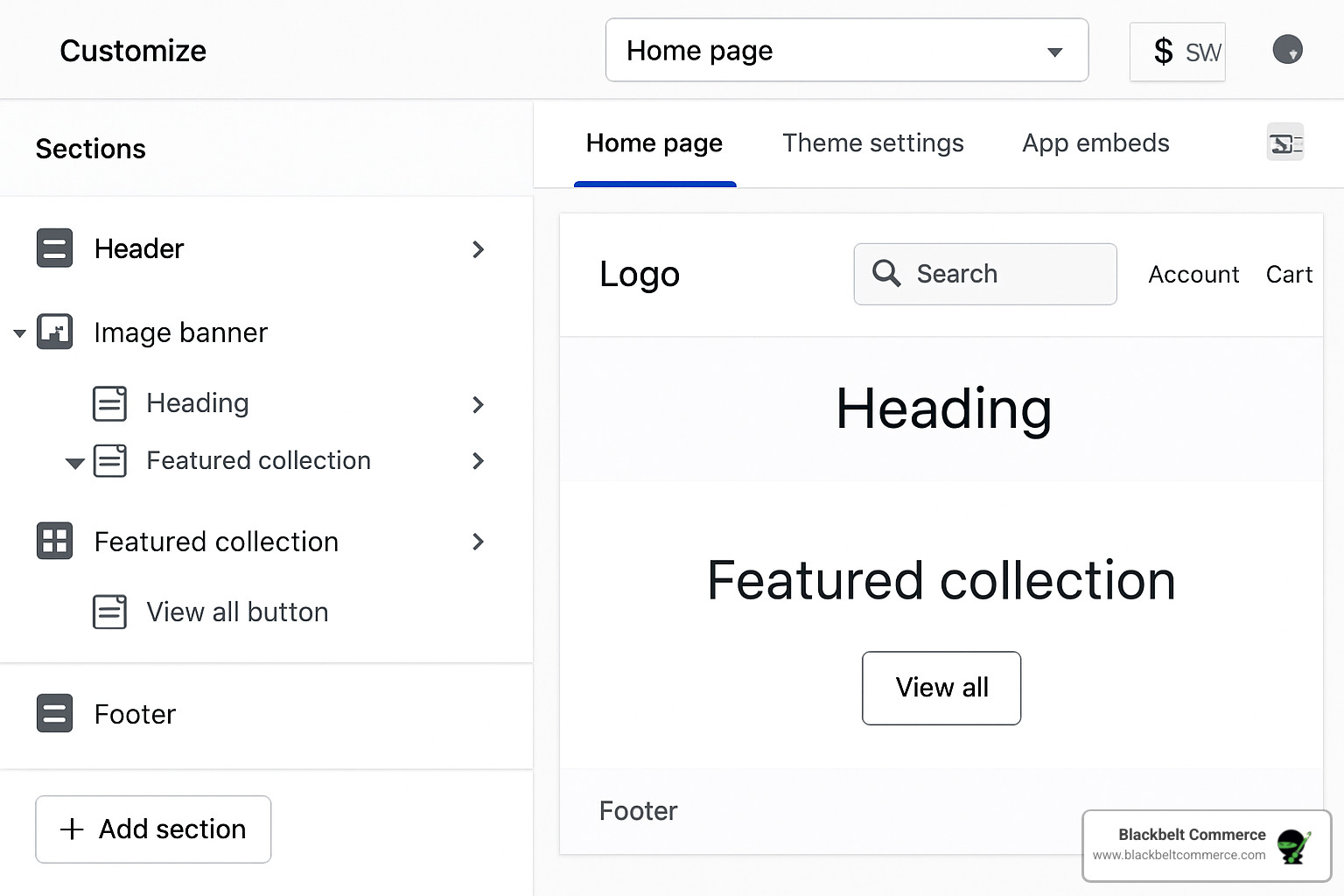
When creating a custom page template Shopify design, you’re not reinventing your entire store. Your theme’s overall style (fonts, colors, and general aesthetic) stays intact, along with your header and footer elements. Global settings that apply across your store remain unchanged too.
What does change is the specific layout and structure of individual pages. You gain the freedom to arrange sections and content blocks uniquely, and add elements that don’t appear elsewhere in your store.
The key difference is really about scope. Edit a default template, and those changes ripple across every page using that template. But create a custom page template Shopify design, and you’re crafting something that can be assigned to specific pages without disturbing others. It’s like having your cake and eating it too – flexibility without sacrificing consistency.
“Templates are a group of sections that are configured to give your online store a consistent design and feel. When you edit a template, the changes apply to every page using that template,” explains Shopify’s documentation. This is precisely why custom templates are so valuable.
Key Reasons to Create a Custom Page Template Shopify
I’ve seen how custom page template Shopify designs transform online stores. Here’s why they’re worth considering:
Creating unique layouts for special content gives pages like About Us or detailed service descriptions the distinctive design they deserve. Your brand story deserves better than a cookie-cutter layout!
Building conversion-focused landing pages optimized for specific campaigns can dramatically boost sales. At Blackbelt Commerce, we’ve seen custom landing pages generate double the revenue per session compared to standard product pages – that’s real money in your pocket.
You’ll also avoid duplicated content issues. As one frustrated merchant shared in a Shopify forum: “I have four pages and whenever I add a new one it duplicates an existing template—how do I start fresh?” Custom templates solve this problem neatly.
Improved user experience comes naturally when different content types get layouts custom to their purpose. Your contact page might showcase a map and form, while your about page features team profiles and a company timeline.
Creating seasonal or campaign-specific designs lets you build templates for holiday promotions without disrupting your standard pages. Think Black Friday specials or summer collection showcases that feel special without requiring a full site redesign.
Must-Have Requirements Before You Begin
Before rolling up your sleeves to create your first custom page template Shopify design, make sure you’ve got these essentials covered:
You’ll need an Online Store 2.0 Theme – this isn’t optional. Custom templates through the theme editor only work with these newer themes. If you’re still using older themes like Debut, you’ll need to use code-level customization instead of the visual editor.
Your theme must be published before creating templates. One merchant learned this the hard way: “Custom templates only appear in the theme editor for published themes; unpublished themes will not show newly created templates.”
Be aware of template limits – Shopify allows up to 1,000 templates per store (including products, collections, pages, blogs, and blog posts). While most stores won’t hit this ceiling, it’s good to know it exists.
Always create a backup copy of your theme before making significant changes. From your Shopify admin, go to Online Store > Themes, click Actions, and select Duplicate. This simple step can save you hours of frustration if something goes sideways.
Establish a clear naming strategy for your templates from the start. Something like “landing-holiday” or “about-with-team” will help you stay organized as your store grows. Trust me, your future self will thank you!
As one experienced Shopify Partner wisely advised: “If you like the DIY route and have time, creating custom templates can be rewarding. But always back up your theme first!” Words to live by when customizing your store.
Build, Assign & Troubleshoot Your Custom Template
Now that we understand the fundamentals, let’s dive into creating your first custom page template Shopify design. The process is surprisingly straightforward, especially if you’re using an Online Store 2.0 theme.
Step-by-Step: Create a Custom Page Template Shopify
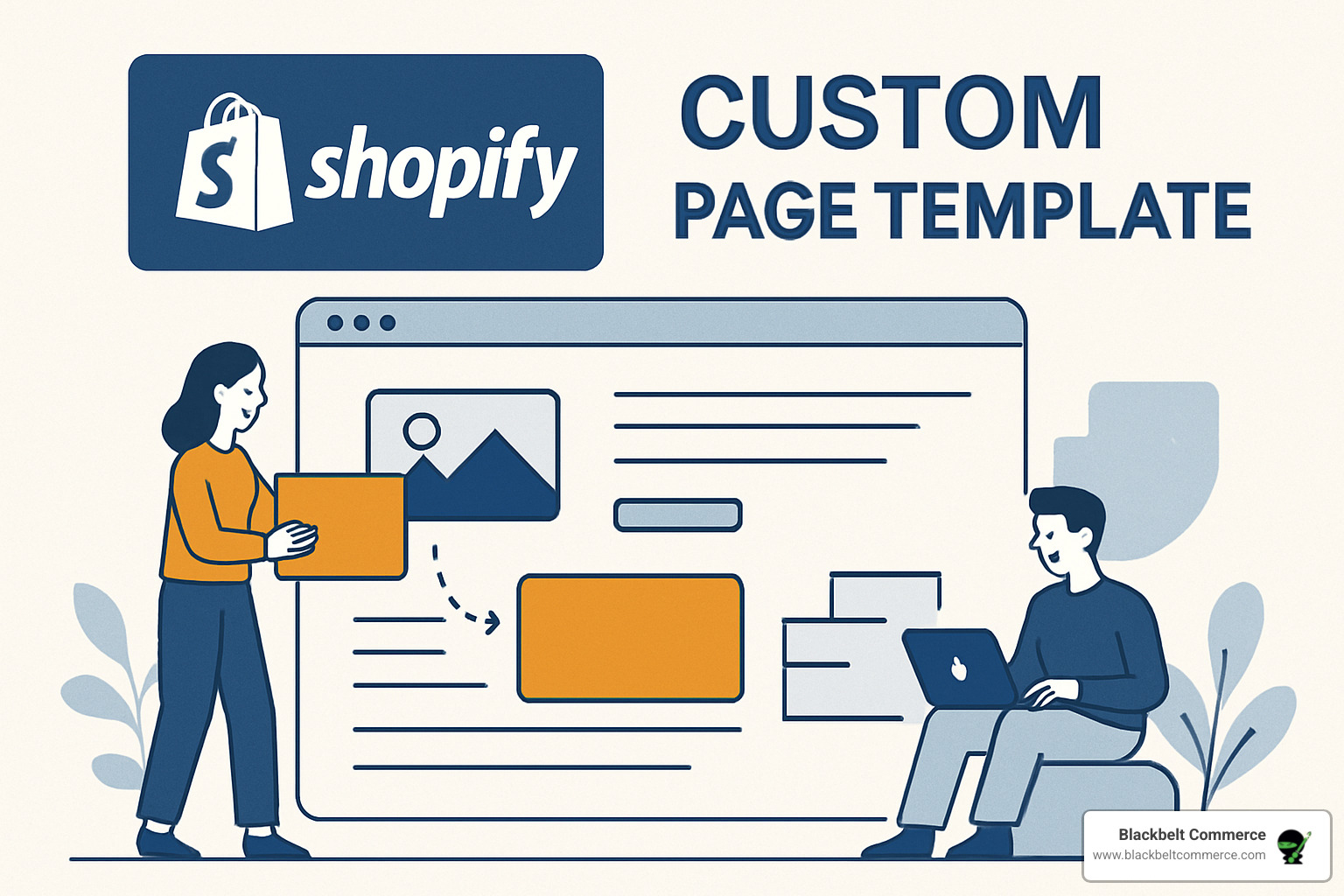
Creating your first custom template is actually quite simple. First, head to your Shopify admin and steer to Online Store > Themes, then click “Customize” on your published theme. This takes you to the theme editor – your canvas for creativity.
From the dropdown at the top, select the page type you want to customize. If you’re making a standard page template, choose “Pages” and then “Default page.” Now comes the fun part – click “Create template” near the template name, give it a descriptive name (something like “landing-page” or “about-us”), and click “Create template.”
Now you’re free to make this template your own! Add sections, remove elements you don’t need, rearrange components – it’s like decorating a room exactly how you want it. Each section can be customized with different blocks, colors, spacing, and content. When you’re happy with your creation, simply click “Save” and your template is ready to use.
“The first time I created a custom template, I was shocked at how easy it was,” one of our clients told me. “I’d been putting it off thinking I needed to hire a developer!”
Behind the scenes, this process creates a JSON template file in your theme that stores all your section configurations. For the tech-savvy among you, you can also create templates directly in the code editor by going to Online Store > Themes > Actions > Edit code, navigating to the Templates folder, and creating a new template file with the appropriate naming convention.
Assigning Templates to Resources
Having a beautiful template doesn’t help much if nobody sees it! The next step is assigning your masterpiece to specific pages, products, or collections.
For pages, simply go to Online Store > Pages and either create a new page or edit an existing one. Look for “Theme template” in the right sidebar, select your custom template from the dropdown, and save the page. It’s that simple!
Products work similarly – edit the product, scroll to find “Theme template” in the sidebar, choose your custom template, and save. Collections follow the same pattern through the Products > Collections menu.
Need to apply a template to multiple products or collections? Shopify has you covered with bulk editing. Select multiple items using the checkboxes, click “Edit products” (or collections), add the “Template” column if needed, choose your template, and save. As one of our merchants put it: “Being able to bulk apply templates to collections saved me hours of work when launching our seasonal catalog!”
Preview & Quality-Check Before Going Live
Before announcing your new page to the world, take time to thoroughly test it. Use the “Preview” button in the theme editor to see how everything looks, and be sure to check it on multiple devices using the device switcher. What looks perfect on your desktop might need adjustments on mobile.
Pay attention to loading speed – templates with many sections or large images can slow things down. Shopify’s Online Store Speed report is your friend here. Also verify that all SEO elements are in place, including proper heading structure and accessible SEO fields.
Don’t forget accessibility – check contrast ratios for text, ensure all images have alt text, and verify that keyboard navigation works properly. These small details make a big difference for many of your visitors.
Here’s a pro tip: You can preview any template on a live page by adding ?view=template-name to the URL (just replace “template-name” with your template’s suffix). This lets you see exactly how it will look before assigning it to a page.
Troubleshooting When the Template Won’t Show
Even with the best planning, sometimes things don’t work as expected. If your custom page template Shopify design isn’t showing up in the dropdown menu, first check that you’re using an Online Store 2.0 theme and that your theme is published – unpublished themes won’t display new templates.
If you make changes that don’t seem to appear, try clearing your browser cache or viewing in an incognito window. Also double-check that you saved both the template and the page/product/collection you assigned it to.
Missing the “Create Template” button entirely? This typically happens with older themes like Debut. The solution is either upgrading to an Online Store 2.0 theme or creating templates manually through the code editor.
When your template shows unexpected content, check for inheritance issues – new templates inherit sections from their base template – and verify you’re editing the correct template.
“The most common issue I see,” shares one of our developers at Blackbelt Commerce, “is merchants trying to create templates on unpublished themes and wondering why they don’t appear in the template selector. Publishing the theme fixes it instantly.”
With these steps and troubleshooting tips, you’re well-equipped to create, assign, and perfect your custom page template Shopify designs. The result? Pages that perfectly match your vision and help convert browsers into buyers.
Advanced Tools, SEO & Best Practices
While Shopify’s native tools are powerful, there are advanced options for creating custom page template Shopify designs, especially for complex layouts or when you need to work more efficiently.
Using Apps to Speed Up Custom Page Template Shopify Design
Not everyone has the time to build custom templates from scratch. That’s where third-party page builders come in – they’re like having training wheels for your design process!
The difference between Shopify’s native editor and dedicated page builder apps is significant. While Shopify’s built-in tools are steadily improving, page builders offer that extra layer of flexibility many merchants crave.
| Feature | Native Shopify Editor | Page Builder Apps |
|---|---|---|
| Drag-and-drop | Limited | Advanced |
| Pre-made templates | Few | Many (70+ in some apps) |
| Learning curve | Moderate | Low |
| Custom code insertion | Limited | Usually supported |
| Cost | Free | Usually subscription-based |
| Performance impact | Minimal | Varies by app |
I’ve watched clients light up when they find how quickly they can create stunning pages with apps like EComposer, which offers a true drag-and-drop interface with over 70 pre-built templates ready to customize. As they say in their own words: “EComposer supports duplicating and versioning templates directly within the app.”
Similarly, Shogun boasts that “You can go from new account creation to a functional, live Shopify store in just 15 minutes—about how long it takes to make and drink a smoothie.” Now that’s efficiency I can appreciate!
PageFly rounds out the top contenders with its extensive element library and responsive design controls that make mobile optimization much simpler.
At Blackbelt Commerce, we’ve seen these tools transform the workflow for clients who need to frequently update their pages or create multiple landing pages for marketing campaigns. One client went from spending days on custom templates to hours – freeing them up to focus on what really matters: growing their business.
The trade-off? There’s always one, isn’t there? Page builders typically come with monthly subscription costs, and depending on how they’re implemented, they might impact your site’s performance. They also create a dependency on third-party services that might someday change their features or pricing.
As one of our merchants wisely noted: “Using a page builder app like EComposer allows deeper customization than Shopify’s native theme editor, but we monitor page speed closely to ensure it doesn’t slow down our site.” Smart thinking!
Code-Level Tweaks & Dynamic Content
If you’re not afraid to roll up your sleeves and get a little code on your hands, your custom page template Shopify designs can reach new heights with some Liquid programming magic.
Think of Liquid code as the secret sauce that makes your templates truly dynamic. Here’s a taste of what’s possible:
With Section Schema Customization, you can create customizable content blocks that appear in the theme editor:
liquid
 {% schema %}
 {
   "name": "Custom Content",
   "settings": [
     {
       "type": "text",
       "id": "heading",
       "label": "Heading",
       "default": "Your Heading Here"
     }
   ]
 }
 {% endschema %}
Want to display different information without creating entirely new templates? Dynamic Content with Metafields lets you store and display custom data:
“`liquid
{% if product.metafields.custom.specifications %}
{% endif %}
“`
One of my favorite techniques is creating Modular Includes – breaking your template into reusable snippets that can be mixed and matched:
liquid
 {% include 'product-reviews' %}
And don’t forget about Conditional Content – showing different content based on who’s viewing your page:
“`liquid
{% if customer %}
Welcome back, {{ customer.first_name }}!
{% else %}
Welcome to our store!
{% endif %}
“`
At Blackbelt Commerce, we often take a hybrid approach for clients needing specialized functionality. We’ll use visual editors for the basic structure, then improve with custom code where needed. It’s like having the convenience of pre-made meals but adding your own special ingredients to make them extraordinary.
SEO, Performance & Accessibility Checklist
Creating a beautiful custom page template Shopify design is only half the battle. If it doesn’t perform well, isn’t findable, or excludes potential customers, you’re missing opportunities.
SEO isn’t just about keywords anymore. Search engines have become increasingly sophisticated, looking at the entire user experience. Make sure your templates support proper heading structure with a clear hierarchy (H1, H2, H3), enable unique meta titles and descriptions, and include structured data markup for rich search results. Clean URL structures and thoughtful internal linking also help search engines understand and rank your content better.
Performance directly impacts your bottom line. Did you know that for every second your page takes to load, your conversion rate potentially drops? Keep your templates lean by minimizing unnecessary sections, optimizing images (compression is your friend!), and implementing lazy loading for below-the-fold content. Be mindful of how many apps you’re running on the same page – they can add up quickly and slow things down.
Accessibility isn’t optional; it’s essential. One of our clients put it perfectly: “After implementing accessibility improvements in our custom templates, we not only avoided potential legal issues but also saw a 15% increase in overall conversion rates.” Maintain proper color contrast ratios (aim for at least 4.5:1), ensure keyboard navigation works correctly, add descriptive alt text to all images, and use ARIA attributes where needed. Testing with screen readers can reveal issues you might otherwise miss.
Google now factors page experience metrics (Core Web Vitals) into rankings. A gorgeous but slow template will underperform compared to a simpler, faster one. It’s like having a beautiful sports car that can’t get out of first gear – what’s the point?
At Blackbelt Commerce, we’ve seen how these considerations can make or break an otherwise perfect template. The good news? When you get them right, you’re not just checking boxes – you’re creating a better experience for all your customers, which naturally leads to better business results.
Frequently Asked Questions about Custom Page Template Shopify
Can I create more than one custom page template Shopify?
Yes, absolutely! Shopify gives you plenty of creative freedom here. You can create multiple custom templates for all your different resources – whether that’s pages, products, collections, or anything else in your store.
The platform allows up to 1,000 templates total across all resource types, which is incredibly generous. In my experience at Blackbelt Commerce, even our largest clients with extensive catalogs typically use fewer than 50 custom templates for their entire store.
You don’t need a unique template for every single page. One template can serve multiple pages with similar layouts. For instance, you might create one “team-member” template and apply it to all your staff profile pages, saving you time while maintaining a consistent look.
Why doesn’t the Create template button appear in my theme?
If you’re scratching your head looking for that elusive “Create template” button, here’s the likely explanation: this feature is only available in Online Store 2.0 themes.
Using an older theme like Debut, Brooklyn, or Minimal? That’s why you’re not seeing the option in your theme editor. I’ve had numerous merchants reach out with this exact confusion!
As one of our clients shared: “I spent half an hour searching for that Create template button until I realized my Debut theme didn’t support it. After upgrading to Dawn, everything worked perfectly!”
You have two options to move forward:
1. Upgrade to an Online Store 2.0 theme (I recommend this for the long-term benefits)
2. Create templates manually through the code editor by adding files to your Templates folder
The first option is much more user-friendly if you’re not comfortable with code.
Do custom templates hurt site speed or SEO?
This is a question I hear often, and the honest answer is: it depends on how you implement them.
Custom templates created through Shopify’s native editor generally have minimal impact on your site’s performance. The potential issues arise when templates become overloaded with:
– Too many complex sections
– Unoptimized, large images
– Excessive third-party apps running on the page
– Poorly written custom code
For SEO, well-designed custom page template Shopify solutions can actually boost your rankings by:
– Allowing more targeted content for specific audience segments
– Enabling better information architecture
– Providing improved user experiences custom to specific content types
At Blackbelt Commerce, we’ve consistently found that thoughtfully designed custom templates improve both user experience and SEO performance. They allow you to create more engaging, conversion-focused experiences without sacrificing speed.
As one of our Shopify experts puts it: “Custom templates don’t inherently hurt performance—it’s what you put in them that matters. A clean, well-structured custom template can actually outperform a bloated default template.”
The key is balance – create templates that improve user experience while keeping performance in mind. When in doubt, test your page speed after making significant changes.
Conclusion
Creating a custom page template Shopify design is truly within your reach, even if you don’t consider yourself tech-savvy. With the right approach, you can create unique, conversion-focused pages that make your store stand out from the crowd.
Let’s take a moment to recap what we’ve learned on this journey:
First and foremost, custom templates give you incredible flexibility without sacrificing the brand consistency that’s so important for customer trust. You can create special experiences for specific pages while maintaining your overall store aesthetic.
If you’re using Online Store 2.0 themes (and I highly recommend you do), template creation becomes surprisingly accessible through Shopify’s visual editor. No coding required! This democratization of design is one of my favorite developments in the Shopify ecosystem.
As your store grows, clear naming conventions will save you countless headaches. Trust me on this one—future you will be incredibly grateful when you can instantly identify what “holiday-landing-2023” or “team-profile-expanded” templates are for!
Always preview thoroughly before publishing. I’ve seen too many merchants rush this step only to find mobile display issues or broken sections after going live. Take the extra few minutes to check your work across devices.
Finally, never forget to consider performance and SEO when designing your templates. A beautiful page that loads slowly is like a gorgeous store with a jammed front door—people simply won’t come in.
At Blackbelt Commerce, we’ve helped hundreds of merchants transform their Shopify stores with custom templates that not only look stunning but drive real business results. Whether you’re creating a special landing page for your next big promotion or redesigning your entire product catalog, custom templates give you the power to create exactly what your business needs.
Ready to lift your Shopify store with custom templates that actually convert? Our team of experts can help you design, build, and optimize templates that turn browsers into buyers. With over 15 years of experience and more than 1000 successful Shopify projects under our belts, we’ve seen what works (and what doesn’t).
For more advanced techniques and creative inspiration, check out our resources on Shopify Theme Customisation.
Remember: Your store’s pages aren’t just digital real estate—they’re your sales team, working around the clock to convert visitors into customers. Give them the tools they need to succeed with custom page template Shopify designs that showcase your products in their very best light.

