

Shopify Pricing vs. Competitors: A Deep Dive for E-Commerce Leaders
Grasping how Shopify’s pricing stacks up against other e-commerce platforms can unlock significant savings for your business, ensuring you’re equipped with the right tools for sustained growth. This guide unpacks the various tiers and potential hidden expenses across leading e-commerce platforms. You’ll get a clear view of how point-of-sale solutions fit into your budget, see direct comparisons with BigCommerce, WooCommerce, Squarespace, Wix, Magento, and Salesforce Commerce Cloud, and explore market shifts shaping future pricing. By the end, you’ll have a solid framework for selecting the optimal platform for your business and understand how expert Shopify Plus development from Blackbelt Commerce can refine your total cost of ownership.
Key insights you’ll gain:
- Shopify’s subscription tiers, transaction dynamics, and scalability pathways
- Shopify POS plans, hardware options, and competitive alternatives
- Head-to-head pricing: Shopify versus BigCommerce, WooCommerce, Squarespace, Wix, Magento, Salesforce Commerce Cloud
- Unforeseen costs: apps, themes, and payment processing
- Strategic selection criteria: budget, growth phase, and enterprise demands
- Emerging trends: global market expansion, headless architecture, subscription evolution
- Optimizing your investment with specialized Shopify Plus services
Decoding Shopify’s Pricing Tiers and Their Competitive Edge
Shopify’s pricing structure dictates both the functionality and the financial commitment for your online store, scaling from foundational setups to robust enterprise solutions. Each plan integrates essential e-commerce capabilities—like hosting and SSL security—but varies in reporting depth, staff access, and advanced features. A nascent online boutique might thrive on a lower tier, while a rapidly expanding brand will likely require enterprise-grade features and custom checkout logic.
Unpacking the Features and Costs of Shopify Basic, Shopify, Advanced, and Plus
Here’s a detailed look at Shopify’s core subscription levels, their monthly investment, and the primary advantages each offers.
Each successive plan enhances analytics capabilities, offers better shipping rates, and expands staff permissions while reducing transaction percentages. This design supports predictable cost scaling and deeper insights into your store’s performance.
Shopify’s Tiered Pricing Strategy
Shopify presents a spectrum of pricing plans—Basic, Shopify, Advanced, and Plus—each tailored with distinct features and cost implications. The Basic plan is ideal for emerging businesses, while the Advanced plan caters to larger operations with more intricate requirements. Shopify Plus stands as an enterprise-grade solution for high-volume merchants.
This citation offers a clear overview of Shopify’s different plans and their intended user base, crucial for understanding the platform’s cost architecture.
The Impact of Shopify’s Transaction Fees on Your Bottom Line

Shopify’s transaction fees typically range from 2.9% + 30¢ down to 2.4% + 30¢ for the Basic, Shopify, and Advanced plans. For enterprise-level accounts, these rates can dip below 2.2% when utilizing external payment gateways. These fees directly affect your net profit; a mere 0.5% reduction on $100,000 in monthly sales translates to $500 in monthly savings. Incorporating these fees into your financial projections provides a realistic picture of your total operational expenses beyond the subscription itself.
Understanding Shopify Transaction Fees
Shopify’s transaction fees fluctuate based on your chosen plan. The Basic plan incurs a 2.9% + 30¢ fee per online transaction, the Shopify plan is 2.6% + 30¢, and the Advanced plan offers a reduced rate of 2.4% + 30¢. Opting for Shopify Payments eliminates additional transaction fees.
This citation underscores the critical importance of understanding transaction fees, as they significantly influence the overall cost of operating on Shopify.
How Shopify’s Pricing Evolves with Your Business Growth
As your order volume and revenue climb, upgrading your Shopify plan unlocks reduced per-transaction fees and introduces features that streamline fulfillment, manage international pricing, and enhance team collaboration. Consider these benefits:
- Volume-Based Savings – Lower credit card processing rates at higher subscription tiers.
- Advanced Analytics – Automated custom reports streamline data analysis and save valuable time.
- Omnichannel Expansion – Integrated tools for marketplaces and social commerce facilitate broader reach.
This tiered approach ensures you invest incrementally in greater capacity and sophisticated automation, rather than facing substantial upfront enterprise licensing costs.
The Strategic Advantages of Shopify Plus Enterprise Pricing
Shopify Plus is engineered for high-volume merchants, offering dedicated account management, priority support, and advanced APIs for headless commerce implementations. Key benefits include:
- Unlimited Staff Accounts to accommodate large operational teams.
- Wholesale Channel for managing B2B pricing structures.
- Shopify Flow for automating repetitive operational tasks.
- Launchpad for precise scheduling of campaigns and flash sales.
These enterprise-grade features are designed to optimize complex operations, justifying the higher investment through enhanced efficiency and accelerated market entry.
Shopify POS Pricing: A Comparative Look at In-Store Solutions
Shopify’s integrated Point of Sale system extends your e-commerce presence into physical retail spaces. It offers two distinct plan options and complementary hardware bundles. This unified system stands apart from standalone POS providers by seamlessly connecting inventory, customer data, and sales analytics across all channels in real time.
Comparing Shopify POS Lite and Pro: Costs and Capabilities
Shopify POS provides two subscription tiers:
- POS Lite (included with all Shopify plans): Essential for basic in-store transactions, QR code checkouts, and limited staff roles.
- POS Pro ($89/month per location): Elevates your in-store operations with advanced inventory management, omnichannel selling capabilities, and detailed sales reporting.
Upgrading to POS Pro often yields a strong return on investment through improved inventory accuracy and increased average order values driven by integrated online-offline promotions.
Shopify POS Pricing Explained
Shopify POS offers two primary versions: POS Lite, which is bundled with all Shopify plans, and POS Pro, available for $89 per month per location. POS Pro is designed to support more sophisticated retail environments.
This citation clarifies the different Shopify POS plans and their associated costs, essential information for businesses operating physical stores.
Shopify POS Hardware: Costs and Integrated Bundles
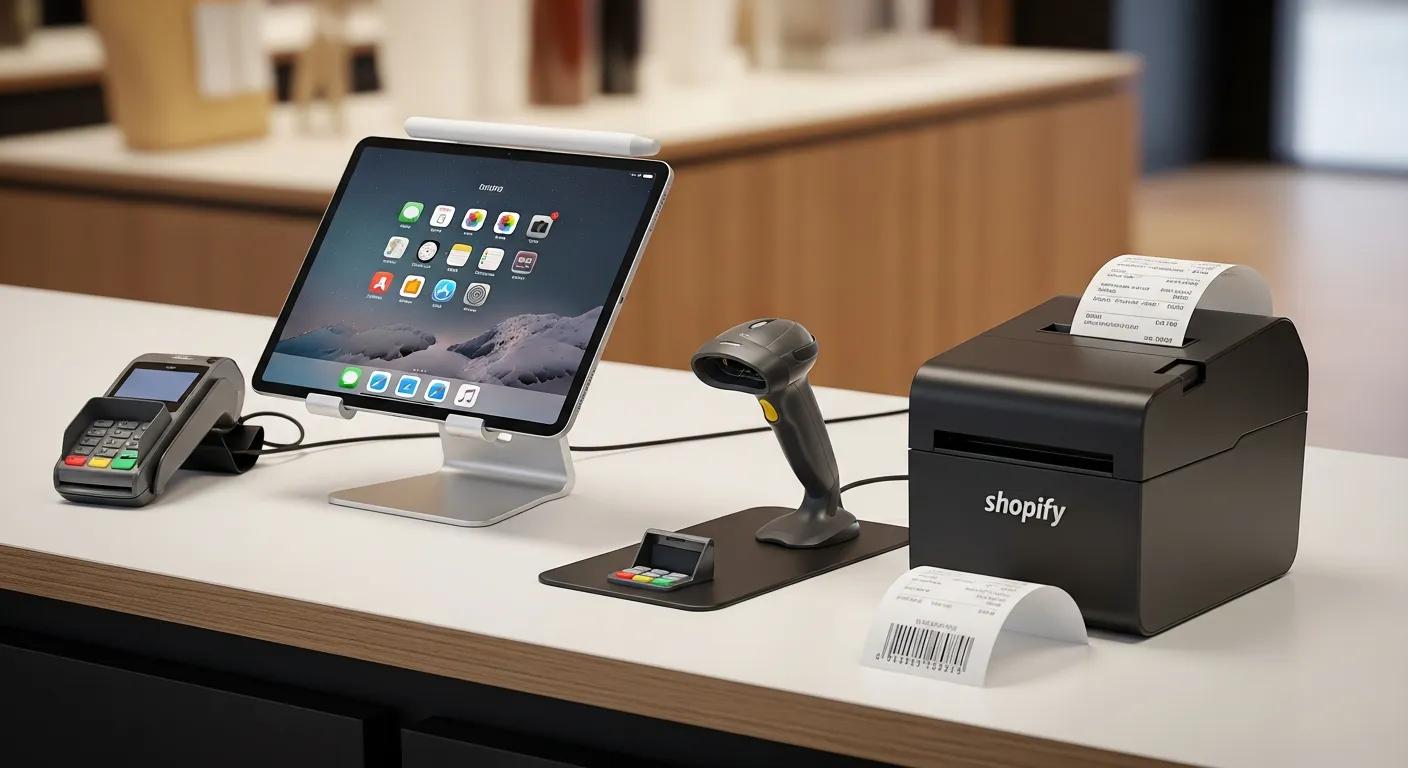
Here’s an overview of Shopify’s recommended hardware bundles and their respective price points.
These curated bundles facilitate rapid deployment in your physical store, ensuring seamless integration with your Shopify dashboard and centralized management of all orders.
Competitive POS Alternatives: Pricing and Feature Sets
Several providers offer compelling standalone POS solutions:
- Square POS: Features a no-monthly-fee entry tier, instant fund transfers, and accessible hardware bundles.
- Lightspeed: Excels in managing complex inventory and multi-location operations, typically at higher subscription tiers.
- Vend: Specializes in retail-specific functionalities like layaway options and integrated gift card programs.
While these alternatives often require third-party integrations for full functionality, Shopify’s native POS system unifies your sales channels for consistent reporting and streamlined loyalty initiatives.
Benchmarking Shopify Pricing Against Key E-Commerce Competitors
A thorough evaluation of Shopify against major platforms involves scrutinizing subscription costs, hosting models, feature sets, and the broader ecosystem expenses. This ensures your chosen platform aligns perfectly with your business model, technical capabilities, and long-term growth aspirations.
Shopify vs. BigCommerce: A Pricing and Feature Showdown
BigCommerce often includes more robust features natively, such as customer segmentation and B2B tools, whereas Shopify leverages its vast app ecosystem for specialized functionalities and boasts a deeper network of development partners.
Shopify vs. BigCommerce: Pricing Perspectives
Shopify and BigCommerce share comparable pricing structures, with plans typically ranging from $29 to $299 monthly. A key differentiator is BigCommerce’s absence of transaction fees, potentially offering long-term savings. Shopify, however, provides greater flexibility and a more expansive app ecosystem.
This citation offers a comparative analysis of Shopify and BigCommerce, highlighting critical differences in pricing and feature sets.
Shopify vs. WooCommerce: Setup and Ongoing Investment
WooCommerce operates as a self-hosted WordPress plugin, involving several cost components:
- Hosting: Monthly fees vary significantly by provider ($10–50).
- Extensions: Premium plugins can range from $50 to $300 each.
- Maintenance: Ongoing investment is required for security, backups, and software updates.
Shopify’s Software-as-a-Service (SaaS) model consolidates hosting and security into a predictable monthly fee. While WooCommerce may offer a lower initial entry point, it often entails greater cost variability and technical management.
Shopify vs. Squarespace and Wix: Small Business Pricing Strategies
Squarespace and Wix integrate website creation with e-commerce functionalities:
- Squarespace Commerce: Priced between $23–49/month, with a 3% transaction fee on the entry tier.
- Wix Business: Ranges from $27–59/month, including a 2.9% + 30¢ processing fee.
Both platforms are known for their user-friendliness but offer less scalability compared to Shopify’s extensive app marketplace and API-driven integrations. They are best suited for simpler online stores with annual revenues under $50,000.
Enterprise-Level Comparisons: Magento and Salesforce Commerce Cloud Pricing
These enterprise-grade platforms provide unparalleled flexibility but come with significant setup investments, a reliance on development resources, and substantial ongoing infrastructure costs.
Beyond Subscription Fees: Uncovering Hidden E-Commerce Platform Costs
Your monthly subscription fee is just one piece of the puzzle. Savvy entrepreneurs must also factor in payment processing charges, app subscriptions, theme purchases, and design customizations to accurately forecast the true total cost of ownership.
Navigating Shopify’s Hidden Costs in 2025
Beyond the stated monthly subscription fees, Shopify users should anticipate additional costs such as transaction fees, recurring app subscriptions, premium theme purchases, and domain registration. These supplementary expenses can significantly inflate the overall cost of ownership.
This citation highlights the critical need to consider hidden costs when evaluating Shopify’s pricing, essential for precise budgeting.
Transaction Fee Variations Across Platforms
Transaction fees differ notably between platforms:
- Shopify charges 2.4–2.9% + 30¢ for transactions processed via Shopify Payments, with additional gateway fees applicable for non-Shopify options.
- BigCommerce eliminates platform transaction fees, relying instead on standard credit card processing rates.
- Squarespace and Wix typically add 2.9% + 30¢ on their business tiers and 3–5% on entry-level plans.
A comprehensive comparison requires evaluating both platform and gateway fees to accurately assess net profit margins across different providers.
App and Plugin Expenses: A Comparative View
Many advanced functionalities on Shopify are accessed through paid apps, with average costs ranging from $10–50 per month per app. In contrast, platforms like BigCommerce and WooCommerce often include more built-in tools but may charge higher one-time fees for extensions. Budgeting for three to five essential apps—such as those for email marketing, subscriptions, or loyalty programs—can add $100–200 monthly to your operational expenses.
Theme and Customization Costs: An Overview
Premium themes on Shopify typically range from $140 to $350 as a one-time purchase. Custom design work, depending on complexity, can average between $2,000 and $10,000. Self-hosted solutions might involve both theme acquisition and developer fees for implementation, potentially increasing initial outlays but offering greater potential for unique brand expression.
Payment Gateway Fees: Their Impact on Total Costs
In addition to platform-specific transaction fees, payment gateway providers impose their own charges:
- Stripe: 2.9% + 30¢ per transaction.
- PayPal: 2.99% + a fixed fee per transaction.
- Authorize.Net: 2.9% + 30¢, plus a $25 monthly fee.
Choosing an integrated solution like Shopify Payments can eliminate redundant platform fees and simplify financial reconciliation.
Selecting the Optimal E-Commerce Platform: Pricing Meets Business Needs
Choosing the right platform involves a strategic balance of your budget, technical resources, sales volume, and essential features. A well-defined decision framework ensures alignment with both your immediate objectives and your long-term growth strategy.
Cost Influencers for E-Commerce Platforms Across Business Sizes
Key factors driving platform costs include:
- Monthly Subscription Fees: Directly tied to the chosen plan tier.
- Transaction and Gateway Fees: Dependent on sales volume and payment processor.
- App and Extension Budgets: For acquiring specialized functionalities.
- Development and Maintenance Costs: For themes, integrations, and ongoing upkeep.
Emerging businesses often prioritize lower entry costs, while scaling brands focus on robust scalability and automation capabilities.
Scalability’s Role in Long-Term Pricing for Shopify and Competitors
As your business expands in sales volume and operational complexity, you’ll benefit from features like bulk shipping discounts, reduced processing rates, and advanced automation tools. Platforms offering native growth functionalities—such as Shopify Flow and international pricing management—minimize incremental service costs compared to solutions requiring numerous third-party add-ons.
Best Value Platforms: Startups vs. Enterprise Clients
Evolving Trends Shaping E-Commerce Platform Pricing
E-commerce platforms continuously adapt their pricing strategies in response to global market expansion, architectural innovations, and a growing demand for transparent subscription models.
Global E-Commerce Growth and Its Influence on Platform Pricing
With the global e-commerce market projected to reach USD 83.26 trillion by 2030, expanding at a compound annual growth rate of 18.9% from 2024 to 2030, platforms are heavily investing in scalable infrastructure, global selling tools, and advanced analytics. This investment fuels tiered pricing models that reflect the enhanced value offered to high-volume merchants.
The Trajectory of E-commerce Market Growth
The global e-commerce market is forecasted to hit USD 83.26 trillion by 2030, demonstrating a robust CAGR of 18.9% between 2024 and 2030. This expansion is propelled by increasing internet and smartphone adoption, alongside evolving consumer purchasing behaviors.
This citation provides essential context on the e-commerce market’s growth trajectory, influencing the strategic pricing decisions of platforms like Shopify.
The Role of Headless Commerce in Modern Pricing Models
Headless commerce architecture separates the front-end presentation layer from the back-end e-commerce engine, enabling highly customized user experiences without disruptive monolithic updates. Platforms offering API-centric headless solutions often adopt usage-based pricing, typically tied to API call volumes or specific feature bundles, moving away from traditional flat-rate subscriptions.
Evolution of Subscription-Based Pricing in E-Commerce
Software-as-a-Service (SaaS) providers are increasingly integrating services previously offered as add-ons—such as advanced fraud protection, enhanced security measures, and multi-currency capabilities—directly into their core subscription packages. This trend simplifies budgeting for merchants and reduces the likelihood of encountering unexpected fees.
Frequently Asked Questions About Shopify Pricing vs. Competitors
Entrepreneurs frequently inquire whether Shopify’s cost structure aligns with their growth trajectory and if alternative platforms offer superior value for specific business needs.
Is Shopify Considered Expensive Compared to Other E-Commerce Platforms?
Shopify’s starting price of $39 per month is competitive within the SaaS e-commerce landscape. Its extensive app ecosystem and robust global infrastructure often negate the need for costly third-party services. When factoring in transaction fees and essential apps, most growing businesses can expect monthly costs ranging from $100 to $500, which is comparable to similar comprehensive solutions.
What Are the Most Budget-Friendly E-Commerce Platforms for Small Businesses?
Platforms like Wix and Squarespace offer the lowest initial investment, with monthly fees around $23–27 that include hosting and SSL certificates. These are excellent options for micro-businesses with annual revenues under $10,000. However, their limited scalability and less developed app ecosystems can lead to higher costs as third-party integrations become necessary.
Does Shopify Include Hidden Fees Beyond Its Base Pricing?
Beyond the monthly subscription, merchants should be aware of potential additional costs:
- Transaction Fees: Applicable when using third-party payment gateways.
- Paid Apps: Required for advanced features and functionalities.
- Premium Themes: For enhanced website design and branding.
- POS Hardware Costs: For physical retail operations.
Proactive budgeting for these items is key to avoiding unexpected expenses.
Shopify Plus vs. BigCommerce Enterprise: A Pricing Comparison
Shopify Plus begins at $2,300 per month, offering integrated automation tools and priority support. BigCommerce Enterprise pricing typically starts between $1,000–1,500 per month, often with additional costs for custom integrations. Shopify’s unified global platform and extensive partner network provide consistent enterprise value, particularly for brands prioritizing rapid international expansion.
Leveraging Blackbelt Commerce for Optimized Shopify Pricing and Platform Strategy
Collaborating with a specialized agency like Blackbelt Commerce ensures you select the most appropriate subscription tier, implement cost-saving automation strategies, and navigate potential pitfalls during migration and customization.
Enhancing Cost Efficiency with Shopify Plus Development Services
Blackbelt Commerce excels in Shopify Plus development, focusing on streamlining checkout processes, automating workflows with Shopify Flow, and reducing reliance on third-party apps through custom integrations. Our deep expertise empowers merchants to lower monthly app expenditures and accelerate their time-to-market. Blackbelt Commerce – Your Shopify Plus Experts
Streamlining Shopify Migration and Setup Costs with Blackbelt Commerce
Our dedicated migration team conducts thorough audits to ensure a seamless transfer of products, customer data, and SEO configurations with zero downtime. This strategic approach minimizes development hours and prevents redundant app purchases, ensuring predictable budgeting throughout your platform transition.
Custom Shopify App Development: Impact on Pricing Strategies
Tailored app solutions can consolidate the functionality of multiple third-party subscriptions into a single, efficient codebase. This custom development approach reduces cumulative app fees and simplifies ongoing maintenance, offering a more cost-effective long-term solution for features like subscription management, loyalty programs, and advanced review systems.
Accessing Expert E-Commerce Strategy for Informed Pricing Decisions
Beyond technical implementation, Blackbelt Commerce provides ongoing strategic guidance through webinars, whitepapers, and our active company blog. These resources equip merchants with the latest insights on evolving pricing models, market trends, and effective optimization tactics.
Shopify’s flexible pricing structure, encompassing tiered subscriptions, transaction fees, and a rich app ecosystem, caters to businesses of all sizes, from emerging startups to global enterprises. By conducting a thorough comparison with platforms like BigCommerce, WooCommerce, Squarespace, Wix, Magento, and Salesforce Commerce Cloud, you can align features, potential hidden costs, and long-term scalability with your budget. Staying informed about global market dynamics, the implications of headless commerce, and the evolution of subscription models is crucial for making an informed platform choice. Partnering with experts such as Blackbelt Commerce ensures efficient implementation, continuous optimization, and strategic planning for sustained growth.
