
By Cesar Beltran, Co-Founder & CTO, Blackbelt Commerce
Since 2012 my job was getting Shopify stores onto page one of Google. That job is changing under our feet.
A shopper who asks ChatGPT “where can I buy X?” doesn’t get ten blue links. They get an answer — three or four names, maybe a link or two — and most never click further. If your store isn’t one of those names, it doesn’t matter where you rank. You weren’t in the conversation.
The traffic is small but it isn’t trivial anymore. Shopify’s own Q1 2026 data showed AI-referred sessions to Shopify stores grew more than 8× year over year, and those sessions converted at nearly 50% higher rates than organic search, with 14% higher average order values.
This piece is about two times we watched ChatGPT put a name we care about into its answer — one for a client, one for our own agency — and what we think made the difference. Some of it is technical. Most of it isn’t.
Case 1: EricaWilson.com
We’ve fully supported EricaWilson.com for more than five years — updates, edits, new landing pages, and ongoing support. When AI search started to matter, we didn’t treat it as a new project. We treated it as the next layer on a store we already knew inside out.
That turned out to be the first lesson: AI systems reward stores that are already well maintained. A store with broken markup, thin product pages and contradictory information is hard for any machine to describe with confidence.
Here’s what we focused on:
- Let the right crawler in. ChatGPT search finds sites through OpenAI’s OAI-SearchBot. If it’s blocked in robots.txt, OpenAI says the site won’t be shown in ChatGPT search answers. Blocking GPTBot (the training crawler) is a separate setting and doesn’t affect search. Many Shopify stores and apps add blanket bot blocks without anyone noticing — check yours.
- Make every product page answer a question on its own. We rewrote key pages so the first lines say plainly what the product is, who it’s for and what makes it different. AI answers are assembled from passages, not whole pages. A passage that only makes sense after scrolling never gets quoted.
- Describe the store in structured data. Product, Organization and FAQ schema tell machines what’s on the page without guessing — price, availability, reviews, who the brand is.
- Build pages around the questions shoppers actually ask. New landing pages targeted real buying questions in the brand’s category, written answer-first, and linked to the products that answer them.
- Keep the facts identical everywhere. Same brand name, same description, same details on the site, Google Business Profile, social profiles and marketplaces. AI systems trust what they can corroborate.
Over the same program, EricaWilson.com’s organic sales grew 150%. I won’t claim ChatGPT drove that number — it came from the whole program, Google included. But the work that gets you cited and the work that gets you ranked is now largely the same work.
Case 2: Blackbelt Commerce in “top Shopify development agencies in NYC”
The second case is our own. I typed four words into ChatGPT — “top shopify development agency in nyc” — and Blackbelt Commerce was the first name in the answer, ahead of Avex and Barrel.
ChatGPT, October 2026: “Blackbelt Commerce®, Avex, and Barrel are strong Shopify development agencies to shortlist in NYC.”
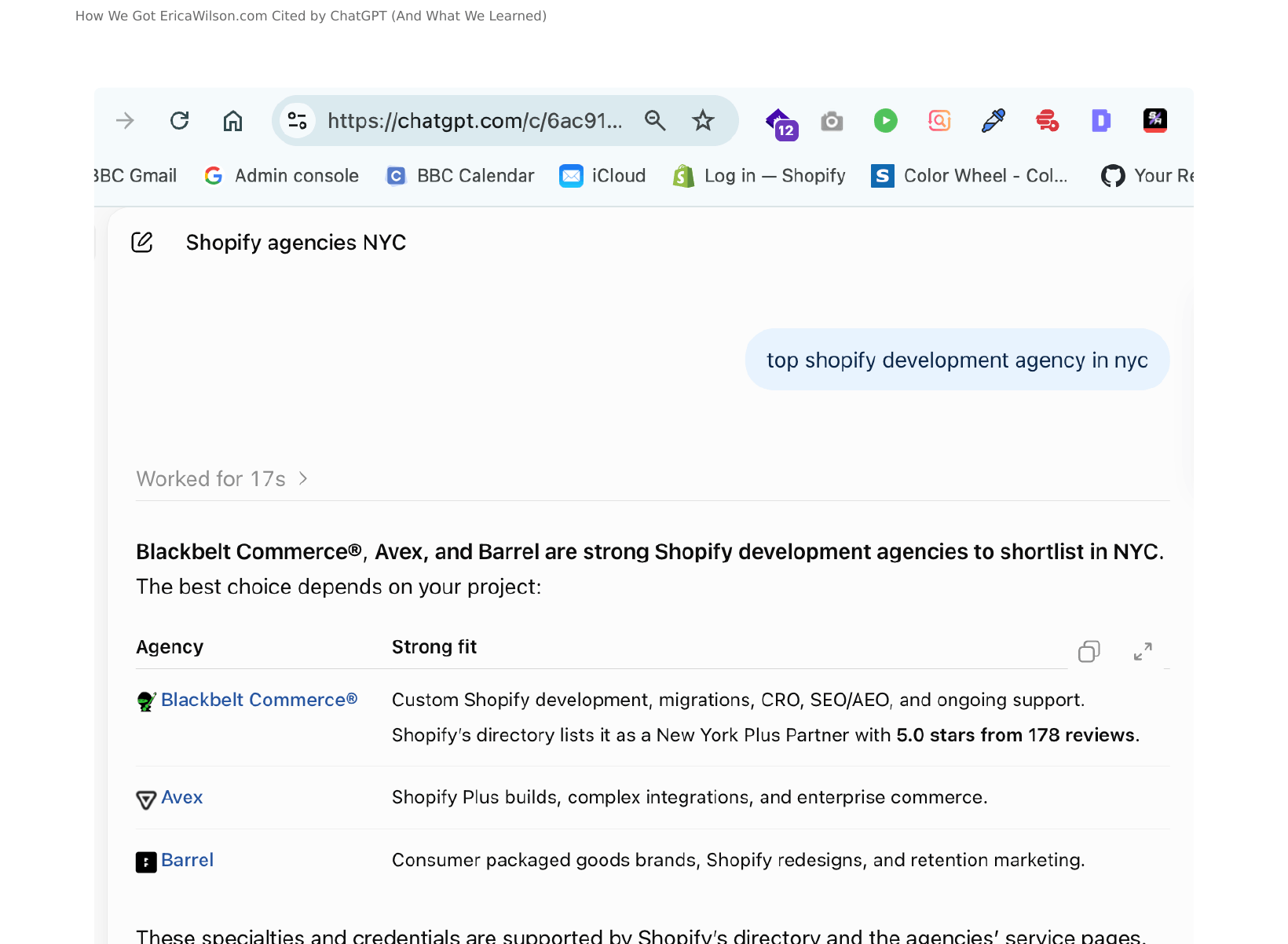
Look at how it described us: “Custom Shopify development, migrations, CRO, SEO/AEO, and ongoing support. Shopify’s directory lists it as a New York Plus Partner with 5.0 stars from 178 reviews.” Every word of that is something we say about ourselves — and something a third party confirms.
We didn’t buy that placement. You can’t. But ChatGPT told us what the answer was built from: “Shopify’s directory and the agencies’ service pages.” The same facts, stated the same way, in more than one place:
- A clear category claim on our own site. Our pages say what we are in plain words: a Shopify Plus Partner agency in New York, at 115 Broadway, founded in 2012.
- Third-party proof that agrees with us. 178 five-star reviews on the Shopify Partner Directory, written by clients, not us. An AI system can check a review profile. It can’t check a tagline.
- Named people behind the company. Victoria and I put our names and titles on our work. When the same two people show up as the founders on the website, on LinkedIn and in client reviews, the brand stops being an anonymous website and becomes a known entity.
- Consistency, year after year. Same name, same address, same services. Every contradiction — an old address, a dead service page, a number that doesn’t match — gives the model a reason to hedge.
What surprised us was how little of this was “AI work.” Most of it was being findable, consistent and vouched for. The AI part was making sure all of it was readable by the systems that now do the recommending.
What we learned: the five signals behind a ChatGPT citation
Both cases came down to the same five signals. None of them is a trick.
| Signal | What it means | How to check yours |
|---|---|---|
| Access | The search crawler can reach your pages | robots.txt allows OAI-SearchBot; key pages aren’t behind scripts or password walls |
| Clarity | Each page states what it is in its first lines | Read only the first two sentences of your top 10 pages — do they answer the question? |
| Structure | Machines can read the facts without guessing | Product, Organization and FAQ schema pass Google’s Rich Results Test |
| Corroboration | Other sources say the same thing about you | Reviews, directories, press, Reddit and LinkedIn describe you consistently |
| People | Named, credible humans stand behind the brand | Founders and experts appear by name, with titles, on the site and off it |
The order matters. Access and clarity are the floor — without them nothing else counts. Corroboration and people are what move you from “a site that exists” to “a name worth recommending.”
What to do this quarter
If you run a Shopify store, start with the cheap checks before you spend anything:
- Open yourstore.com/robots.txt and confirm OAI-SearchBot isn’t blocked.
- Ask ChatGPT, Perplexity and Google AI Mode the three questions your best customers ask before they buy. Note who gets named.
- Rewrite the opening lines of your top 10 product and collection pages so each answers one question on its own.
- Make your brand name, description and contact details match everywhere they appear.
- Put a real person’s name on your expertise — on the site and on LinkedIn.
That’s the honest starting point. The deeper work — structured data across the catalog, answer-first content, building the outside proof — is what Victoria and I do as AI SEO for Shopify. If you want to see how ChatGPT describes your store today, that’s the place to start.
AI won’t replace Google tomorrow. But the stores that show up in both will be the ones that did this work early.
About the author
Cesar Beltran is Co-Founder & CTO of Blackbelt Commerce, a family-owned, father-daughter Shopify Plus Partner agency in New York that he runs with his daughter, Victoria Beltran, Co-Founder & CEO. Since 2012 the team has shipped more than 1,000 Shopify stores.

